










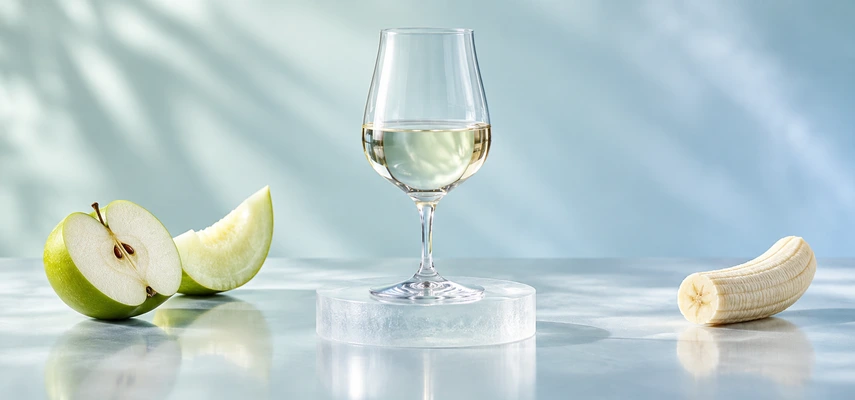

Ginjō and Daiginjō can make a useful party trick out of a simple ingredient list: rice, water and the work of microorganisms can produce aromas that suggest apple, melon or banana. The fruit isn’t necessarily an ingredient. Fermentation creates aroma compounds, and the brewer’s decisions influence which of them become prominent in the finished sake.
These names also carry production requirements. Understanding them means joining the classification rules to the brewing choices, then leaving room for variation between actual bottles. More extensive polishing can support a particular expression, but a lower number doesn’t automatically make every sample more aromatic, more complex or better balanced.
Ginjō and Daiginjō are production designations
Ginjo has a polishing threshold of 60% or less remaining; daiginjo has 50% or less. Junmai ginjo and junmai daiginjo share those respective thresholds while excluding added brewing alcohol. The NRIB classification table places the four names within the wider special-designation framework.
The numbers describe seimai-buai, the weight of polished rice relative to its original brown-rice weight. At 50%, the nominal remaining and removed portions are equal. At 40%, more has been removed. This is a processing measure, not the percentage of alcohol, koji or fruit aroma in the bottle.
The NTA standard also requires relevant production and sensory conditions. A 50% figure alone doesn’t document everything needed for daiginjo eligibility. In an examination scenario, distinguish meeting the polishing condition from proving the complete designation.
Ginjo-zukuri links several careful choices
Ginjo-zukuri refers to the production approach used to achieve characteristic expression. More extensive polishing, carefully prepared rice, appropriate koji and yeast, and controlled fermentation work together. It isn’t one machine or a single point at which ordinary sake suddenly becomes aromatic.
The JSS production account connects rice preparation, koji, yeast selection and low-temperature fermentation. Treat that as an interacting system. If the rice condition or enzyme supply doesn’t suit the mash, merely turning the temperature down isn’t a complete solution.
This is also why the distinction between technique and outcome matters. A brewery can follow demanding procedures with an intended result, while a taster still needs to assess what actually emerged. Production effort is relevant to understanding the product but cannot substitute for evidence of successful balance and expression.
Polishing changes the raw-material balance
Outer parts of rice contain relatively more proteins, lipids and other components than the starchy interior. Removing more material changes what enters brewing and can support a cleaner, more delicate expression. It also reduces yield from the original grain and creates practical demands for careful handling.
That doesn’t mean protein and lipid are simply bad substances that a brewery should always eliminate as far as possible. Yeast needs a suitable environment, and the brewer manages composition to fit the fermentation and intended sake. The process is a balance rather than a contest to remove everything except starch.
Two products with the same seimai-buai can differ because variety, grain condition, polishing method and downstream management differ. Likewise, a 40% daiginjo isn’t guaranteed to show more aroma than a 55% ginjo. The numerical comparison confirms polishing extent; the aroma comparison requires smelling the samples.
Koji and rice preparation support the fermentation
Controlled washing, soaking and steaming prepare the rice for digestion and koji growth. Highly polished grains can demand precise handling, and water uptake affects the condition of the steamed rice. These choices help the brewery obtain predictable material rather than leaving the later process to compensate for variation.
Koji supplies enzymes that make fermentable sugar available and influence other components. Its growth pattern and enzyme activity need to suit the mash. Tsukihaze-style koji is associated with ginjo production, but a visual label for koji doesn’t tell the whole story of enzyme supply or final palate.
In a written answer, connect the steps. Rice preparation affects the substrate; koji affects conversion; yeast uses suitable sugars during fermentation. Saying only that ginjo uses special rice and special mold repeats the category’s prestige without explaining why the choices matter.
Yeast creates much of the fruity direction
Different yeast strains can produce different amounts and balances of esters and other aroma compounds. Esters help explain fruit-like aromas without requiring actual fruit addition. Ethyl hexanoate, also called ethyl caproate, and isoamyl acetate are important examples in discussions of ginjo aroma.
Use sensory associations with care. An aroma reminiscent of apple isn’t proof of one isolated molecule at a known concentration. Several compounds and their interactions contribute to perception, and the sake’s wider composition matters. The familiar fruit words are useful descriptions rather than laboratory identification results.
Yeast selection also includes fermentation performance. A strain must work within the intended temperature, nutrient and mash conditions. Choosing an aromatic strain isn’t enough if the brewery can’t support healthy, controlled fermentation. The brewer balances the desired aromatic direction with the practical job of completing the process.
Low temperature changes the pace and expression
Cool fermentation slows biological and enzymatic activity and helps shape the aromatic result. The brewer must coordinate rice conversion and yeast fermentation rather than assuming both proceed at a fixed rate. A longer, carefully managed fermentation can suit the intended delicate expression.
Avoid a universal rule that colder always means better. Temperature outside a suitable range can undermine activity or make control difficult. The correct explanation is that an appropriate temperature course supports the intended yeast performance and expression within the wider production plan.
Low-temperature management also doesn’t guarantee that every ginjo is dry, low in acidity or light-bodied. Fermentation endpoint, sugar balance, rice dissolution and finishing can differ. A style tendency is helpful when qualified; it becomes misleading when used to replace an observation or an actual analytical figure.
Junmai forms and alcohol-added forms can overlap in style
Junmai ginjo and junmai daiginjo exclude added brewing alcohol. The conventional non-junmai ginjo and daiginjo presentation includes restricted alcohol use. Alcohol addition can assist aroma extraction before pressing and change the balance of rice-derived components, helping shape a selected expression.
WSET’s overview of sake types describes possible differences while emphasizing that they aren’t guaranteed. A non-junmai example can be particularly aromatic and light in body, but a junmai version can also be fragrant and elegant. Don’t turn the ingredient distinction into two mutually exclusive flavor boxes.
Nor should one family automatically receive a higher quality judgment. The question is how successfully the actual sample expresses its components. A restrained aromatic profile with excellent integration can be more convincing than a powerful nose followed by a short, awkward palate.
Finishing can preserve or redirect the expression
Pressing, clarification and heat treatment still matter after the aromatic fermentation. Fraction selection and controlled separation influence what is collected. Charcoal treatment can adjust selected components, while the decision to omit it doesn’t remove the need for other production controls.
Pasteurization history affects enzyme and microbial stability. A ginjo can be nama, once-heated or more conventionally pasteurized according to its actual production. The ginjo designation alone doesn’t answer that question, just as it doesn’t establish whether the product is genshu or diluted.
Maturation can retain a youthful profile under suitable conditions or deliberately develop another expression. Therefore, don’t insist that every sake carrying ginjo terminology must always show the same fresh fruit at the same intensity throughout its life. The bottle’s history belongs in the explanation.
Protect aroma through storage and thoughtful service
JSS storage guidance recommends cold storage for aromatic ginjo and daiginjo styles. Protect the bottle from inappropriate heat and light, and follow producer instructions, especially for unpasteurized products. A carefully brewed aroma profile can still be altered through poor distribution or storage.
For tasting, use clean glassware and a suitable serving temperature. Excessive chilling can make details harder to perceive, while warming changes aroma release and palate balance. Producer guidance and the actual sample are better guides than the absolute statement that any warmed ginjo must be ruined.
Compare at controlled temperatures when evaluating two bottles. If one is very cold and another much warmer, apparent differences in intensity may partly reflect service. Record what you observe, then consider whether a temperature adjustment clarifies the expression before assigning the difference entirely to production.
Judge quality with evidence
Look for balance across aroma, sweetness, acidity, alcohol and texture; assess the persistence of attractive flavor and the variety and development of character. Strong aroma isn’t automatically complexity, and a long alcoholic burn isn’t automatically a long attractive finish. Explain what remains and how it supports the conclusion.
A useful revision comparison pairs two hypothetical samples with similar fruit intensity. One has integrated alcohol and a sustained layered finish; the other feels hot and fades quickly. The first has stronger quality evidence even before you learn their polishing figures. That keeps the assessment grounded in the glass.
The aromatic goal depends on yeast choice and fermentation management, not polishing alone. Compare the designation with other premium categories, then assess achievement through tasting evidence for quality.
One-page revision summary
Remember 60% for ginjo and 50% for daiginjo, with the relevant additional requirements. Junmai forms exclude brewing alcohol addition. Explain aroma through yeast and coordinated rice, koji and fermentation management, then consider finishing and storage. Use fruit descriptors as sensory analogies and quality criteria as evidence, while resisting the temptation to turn a polishing number into a complete tasting note.
Written practice: original TFE exercises
These suggested marks and indicative points are independent teaching guidance, not official WSET marking schemes.
Exercise 1: 5 suggested marks
Explain how yeast, temperature and rice preparation can contribute to an aromatic ginjo expression. Mapping: Unit 1 LO1; LO2.
Indicative marking points:
- Appropriate polishing changes the raw-material composition and can support delicacy.
- Controlled rice preparation supports predictable conversion.
- Koji enzymes make fermentable sugars available.
- An appropriate yeast can produce relevant esters.
- A suitable temperature course supports yeast/conversion management and the intended aromatic result without guaranteeing it alone.
Model answer: Suitable polishing and controlled rice preparation establish a substrate for predictable conversion. Koji enzymes make sugars available, while an appropriate yeast can produce aroma esters. A controlled low-temperature course helps coordinate activity and the intended expression. The result depends on the system, not a guarantee from any single input.
Why it works: It links raw material, conversion and fermentation through mechanisms rather than claiming fruit was added or already present as a finished aroma in rice.
Common mistake: Saying low temperature alone creates every aroma or that a fruit descriptor proves fruit is an ingredient.
Exercise 2: 5 suggested marks
Two samples have similar fruit intensity, but one shows integrated alcohol and a sustained layered finish while the other feels hot and fades quickly. Explain a quality comparison without using polishing as a shortcut. Mapping: Unit 1 LO2.
Indicative marking points:
- Similar intensity alone does not establish equal quality.
- Integrated alcohol supports better balance in the first sample.
- A sustained attractive finish supports length.
- Layered character can support complexity.
- The conclusion uses actual sensory evidence rather than assuming a designation or polishing figure guarantees quality.
Model answer: The first sample has stronger evidence of quality: integrated alcohol supports balance, the sustained attractive finish supports length and layered character supports complexity. Similar fruit intensity does not erase these differences. The second sample’s heat and short finish weaken its result regardless of any impressive polishing figure.
Why it works: It assigns observations to distinct quality criteria and explains the comparative conclusion without pretending production prestige is sensory evidence.
Common mistake: Treating intensity as the whole quality assessment or calling alcoholic heat a long desirable finish.
Knowledge check: 10 original practice questions
Independent TFE questions, not official WSET examination items. Choose one answer per question; explanations follow separately.
1. Which provides stronger quality evidence?
2. What does junmai add to junmai daiginjo?
3. Which pair correctly gives polishing limits?
4. Why is colder not automatically better during fermentation?
5. What is a possible effect of permitted alcohol addition before pressing?
6. Why does 50% seimai-buai alone not prove complete daiginjo eligibility?
7. What does the ginjo name establish about pasteurization?
8. Why can a rice-based sake smell fruity?
9. Why control serving temperature in a comparison?
10. Which compounds are important in discussions of ginjo aroma?
Answers and explanations
1. C — Observed balance, attractive length and complexity in the sample.. Quality requires sensory reasoning rather than a production or price shortcut. Mapping: Unit 1 LO2 Range 1; LO1.
2. C — The absence of added brewing alcohol under the designation.. The ingredient distinction combines with daiginjo requirements rather than replacing them. Mapping: Unit 1 LO2 Range 1; LO1.
3. B — Ginjo 60%; daiginjo 50%.. The limits are maximum percentages remaining and accompany other production requirements. Mapping: Unit 1 LO2 Range 1; LO1.
4. B — The temperature course must support suitable conversion and yeast activity.. The goal is coordinated fermentation within appropriate conditions, not minimum temperature as an isolated target. Mapping: Unit 1 LO2 Range 1; LO1.
5. A — Assisting aroma extraction and adjusting the expression.. The technique can support a chosen style without itself establishing the final quality. Mapping: Unit 1 LO2 Range 1; LO1.
6. C — Other production and relevant quality conditions also apply.. Meeting one numerical condition is not documentary evidence of every designation requirement. Mapping: Unit 1 LO2 Range 1; LO1.
7. D — Heat history requires separate information.. Classification and heat-treatment terminology describe different production questions. Mapping: Unit 1 LO2 Range 1; LO1.
8. A — Fermentation can create aroma compounds with fruit-like sensory associations.. Sensory analogies describe the aroma without establishing fruit as an ingredient. Mapping: Unit 1 LO2 Range 1; LO1.
9. B — It affects perception and can otherwise confound the comparison.. Apparent differences in aroma and balance can partly reflect service conditions. Mapping: Unit 1 LO2 Range 1; LO1.
10. D — Esters including ethyl hexanoate and isoamyl acetate.. Aroma perception remains broader than identifying one compound from a descriptor. Mapping: Unit 1 LO2 Range 1; LO1.












