










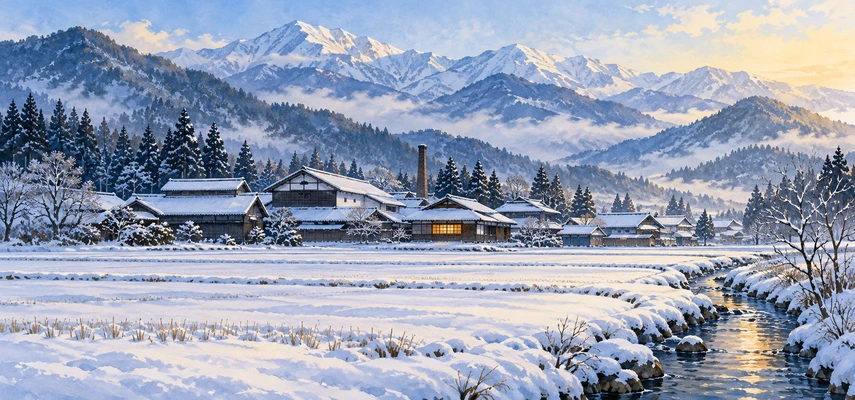

Japan’s sake regions are easier to remember when the landscape becomes a set of practical brewing questions. What rice can be grown reliably? What water is available? How does winter affect temperature control? Who develops ingredients and passes on the skills? Iwate, Yamagata and Niigata provide three useful northern case studies.
The shared cold-weather association is a starting point, not the whole explanation. Each prefecture contains different sites and producers, and modern brewing can control conditions beyond what the outdoor weather provides. Regional reputation is useful context; it isn’t a guarantee that every bottle has one prescribed aroma or palate.
Sake regions combine nature and decisions
The WSET specification includes these prefectures within regional study. The goal is to explain influences on style and quality, not merely place names. A useful answer connects an environmental or human factor with the brewing action it supports.
For example, a cold winter can help a brewery maintain a low-temperature fermentation environment. The brewer must still select yeast, prepare rice and monitor the mash. The weather supplies a condition; the brewery turns it into a controlled process. Saying the snow creates fruit aromas skips several important steps.
Water composition also matters more than a picturesque source description. Relevant nutrients can influence fermentation, while low levels of unwanted components support clean production. Actual sources vary, and treatment or blending may be part of management. A prefecture name isn’t a complete water analysis.
Iwate links landscape with a strong skills tradition
Iwate lies in northeastern Honshu, on the Pacific side of Tohoku, with mountainous terrain and cold winters. Its regional account links suitable water and low-temperature conditions with brewing, while also emphasizing people. The Nanbu toji tradition is a central association to remember.
The NTA Iwate specification describes the development and transmission of Nanbu brewing skills, including work beyond the prefecture. That last point matters: a guild association isn’t a rule that its members or influence stay inside one administrative boundary.
Training and accumulated experience help brewers adapt to materials and conditions. The mechanism isn’t that belonging to a named group automatically produces identical sake. It is the movement and refinement of practical knowledge: rice handling, fermentation judgment and production control can be taught, tested and adjusted.
Iwate research adds to inherited practice
The same regional specification describes locally developed rice and microbial resources. Ginginga and Yui no Ka are examples of rice associated with that development. These give the region tools suited to its circumstances rather than requiring every producer to rely on exactly the same materials used elsewhere.
Think of the connection as adaptation. Cold-region agriculture needs rice that can perform in the local growing environment; brewing needs material with appropriate processing properties. Research links those requirements. It doesn’t turn the rice name into a fixed finished-sake flavor independent of polishing and fermentation.
The regional profile often emphasizes a soft texture and rice-derived umami, with aromatic expressions among ginjo products. Treat that as a useful tendency to investigate. A particular Iwate bottle may emphasize another dimension, and its actual quality still needs sensory assessment.
Yamagata combines snow country with technical cooperation
Yamagata is on the Sea of Japan side of northern Honshu. Winter snow and cold conditions form part of its brewing context, alongside suitable groundwater. Its reputation for refined expressions is linked to technical work as well as the environment.
The NTA Yamagata sake specification highlights cooperation among the regional research institute, brewers and communities. Note that the linked page also contains a separate wine specification; rice-sake requirements must be read from the sake section. A shared geographical name doesn’t make wine and sake rules interchangeable.
Cooperation can provide training, evaluation and a way of sharing technical advances. This helps explain how a regional reputation develops through human effort. It is more convincing than saying the mountain water is so good that the fermentation needs no attention.
Yamagata rice is part of a wider portfolio
Zennoh Yamagata’s sake-rice information presents local rice resources including Dewasansan. Other local varieties expand the options available for different brewing goals. A region can cultivate its own materials while its producers also make choices according to individual product plans.
Avoid interpreting local identity as proof that every bottle uses exclusively prefectural rice. Origin claims and geographical-indication rules have specific conditions. A brewery address, a regional GI and a named rice variety each supply different information, which should be read separately on the actual product.
For a style explanation, connect suitable rice and technical fermentation control with the intended expression. The region’s reputation for smooth, clear-textured sake and aromatic ginjo provides a context, but the exact fruit, sweetness or body remains a question for the sample.
Niigata illustrates snow-country brewing
Niigata lies along the Sea of Japan coast and has extensive rice-growing plains as well as mountainous areas. Snow country is a prominent part of its sake identity. The Japan Tourism Agency account connects water resources, rice and long cold winters with the region’s brewing conditions.
Don’t imagine the snow itself dropping a predetermined flavor into the tank. Its practical relevance includes the broader water cycle and the winter environment in which brewing developed. The brewery still needs controlled water composition, suitable rice preparation and a chosen fermentation course.
Niigata is particularly associated with a light, clean expression, often discussed through tanrei karakuchi. The phrase is useful as a regional reference, but not a requirement for every product. Contemporary producers can pursue fuller, sweeter or more aromatic expressions without ceasing to be Niigata brewers.
Niigata rice and institutions support the reputation
Gohyakumangoku is strongly associated with Niigata, while Koshitanrei was developed to support demanding local brewing goals, including highly polished ginjo-style production. The prefectural rice account explains their different attributes. This is a concrete example of agricultural development serving a brewing objective.
The NTA Niigata specification also emphasizes the Echigo brewing tradition and technical institutions. Research, cross-company study and training help maintain and develop skills. The regional explanation therefore needs both material resources and the people who know how to use them.
It is tempting to reduce the story to soft water equals light sake. Water is relevant, but the final expression reflects rice, koji, fermentation and finishing too. The stronger answer explains a coordinated approach rather than expecting one mineral figure to account for every bottle.
Compare the three without inventing rigid borders
A useful comparison gives Iwate a strong Nanbu training association, Yamagata a clear example of research-and-brewer cooperation, and Niigata a snow-country, rice and technical-training story linked to clean light expressions. These are anchors, not exclusive possessions. All three involve agriculture, water, technical skill and producer choices.
Nor is northern Japan one identical climate zone. Pacific-facing Iwate and Sea-of-Japan-facing Yamagata and Niigata have different geographical contexts, while local conditions vary within each. Learn the location before making claims about snowfall or assuming that every mountain source has the same composition.
The JSS regionality overview also discusses how modern production and distribution complicate older regional patterns. Use historical reputations as context while checking current product information. An old overview’s count of geographical indications should not be repeated as a current total.
Geography and GI eligibility answer different questions
A geographical indication has defined requirements and management. It isn’t simply a poetic regional description, and a producer address alone doesn’t prove that every product meets a GI specification. Rice origin, local water, production, storage and bottling conditions need checking against the relevant rules.
For revision, distinguish general regional influences from exact eligibility. An answer about climate should explain its brewing relevance; an answer about a GI should refer to the actual specification. Mixing the two can produce an unjustified claim that all regional sake must use only rice grown within that prefecture.
Build a fair regional tasting exercise
Choose examples with comparable broad designations if the goal is to investigate regional tendencies. Record rice, heat history, alcohol level and service temperature where known. Large production differences can obscure what the exercise is trying to explore.
Then taste without reading the region first. Describe the actual samples before comparing observations with the regional account. Three selected bottles cannot establish a universal rule about three prefectures; they can show how some producers express, adapt or depart from familiar tendencies.
An original written exercise can use the same discipline. Given a light Niigata sake, explain plausible links through water, rice and technical management, while stating that the region alone doesn’t prove the exact method. This earns its value from connected reasoning rather than confidence unsupported by evidence.
When making revision cards, include one exception or limitation beside each regional anchor. That small addition helps you use the association intelligently instead of turning a memorable phrase into an inflexible rule about every local producer.
Compare these northern associations with Ishikawa, Nagano and Kyoto and Hyogo, Nara and Hiroshima. The regional comparison lesson shows how to test the explanation without making prefecture a fixed flavor recipe.
One-page revision summary
Remember Iwate with Nanbu skills and locally adapted resources, Yamagata with snowy brewing conditions and technical cooperation, and Niigata with rice, snow-country resources and the Echigo training tradition. Connect each factor to an action and a qualified result. Keep GI eligibility distinct from regional reputation, and let actual tasting evidence test the tendencies rather than merely repeat them.
Written practice: original TFE exercises
These suggested marks and indicative points are independent teaching guidance, not official WSET marking schemes.
Exercise 1: 5 suggested marks
Explain how natural and human factors can work together in a northern sake region, using Niigata as the example. Mapping: Unit 1 LO2.
Indicative marking points:
- Snow-country water resources and winter conditions form part of the natural context.
- Suitable water composition and temperature management support brewing.
- Rice resources such as Gohyakumangoku and Koshitanrei provide production options.
- Echigo skills, research and training support control and adaptation.
- The combination can support a clean light expression, without guaranteeing every bottle has that style.
Model answer: Niigata combines snow-country water and winter conditions with rice resources such as Gohyakumangoku and Koshitanrei. Brewers manage water and temperature, drawing on Echigo skills and technical training. These linked factors can support a clean light expression, but region alone cannot guarantee the style of every product.
Why it works: It joins resources to decisions and institutions, then qualifies the sensory result instead of assigning everything to snow or water alone.
Common mistake: Claiming every Niigata sake must be dry and light or that soft water independently guarantees the finished profile.
Exercise 2: 5 suggested marks
Compare Nanbu toji tradition in Iwate with technical cooperation in Yamagata, explaining why neither creates a universal flavor. Mapping: Unit 1 LO2.
Indicative marking points:
- Nanbu toji provides an important Iwate association of inherited and transmitted skills.
- Its influence and workers can extend beyond prefectural borders.
- Yamagata cooperation links research, brewers and training.
- Both help people manage materials and fermentation.
- Individual production and finishing choices still create variation within regions.
Model answer: Iwate’s Nanbu tradition emphasizes transmitted brewing skills whose influence extends beyond the prefecture. Yamagata illustrates cooperation among technical institutions and producers. Both strengthen control and adaptation, but individual rice, yeast, fermentation and finishing choices remain, so neither guarantees one universal flavor.
Why it works: The response identifies different human-factor anchors without turning them into exclusive or deterministic regional rules.
Common mistake: Treating guild membership as a geographical restriction or assuming a research institution makes all local products identical.
Knowledge check: 10 original practice questions
Independent TFE questions, not official WSET examination items. Choose one answer per question; explanations follow separately.
1. Which brewing tradition is particularly associated with Iwate?
2. Which claim about local rice is most reliable?
3. Which pair belongs on the Sea of Japan side in this comparison?
4. What can three selected regional bottles establish?
5. Which is an important Yamagata human factor?
6. How should a light clean Niigata reputation be used?
7. What distinguishes a GI from a general regional reputation?
8. Which rice pairing is associated with Niigata?
9. What can cold winter conditions support?
10. Why record heat history and designation in a regional tasting?
Answers and explanations
1. B — Nanbu toji.. Nanbu is the useful Iwate association, though its workers and influence are not confined to one prefecture. Mapping: Unit 1 LO2 regional factors.
2. D — Read the actual origin claim and applicable specification.. Geographical location, variety and raw-material origin are separate facts. Mapping: Unit 1 LO2 regional factors.
3. C — Yamagata and Niigata.. This location distinction helps avoid treating all northern prefectures as one identical climatic setting. Mapping: Unit 1 LO2 regional factors.
4. C — Evidence about those samples and possible examples of regional tendencies.. A small selected flight can teach interpretation without representing every producer. Mapping: Unit 1 LO2 regional factors.
5. D — Cooperation among research institutions, brewers and training initiatives.. Human organization helps turn natural resources into controlled brewing results. Mapping: Unit 1 LO2 regional factors.
6. C — As context to investigate alongside actual product evidence.. Regional tendencies are useful guides rather than complete sensory or production guarantees. Mapping: Unit 1 LO2 regional factors.
7. A — A GI has defined requirements and management that need checking.. Eligibility is a specific question distinct from broad historical or sensory associations. Mapping: Unit 1 LO2 regional factors.
8. A — Gohyakumangoku and Koshitanrei.. The prefecture’s rice resources support different brewing aims, including demanding highly polished production. Mapping: Unit 1 LO2 regional factors.
9. B — A favorable setting for controlled low-temperature brewing.. The environment can assist, but the brewery still needs active management and suitable inputs. Mapping: Unit 1 LO2 regional factors.
10. B — Large production differences can confound a comparison.. A fair comparison should account for variables beyond geography. Mapping: Unit 1 LO2 regional factors.












