










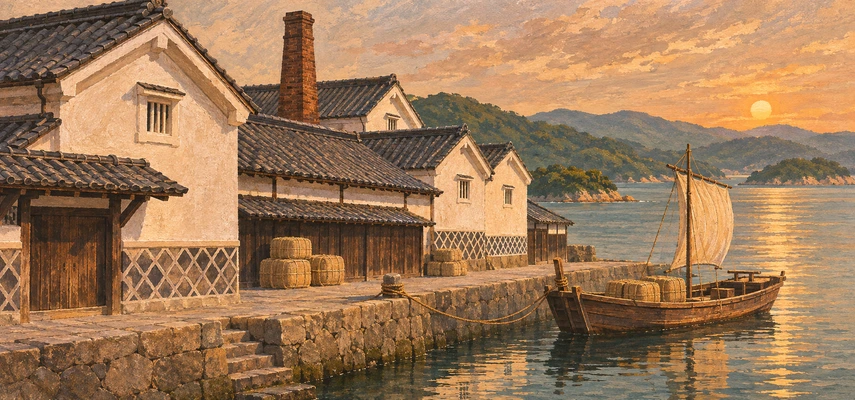

Western Japan’s sake regions show how a useful resource becomes more powerful when someone learns to work with it. Hyogo combines renowned rice-growing areas, brewing water, skilled labor and trade. Nara adds an important history of institutions and temple production. Hiroshima demonstrates technical adaptation to water that earlier methods found difficult.
These are three different stories, not three guaranteed tasting notes. A regional association can explain why a particular technique developed or a brewing center expanded. The actual bottle still reflects its producer’s rice, yeast, fermentation and finishing choices. Keep both levels visible: the regional context and the individual production plan.
Sake regions need more than a water adjective
The WSET specification includes Hyogo, Nara and Hiroshima among the prescribed prefectures. For revision, identify a natural factor, a human factor and a practical consequence for each. This produces an explanation rather than a list of admired place names.
Water hardness is relevant, but broad categories don’t identify every useful or unwanted component. Yeast nutrition, iron content and the whole production environment need consideration. Nor can water alone determine sweetness: sugar supply, fermentation progress and later adjustment also influence the result.
The most useful regional comparison therefore asks how people adapted their methods to available materials. A successful approach can then spread beyond its place of development. Technical influence doesn’t stop at a prefectural border, even when the region remains closely associated with it.
Hyogo connects rice country with brewing centers
Hyogo includes important rice-growing areas and major sake-brewing districts. Yamada-nishiki is a central association, particularly in discussing suitable growing sites and rice intended for demanding brewing. Don’t confuse the rice-growing location with the address of every brewery that purchases the rice.
The NTA Harima specification explains the relationship among agriculture, brewing and skilled labor. This is a useful reminder that a regional system can involve suppliers and brewers in different places. Raw material and expertise move through commercial networks.
A grower aims to produce suitable grain under local agricultural conditions, while the brewery chooses polishing and preparation for its product. The rice’s reputation doesn’t remove the need for inspection or careful processing. A famous variety handled badly isn’t an automatic route to an excellent sake.
Nada makes the water-and-trade link concrete
Nada’s brewing districts lie along the coast near Kobe and Nishinomiya. Miyamizu is the famous water association, linked specifically to wells in Nishinomiya rather than every source across Hyogo. Use the name precisely instead of calling all local brewing water Miyamizu.
The official Kobe account of Nada sake connects water, skills and the district’s development. Relevant mineral composition can support fermentation, but the brewer still coordinates koji, rice and yeast. The practical link is a suitable fermentation environment, not a universal instruction that every tank must finish identically dry.
Coastal transport helped sake reach major markets. Access to customers, the ability to move volume and accumulated production skill all contributed to the center’s importance. A water-only explanation misses why one suitable source becomes part of a nationally recognized brewing district while another remains local.
Tanba skills are another Hyogo anchor
Tanba toji are an important skilled-brewer association in the Nada story. The official Kobe guide presents their role alongside rice and water. People learned how to exploit the available conditions, maintain production and pass practical knowledge to others.
The skill itself includes adaptation. Rice quality varies, fermentation changes through its course and a production target may differ between products. A trained brewer uses observation and control rather than applying a place name as a recipe. This explains why a guild can support consistency without producing one identical flavor everywhere.
Nada is often discussed through firm, relatively dry expressions, but those words aren’t a legal requirement for all Hyogo sake. Aromatic, sweet and otherwise different products also need to be understood through their actual production. Keep the historical anchor without turning it into a ban on variation.
Nara contributes a history of organized brewing
Nara’s importance isn’t best summarized by one water profile. It is a valuable example of how court institutions, temples and accumulated technique contributed to sake’s development. The Nara prefectural history describes evidence of organized production and later brewing traditions.
The JSS historical overview places Nara within a longer sequence of change. Treat historical claims at the scale the evidence supports. Saying one place contributed significantly is different from proving that every modern brewing operation was invented there at one moment.
This distinction matters because beverage history attracts tidy origin stories. A label or tourism phrase can compress centuries into the birthplace of sake. For study, explain the specific institutional or technical contribution instead of relying on the slogan to do the historical work.
Temple heritage is not a complete modern recipe
Nara’s temple-brewing associations provide a context for starter development and the control of fermentation. Modern products drawing on that heritage still need their actual method identified. A historic setting doesn’t establish that the producer omitted modern measurement, selected yeast or refrigeration.
Equally, heritage doesn’t guarantee a sweet, rustic or mature expression. Those are sensory observations affected by the whole production plan. A contemporary Nara ginjo can be aromatic and carefully refined without contradicting the region’s historical importance.
For a written answer, state the relevant contribution, explain its significance and stop before inventing extra details. If the question doesn’t supply a specific starter or maturation history, don’t assign one merely because the bottle comes from Nara. Historical context is useful evidence, but it has limits.
Hiroshima shows why technique can change an opportunity
Hiroshima is strongly associated with the development of soft-water brewing. Water with relatively low nutrient mineral content created challenges for methods that worked readily with other sources. The important response was adaptation, not the conclusion that suitable sake could never be made there.
The Hiroshima brewers association history explains Miura Senzaburo’s work and the wider adoption of the approach. Careful rice and koji management, fermentation control and hygiene helped make a reliable process possible. This is a strong example of human knowledge changing what a natural resource can support.
It also challenges a simplistic regional hierarchy. Harder water isn’t automatically better, and softer water isn’t automatically more refined. Suitability depends on the intended fermentation and the brewer’s ability to manage it. Different materials can support excellent results through different controls.
Don’t assign one analysis to all Hiroshima water
The soft-water association is historically important, but individual sources vary. Kamoizumi’s production account describes its own water as medium hard. A direct producer example prevents the prefectural shorthand from becoming a false claim about every brewery.
Likewise, Hiroshima’s reputation for skilled ginjo production doesn’t require every local sake to be floral, light or chilled. Products can range in sweetness, body, aroma and maturation. Read the actual description and taste the sample before selecting the sensory terms.
This is not an exception that destroys the regional story. It makes the story more accurate: an influential technique developed in response to a particular challenge, while producers across a varied area continue to make choices. Regionality is a relationship between resources and people, not a single laboratory result.
Compare the three causal chains
For Hyogo, connect rice-growing suitability, brewing water, skilled workers and market access. For Nara, connect institutional and temple history with the development and transmission of technique. For Hiroshima, connect the characteristics of available water with deliberate adaptation of brewing practice.
Then add the limitation to each. Rice and water don’t prove final quality; historical origin doesn’t identify every modern process; a soft-water reputation doesn’t establish every source’s composition. These limits make your reasoning more precise rather than weakening it.
Use regional knowledge after observation
In a comparative tasting, record the actual aroma and palate before revealing the origins. A firm dry sample may fit an expected Nada tendency, but it doesn’t prove that identity. Several other places and production plans can produce similar results.
Once the labels are revealed, identify which regional factors plausibly support the expression and which product-specific facts offer stronger explanation. If the sample is nama, genshu or long-matured, that information may explain a difference more directly than the prefecture. Avoid making geography responsible for everything in the glass.
For revision, draw the supply chain as well as the landscape: grower, material, skilled brewer, production and customer. Hyogo makes those connections particularly visible, while Nara and Hiroshima show how ideas move across generations. A useful explanation includes movement and change, not merely a pin on a map.
Check the geographical scale in any comparison. Nada is a brewing district within Hyogo, while Harima identifies another regional context; neither word covers the whole prefecture. Similarly, a particular Hiroshima well can differ from a prefectural generalization. Precise scale helps you explain an example without accidentally enlarging its claims.
For a broader comparison, revisit Ishikawa, Nagano and Kyoto and the brewing-water mechanisms. Use the regional tasting exercises to separate a historical association from evidence about a particular bottle.
One-page revision summary
Hyogo brings together Yamada-nishiki, specific Miyamizu sources, Tanba skills and trade. Nara contributes important institutional and temple-brewing history. Hiroshima demonstrates adaptation through soft-water brewing and continuing technical skill. Explain each mechanism, acknowledge local variation and assess the actual product instead of treating regional reputation as a quality certificate.
Written practice: original TFE exercises
These suggested marks and indicative points are independent teaching guidance, not official WSET marking schemes.
Exercise 1: 5 suggested marks
Explain why Miyamizu alone is an incomplete account of Nada’s brewing importance. Mapping: Unit 1 LO2.
Indicative marking points:
- Miyamizu identifies specific Nishinomiya brewing-water sources.
- Relevant composition supports fermentation.
- Rice supply and preparation remain important.
- Tanba skills support control and adaptation.
- Coastal trade and markets contributed to the center’s growth.
Model answer: Miyamizu provides a specific suitable water resource, but rice supply and preparation, Tanba brewing skills and commercial transport also matter. Brewers use the water within a controlled fermentation rather than receiving a finished style from it. Coastal access helped turn production into a major market presence.
Why it works: It joins natural resource, technical action and commerce instead of repeating a single water claim.
Common mistake: Calling every Hyogo water source Miyamizu or assigning the entire finished style to hardness.
Exercise 2: 5 suggested marks
Use Hiroshima to explain how human adaptation can change the usefulness of a regional resource. Mapping: Unit 1 LO2.
Indicative marking points:
- Soft water posed challenges for some established methods.
- Miura Senzaburo is associated with developing a successful adapted approach.
- Koji/rice and fermentation control were important.
- Sharing and refining technique extended the influence.
- The history does not mean every Hiroshima source or bottle is identical.
Model answer: Hiroshima’s soft-water challenge prompted adapted brewing associated with Miura Senzaburo. Careful rice, koji and fermentation management made the resource workable, and the technique spread through sharing and refinement. This explains human influence without claiming every local source has the same composition or every bottle the same taste.
Why it works: It identifies the challenge, the response and its significance while preserving the distinction between regional association and universal fact.
Common mistake: Saying soft water makes high-quality sake impossible or assuming all Hiroshima water has one fixed analysis.
Knowledge check: 10 original practice questions
Independent TFE questions, not official WSET examination items. Choose one answer per question; explanations follow separately.
1. What does a Hiroshima soft-water reputation prove about one producer’s well?
2. Which historical claim is most careful?
3. A dry firm sample fits a Nada tendency. What can be concluded blind?
4. Which skilled-brewer association belongs in the Nada explanation?
5. Which factor is particularly useful for Nara study?
6. Miyamizu is most precisely associated with what?
7. Which is the strongest regional explanation?
8. Which rice is central to the Hyogo regional discussion?
9. Who is associated with Hiroshima soft-water adaptation?
10. Why did coastal access matter?
Answers and explanations
1. D — Nothing exact without source-specific evidence.. Individual sources vary, as direct producer accounts demonstrate. Mapping: Unit 1 LO2 regional factors.
2. C — Nara contributed significantly to organized brewing and technical development.. Specific contributions are more defensible than a compressed universal invention story. Mapping: Unit 1 LO2 regional factors.
3. C — The style is compatible, but identity needs more evidence.. Sensory compatibility supports a possibility rather than documentary geographical identification. Mapping: Unit 1 LO2 regional factors.
4. A — Tanba toji.. Tanba skills are a useful anchor for the district without implying workers never move. Mapping: Unit 1 LO2 regional factors.
5. B — Institutional and temple-brewing history.. Nara’s historical significance should be explained through specific contributions rather than one sensory stereotype. Mapping: Unit 1 LO2 regional factors.
6. B — Specific brewing-water sources in Nishinomiya.. The famous name identifies a specific source association rather than a prefecture-wide water analysis. Mapping: Unit 1 LO2 regional factors.
7. B — Resources interact with skills, processing and commercial choices.. Connected mechanisms explain more than deterministic place-name shortcuts. Mapping: Unit 1 LO2 regional factors.
8. C — Yamada-nishiki.. Hyogo’s growing areas and rice expertise are important alongside its brewing centers. Mapping: Unit 1 LO2 regional factors.
9. A — Miura Senzaburo.. The regional story emphasizes technical response to a resource challenge. Mapping: Unit 1 LO2 regional factors.
10. D — It helped connect brewing volume with markets and transport.. Commerce contributes a different part of the explanation from rice and water. Mapping: Unit 1 LO2 regional factors.












