










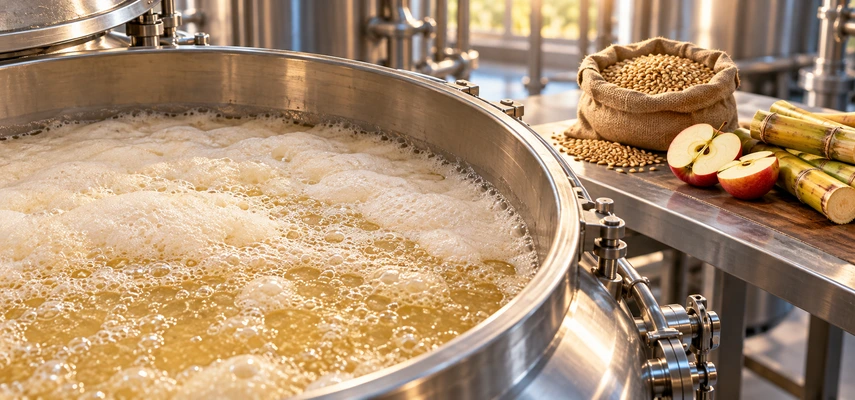

A grape can arrive with much of a distiller’s first problem already solved. A grain of barley cannot. Both can contribute to an alcoholic drink, but yeast cannot treat a grape’s dissolved sugars and a grain’s packed starch as the same ready meal. Spirits fermentation begins with making the right food available.
That preparation is easy to overlook because the still is the photogenic equipment. Yet the fermented liquid decides much of what the still has to work with. Change the starting material, the sugar-conversion method or the fermentation conditions, and you change more than the amount of alcohol available. You change the chemical material from which a style can develop.
This lesson explains that first half of the journey. It is about understanding the function of each operation, not following a practical recipe. Once those functions are clear, grape brandy, whisky, rum and agave spirits become easier to compare without pretending their producers all use the same process.
Locate spirits fermentation in the four stages
The four broad stages are preparing a sugary liquid, alcoholic fermentation, distillation and post-distillation operations. Stage one supplies accessible fermentable material. Stage two creates ethanol and congeners. Stage three selects and concentrates ethanol and congeners through distillation. Stage four can adjust colour, aroma, sweetness and strength through permitted maturation, blending, flavouring, dilution and related operations.
Notice that sugar conversion and alcoholic fermentation answer different questions. Conversion asks how a plant’s stored carbohydrate becomes sugar yeast can use. Fermentation asks what yeast does with that sugar. Cooking agave or mashing grain does not replace fermentation; it prepares the substrate for the next biological task.
Equally, an efficient still cannot rescue a missing source of ethanol. Its job is separation rather than converting non-alcoholic starch into spirit. Keeping these roles distinct is useful when an examination question mentions unfamiliar equipment. Identify what the operation achieves before deciding which category or stage owns it.
Sugars can be accessible or locked in longer chains
Fermentable sugar is sugar the relevant yeast can use under the fermentation conditions. Grapes and other fruit can provide sugars in juice after crushing and pressing. Cane juice also supplies sugar, while molasses needs suitable preparation and dilution. These materials still need careful handling, but they don’t pose the same conversion problem as a sack of grain.
Starch is a larger carbohydrate made from linked sugar units. Cereal grains and potatoes store carbohydrate this way. The useful comparison is a packet of individual envelopes versus a bound book: the information is present in both, but you can’t sort the book into separate pages without another operation. The analogy concerns access, not a claim that yeast digests paper.
Fructans, important in agave, are a different group of linked carbohydrates. They too need conversion into suitable smaller sugars. Starch and fructans should therefore sit together in your revision notes as complex carbohydrates needing preparation, but not as chemically identical materials that necessarily require identical treatment.
The choice of raw material also supplies more than potential alcohol. Plant-derived compounds and their precursors can contribute to the eventual aroma profile. Processing may preserve, release, transform or remove them. A distiller seeking a highly neutral base may pursue a different outcome from one trying to retain a noticeable connection with fruit or cane.
Grain preparation is a sequence of useful jobs
In malted barley production, malting makes enzyme activity available for later conversion. Crushing opens the grain structure. Mixing with suitably warm water helps bring accessible starch and enzymes together, producing sugars in the liquid. The important idea is that the grain’s stored carbohydrate must become usable by yeast; “grain contains carbohydrate” is only the start of the answer.
Other grains can require cooking to make starch accessible before enzymes break it down. Malted barley or purchased enzymes can supply the relevant activity, depending on the process. Potatoes likewise need suitable preparation and enzyme treatment. Don’t assume that every grain spirit is made entirely from malted barley simply because malt provides one familiar route.
In an examination comparison, state the purpose of cooking and enzymes separately. Heat and water can help make starch available; enzymes break the large carbohydrate into smaller units. Neither operation alone is the same as creating the ethanol. This distinction carries forward into the whisky and vodka lessons, where different materials use related principles.
Agave brings a different conversion problem
Agave stores much of its relevant carbohydrate as fructans in the harvested plant material. Cooking can break these down into sugars suitable for fermentation. The familiar cook-and-crush sequence combines chemical conversion with physical extraction. The producer needs an appropriate sugary liquid, not just a pile of hot plant fibres.
Some production systems extract fructan-containing liquid using a diffuser and convert the extracted carbohydrate afterwards. That changes the order of operations without changing yeast’s basic requirement for usable sugar. The later Tequila and Mezcal lessons examine their particular methods and regulations. Here the transferable lesson is to distinguish extraction from conversion, whichever happens first.
Fruit, grain and agave now converge on the same broad destination: a liquid containing suitable sugars. They haven’t become identical raw materials, however. Their other components, processing history and microbial handling can still differ. The shared endpoint makes fermentation possible; it doesn’t erase the characteristics carried into the vessel.
Yeast creates ethanol and a chemical supporting cast
In alcoholic fermentation, yeast uses fermentable sugars and produces ethanol, carbon dioxide and heat. Ethanol is the alcohol central to beverage strength. Carbon dioxide accounts for gas production. Heat matters because a fermentation is an active process whose conditions need managing, rather than a container that simply waits unchanged until the calendar says stop.
Yeast also makes compounds relevant to aroma. Esters can contribute fruity associations, while fusel alcohols, also called higher alcohols, form another important group. The mixture depends on the organism, substrate and conditions. A congener’s contribution depends on identity and concentration, so “remove all congeners” isn’t a sensible universal definition of good spirits production.
Lallemand’s fermentation-control explanation describes how strain and environment affect aroma compounds, using brewing examples. Its distilling yeast page illustrates selection for particular fruit substrates and fermentation conditions. A yeast description should not be expanded into a promise of identical flavour in every possible fermentation.
Methanol is another alcohol included in the congener vocabulary. Its occurrence is particularly relevant to pectin-containing materials and their processing. It is chemically distinct from ethanol. This educational distinction is not a production safety test: smell, a simple boiling-point story or a standardised discarded portion cannot establish that a spirit complies with analytical requirements.
Conditions matter, but shortcuts mislead
Temperature influences microbial activity and the compounds formed. Yeast strain, available nutrients, sugar concentration and the time allowed also matter. A warmer fermentation is not automatically more aromatic, better or worse across every organism and substrate. The useful question is how conditions interact with the selected organism and the producer’s intended result.
Consider two hypothetical producers starting from the same material. One seeks efficient fermentation for a relatively neutral base. Another values a more expressive mixture to carry through lower-strength distillation. They may choose different yeast and handling. That is a difference in objective, not evidence that one producer understands fermentation and the other has forgotten it exists.
Fermentation also sits inside a larger microbial context. Other microorganisms can influence the chemical mixture, deliberately or otherwise, in particular traditions. Later rum lessons explore this where it matters. For now, avoid replacing one oversimplification with another: fermentation character isn’t determined solely by yeast brand, and extra time doesn’t always mean extra desirable complexity.
Alcohol by volume and US proof measure strength
Alcohol by volume, usually written ABV or abv, expresses the volume of ethanol as a percentage of the liquid volume under the relevant measurement conditions. A bottle labelled 40% ABV is not claiming that 40% of its aroma comes from alcohol, or that it contains 40% of its raw material. It is stating alcoholic strength.
In the current US system, US proof is twice the ABV percentage. A hypothetical 45% ABV spirit is 90 proof; a 100-proof spirit is 50% ABV. These are two ways of expressing the same strength relationship. Do not import that simple conversion into historical or other national proof systems without checking their definitions.
Strength after fermentation, strength leaving a still and strength in the bottle are separate observations. Distillation can increase concentration; later water addition can reduce it for bottling. A familiar bottled strength therefore doesn’t reveal the strength at which fermentation ended or the spirit was distilled. Read the stage as carefully as the number. For revision, label every strength example with its stage before attempting a comparison between two drinks.
What to remember
Build every answer around the job being done. Raw-material preparation makes suitable sugar accessible. Yeast turns that sugar into ethanol while helping shape the congener mixture. Distillation then works on the fermented result. Understand those handovers and the production story stops being a string of technical words: each step solves a different problem for the next one.
Continue your study
To follow starch conversion into whisky production, read How Whisky Is Made: Grains, Mashing, Fermentation, and Maturation. To compare cane-derived sugar sources, read How Rum Is Made: Sugar Cane, Molasses, Fermentation, and Distillation. To see how agave fructans are prepared, read Tequila Explained: Blue Agave, Jalisco, Production, and Ageing Labels.
Knowledge check: 10 original practice questions
Independent TFE questions, not official WSET examination items. Choose one answer per question; explanations follow separately.
1. Why must grain starch be converted before alcoholic fermentation?
- To remove every aroma compound
- To turn carbon dioxide into ethanol
- To provide sugars yeast can use
- To make oak colour dissolve
2. What does crushing or pressing fruit primarily help provide for fermentation?
- Access to sugar-containing juice
- Finished cask-aged spirit
- Condensed ethanol vapour
- A legally defined proof measurement
3. Which group can contribute fruity aroma associations?
- Esters
- US proof numbers
- Oak staves themselves
- Stainless steel plates
4. Which statement distinguishes fermentation strength from bottled strength?
- Later distillation and dilution can change concentration
- They must always be identical
- Fermentation strength measures colour
- Bottled strength reveals the grain percentage
5. What is the principal role of enzymes during starch conversion?
- Supplying barrel colour
- Measuring bottled strength
- Breaking larger carbohydrates into suitable smaller sugars
- Condensing spirit vapour
6. What does 90 US proof express in ABV?
- 90% ABV
- 30% ABV
- 180% ABV
- 45% ABV
7. Which statement best describes yeast strain and fermentation conditions?
- Temperature alone identifies the finished category
- Longer fermentation always improves every spirit
- Every strain makes the same result under all conditions
- They interact to influence fermentation and its compounds
8. Which pair is produced alongside ethanol during alcoholic fermentation?
- Juniper and oxygen
- Starch and oak tannin
- Fructans and caramel
- Carbon dioxide and heat
9. Which carbohydrate is especially important in agave preparation?
- Caramel colour
- Fusel alcohols
- Fructans
- Cellar charcoal
10. Which statement about congeners is most accurate?
- They are all legally prohibited additives
- They are simply another name for water
- Their contribution depends on identity, concentration and context
- They are all faults
Answers and explanations
1. C — To provide sugars yeast can use. Starch conversion supplies suitable smaller sugars; fermentation then creates ethanol from those sugars. Mapping: LO1.
2. A — Access to sugar-containing juice. Crushing and pressing provide access to fruit juice containing fermentable sugars before fermentation. Mapping: LO1.
3. A — Esters. Esters are among the fermentation-related compounds that can contribute fruity impressions. Mapping: LO1.
4. A — Later distillation and dilution can change concentration. Distillation can concentrate ethanol and dilution can reduce strength, so stage-specific measurements differ. Mapping: LO1.
5. C — Breaking larger carbohydrates into suitable smaller sugars. Enzymes act on the carbohydrate before yeast uses the resulting sugars in fermentation. Mapping: LO1.
6. D — 45% ABV. Current US proof is twice the ABV percentage, so 90 proof corresponds to 45% ABV. Mapping: LO1.
7. D — They interact to influence fermentation and its compounds. Strain, substrate and conditions jointly influence fermentation; single-factor universal rules are unreliable. Mapping: LO1.
8. D — Carbon dioxide and heat. Alcoholic fermentation produces ethanol, carbon dioxide and heat from suitable sugars. Mapping: LO1.
9. C — Fructans. Agave stores relevant carbohydrate as fructans, which need conversion into suitable sugars. Mapping: LO1.
10. C — Their contribution depends on identity, concentration and context. Congeners include aroma-relevant and other compounds; they are not universally desirable or undesirable. Mapping: LO1.












