










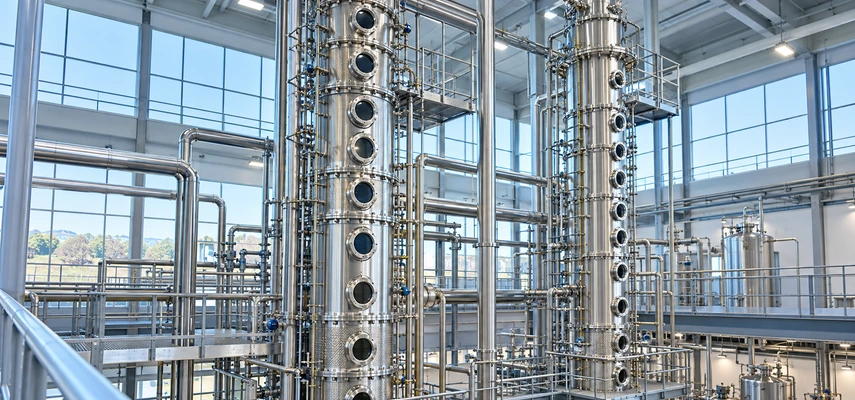

Picture two streams passing in opposite directions inside a tower: vapour moving up, liquid moving down. Each encounter changes their composition. That exchange is the engine of column still distillation. Height provides room for a series of separations; it doesn’t, by itself, explain what comes out at the end.
This is why calling a column a taller pot still misses the point. A pot batch changes over time as material is distilled away. A continuous column is arranged to maintain flows and collect selected streams while new feed enters. To understand it, follow the moving material rather than the outline of the metalwork.
There are many industrial configurations, including linked columns and different kinds of internals. This lesson explains the typical plate-column model used in the course. It provides a mental picture you can apply to later whisky, rum and vodka lessons without pretending every distillery has built an identical tower.
Column still distillation needs flows in both directions
The starting material is an already fermented alcoholic liquid. It contains water, ethanol and congeners. In a continuous system, feed enters while energy supports vaporisation, selected products are withdrawn and spent liquid leaves. The operation depends on managing these inputs and outputs together, rather than filling a pot, completing one charge and starting again.
Steam supplies heat in the typical model. Rising vapour travels through the column, meeting liquid held on internal levels. Some components move preferentially into vapour, while others remain more concentrated in liquid. The resulting streams therefore change composition as they pass from one level to another. Neither stream is simply “alcohol” or “water” in pure form.
Think of a staircase where people exchange parcels at every landing. What reaches the top depends on the exchanges made along the way, not just the building’s height. The analogy is limited: molecules move through phase interactions, not personal decisions. It is useful because it reminds you that the important work occurs repeatedly inside the structure.
Plates provide places for contact
Plates, also called trays, hold liquid across sections of the column. The plate arrangement creates opportunities for rising vapour to contact that liquid. A plate is therefore more than a shelf carrying equipment. It is part of the separation system, helping bring the two phases into contact under controlled operating conditions.
In the course’s bubble-cap model, vapour is directed through a bubble cap and into liquid on the plate. This encourages interaction rather than letting vapour take an unobstructed route straight up an empty tube. The details of cap construction aren’t the same as a pot still’s swan neck: both belong to distillation equipment, but they perform different jobs.
Downcomers provide a route for liquid to move to the level below. Vapour rises through the contacting arrangement while liquid descends through the appropriate path. Keeping those directions clear resolves several common diagram questions. A downcomer isn’t the principal route for vapour to climb the tower, despite both streams sharing the same overall vessel.
Sulzer’s tray overview shows that commercial separation equipment includes several tray designs and downcomer arrangements. The bubble-cap description is an examinable model, not a claim that every modern distillation column uses that one design. Learn the specified anatomy first, then recognise the wider engineering context.
Each encounter changes the balance
At a contacting stage, the vapour leaving upwards can be richer in the more volatile components. The descending liquid becomes richer in less volatile components relative to that vapour. Repeat the process through the column and the separation develops further. This is a change in mixture composition, not a mechanical filter that catches only molecules above a particular size.
Reflux involves condensed liquid returning within the system. Rectification is the increasing separation supported by repeated vapour-liquid interactions. The terms are linked, but they aren’t interchangeable names for a specific piece of metal. Reflux describes a returning liquid flow; rectification describes what repeated separation can achieve.
The number and effectiveness of contacting stages, reflux conditions, feed, energy and withdrawals all matter. You don’t need to calculate a column’s engineering design for this qualification. You do need to explain the mechanism: repeated contact permits further separation, which can change alcoholic concentration and the balance of congeners retained in a collected stream.
Continuous operation means managing a moving balance
In the typical sequence, preheated fermented liquid enters the column. Heating the incoming feed supports the system’s energy management. Vapour moves upwards and liquid downwards while collection and waste removal continue. “Continuous” describes this operating arrangement; it doesn’t mean equipment never shuts down for cleaning, maintenance or a change in production.
Compare a restaurant serving from a replenished kitchen with a single covered dish being emptied at a table. Both provide food, but the flows are organised differently. A continuous column maintains a balance between incoming material, heat, internal movement and outgoing streams. A batch pot works through a particular charge whose composition changes as it is distilled.
If feed conditions or operating choices change, the result can change too. A continuous plant is not a magical appliance that ignores the fermented material entering it. Raw-material and fermentation choices still influence what is available for selection. The still determines how that mixture is reshaped; it doesn’t erase the production stages that came before it.
Selection over space replaces the simple batch timeline
In the teaching model, fractions are selected at different positions. Heads are associated with the top region, the desired heart with a point near the top, and tails with a lower location. The key phrase is selection over space. These positions reflect differences in composition within the operating column.
The official specification uses the same broad fraction groups introduced in the pot-still lesson. The contrast is how they are collected. Pot distillation selects changing portions over time; the continuous model withdraws different streams from different locations. This distinction is more useful than memorising “column equals tall.”
Spent liquid waste leaves from the base. It is not simply another name for the collected tails stream. Draw each outlet separately in your revision sketch, then describe its role. That small discipline helps prevent a diagram from turning several different movements into one arrow labelled “the bad stuff.”
Real installations may distribute these functions across more than one column and use arrangements more complex than the classroom drawing. Don’t infer a universal withdrawal location from a photograph of an unfamiliar plant. For examination purposes, understand the specified model; for an actual producer, consult its documented configuration before making a production claim.
A column can make characterful spirit
Increased separation can produce highly concentrated ethanol with fewer of many aroma-active congeners. This is useful when the producer wants a relatively neutral base for vodka or subsequent flavouring. Neutrality is an intended style characteristic, not proof that the equipment failed to preserve something it was meant to preserve.
But column-distilled spirit can also have pronounced aroma. The result depends on configuration and operation, including the degree of separation and what is collected. A shorter or differently operated system may retain a more noticeable congener profile. Neither material choice nor the word “column” alone tells you how intense the finished drink will smell.
Nikka’s Coffey-still account gives a producer example of valuing character from continuous distillation. It illustrates why the equipment category shouldn’t be treated as a synonym for flavourlessness. One example doesn’t establish that all Coffey stills make the same spirit, just as one pot-still malt doesn’t define every pot-distilled drink.
Also separate distillation strength from bottling strength. Two spirits can both be bottled at 40% ABV after dilution while having been distilled to quite different strengths. Comparing only the numbers on the finished bottles would hide that distinction. To explain style, ask where in production a strength measurement was taken.
Test your understanding with two hypothetical goals
Suppose one producer wants a highly neutral base to carry a later botanical recipe. Strong separation can help reduce the original material’s aromatic footprint. The later flavouring then has a relatively restrained background. That doesn’t make the recipe simpler; it changes where the producer places the main source of character.
Now suppose another producer wants a cane-derived spirit whose fermentation character remains noticeable. A column can be arranged and run towards that different goal. Subsequent oak maturation or blending adds more decisions, but the initial spirit need not begin neutral. This is why category lessons should connect the still’s operation with its purpose instead of treating equipment as destiny.
When revising, explain both possibilities aloud. If your answer ends with “columns always remove flavour,” you have lost the range the syllabus asks you to understand. If it ends with “columns do nothing to flavour,” you have lost the separation mechanism. A useful explanation holds both facts together: the process changes composition, and its operation determines the extent and direction.
What to remember
Keep three movements in view: vapour rises, liquid descends, selected streams leave at different positions. Plates, bubble caps and downcomers make those movements purposeful. Reflux and rectification explain how repeated contact changes composition. Continuous collection explains why the producer selects over space. Once that picture is clear, the column becomes a comprehensible process rather than a mysterious silver tower.
Continue your study
To contrast column operation with a pot-still run, read Pot Still Distillation Explained: Heads, Hearts, Tails, and Double Distillation. To see a characterful short column in Armagnac, read Armagnac Explained: Grapes, Column Distillation, and Regional Styles. To connect extensive rectification with vodka, read Vodka Explained: Neutral vs. Characterful Styles, Raw Materials, and Filtration.
Knowledge check: 10 original practice questions
Independent TFE questions, not official WSET examination items. Choose one answer per question; explanations follow separately.
1. What does continuous operation mean here?
- The plant can never shut down
- Every stream has a permanently identical composition
- Feed and collection occur during a managed ongoing process
- Fermentation is unnecessary
2. Which statement about column-distilled aroma is correct?
- It can range from neutral to pronounced
- It must always be smoky
- It is always neutral
- It is determined only by column height
3. Why can equal bottled strengths hide different distillation histories?
- Bottle strength determines grain species
- Columns always bottle without water adjustment
- ABV measures colour rather than ethanol
- Dilution can bring differently distilled spirits to the same ABV
4. What does rectification describe?
- The conversion of starch to sugar
- Increasing separation through repeated vapour-liquid interaction
- The addition of sugar to a liqueur
- Oak extraction during maturation
5. Where does spent liquid waste leave in the typical model?
- From the fermentation yeast packet
- At the base
- Through every bottle cork
- Only from the highest heads outlet
6. What is the principal role of a downcomer?
- Pressing fruit juice
- Allowing liquid to descend to a lower level
- Carrying vapour upwards through the cap
- Adding caramel colour
7. Which phrase best describes continuous-column fraction selection?
- Selection only after bottling
- Selection only through a batch timeline
- Selection by grain colour
- Selection over space
8. Which sequence correctly describes the opposing internal flows?
- Liquid upwards with no vapour movement
- Vapour upwards and liquid downwards
- Both phases only downwards
- Both phases only upwards
9. Why does vapour pass through bubble caps?
- To create sugar from ethanol
- To remove the need for heat
- To measure US proof
- To promote contact with liquid on the plate
10. What is the main role of a plate in the teaching model?
- Ageing spirit in oak
- Measuring the final bottle volume
- Converting grain starch into sugar
- Holding liquid for contact with rising vapour
Answers and explanations
1. C — Feed and collection occur during a managed ongoing process. Continuous describes the flow arrangement; maintenance, shutdowns and changes remain possible. Mapping: LO1.
2. A — It can range from neutral to pronounced. Column design and operation can produce a range of aroma intensities, including characterful spirits. Mapping: LO1.
3. D — Dilution can bring differently distilled spirits to the same ABV. Later dilution can make bottled ABV identical even when distillation strengths and retained mixtures differed. Mapping: LO1.
4. B — Increasing separation through repeated vapour-liquid interaction. Rectification increases separation through repeated interactions and can change strength and congener balance. Mapping: LO1.
5. B — At the base. The base outlet removes spent liquid, which is distinct from the collected tails stream. Mapping: LO1.
6. B — Allowing liquid to descend to a lower level. Downcomers provide the descending liquid path, separate from the main upward vapour route. Mapping: LO1.
7. D — Selection over space. Different streams can be withdrawn at different column positions, contrasting with batch selection over time. Mapping: LO1.
8. B — Vapour upwards and liquid downwards. The typical model relies on rising vapour contacting descending liquid through the column. Mapping: LO1.
9. D — To promote contact with liquid on the plate. Bubble caps direct vapour into liquid, supporting the interaction central to the separation model. Mapping: LO1.
10. D — Holding liquid for contact with rising vapour. Plates hold liquid and create opportunities for vapour-liquid interaction inside the column. Mapping: LO1.












