










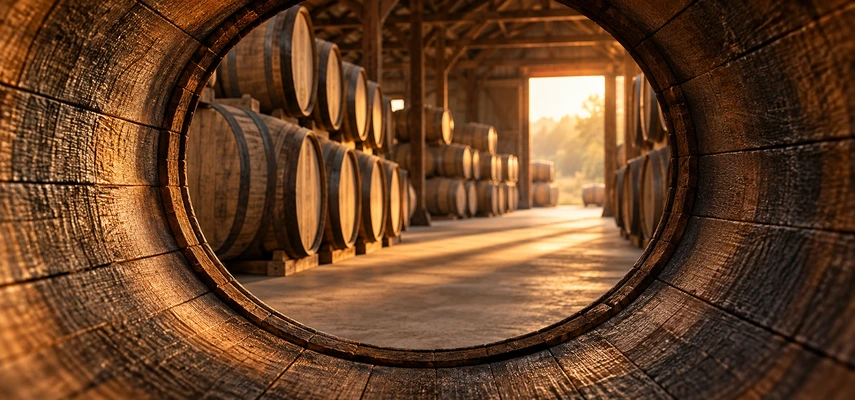

Two spirits spend the same number of years in wood and emerge with very different personalities. One has vivid fruit framed by gentle spice; the other is dark, drying and dominated by oak. Oak maturation is not a clock that adds quality at a fixed rate. It is an interaction between a particular spirit, vessel and environment.
To explain the difference, separate extraction, reactions, evaporation and changes in the balance of compounds. Then examine the cask’s construction, history and conditions of use. Time matters, but it doesn’t work alone. A useful answer follows what the vessel permits to happen rather than treating an age statement as a complete production record.
Oak maturation begins with a constructed vessel
A barrel is assembled from shaped staves, with heads closing the ends and hoops holding the structure together. Suitable wood preparation, joints and construction allow it to contain spirit while providing an internal surface for interaction. It isn’t simply a hollow log. The way the wood is prepared affects both the vessel’s physical performance and the material the spirit encounters.
Coopers season and shape wood, assemble the vessel and apply appropriate heat treatments for the intended product. Toasting and charring are different treatments, although their effects can overlap within a barrel’s heat history. Toasting modifies wood through controlled heating; charring creates a carbonized inner surface. Neither label alone specifies every condition or sensory result.
The WV Great Barrel Company handbook provides a manufacturer’s account of stave preparation, assembly and separate toast and char options. It is evidence of the choices available. Its suggested flavor descriptions remain product guidance, rather than a promise that a particular treatment gives every spirit the same tasting notes.
Extraction adds compounds from the wood
Spirit can extract compounds from the vessel, contributing color, aroma, taste and structure. Vanilla-like, coconut-like, spicy or toasted impressions may be associated with wood-derived material, depending on the cask and conditions. The relevant compounds differ, so “oak flavor” is a convenient umbrella rather than one substance moving into the liquid.
The ethanol-water mixture acts as a solvent, and its strength influences extraction behavior. Wood preparation and contact conditions also matter. The practical question is not simply whether wood is present, but what material is available and how it interacts with the liquid. Two barrels made from apparently similar timber needn’t supply identical contributions.
Extraction also isn’t the whole of maturation. An increasingly woody spirit may be changing quickly along one dimension while other aspects develop differently. A darker color can show a change in appearance without demonstrating improved balance. This is why a comparison based solely on how brown the samples look can be impressively decisive and entirely unhelpful.
New and previously used casks offer different starting points
A new cask generally offers more readily available wood-derived extractives than a comparable repeatedly used one. Previous use can reduce some of that available material while introducing another history. A former wine or spirit cask may retain influences associated with its earlier contents and treatment. “Used oak” therefore covers a wide range of actual vessels.
Distinguish previous contents from the number and nature of subsequent fillings. A cask that once held another drink and has since matured several charges of spirit is different from one newly entering that producer’s system. Condition, storage and preparation also matter. The name of the former occupant is not a complete chemical specification.
Annandale’s technical note discusses cask size and previous use as influences on development. Its producer perspective reinforces the need to match cask activity to spirit character. A more active vessel may be useful for one objective and excessive for another; a gentler vessel can offer time for development without the same rapid wood contribution.
Size changes the relationship between surface and liquid
For geometrically similar vessels, a smaller cask generally has a higher internal wood-surface-area-to-liquid-volume ratio. More contact area per unit of liquid can increase the relative opportunity for extraction. Shape and actual dimensions matter, so the relevant relationship is more precise than “small barrels are fast.”
Even when extraction proceeds more quickly, not every maturation process accelerates in the same proportion. A short stay in a small active vessel isn’t automatically equivalent to many years in a larger one. Reactions, evaporation and changes in integration follow their own conditions. The result needs sensory assessment rather than a simple multiplication of barrel size and time.
This makes a good examination chain: smaller comparable vessel, greater surface relative to liquid, potentially stronger or faster wood contribution under otherwise similar conditions. The qualification is important. It predicts a possible extraction difference, not a guaranteed final quality level or a universal schedule for bottling.
Oxygen-related development involves chemical change
Maturation can include oxygen-related reactions that modify the mixture. A wooden vessel, its closures, headspace and handling provide a different environment from a perfectly sealed inert container. The resulting transformations interact with material from fermentation, distillation and wood. “Oxygen softens spirit” is a useful prompt for a question, but too vague as a full explanation.
Different compounds participate in different reactions. Some substances can diminish while others form or change their sensory expression. The distiller seeks a favorable overall result rather than the greatest possible exposure. More oxygen isn’t a universal improvement, just as more oak isn’t. The balance of processes depends on the spirit and the conditions.
Keep formation distinct from extraction in your answer. A compound entering from wood and a compound forming through a reaction are different mechanisms, even if both alter the same aroma impression. Naming the route helps explain why two vessels of similar appearance can produce different outcomes and why time alone doesn’t describe their effects.
Evaporation changes more than the fill level
Some volatile material is lost during cask storage, reducing the quantity remaining. This loss is often called the angels’ share. Water and ethanol do not necessarily leave in the same proportion, so alcoholic strength can change as well as volume. Conditions determine the direction and extent; don’t assume every cask loses strength at the same annual rate.
Evaporation can also influence the relative concentration of material that remains, while other compounds may themselves be volatile or undergo reactions. It isn’t accurate to say every flavor becomes stronger because the barrel contains less liquid. The mixture is changing through several mechanisms at once, and the sensory result reflects their combined effects.
Temperature, humidity, air movement, vessel condition and location can influence losses and development. These variables also change over time. A standard percentage copied from one warehouse shouldn’t become a law of maturation across climates. Use a documented figure only for the conditions it describes and distinguish it from a general explanation.
Warehouse location is a production variable
A warehouse’s construction, local climate and position of individual casks affect the environment around the liquid. Temperature patterns can influence extraction, reaction rates and evaporation. A location within a large building may experience different conditions from another part of the same site. “Same warehouse” does not necessarily mean identical exposure.
The distiller can respond through selection, movement, monitoring and blending, according to the production system. The objective may be consistency across releases, or a particular cask expression. Neither approach makes location irrelevant. Records help connect the observed spirit with the conditions it actually experienced rather than an atmospheric story about the landscape outside.
Rebarrelling and finishing introduce another vessel history
Rebarrelling means transferring spirit into another cask. A finishing period is a later maturation stage used to influence the spirit through a different vessel or cask history. These choices can change the available extractives, previous-content influence and subsequent development. The result depends on the receiving cask and duration, not just the finish name on the label.
Legal constraints remain important. The Scotch Whisky Association’s cask guidance explains requirements and limits on previous use, including that casks must be empty of their previous contents before filling. A permitted cask influence isn’t equivalent to simply adding the former drink to the spirit. Other categories have their own frameworks.
Other woods and oak alternatives need their own checks
Other woods can contribute different compounds and vessel behavior in categories where they are permitted. Oak alternatives, such as pieces of wood used within another vessel, can provide extraction surfaces. They should not be assumed to reproduce every process occurring in a traditionally constructed cask, or to meet every category’s legal maturation requirement.
Separate three questions: what chemistry is possible, what result is desirable, and what the rules allow. A technique can be effective for one product and prohibited in another. The syllabus also excludes oak species from explain-type written questions; that restriction doesn’t mean all vessel design and use topics are excluded. Follow the precise boundary.
Inert vessels distinguish development from wood extraction
An inert vessel doesn’t supply an oak contribution in the way a wooden cask does. It can still support storage and, depending on conditions, development through other changes. The NRIB and JSS shōchū guide provides context for spirits developing outside a compulsory oak-aging model. Avoid applying whisky’s wood-centered description to every category.
Storage means holding the product; maturation implies relevant development over time; preservation aims to maintain desired condition. These purposes can overlap but aren’t identical. For quality, assess whether the resulting balance, aroma and texture suit the spirit. The longest stay, darkest color and most forceful wood character cannot answer that question on their own.
What to remember
Explain the vessel’s construction, available material and surface relationship, then consider reactions, evaporation and warehouse conditions. Match cask activity to spirit character and check the rules before proposing finishes or alternatives. Keep inert storage and development distinct from wood extraction. Time records duration; the production environment explains what that duration may have done.
Written practice: original TFE exercises
These suggested marks and indicative points are independent teaching guidance, not official WSET marking schemes.
Exercise 1: 5 suggested marks
Explain why a smaller comparable cask may increase wood influence without guaranteeing equivalent long maturation. Mapping: LO1 explain: vessel design.
Indicative marking points:
- Comparable smaller vessels have greater internal surface relative to liquid volume.
- The spirit therefore has more wood contact area per unit volume.
- This can increase extraction opportunity.
- Other reactions and evaporation do not necessarily accelerate in the same ratio.
- Final balance and quality therefore need assessment rather than age equivalence assumptions.
Model answer: A smaller geometrically comparable cask has more internal surface area per unit of liquid. That can increase extraction opportunity and wood influence. Other reactions and evaporation need not accelerate proportionally, so a short period in a small cask cannot automatically stand in for long maturation. The resulting balance must be assessed.
Why it works: It traces geometry into extraction and then identifies why the mechanism cannot justify a complete time-equivalence claim.
Common mistake: Equating rapid color gain with every aspect of maturity confuses one visible change with the whole process.
Exercise 2: 5 suggested marks
Explain why a repeatedly used cask can suit a delicate spirit better than a very active new one, without claiming it always does. Mapping: LO1 explain: previous use.
Indicative marking points:
- Previous fillings can reduce readily available wood compounds.
- A repeatedly used cask may provide a gentler extraction contribution.
- An active new cask may add stronger wood influence under comparable conditions.
- Excess wood could overwhelm delicate existing character.
- Actual suitability depends on cask condition, spirit and time.
Model answer: Previous fillings can reduce the readily available wood compounds, so a repeatedly used cask may contribute more gently. Under comparable conditions, a very active new cask could add stronger wood character and overwhelm delicate existing aromas. That makes a gentler cask a plausible choice, although condition, duration and the actual spirit determine success.
Why it works: The answer links previous use to availability, extraction and sensory balance while keeping the comparison conditional.
Common mistake: Assuming every used cask is inactive ignores its actual history, condition and remaining extractives.
Knowledge check: 10 original practice questions
Independent TFE questions, not official WSET examination items. Choose one answer per question; explanations follow separately.
1. Why does darker color not prove better quality?
2. What is rebarrelling?
3. What distinguishes toasting and charring?
4. What does previous use change?
5. Which statement about evaporation is correct?
6. Which statement about oak alternatives is sound?
7. Why can smaller comparable casks give stronger wood influence?
8. What is extraction during oak maturation?
9. Which principle best guides a cask choice?
10. What can an inert vessel do?
Answers and explanations
- C — Appearance alone does not establish balance or development. Quality needs supported sensory assessment rather than a single visual measure or assumed maturation history. Mapping: LO1.
- D — Transferring spirit into another cask. A receiving cask introduces a different vessel history and possible interaction with the spirit. Mapping: LO1.
- A — They are different heat treatments with potentially overlapping effects. Toasting modifies wood under controlled heating; charring produces a carbonized surface, with details depending on treatment. Mapping: LO1.
- D — Available extractives and the vessel history. A used cask may have reduced wood availability and influences from prior contents and handling. Mapping: LO1.
- D — Water and ethanol need not be lost in identical proportions. Losses depend on conditions and can change both quantity and alcoholic strength, without one universal annual rule. Mapping: LO1.
- D — Extraction effects do not prove legal or complete equivalence to casks. Physical extraction, overall maturation and category permission are separate questions that require specific checks. Mapping: LO1.
- A — They have more internal surface relative to liquid volume. Surface-to-volume relationships can influence extraction opportunity without making every maturation process scale identically. Mapping: LO1.
- C — Movement of available wood-derived compounds into spirit. Wood can supply compounds affecting color, aroma, taste and structure, but extraction is only one maturation mechanism. Mapping: LO1.
- A — Match vessel activity and conditions to the intended spirit. The desired product determines whether extraction and development are suitable rather than one universally superior vessel choice. Mapping: LO1.
- C — Hold spirit without supplying an oak extraction contribution. Inert storage differs from wood contact, while other development can occur depending on the spirit and conditions. Mapping: LO1.
Continue exploring this series
8. How Distillers Manage Flavor: Sulfur, Esterification, Pressure, and Distillation Choices
10. Spirits Finishing Explained: Blending, Filtration, Sweetening, Coloring, and Packaging
12. Single Malt Scotch Whisky Explained: Production, Distillation, and Quality
14. Bourbon Explained: Mash Bills, Distillation, New Oak, and Quality
17. Cognac Explained: Grapes, Double Distillation, Oak, and Quality
19. Armagnac Explained: Grapes, Column Distillation, and Regional Styles
22. Caribbean Rum Explained: Distillation, Regional Traditions, and Quality
29. Spirits Quality Explained: How Production Decisions Affect Balance and Complexity
39. Cachaça Explained: Brazilian Sugar Cane Spirits, Wood, and Classification
50. WSET Level 3 Spirits Exam: Complete Revision Guide and Practice Examinations












