










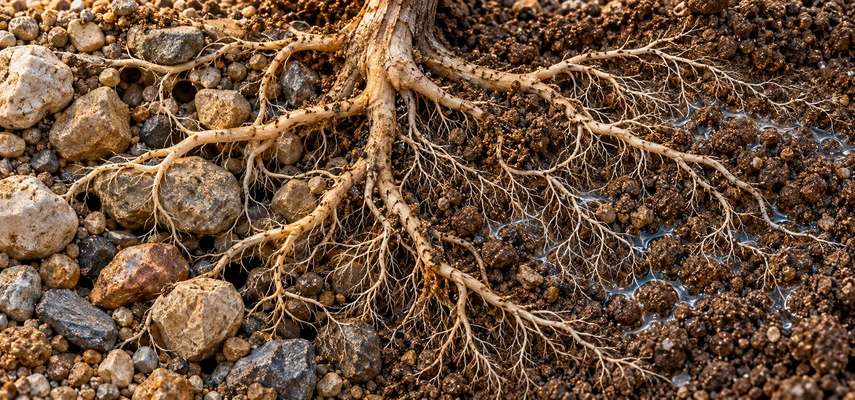

Rain falls across a vineyard, yet some vines soon struggle for water while others stand above saturated roots. The rainfall total is the same. The growing environment is not. Vineyard soil and water interact through storage, drainage, root access and the rate at which the atmosphere draws moisture away.
For a Diploma answer, the name of the soil is a starting clue. “Clay,” “gravel” or “limestone” does not explain the crop until the relevant property is identified. Does it influence available water, aeration, rooting, nutrient uptake or temperature? Then ask how that effect changes vine function and the grapes intended for a particular wine.
The official D1 specification links water and nutrient availability with rainfall, soil and land characteristics, evapotranspiration, soil pH and soil health. This lesson explains those mechanisms. Irrigation methods and nutrition programmes are separate management decisions built on the same foundations.
Vineyard soil and water: read properties before labels
Soil texture describes the relative proportions of sand, silt and clay-sized mineral particles. Structure describes how particles are arranged into aggregates and the spaces between them. Soil depth, stones, organic matter and restrictive layers further influence the environment roots can explore.
Two soils with a similar texture can therefore function differently. Stable aggregation and connected pores may permit infiltration and aeration, while compaction or a restrictive layer can obstruct movement. The surface also may hide a contrasting subsoil. The British Columbia Wine Grape Council’s soil guide describes how subsurface variation can affect water supply and vine growth within a vineyard.
A soil map is useful context, but the question concerns the actual root zone. Depth to a barrier can matter more than the attractive material visible at the surface. A deep profile only provides a large reservoir if roots can explore it and the water held there is accessible.
Drainage is different from having no water
Water enters through infiltration, occupies pores, moves through the profile and may leave the root zone through drainage. Some is retained against gravity. Drainage and retention are therefore complementary properties, not opposite ends of a simple “good soil/bad soil” scale.
Coarse, sandy or gravelly material commonly has lower water storage than a finer-textured profile. However, the amount available to a vine also depends on depth, stone content, structure and root distribution. A rapidly draining shallow soil can become limiting in a dry season. A well-structured finer soil can retain a useful reserve without remaining saturated.
The Council’s soil-management account distinguishes texture, structure and available storage. Avoid translating its regional tables into a universal prescription. The useful comparison is how much usable water the effective root zone can hold under the vineyard’s conditions, not which texture wins a popularity contest.
Available water is a limited part of the reservoir
Field capacity describes the water remaining after a saturated soil has drained under the relevant conditions. The permanent wilting point describes a low-water condition at which plants cannot recover normal turgor. The difference is commonly used to describe available water storage. These are reference concepts, not permission to let vines approach permanent wilting before responding.
Water is held with different strengths in different pores and soils. A profile can contain water that the vine cannot obtain fast enough to meet demand. Roots also cannot exploit water equally throughout every part of the soil volume. The Council’s irrigation guide warns that vine stress can arise well before the permanent wilting point is reached.
For a hypothetical comparison, a shallow stony block and a deeper loam receive the same rainfall. The first may have a smaller usable reservoir and dry down sooner. That does not establish the final wine quality. It identifies a different constraint that should be tested against canopy demand, root access and subsequent weather.
Rainfall must reach the right place at a useful time
Rainfall contributes to supply only when it infiltrates and becomes accessible. Some runs off, evaporates or drains beyond the active roots. The same annual total can therefore support different vine water conditions depending on intensity, timing and the profile’s capacity to store it.
Winter rainfall may recharge a reservoir for later use. Rain during active growth may relieve a deficit, while prolonged wet conditions can create other problems. A brief shower on a hot day need not meaningfully replenish a deep root zone. Evaluate effective rainfall rather than treating every millimetre as an equal addition to a vine’s supply.
Oregon State’s vineyard guidance emphasises soil depth, water-holding capacity and restrictive features. These properties help explain why even a broadly suitable region contains unsuitable or difficult parcels. A region’s climate does not cancel the root zone’s physical limitations.
Evapotranspiration describes the demand side
Evapotranspiration combines evaporation from surfaces with transpiration through plants. Solar energy, air temperature, humidity and wind influence atmospheric demand. Canopy size, ground vegetation and available water influence how that demand translates into actual vineyard water use.
This creates an important distinction between soil moisture and vine water status. A sensor measures a particular part of the soil, while a vine integrates access across its roots against demand from its canopy. A moist reading at one depth cannot, by itself, establish that the whole vine is adequately supplied.
The New South Wales physiological guide to vine water status recommends considering soil and plant information together. It also explains why variety and rootstock responses matter. The same weather and nominal soil moisture need not produce an identical response in every vine.
When stomata close to conserve water, carbon dioxide entry can also decline, limiting photosynthesis. Severe stress can constrain shoot function, berry development or the ability to complete the intended ripening. Conversely, abundant water under some conditions can promote vigorous growth and a shaded canopy. Neither maximum supply nor maximum stress is a sensible universal objective.
Waterlogging: roots need oxygen too
Saturation can replace air in the soil pores and restrict oxygen supply to roots. Roots require oxygen for respiration; prolonged deprivation can impair function and cause damage. A waterlogged vine can consequently struggle with uptake even though the surrounding soil contains abundant water.
The AWRI’s waterlogging factsheet explains how timing, duration, soil drainage and impermeable layers affect the risk. Surface water disappearing does not prove that the root zone has regained suitable aeration. The physiological problem can persist below an apparently improving surface.
This is why wilted or weak growth is not an instruction to add water without diagnosis. Similar visible symptoms can arise from different constraints. The explanatory task is to identify the root environment and mechanism before recommending a response. Detailed hazard management belongs in the weather-hazards lesson.
Nutrients must be accessible, not merely present
Roots absorb nutrients from their surroundings, but total soil content is not the same as availability. Soil chemistry, moisture, aeration, biological processes and root activity influence uptake. A laboratory report showing an element in the soil does not prove that the plant receives enough of it.
Soil pH describes acidity or alkalinity and affects nutrient solubility and biological activity. At unsuitable pH, particular nutrients may become difficult to obtain or other elements may reach harmful availability. The relevant range depends on the soil, rootstock, nutrient and local conditions; one global target would conceal those differences.
Cornell’s vineyard nutrition guidance separates soil conditions from actual vine nutrient status. Its point is useful beyond the particular regional recommendations: moisture and drainage influence whether nutrients reach the root, while tissue information helps reveal what the vine has taken up.
Water shortage can reduce nutrient access or movement, and root damage from poor aeration can impair uptake. This connection explains why simply adding fertiliser may fail to correct a problem whose cause is water or root function. Equally, excess nutrient supply can have undesirable consequences; nutrition should support the intended crop rather than pursue the highest possible input.
Soil health joins physical, chemical and biological function
Soil health concerns the capacity of the soil system to function, rather than the presence of a single fashionable organism or amendment. Physical indicators include structure and infiltration; chemical indicators include pH and nutrient conditions; biological indicators describe living activity and its processes.
The USDA’s soil-health assessment guidance uses those interacting categories. Organic matter can support aggregation, water retention and biological activity, but the desired change should be tied to the starting condition and production goals. More of one indicator does not automatically establish a better overall system.
Healthy roots depend on that functioning environment and also influence it. Compaction, erosion, loss of organic matter or adverse chemistry can change access to water and nutrients. Appropriate management must diagnose which function needs attention. Farming labels alone cannot substitute for evidence of soil performance or grape composition.
Follow the consequences into the wine
The effect on yield per vine depends on when and how strongly a constraint acts. Water availability during early berry development can affect growth and the eventual crop, while later stress can alter ripening or fruit condition. Lower harvested weight is therefore not proof of more concentrated, balanced or higher-quality wine.
Grape component balance, aroma and flavour ripeness require functioning leaves, suitable development and healthy fruit. Conditions that reduce excessive canopy growth may help in one situation, while severe restriction in another can prevent the crop reaching the desired composition. Evaluate the starting vigour and intended style before praising a deficit.
Grapes for sweet wines still need appropriate health and balance. A dehydrated berry may become more concentrated through water loss, but that alone does not establish desirable flavour development or a suitable sweet-wine raw material. The production method and resulting acidity, aroma and fruit condition remain relevant.
Costs follow the same conditional logic. Drainage work, water infrastructure, monitoring, amendments and replacement of damaged vines can add expense. Lost saleable yield can spread costs across fewer grapes. Those pressures influence production economics, but the final price still depends on demand and the market. Soil can help explain cost without independently setting value.
Connect the soil mechanism with irrigation and vine nutrition before choosing a management response. Compare climate and vineyard location and vineyard weather hazards to distinguish long-term conditions from an individual hazard. Then test viticulture approaches against the site constraint, and link harvest decisions with sweet wine production when explaining the intended fruit and wine.
Original Diploma practice and outline answers
These are hypothetical TFE exercises with indicative points, not official examination questions or marking schemes.
Question 1: compare equal rainfall
Two blocks receive equal rainfall. One has a shallow, stony root zone; the other has a deeper, well-structured profile. Explain why their water status may differ and identify evidence needed to evaluate the consequences.
Indicative points: Effective storage; infiltration and drainage; root access; atmospheric demand and canopy; plant status; fruit development rather than automatic quality ranking.
Outline answer: The shallow, stony block may store less usable water and dry down sooner, although actual structure and rooting must be checked. Rainfall may also be lost differently through runoff or drainage. Compare moisture across relevant depths with vine response, canopy demand and fruit development. Equal rainfall does not establish equal supply, and unequal supply does not by itself rank wine quality.
Question 2: diagnose before adding inputs
A vine grows weakly despite moist soil and a soil test showing substantial nutrient content. Explain why extra water or fertiliser may not address the cause.
Indicative points: Moisture can coexist with inadequate aeration; roots need oxygen; total nutrient presence differs from uptake; pH and root health; diagnose with soil and plant evidence.
Outline answer: Saturated or poorly aerated soil can impair root respiration and uptake even where water is abundant. Nutrients may also be unavailable because of chemistry or damaged roots. More water could worsen saturation, while fertiliser would not repair the underlying physical constraint. Investigate drainage, aeration, pH and vine nutrient status before selecting a corrective action.
Question 3: evaluate a stress claim
A producer argues that the driest block must make the highest-quality wine because its berries are smaller. Evaluate the reasoning and explain one possible cost consequence.
Indicative points: Berry size is not full composition; stress timing and severity; photosynthesis and maturity; fruit health and style; saleable yield and costs; market price separate.
Outline answer: Smaller berries may reflect water limitation, but size alone cannot establish useful aroma, acidity or extractable phenolic balance. Severe stress can constrain carbon supply and prevent the intended maturity. Assess the actual grapes and resulting wine rather than assuming a benefit. If saleable yield falls, costs may be spread across fewer units, yet buyers need not pay a higher price.
Read the reservoir and the vine together
For a soil claim, identify the property, its effect on water or nutrients and the vine’s response. Then ask whether that response helps the intended crop. This sequence makes soil and water understandable without turning either drought or fertility into a quality slogan.












