










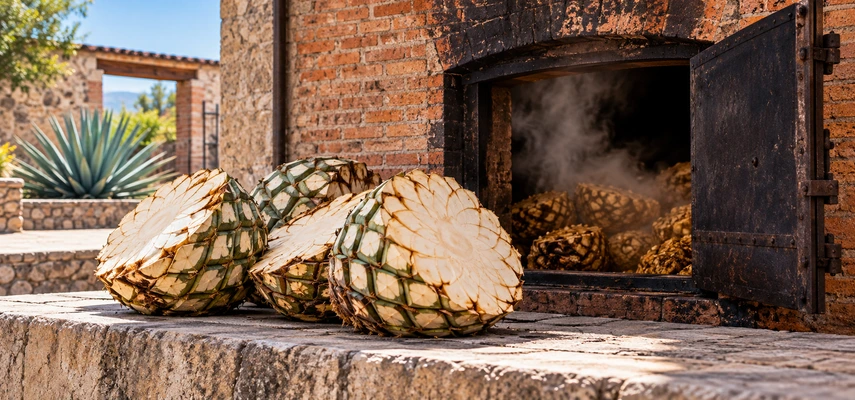

Tequila production begins with a plant whose useful reserves are stored in a heart, not a barrel of ready-made juice. Blue agave needs preparation before yeast can make efficient use of its carbohydrates. Understanding that step makes the rest of the process much less mysterious.
It also stops the label from becoming a guessing game. 100% agave answers a different question from reposado. A gold-coloured tequila is not automatically old, and a clear tequila need not have avoided every moment of wood contact. Read the production and classification information separately before trying to put them together.
This lesson follows agave from harvest through conversion, extraction, fermentation and distillation, then explains what the familiar class names add. The goal is to make the terms useful clues to the liquid rather than an impressive list of Spanish vocabulary.
Tequila production starts with blue agave and a defined place
The relevant plant is Agave tequilana Weber variety azul, commonly called blue agave. Agave is not a cactus, even if the spiky silhouette encourages that shorthand. Nor can any plant called agave automatically replace the permitted blue variety in tequila.
Tequila is a Mexican denomination with a defined production territory. Jalisco is its central reference point, but the territory also includes specified areas of Guanajuato, Michoacán, Nayarit and Tamaulipas. The Tequila Regulatory Council’s origin explanation is more precise than the slogan made anywhere in Mexico.
These are two separate controls: permitted plant and permitted place. A blue-agave spirit made outside the designated territory does not qualify simply because its raw material matches. Equally, being within Jalisco does not turn a spirit from another plant into tequila.
Avoid using either condition as a complete tasting description. The same permitted variety can enter different cooking, fermentation, distillation and maturation routes. Geography and plant identity establish a framework; they leave considerable production work still to do.
Harvesting exposes the piña
At harvest, the long leaves are cut away to reveal the central piña, named for its pineapple-like appearance. The distillery is interested in the carbohydrate-rich material in that heart. The leaves and heart are not interchangeable ingredients simply because they come from one plant.
The piña is commonly cut into pieces for subsequent processing. Size and preparation affect how evenly heat and water can reach the material. A photograph of a pile of harvested hearts therefore shows the beginning of raw-material handling, not a finished fermentable liquid.
Harvest timing and plant condition influence the material available to the producer, but they do not remove the need for carbohydrate conversion. A mature agave is not equivalent to a container of fully fermented alcohol. The stages still have to happen in the right relationship.
Fructans must become fermentable sugars
Agave stores much of its carbohydrate as fructans, chains containing fructose units. Yeast cannot simply treat those reserves as if every unit were already freely available sugar. Hydrolysis breaks the chains into smaller sugars that can be fermented.
In a familiar route, the piña pieces are cooked before extraction. Steam cooking in ovens or pressure vessels helps convert the stored carbohydrates and soften the plant material. This is a different task from cereal malting, where germination develops enzymes for later starch conversion.
Cooking can also affect flavour development. A cooked-agave impression is therefore a useful production association, though the intensity depends on the complete process. Do not assume that every oven, pressure regime or producer produces one identical aroma.
The word roasting is sometimes used broadly in descriptions of agave cooking, but distinguish a steam-cooked tequila route from the direct earth-oven smoke exposure important in many mezcal traditions. Cooking and smoke are related only when the actual method connects them.
Conversion, fermentation and distillation do different jobs
Hydrolysis makes the carbohydrates accessible. Fermentation then uses the sugars to produce alcohol. Distillation subsequently separates and concentrates volatile components. Those are three operations, not three alternative names for the same transformation.
The distinction is useful in an exam question. If the problem asks how fructans become fermentable sugars, yeast turning sugar into ethanol is too late in the chain. If it asks where ethanol originates, the oven is too early. Name the stage that actually performs the task.
Crushing and washing recover the sugary liquid
After cooking, the material can be crushed to release liquid. A tahona, a large stone wheel, is one method; roller mills provide another. Water can flush sugars from the opened fibres into the liquid collected for fermentation.
Patrón’s production guide describes parallel tahona and roller-mill routes, followed by separate fermentation and distillation before blending. This is a useful example of a producer treating extraction choices as flavour choices. It is not a requirement that every tequila must use both methods.
Water addition has a practical purpose in extraction and preparation of the fermenting liquid. It should not be confused with the later dilution of distilled tequila to bottling strength. The same word water can appear at different stages while doing different work.
The fibrous material also creates choices: fermentation with some fibre differs from fermenting separated juice alone. When comparing producer methods, look for the actual handling described rather than assuming all references to agave juice mean exactly the same mixture.
A diffuser can change the order of operations
A diffuser route can begin with shredded raw piña material. Water extracts the carbohydrate-containing liquid from the fibres before the conversion treatment is completed. The extracted liquid is then treated or cooked to hydrolyse fructans before fermentation.
That order matters: traditional cooked-heart extraction is not the only possible sequence. Write raw agave, extraction, conversion of extracted carbohydrates, fermentation when describing the alternative route. Simply adding the word diffuser to a diagram that always cooks whole piñas first misses the distinction.
Academia Patrón describes this reversal, while primary experimental research examines extraction and enzymatic hydrolysis of agave fructans. Different implementations can use different conversion conditions; avoid pretending one photograph reveals all of them.
Extraction efficiency and sensory character are different questions. It is reasonable to discuss how a route changes processing, but the equipment name alone does not supply a complete quality verdict. Fermentation and distillation still have considerable influence afterwards.
Fermentation and distillation shape the spirit
Yeast converts sugars into alcohol while developing aroma compounds. Culture, temperature, duration and the presence or absence of fibre can influence the resulting fermented liquid. Fruity or floral aromas do not require the addition of fruit or flowers.
Distillation then selects from that liquid. Double pot distillation is a familiar production route, and Patrón describes that method for its own spirit. Other equipment arrangements exist; tequila should not be reduced to one universal copper still shape or one producer’s operating recipe.
Cuts and rectification affect the balance between retained agave character, fruity notes and other compounds. More separation can produce a lighter profile, while selection that retains different components can change weight and intensity. Neither maximum aroma nor maximum neutrality is automatically the right objective.
At this point the producer has a distillate to prepare for the intended class. Dilution, permitted finishing, maturation where required and blending then determine the presentation that reaches the bottle. Those later choices explain why agave percentage and age terminology need separate attention.
Tequila and Tequila 100% agave are sugar categories
The official standard distinguishes Tequila 100% agave from Tequila. The former uses only qualifying blue-agave sugars; the latter requires at least 51% of the relevant fermentable sugar contribution from that agave, with other permitted sugars making up the balance.
This concerns the fermentation recipe. It does not mean that a bottle labelled Tequila is 51% tequila mixed afterwards with 49% another finished spirit. The informal word mixto can be encountered in discussion, but it should not replace an accurate explanation of the sugar contribution.
Likewise, 100% agave does not mean 100% alcohol, one distillation or one barrel. It is not, by itself, a guarantee of a particular maturation class or proof of every possible additive-free claim. Ask the label term to answer the question it actually addresses.
Blanco, joven and the ageing classes
Blanco, Plata and Silver identify the familiar clear class, commonly bottled without substantial wood maturation. The framework permits less than two months in qualifying wood, so never write that blanco universally means no wood contact whatsoever.
Joven, Oro and Gold do not establish long ageing. The class can involve blanco combined with aged tequila or permitted mellowing treatment. Colour therefore cannot establish how much time every component spent in a barrel.
For the main maturation ladder, remember Reposado: at least two months; Añejo: at least one year; Extra Añejo: at least three years in the specified oak framework. The latter two also have a 600-litre maximum vessel capacity. The CRT overview reinforces these minimums.
Wood can add vanilla, spice, toast, colour and texture while changing the emphasis of agave-derived aromas. Longer time can increase some effects, but cask activity, previous use and blending matter as well. More brown colour is not a universally reliable measure of either age or quality.
What to remember
Tequila connects blue agave with a defined Mexican territory, particularly Jalisco. Fructans need conversion before fermentation; cooked-heart extraction and a raw-material diffuser route can arrange those steps differently. Yeast produces the alcohol, and distillation shapes the retained character.
Read sugar category and maturation class independently. Tequila 100% agave can be blanco or aged; gold does not promise long maturation. The useful age sequence is reposado two months, añejo one year and extra añejo three years, with the relevant conditions kept attached.
Continue your study
To revisit fructan conversion, read How Spirits Begin: Raw Materials, Sugar Conversion, and Fermentation. To compare Mezcal’s agaves and production categories, read Mezcal Explained: Agave Varieties, Production Methods, and Mexican Traditions. To separate agave character from oak influence, read How to Taste and Compare Spirits: A WSET Level 2 Revision Guide.
Knowledge check: 10 original practice questions
Independent TFE questions, not official WSET examination items. Choose one answer per question; explanations follow separately.
1. Which statement about blanco is most precise?
- It must be at least one year old
- It must always have no wood contact
- It always contains other fermentation sugars
- It can have less than two months in qualifying wood
2. What does Tequila 100% agave primarily describe?
- One compulsory still design
- A guaranteed ten-year age
- The qualifying sugar source used for fermentation
- A 100% ABV bottling
3. What is the purpose of hydrolysing agave fructans?
- To make fermentable sugars available
- To remove all water from tequila
- To distil ethanol directly
- To add oak colour
4. Which minimum-age sequence is correct?
- Blanco ten years, reposado twenty years
- Reposado two months, añejo one year, extra añejo three years
- Reposado one year, añejo two months, extra añejo two years
- Every class requires three years
5. Why is Jalisco important but not a complete origin statement?
- The plant need not be blue agave there
- Tequila can be made only in one town
- All Mexico is automatically permitted
- Other specified areas also belong to the tequila territory
6. Why can water be applied during milling?
- To wash sugars from opened fibres
- To age the spirit
- To create alcohol without yeast
- To turn all agave into starch
7. Why is gold colour insufficient proof of long tequila maturation?
- Wood has no effect on tequila
- Caramel can never affect any spirit colour
- Joven or oro does not guarantee long wood ageing
- All gold tequila is at least ten years old
8. Which plant is the permitted agave reference for tequila?
- Agave tequilana Weber variety azul
- Any agave species without restriction
- Sugar cane
- Any cactus
9. Which statement about the Tequila category with other permitted sugars is correct?
- It is made by blending 51% tequila with any other spirit
- It must be extra añejo
- It contains no agave
- At least 51% of the relevant sugar contribution must come from qualifying blue agave
10. Which sequence can describe a raw-agave diffuser route?
- Ferment whole leaves, then harvest
- Bottle, hydrolyse, then distil the bottle
- Extract carbohydrate liquid, hydrolyse, ferment
- Age raw agave in oak for three years
Answers and explanations
1. D — It can have less than two months in qualifying wood. The class does not universally rule out brief wood contact, and it is independent of the agave sugar category. Mapping: LO2.
2. C — The qualifying sugar source used for fermentation. It identifies agave-only sugar sourcing within the category, rather than alcoholic strength or maturation class. Mapping: LO2.
3. A — To make fermentable sugars available. Hydrolysis breaks carbohydrate chains into sugars; fermentation then uses those sugars to make alcohol. Mapping: LO2.
4. B — Reposado two months, añejo one year, extra añejo three years. The three minimums form the useful tequila maturation ladder, with the specified wood and vessel conditions. Mapping: LO2.
5. D — Other specified areas also belong to the tequila territory. The denomination includes Jalisco and specified areas in four other Mexican states. Mapping: LO2.
6. A — To wash sugars from opened fibres. Water helps recover sugars during extraction, a different task from later adjustment to bottling strength. Mapping: LO2.
7. C — Joven or oro does not guarantee long wood ageing. The joven/oro class may reflect blending or permitted treatment, so appearance alone cannot establish age. Mapping: LO2.
8. A — Agave tequilana Weber variety azul. The blue variety of Agave tequilana is the relevant raw-material identity, within the specified origin framework. Mapping: LO2.
9. D — At least 51% of the relevant sugar contribution must come from qualifying blue agave. The percentage concerns sugars in the fermentation formulation, not a simple blend of finished spirits. Mapping: LO2.
10. C — Extract carbohydrate liquid, hydrolyse, ferment. A diffuser can extract from raw material before the extracted liquid undergoes conversion and fermentation. Mapping: LO2.











