










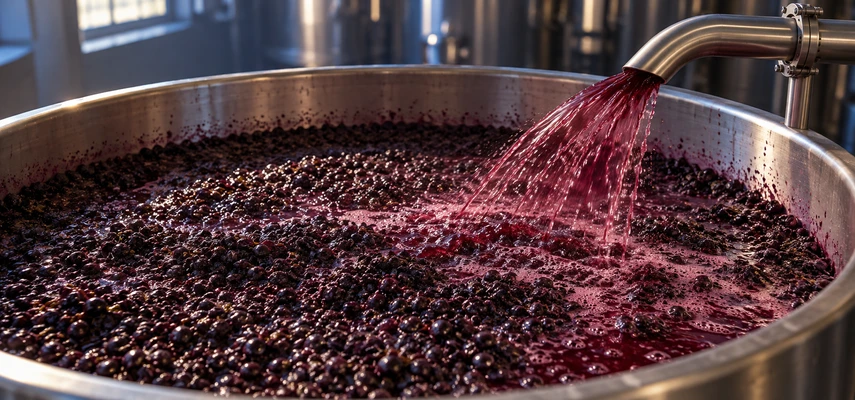

A dark red ferment can look impressive long before it tastes balanced. Colour enters the liquid relatively quickly, while the amount and character of tannin follow a different path. Red winemaking therefore involves deciding what to extract, how to manage fermentation and when further contact is no longer helping.
The aim is not to empty every skin and seed of everything it contains. A light, perfumed red and a structured wine intended for maturation can justify different decisions from similar equipment. Fruit composition sets the possibilities; processing selects and transforms them. More extraction is a description of an operation, not a synonym for better wine.
The official D1 specification includes temperature, vessel, yeast, extraction, whole-fruit methods and post-fermentation decisions. The useful thread is the relationship between grape solids and a liquid whose temperature, alcohol and microbial activity change throughout production.
Red winemaking separates colour from the idea of strength
Anthocyanins contribute colour in many red grapes, while tannins influence astringency and other aspects of structure. Skins, seeds and any included stems provide different sources of phenolic material. Their presence in the grapes does not mean that identical proportions will appear in the finished wine.
Extraction depends on time, temperature, the medium and physical contact. As fermentation proceeds, increasing ethanol changes the conditions. Extracted compounds can also react, bind or be retained by solids. The final concentration is therefore the result of movement and transformation, not just a running total of material released.
Consider two wines of similar colour. They may differ substantially in tannin concentration, texture, acidity and aroma. Likewise, a pale variety need not produce a wine without structure or ageing potential. Sensory assessment and appropriate measurements provide a better basis for decisions than looking through the sampling glass alone.
Begin with the desired style and the fruit’s condition. Healthy, suitably mature material offers different options from damaged fruit or grapes with unwanted flavours. Aggressive extraction cannot manufacture desirable maturity. It may instead make an existing problem more prominent and harder to manage later.
Fermentation needs a viable yeast plan
Selected yeast cultures can provide useful performance characteristics, while spontaneous fermentation depends on populations associated with fruit and winery. Each approach still needs suitable conditions and monitoring. AWRI’s yeast-choice resource links strain choice, nutrition and fermentation behaviour without establishing a universal quality winner.
Track sugar consumption and temperature rather than relying on a lively-looking surface. The ferment’s initial sugar, nutrient status and inhibitors affect progress. A highly extractive plan is of limited value if the alcoholic fermentation stops before the intended endpoint. Technical control and stylistic ambition have to coexist.
Co-fermentation means different grape varieties or lots ferment together. Their constituents interact during production, and their harvest timing must permit the intended combination. This differs from blending finished wines, where the producer can assess separate components before choosing proportions. Earlier combination can create possibilities while surrendering some later flexibility.
Must concentration changes the balance of starting material. Saignée removes a portion of juice, increasing the solids-to-liquid ratio remaining in the red ferment. AWRI’s saignée account explains the possible concentration effect. The removed juice can have another use, but the red wine’s useful yield and the value of both products must be evaluated.
Temperature and vessel shape the working environment
Warmer conditions can accelerate extraction, but not every phenolic responds identically. AWRI’s fermentation-temperature review distinguishes the timing of colour and tannin extraction. Increasing temperature can change rates without necessarily producing the same proportional change in final concentrations.
Fermentation itself releases heat. A vigorous ferment can demand substantial cooling, and extreme or unsuitable conditions can impair yeast performance. Large vessels may contain different conditions in different places, so a single convenient reading needs interpretation. The cap and the liquid are connected but not necessarily uniform.
Vessel choice affects access, heat management and the practical range of operations. Open-top vessels can permit direct cap work; closed tanks provide different possibilities for pumping and protection. Wood, steel and other materials also differ in cleaning, handling and capital requirements. The appropriate comparison concerns the actual vessel and operation.
For example, a small producer may manage individual lots selectively but spend more labour per unit of wine. A larger winery may automate operations and need reliable throughput. Neither scale proves the style or quality. Ask whether the available control matches the fruit, production volume and intended extraction.
Cap management controls contact and distribution
Fermentation gas lifts grape solids into a floating cap. Cap management wets or mixes those solids with liquid, influencing extraction, temperature distribution and exposure. It is also part of managing the surface environment. Leaving the cap untouched is a decision with consequences rather than the absence of a production method.
Punching down, or pigeage, pushes cap material into the liquid. Pumping over, or remontage, draws liquid from below and returns it across the cap. Rack and return, or délestage, temporarily separates liquid into another vessel and returns it to the solids. AWRI’s cap-management guide describes these distinct movements.
Their effects depend on intensity, frequency, equipment and stage. Pumping can be gentle or abrasive; a punch-down programme can be restrained or vigorous. Counting operations without describing how they were performed conceals important differences. Rack and return also requires spare capacity and additional movement, which can be a significant operational cost.
A fixed programme may be easy to organise, but fruit and fermentation change. Reassess the intended balance of extraction, mixing and exposure as the ferment develops. The relevant measure is the resulting condition and wine, not whether every tank received the same number of interventions.
Whole berries and whole bunches are different choices
Whole berry fermentation retains some intact berries after destemming or gentle handling. Whole bunch additions retain stems with the fruit. A mixed ferment may include both intact and crushed material. These descriptions identify the starting structure rather than a single guaranteed aroma profile.
Stems can contribute compounds and change the physical arrangement, drainage and handling of the solids. They can also introduce unwanted herbal character or astringency. AWRI’s whole-bunch discussion explains why proportion, placement and handling affect results. A whole-bunch percentage is not a complete specification.
Intact berries also complicate sampling. Juice outside them may not represent sugar still retained inside, and pressing can release fermentable material later. Check progress after separation rather than assuming that the apparently dry surrounding liquid establishes completion of the entire lot.
Evaluate whole-fruit choices with the intended style, fruit condition and practical handling in mind. Adding stems because another producer obtained a desirable perfume does not establish that this fruit will respond similarly. A small, well-designed comparison can be more informative than a dramatic change across the whole harvest.
Carbonic and semi-carbonic maceration have distinct mechanisms
Carbonic maceration uses intact berries in an oxygen-excluding atmosphere to support intracellular activity. Some sugar and malic acid are metabolised within the berry, producing a limited amount of ethanol and changing aroma-related constituents. Conventional yeast fermentation is still needed to complete production; the intracellular stage does not convert all grape sugar into finished wine.
Semi-carbonic maceration combines activity in intact fruit with yeast fermentation in juice released from some berries. Fermentation-derived carbon dioxide helps create conditions for the intact portion. It differs from deliberately establishing the full carbonic treatment, although real production routes can include mixtures of mechanisms.
AWRI’s carbonic-maceration resource distinguishes these routes from simply including some whole bunches. The techniques can support pronounced fruit and perfume, but do not guarantee a particular quality level. Their effect depends on material, proportion, duration and the subsequent process.
For Diploma comparison, state which material remains intact, how the atmosphere develops and where yeast fermentation occurs. That explains the mechanism more clearly than memorising a list of fruit aromas. It also prevents confusing a fermentation method with the grape variety or region where it is commonly used.
Post-fermentation extraction requires another decision
Post-fermentation extraction continues contact between wine and solids after alcoholic fermentation. Extended maceration can change tannin and other constituents, sometimes substantially. Its usefulness depends on the starting phenolics, extractability, time and conditions; a longer period does not have one predictable sensory effect.
AWRI’s extended-maceration account emphasises that no universal duration is appropriate. Potential drawbacks include excessive bitterness or astringency, spoilage and prolonged occupation of the fermenter. Sampling a heterogeneous tank can also make interpretation difficult.
Compare pressing at the intended endpoint with continued contact. A producer must consider the sensory objective, fruit health, ability to protect the wine and the next loads requiring that tank. A treatment offering a small possible benefit can be commercially unattractive if it blocks scarce harvest capacity.
Pressing preserves or closes blending options
Pressing separates wine from skins, seeds and any stems. Free-run wine and successive press fractions can differ in composition and texture. Keep them separate where useful and practical, then assess blending. The most forcefully recovered fraction may need a different role rather than automatic addition or automatic rejection.
Press timing can occur before, at or after alcoholic fermentation completion, depending on the route. If sugar remains, provide suitable conditions for fermentation to continue after separation. Moving wine out of the fermenter does not itself complete the biological work.
Record recovery alongside the quality of each fraction. Additional volume can improve utilisation or dilute the intended balance. The sensible endpoint reflects what the wine needs and what the fractions contribute, rather than a principle that every possible litre must be recovered into the same product.
Plan malolactic conversion and the next stage
MLF encouragement is common in red winemaking because bacterial conversion of malic acid can affect balance and reduce the risk of unwanted later malic metabolism. It is separate from alcoholic fermentation. AWRI’s red-wine MLF fact sheet explains the interacting effects of alcohol, pH, temperature and sulfur dioxide on success.
Culture choice and timing need to fit those conditions and the yeast involved. Completion should be checked rather than inferred from elapsed time or a previous season. Extended maceration is not proof that MLF has finished; a challenging wine can still require investigation and management.
MLF avoidance, where stylistically intended, requires ongoing control rather than simply declining to inoculate. Retained malic acid remains a possible substrate for later activity. Assess hygiene, protection and suitable stabilisation as part of the route, with the desired final acidity and flavour clearly defined.
The finished structure emerges from all these decisions together. Fruit, temperature, extraction, intact material, press fractions and bacterial conversion interact. A convincing red-winemaking recommendation identifies which problem a change addresses and tests whether it improves the wine at an acceptable cost.
Connect this explanation with rosé winemaking and white winemaking as linked parts of the same explanation. Trace the relevant growing or cellar decision through to its consequences, and identify the condition that could change the result rather than treating the relationship as automatic.
Original Diploma practice
These original exercises are not official WSET questions and have no official mark allocations.
Question 1: evaluate a stronger extraction programme
A pale red ferment is given warmer temperatures and more vigorous cap work to make it better. Evaluate the reasoning.
Indicative answer points: colour versus tannin; grape potential; style target; temperature and yeast; cap intensity; sensory monitoring; no universal darkness-quality link.
Outline answer: Pale colour alone does not establish insufficient structure or poor quality. More heat and physical work can change extraction rates and the balance of phenolics, potentially increasing unwanted tannin as well as useful components. Check variety, fruit condition, existing texture and the intended style before changing the programme. Monitor actual fermentation conditions and sensory development. The recommendation needs a desired compositional or sensory outcome, not merely a darker appearance.
Question 2: compare whole-bunch and carbonic routes
Explain why adding some whole bunches to crushed fruit is not equivalent to a fully carbonic treatment.
Indicative answer points: intact berries versus stems; released juice; oxygen-excluding conditions; intracellular activity; yeast fermentation; proportion and handling; sensory uncertainty.
Outline answer: Whole bunches introduce intact fruit and stems into a mixture that may already contain substantial fermenting juice. Some intracellular activity can occur, but its extent depends on conditions and how long berries remain intact. A carbonic route deliberately establishes an oxygen-excluding environment for intact berries, followed by conventional fermentation to complete production. Compare mechanisms, not just the presence of bunches. The same nominal bunch percentage cannot guarantee an equivalent aroma or tannin outcome.
Question 3: decide when to press
A structured wine has completed alcoholic fermentation while another harvest load needs the tank. Evaluate extended maceration versus pressing now.
Indicative answer points: desired tannin change; fruit and wine condition; no fixed ideal duration; protection and sampling; tank opportunity cost; fraction separation; MLF verification.
Outline answer: Further contact may alter the phenolic profile, but the current wine must offer a reason to expect a useful change. Assess its condition, available protection and the difficulty of representative sampling. Compare that possible benefit with spoilage risk and the need for fermenter capacity. Pressing now can retain separate fractions for blending, while extended contact delays the next use. Verify MLF separately; completion of alcoholic fermentation or an extended waiting period does not establish bacterial completion.












