










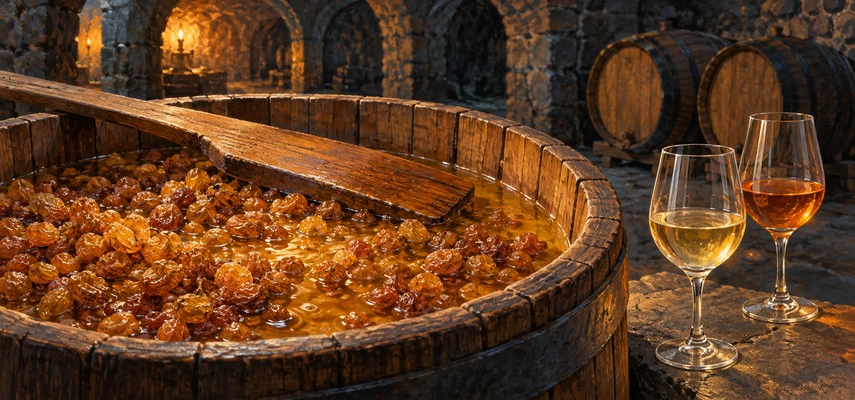

Tokaj’s most useful surprise may be a dry wine. The region’s fame rests on extraordinary sweet wines, yet a dry Furmint reveals how much of the story begins before sugar becomes the obvious subject. Acidity, fruit, texture and site still matter when the palate isn’t sweet.
For Diploma study, connect three decisions: what fruit the vineyard produces, which berries the grower selects, and how the cellar extracts and ferments that material. Aszú isn’t simply ordinary white wine left on the vine for longer. Its selective harvest and distinctive maceration create a different production route, with consequences for style, quality, quantity and price.
Locate Tokaj before interpreting the mist
Tokaj lies in northeastern Hungary around the foothills of the Zemplén Mountains and the Bodrog and Tisza river setting. The regional council’s location account places the vineyards within that landscape. Tokaj names the region; Tokaji is the adjectival form commonly encountered on its wines. A bottle still needs a style description before its sweetness is clear.
Temperature affects growth, ripening and acid retention. Sunlight supports photosynthesis and helps determine bunch conditions. The regional climate account describes continental conditions and the interaction of autumn humidity with subsequent drying. River influence contributes to the opportunity for noble rot, but proximity to water doesn’t guarantee suitable fruit every year.
Water availability depends on rainfall, soil depth, rooting and drainage. Nutrient availability influences vigour, leaf function and crop balance. The regional soil account describes volcanic parent materials and varied weathered soils, with loess also relevant. Their physical effects help explain vineyard performance; volcanic rock doesn’t travel into the glass as a ready-made smoky flavour.
Give Furmint and its neighbours different jobs
Furmint is central to Tokaj, with acidity and an ability to develop suitable concentrated fruit under favourable conditions. It can also produce dry wines with citrus, orchard-fruit or riper character, depending on maturity and production. Don’t assume the variety itself determines a sweet finish.
The regional grape account distinguishes Furmint, Hárslevelű, Sárgamuskotály, Kövérszőlő, Zéta and Kabar. Hárslevelű can bring a more fragrant character to a blend, while Sárgamuskotály is Muscat Blanc à Petits Grains. The other varieties add different ripening and blending possibilities. A grape’s presence on the permitted list doesn’t require every producer to use it.
Compare two fictional Furmint parcels intended for different programmes. One supplies healthy grapes for a dry wine; the other may produce selected aszú berries if the autumn cooperates. The grower needs different harvest decisions, but neither parcel benefits from uncontrolled destructive rot. Suitability for noble rot is a potential that has to be managed, not an instruction to abandon fruit health.
Distinguish noble rot from a ruined harvest
Weather brings frost, hail, heat, drought and harvest-rain risks. Downy and powdery mildew and bunch rot require monitoring. For noble rot, suitable ripe berries and alternating conditions can encourage concentration and characteristic development. Persistent wetness can instead favour destructive rot, splitting or dilution. A foggy postcard isn’t a vintage report.
Vineyard establishment considers exposure, access, training, drainage and the intended production. Planting materials should suit variety, vigour, soil and water conditions. Nutrient and water management follows observation and analysis within applicable rules. Canopy management balances productive leaf area, airflow and bunch protection; excessive shade can retain moisture, while severe exposure can damage fruit during heat.
Harvest timing balances flavour, sugar, acidity, health and style. Hazard management includes erosion control, maintaining access and appropriate frost precautions. Pest and disease management combines monitoring, canopy decisions and justified interventions. A dry-wine harvest may need to proceed while other fruit remains for selection. Waiting for the richest possible berries creates an opportunity cost if weather then destroys them.
The council’s account of Aszú in the cellar begins with repeated vineyard passes and individual berry selection. Different berries become ready at different times. That repeated work and the proportion rejected help explain cost more precisely than calling the wine rare and leaving the matter there.
Follow the separate dry-wine route
Winemaking approaches begin with the intended style. For dry Furmint, careful grape transportation limits crushing, heating and oxidation. Reception should separate origin, maturity and health. Processing and pressing affect juice yield, phenolics and the fractions available for different wines. A broader press fraction may add texture or unwanted bitterness, depending on the material and its use.
Pre-fermentation clarification adjusts solids for the intended fermentation. Must adjustments require analysis and permission under the relevant category. Alcoholic fermentation choices include yeast, nutrition, temperature and vessel. Tank can help preserve a particular youthful profile; wood can provide another fermentation or maturation environment. Neither vessel guarantees complexity.
Malolactic conversion may be avoided when preserving acidity is desirable. Lees maturation can add texture without obvious new-oak flavour. Blending eligible lots can balance acidity, concentration and aromatic character while preserving a valid claim. A dry wine’s structure should work with its fruit; high acidity on its own isn’t evidence of greatness or longevity.
Explain Aszú through maceration
Selected aszú berries contain relatively little readily recoverable liquid, so simply treating them like ordinary juicy grapes misses the method. They are soaked in suitable same-vintage must, fermenting material or wine, followed by pressing and further fermentation as appropriate. Choice of liquid, berry condition, contact and pressing influence extraction and the final balance.
The Disznókő production explanation describes decisions about maceration medium and duration, followed by pressing, fermentation, maturation and blending. This is one producer’s practice, not a compulsory recipe for every estate. It illustrates why two wines with the same sweetness designation can differ in texture, freshness and flavour development.
Extraction and pressing should recover desirable material without unnecessary harshness. Seed damage and overly forceful treatment can add unwanted phenolics. High sugar and the changing must environment challenge fermentation, making yeast performance and monitoring important. Sweetness is the intended result of concentrated grapes and controlled production, rather than proof that fermentation was careless.
The current ministry-published specification requires Aszú to contain at least 120 g/L residual sugar and undergo at least 18 months in wooden cask. That minimum isn’t a command to use new oak or an assurance that every wine has integrated its wood. Maturation needs to support the actual fruit, acidity and concentration.
Read puttonyos without counting modern baskets
Historically, puttony baskets measured the selected berries added to a barrel quantity. The producer’s explanation of puttonyos distinguishes that history from modern labelling, where the numerical term isn’t mandatory for Aszú. Five- and six-puttonyos names remain familiar, but the label isn’t a photograph of baskets tipped into a particular modern tank.
A 2025 Hungarian wine summit presentation contrasts the pre-2013 categories with the modern framework. Six puttonyos has a 150 g/L minimum, while the modern Aszú baseline is 120 g/L. Older three- and four-puttonyos bottles belong to their historical rules. Don’t present those categories as the current entry levels for newly made Aszú.
More residual sugar doesn’t automatically make a wine better. Compare concentration, acidity, complexity, integration and persistence. A sweeter wine can feel surprisingly energetic, while another may feel heavy despite meeting the same legal category. Sugar is useful analytical information; it isn’t an answer to the whole tasting question.
Separate Eszencia and Szamorodni from Aszú
Eszencia comes from the extraordinarily concentrated liquid that drains from selected berries under their own weight, followed by limited fermentation. The regional wine-style guide explains that distinct route and a minimum 450 g/L residual sugar. It isn’t simply six-puttonyos Aszú with more baskets added, nor the historical Aszúeszencia category under another spelling.
Szamorodni processes bunches containing a mixture of healthy and botrytised berries, rather than individually selecting every aszú berry for the same separate maceration route. It may be dry or sweet. The dry style’s maturation can involve a yeast film and a savoury, nutty direction; sweet examples retain a different balance. Don’t assume every dry Tokaj is dry Szamorodni.
For wines from grapes harvested after 1 August 2025, the ministry’s specification sets dry Szamorodni’s wooden-cask minimum at 24 months and sweet Szamorodni’s sugar minimum at 60 g/L. Older regional web summaries may still show six months or 45 g/L respectively. Use the applicable vintage document. The council’s document list also labels its eleventh-version proposal as a draft; a proposal shouldn’t silently replace operative rules.
Protect both freshness and intended development
Post-fermentation clarification removes unwanted suspended material. Stabilisation considers protein, tartrate and microbial risks as appropriate. Finishing adjustments, sulfur dioxide and filtration should suit analysis, retained sugar and distribution. Aszú’s legal restrictions include no enrichment, sweetening or acid adjustment, so a generic cellar option isn’t automatically available to this category.
Packaging and closures should protect the intended wine and development period. Wine transportation requires suitable temperature and handling. Sweetness and concentration don’t make a bottle immune to heat or oxidation. Before claiming ageing potential, examine whether the wine has sufficient fruit and structural balance to develop positively rather than merely survive.
International and EU protection frameworks, national Hungarian law and local Tokaj specifications interact. A geographical indication ties origin to production conditions. Tokaj is a PDO; PGI wines and wines without GI make different claims and cannot borrow its protected identity by growing Furmint elsewhere. Industry associations and the regional council communicate and administer relevant work within their roles, rather than making every promotional description a legal requirement.
Connect selective harvest with the business
Supply depends on crop, suitable botrytised fruit, selection and the allocation between dry and sweet programmes. Demand differs between dry Furmint, accessible sweeter styles and expensive Aszú or Eszencia. Costs include vineyard passes, low recovery, cellar work, maturation and inventory. More grapes in the vineyard don’t guarantee more saleable Aszú.
Legislation affects production, claims and destination compliance. Currency exchange changes an importer’s landed cost without changing wine quality. Importing adds freight and intermediary costs. Retail needs clear style and sweetness information; HoReCa buyers need staff education and useful serving contexts. Direct-to-consumer sales can retain revenue but require hospitality and fulfilment. Mature and emerging markets contain varied customers rather than one universal demand for dessert wine.
A grower may supply fruit, an estate can coordinate vineyard and cellar, and a winery provides production capacity. A merchant sources wine or grapes; a broker connects parties without necessarily owning stock. A virtual winery contracts production under its brand, while a custom crush facility provides agreed services. These models clarify responsibility rather than claiming every arrangement is equally common in Tokaj.
A cooperative can pool resources; a conglomerate may coordinate several businesses and channels. Selection standards, contracts and stock risk matter more than a simple small-versus-large quality assumption. Wine brands can lead with place, producer, variety or style, but the promise needs to match the bottle.
Marketing concepts begin with a defined customer and useful proposition. Marketing options include dry-versus-sweet comparisons, estate visits, restaurant training and clear digital information. The five Ps connect product, price, place, people and promotion. Teaching buyers that Tokaj can be dry may open a different occasion; it doesn’t require diminishing the sweet wines that made the region famous.
Compare the evidence here with Greece as a regional case, then apply the regional comparison framework to the comparison. Compare growing conditions, production decisions, style, quality and the commercial reasons for price. Establish the differences rather than assuming that one familiar name must be better.
Original Diploma practice
These original questions and indicative points are teaching material, not official WSET questions or marking allocations.
Question 1: explain the cost of selection
A fictional grower records a healthy total crop but a small quantity of suitable aszú berries. Explain why Aszú supply and cost may differ from the headline harvest volume.
Indicative points: weather, maturity, noble versus destructive rot, selection, recovery and inventory.
Outline answer: Total grapes aren’t equivalent to suitable selected berries. Repeated passes and rejected material add labour; poor concentration conditions can restrict supply even when dry-wine fruit is available. Maceration, pressing, fermentation and cask maturation add work and stockholding. Evaluate realistic revenue rather than assuming scarcity covers any cost.
Question 2: evaluate a sugar ranking
A buyer rates a fictional six-puttonyos wine above every five-puttonyos wine without tasting either. Evaluate the approach.
Indicative points: category, actual sweetness, acidity, fruit, complexity, finish and ageing.
Outline answer: The number provides a concentration-related labelling cue, not a complete quality conclusion. Assess integration, concentration, complexity and desirable persistence in each glass. Ageing needs separate evidence of remaining fruit and structural support. More sugar can contribute richness without establishing better balance or longer positive development.
Question 3: update a vintage-specific rule
A retailer applies an older sweet Szamorodni sugar minimum to a wine made from grapes harvested after August 2025. Explain the verification needed.
Indicative points: vintage, operative specification, current threshold, older summaries and draft proposals.
Outline answer: Match the harvest to the ministry-published document and check its category conditions. The relevant specification uses a 60 g/L minimum for sweet Szamorodni. Don’t substitute an older web summary or treat a later draft proposal as adopted law. Label eligibility and sensory quality remain separate assessments.
Analytical tasting preparation: compare dry Tokaji and Aszú
The official Diploma specification, PDF page 26, requires a good or very good dry or medium Tokaji and a very good or outstanding Tokaji Aszú. Propose suitable examples of those two categories; Eszencia isn’t a compulsory substitute. These are study selections, not wines tasted here, automatic grades or examination predictions.
Write full systematic descriptions before revealing identity. Compare sweetness, acidity, alcohol, body, aroma, development and finish. Justify quality through balance, concentration, complexity and desirable persistence. Assess bottle-ageing suitability separately through retained fruit, structure and development. Explain the difference between dry and sweet through production evidence, without deciding that the sweeter glass must win.












