










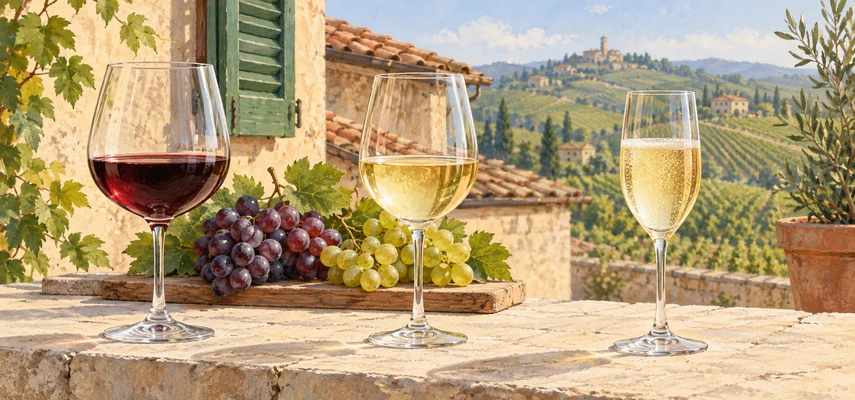

Piemonte’s wine story doesn’t end when the Nebbiolo glasses leave the table. Barbera can bring colour and brisk acidity without Nebbiolo’s tannic weight. Dolcetto can taste decisively dry despite its sweet-sounding name. Cortese, Arneis and Moscato then change the conversation again.
For Diploma study, this wider region offers useful contrasts in grape composition, harvest timing, production and business. Start with the intended wine rather than treating every variety as a cheaper route to Barolo. A fresh Gavi, a structured Barbera and a lightly sparkling sweet Moscato solve different problems, and each needs its own quality assessment.
Find several Piemontes within the regional map
Piemonte lies in northwestern Italy, with important vineyards across the Langhe, Roero, Monferrato, Asti area, southeastern Gavi district and northern wine areas. The Langhe’s hill settings aren’t a climate or soil template for every part of the region. The Langhe consorzio’s directory places Dolcetto, Barbera, Nebbiolo and other wines alongside its celebrated appellations.
The Gavi consorzio identifies eleven communes wholly or partly within its Alessandria production area. Cortese is its white-grape reference. The Roero consorzio distinguishes Nebbiolo-based red Roero from white Roero Arneis; the two names shouldn’t be collapsed into a single white-wine identity.
Farther north, the Nebbioli Alto Piemonte consorzio represents Gattinara, Ghemme and other appellations. These provide another Nebbiolo context, with separate origin and production conditions. A familiar grape doesn’t turn every northern wine into Barolo made somewhere else.
Compare Barbera with Dolcetto before reaching for oak
Barbera is important across Piemonte, with Barbera d’Asti and Barbera d’Alba among the familiar names. The Monferrato consorzio’s grape account highlights considerable acidity and colour with relatively little grape tannin. That combination can support both fresh wines and more ambitious maturation programmes. Dark colour doesn’t prove a high-tannin palate.
Nizza is a distinct DOCG identity based on Barbera, rather than merely a producer’s name for any reserve Barbera. The Nizza producers’ association explains its varietal focus and maturation ambition. The category provides a useful serious-Barbera comparison, but its prestige doesn’t establish that every example is better balanced than every simpler release.
Dolcetto commonly ripens earlier than Nebbiolo and can provide a dry wine with moderate acidity, dark fruit and a distinctly different tannin balance. The Langhe grape account explicitly separates the sweetness of its grapes from the dry wine. Dolcetto d’Alba, Dogliani and Diano d’Alba offer different appellation contexts. Don’t treat every Dolcetto as either sweet or incapable of development.
Imagine a fictional winery receiving healthy Barbera and Dolcetto on different days. Copying one extraction programme across both can ignore acidity, tannin, concentration and intended release. A relatively low-tannin variety doesn’t need new oak simply to make it more serious; the final wine needs integration rather than a borrowed Nebbiolo silhouette.
Give Cortese and Arneis their own white-wine targets
Gavi or Cortese di Gavi is associated with Cortese and can offer citrus, orchard-fruit and floral character with freshness. The appellation specification provides its production framework. Still wine is an important reference, but the appellation also contains other types; Gavi doesn’t automatically mean one vessel, release date or drinking window.
Roero Arneis can offer a different aromatic and textural balance. The regional consorzio distinguishes it from red Roero and recognises several styles, including Riserva and sparkling Arneis. Neither white variety should be judged on whether it reproduces the perfume of Moscato. Restrained aroma can coexist with concentration, persistence and a complete palate.
For a fresh white, careful pressing and protection of aroma may matter more than obvious oak flavour. A more concentrated lot may support greater texture or maturation. Decide from the material and intended result rather than assuming every regional white must be released immediately or every expensive white must have spent time in new wood.
Understand Moscato as controlled sweetness
Moscato Bianco gives Piemonte an aromatic pathway, with floral, grape and fruit character that differs from the region’s still whites. The Asti consorzio’s production explanation describes Moscato d’Asti’s partial fermentation in pressure tanks and the role of chilling and subsequent stabilisation. Its sweetness and modest alcohol are deliberate production outcomes.
Moscato d’Asti isn’t simply Asti Spumante under a longer name. The consorzio-hosted specification distinguishes categories, including Moscato d’Asti’s 4.5–6.5% actual alcohol and pressure ceiling of 2.5 bar. Asti’s permitted style range is broader than an assumption that every bottle must have identical sweetness.
Canelli now has its own DOCG framework. The official specification hosted by the consorzio records its 2023 recognition and Moscato Bianco basis. Older charts that show Canelli only as a Moscato d’Asti subzone need vintage-aware reading. A separate name changes the regulated claim; it doesn’t remove the need to taste the wine.
Match growing conditions to a varied harvest
Temperature affects growth, ripening and acid retention. Sunlight supports photosynthesis and influences bunch conditions. Water availability depends on rainfall, rooting, soil depth and drainage; nutrient availability influences vigour and crop balance. Apply these mechanisms to the actual Langhe, Roero, Monferrato, Gavi or northern parcel rather than assigning one soil and climate to all Piemonte.
Weather brings frost, hail, heat, drought and harvest rain. Downy and powdery mildew and bunch rot require monitoring. Earlier-ripening Dolcetto and later-ripening Nebbiolo can face different harvest windows; Barbera and aromatic whites add their own priorities. A sensible schedule follows actual maturity and health rather than a fixed order copied from last year.
Vineyard establishment considers exposure, access, drainage, row arrangement and training. Planting materials should match variety, vigour, soil and water conditions. Nutrient and water management follows observation and analysis within applicable rules. Canopy management balances productive leaf area, airflow and bunch protection; too much shade can delay maturity, while excessive exposure can increase heat damage.
Harvest timing balances flavour, sugar, acidity, health and style. Hazard management includes erosion control, maintaining access and appropriate frost precautions. Pest and disease management combines monitoring, canopy work and justified interventions. A fresh aromatic wine and a structured red may require different maturity targets even when fruit comes from the same business.
Follow the white-wine process as carefully as the red
Winemaking approaches range from fresh whites and early-drinking reds to concentrated, matured wines and aromatic sweeter styles. Careful grape transportation limits crushing, heating and oxidation. Reception should separate variety, origin, maturity and health. Processing and pressing influence juice yield, phenolics and the fractions available for different wines.
Pre-fermentation clarification adjusts solids for the intended white fermentation. Must adjustments require analysis and legal permission; more potential alcohol isn’t a universal quality objective. Alcoholic fermentation choices include yeast, temperature, nutrition and vessel. For Moscato, retaining sugar and controlling pressure require a different programme from fermenting a dry Cortese.
Malolactic conversion can change acidity and character, so its suitability depends on the lot. Extraction and pressing for reds should suit skin and seed maturity, concentration and style. A fresh Dolcetto can suffer from excessive phenolic extraction, while a concentrated Barbera still needs its acidity, fruit and wood to work together.
Lees maturation can build white-wine texture without obvious oak aroma. Blending eligible lots can improve balance or consistency while respecting origin and variety conditions. A blend may be thoughtful production rather than a compromise; a single-parcel claim doesn’t guarantee that all components are better integrated.
Post-fermentation clarification removes unwanted suspended material. Stabilisation considers protein, tartrate and microbial risks where appropriate. Finishing adjustments, sulfur dioxide and filtration should suit analysis and distribution. Retained-sugar Moscato particularly needs effective control of unwanted refermentation. Preserving a gentle spritz involves technical precision, not simply leaving wine unfinished.
Read regional categories without inventing an IGT
National Italian law and local appellation specifications define the permitted claims. DOC and DOCG belong within the protected-origin framework; their initials aren’t sensory grades. Terms such as Superiore, Riserva, named origin and variety need the particular specification and vintage, rather than one national maturation rule applied everywhere.
PGI, often expressed through Italy’s IGT term, is a different geographical category. However, Regione Piemonte’s official explanation states that Piemonte doesn’t produce IGP/IGT wines. Don’t invent a Piemonte IGT as a catch-all for every unconventional regional blend. Broader DOC categories and wines without GI are different possibilities, each with their own permitted claims.
A wine without GI cannot borrow a protected appellation merely because its grapes grew nearby. Conversely, an ambitious wine outside one narrow recipe isn’t automatically poor. Legal eligibility establishes what may be claimed; tasting establishes what is actually in the glass.
Compare business needs across styles
Supply depends on harvest, usable fruit and allocation between products. Demand differs between accessible reds, recognised Gavi, aromatic Moscato and specialist northern Nebbiolo. Costs include vineyard labour, selection, cellar capacity, technical control, maturation and inventory. A fresh wine may release cash sooner, but efficient volume production still requires sound margins and reliable demand.
Legislation affects production, labels and destination compliance. A grower may supply fruit, an estate can coordinate vineyard and cellar, and different contracts assign responsibility for quality and stock. A virtual winery contracts production under its brand, while a custom crush facility provides agreed production services. These are business-model comparisons, not claims that every arrangement is equally common across Piemonte.
A cooperative can pool member resources and market access. A conglomerate may coordinate multiple businesses and channels. Specialist equipment for chilled storage, pressure fermentation and microbial control can influence production arrangements for aromatic wines. Scale offers resources and coordination challenges; it doesn’t determine flavour or sensory quality by itself.
Marketing concepts begin with a defined customer and useful proposition. Marketing options include comparative tastings, restaurant education, local hospitality and clear digital information. The five Ps connect product, price, place, people and promotion. Explaining that Dolcetto is dry and Moscato d’Asti is deliberately sweet can be more useful than describing both as authentic without clarifying the drinking experience.
Compare the evidence here with Veneto as a regional case, then apply the regional comparison framework to the comparison. Compare growing conditions, production decisions, style, quality and the commercial reasons for price. Establish the differences rather than assuming that one familiar name must be better.
Original Diploma practice
These original questions and indicative points are teaching material, not official WSET questions or marking allocations.
Question 1: compare two red-wine structures
A fictional buyer assumes a dark Barbera must have more tannin than a paler Nebbiolo. Evaluate the inference and its implications for cellar choices.
Indicative points: colour, acidity, grape tannin, extraction, wood, balance and style.
Outline answer: Colour and tannin aren’t interchangeable measurements. Assess each lot’s actual structure and maturity. Barbera can combine considerable colour and acidity with relatively modest grape tannin; extraction and wood can alter the final result. Choose treatment for integration rather than making every red resemble Nebbiolo.
Question 2: evaluate a fermentation proposal
A fictional producer plans to make sweet, low-alcohol Moscato d’Asti simply by stopping fermentation and bottling immediately. Assess the missing steps.
Indicative points: intended sweetness, alcohol, pressure, chilling, microbial stability and distribution.
Outline answer: Stopping fermentation doesn’t by itself establish a stable bottled wine. Control the target alcohol, sugar and pressure, then apply appropriate clarification, stabilisation and filtration. Verify category conditions and protect the wine through storage and transport. Deliberate sweetness needs technical control rather than an unfinished process.
Question 3: correct an origin assumption
A retailer offers a fictional local blend as Piemonte IGT because it doesn’t fit a narrow DOCG recipe. Explain the problem.
Indicative points: geographical categories, regional availability, broader DOC, wine without GI and claims.
Outline answer: Piemonte’s official regional explanation doesn’t provide an IGT category to use as that shortcut. Verify whether the wine qualifies for an appropriate DOC or another permitted designation. A wine without GI follows different claims. Avoid both an invented appellation and the assumption that a broader category proves poor quality.
Analytical tasting preparation: complete the northwest Italian selection
The official Diploma specification, PDF page 26, makes Gavi, a Barbera wine, a Dolcetto wine, and Nebbiolo d’Alba or Langhe Nebbiolo essential at good or very good quality. Barolo or Barbaresco at very good or outstanding quality completes the regional selection introduced earlier. Ghemme, Gattinara or Valtellina at very good quality and Arneis at good or very good quality are optional. Valtellina supplies a wider northwest Italian comparison rather than becoming part of Piemonte.
Propose suitable bottles and assess them blind before revealing identity. Moscato is a useful additional regional comparison here, not an invented essential sample in this table. These are proposed selections, not actual tastings, automatic grades or examination predictions. Write full systematic descriptions of sweetness, acidity, alcohol, body, tannin where relevant, aroma, development and finish. Justify quality through balance, concentration, complexity and desirable persistence. Assess bottle-ageing suitability separately through retained fruit, structure and development.












