










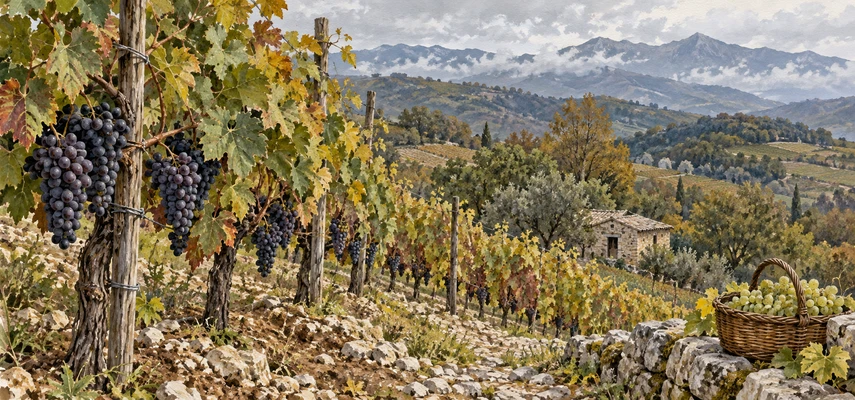
Campania can put a firmly tannic red and a textured, refreshing white on the same table without asking either to behave like the other. Aglianico, Fiano and Greco are useful starting points, but the region’s interest also includes Falanghina, Piedirosso and several very different growing environments.
For Diploma study, resist the tempting shortcut that everything here is hot, coastal and volcanic. Inland hills can have cold winters, substantial rainfall and a late harvest. A volcanic landscape can shape soils and rooting conditions without supplying a compulsory smoky flavour. Start with the vineyard, then follow the decisions that turn its fruit into a particular wine.
Locate Campania’s inland and coastal contrasts
Campania lies in southwestern Italy around Naples, extending from the Tyrrhenian coast into inland hills and mountains. Irpinia, in Avellino province, supplies the key Taurasi, Fiano di Avellino and Greco di Tufo comparisons. The Irpinia consorzio’s territory account describes a landscape of valleys and elevations rather than one continuous seaside vineyard.
Farther north, Benevento’s Sannio setting includes Falanghina and Aglianico. Aglianico del Taburno DOCG has its own production area and red, Riserva and rosato identities; it isn’t another name for Taurasi. Around Naples, Campi Flegrei and Vesuvio provide different volcanic-influenced settings. Islands and steep coastal sites add still more variation, so one provincial example cannot stand for every Campanian parcel.
Cantine Astroni’s Campi Flegrei range illustrates Falanghina and Piedirosso alongside different production ambitions. At Vesuvio, a local producer’s account identifies Caprettone whites and Piedirosso reds. These are regional reference points, not permission to copy that producer’s exact grape percentages or barrel programme onto every neighbouring wine.
Explain the vineyard without a volcanic shortcut
Temperature affects growth, ripening and acid retention. Sunlight supports photosynthesis, while elevation, aspect and canopy exposure modify bunch conditions. Inland Aglianico can need a long season to reach suitable flavour and tannin maturity. A warm latitude doesn’t guarantee an early harvest, and a cooler parcel can be useful in one vintage and challenging in another.
Water availability depends on rainfall, soil depth, rooting and drainage. Nutrient availability influences vigour and crop balance. The consorzio’s detailed Fiano di Avellino account describes calcareous and marly materials alongside volcanic and alluvial deposits. Campania’s soils aren’t all recent lava, and the same geological term can cover different physical growing conditions.
Weather creates frost, hail, heat, drought and harvest-rain risks. Downy and powdery mildew and bunch rot can threaten fruit when moisture persists. Late-picked Aglianico may remain exposed to autumn weather after some whites have entered the cellar. Volcanic material doesn’t disinfect a canopy, while drought can impair vine function rather than improving concentration indefinitely.
Vineyard establishment considers slope stability, access, exposure and training. Planting materials should match variety, soil and water conditions, with healthy material and appropriate rootstocks where required. Some local sandy sites support own-rooted vines, but don’t generalise a particular vineyard’s situation into a claim that the whole region escaped phylloxera.
Nutrient and water management follows observation and analysis within applicable rules. Canopy management balances productive leaf area, airflow and bunch protection. Harvest timing balances flavour, sugar, acidity, phenolic maturity and health, with different targets for an aromatic white and a structured red. Hazard management includes erosion control and appropriate frost precautions. Pest and disease management combines monitoring, canopy work and proportionate interventions, not reliance on altitude or a celebrated soil name.
Distinguish Aglianico from Taurasi
Aglianico is a grape; Taurasi is a protected origin with prescribed conditions. The ministry’s Taurasi specification requires at least 85% Aglianico, with permitted red complements. Not every Campanian Aglianico qualifies as Taurasi, and an all-Aglianico blend doesn’t by itself establish the right origin.
Taurasi requires at least three years’ ageing, including at least one year in wood; Riserva requires four years, including at least eighteen months in wood. The legal ageing clock starts on 1 December of the harvest year. That’s worth checking against summaries that casually substitute the January starting date used in some other appellations.
The grape can provide substantial acidity and tannin alongside dark fruit, making ripe fruit and measured extraction important. Longer maturation may bring integration and developing complexity when the wine has sufficient material. It doesn’t guarantee that a dry, harsh red will become balanced merely by waiting. Assess the tannin’s texture and fruit support rather than treating firmness as a promise of greatness.
Less ambitious Aglianico routes can target earlier drinking, depending on the category and producer. Piedirosso provides a useful contrasting red reference around Naples, often inviting a different extraction and maturation plan. Neither the darkest colour nor the heaviest oak establishes which wine has been made more successfully.
Compare Fiano, Greco and Falanghina as different whites
Fiano di Avellino and Greco di Tufo are separate grape-and-place combinations. Fiano can combine floral and fruit expression with texture and the potential for developing nutty complexity; Greco often offers conspicuous acidity and a more phenolic feel. Treat these as tendencies to test, not compulsory tasting notes for every bottle.
The official Fiano specification requires at least 85% Fiano, with specified complementary varieties. The Greco specification requires at least 85% Greco, with Coda di Volpe Bianca as the permitted complement up to its limit. Don’t replace that named allowance with an unrestricted list of regional white grapes.
Both still whites have Riserva categories requiring at least twelve months from 1 November of the harvest year. That period doesn’t mean compulsory new oak or an automatic quality advantage. Greco di Tufo also permits sparkling categories under their own rules; those production methods belong in the sparkling-wine unit rather than being assumed from the still-white name.
Falanghina supplies another important white comparison, including Sannio and Campi Flegrei examples. Cantina del Taburno’s technical account illustrates controlled fermentation and lees contact for one wine. It helps explain a fresh yet textured approach without establishing that every Falanghina must use the same vessel, picking date or maturation time.
Follow fruit through distinct cellar programmes
Winemaking approaches begin with the intended style and the actual fruit. Careful grape transportation limits crushing, oxidation and unwanted fermentation. Reception should separate varieties, origins, health and ripeness. A sorted Fiano lot and a late-harvest Aglianico lot need appropriate handling and their own traceable identities, even when they arrive at the same winery.
Processing and pressing affect yield and phenolic pickup. Gentle pressing can help manage a white’s texture without extracting excessive bitterness. Pre-fermentation clarification adjusts solids for the intended fermentation. Must adjustments require analysis and legal permission; a general regional description doesn’t establish that any proposed adjustment is allowed for a particular appellation.
Alcoholic fermentation decisions include yeast, temperature, vessel and nutrient management. A fruit-led Falanghina may benefit from controlled fermentation away from skins; an Aglianico red requires a skin-contact programme. Extraction and pressing should suit skin and seed maturity, with cap management and press fractions evaluated through their effect on balance rather than the maximum colour obtainable.
Malolactic conversion and subsequent maturation should suit acidity and the desired style. Lees maturation can build texture in a white, while oak size, age and duration influence a red’s development. Stainless steel doesn’t prove a wine is simple, and a barrel doesn’t supply complexity automatically. A concentrated Greco still needs appealing fruit and phenolic balance rather than extraction pursued for its own sake.
Finishing adjustments, sulfur dioxide and filtration depend on analysis and stability needs. Blending eligible lots can improve balance while maintaining label entitlement. Post-fermentation clarification removes unwanted solids, and stabilisation considers protein and tartrate risks. Microbiological safeguards should fit analysis, retained sugar and distribution, including the effect of any chosen malolactic programme.
Packaging and closures should protect the intended drinking period. Wine transportation requires suitable temperature management. A fresh white and a mature Taurasi can both deteriorate through poor handling after release, so provenance and condition belong in the buying decision. Potential longevity describes what a sound wine may do under suitable storage, not what every bottle is guaranteed to achieve.
Read protected origins before ranking quality
International and EU protection frameworks, national Italian law and local appellation specifications interact. Industry associations such as the consorzi communicate origin and support promotion; official specifications and control arrangements govern entitlement. A geographical indication ties a place to prescribed conditions. DOC and DOCG sit within the PDO framework; PGI/IGT wines have their own specifications, while wines without GI cannot borrow protected origin claims.
Taurasi, Aglianico del Taburno, Fiano di Avellino, Greco di Tufo and broader regional designations therefore need separate interpretation. Riserva has defined conditions within the relevant specification; it isn’t one identical national production recipe. The Campania government’s amendment notice confirms the introduction of the Irpinian white Riserva categories. A recently uploaded PDF can still contain an older rule text, so document content matters more than the upload folder’s year.
Make the commercial explanation as precise as the cellar one
Supply depends on suitable sites, healthy harvests and wine retained for maturation. Demand differs between fresh whites, regional restaurant reds and expensive aged Taurasi. Costs include slope labour, sorting, oak where chosen, cellar storage and finance. Legislation affects origin claims, yields and release programmes; currency exchange changes export returns. Holding a wine for years needs cash before the final customer has paid for a bottle.
A grower may supply fruit, while an estate can coordinate vineyard and cellar decisions. A broker connects parties; a merchant sources wine or grapes; a winery provides production capacity. A virtual winery contracts production, and a custom crush facility supplies agreed production services. A cooperative can share equipment and market access; a conglomerate may coordinate businesses. These are possible functions to evaluate, not assertions that all models are equally common locally. The contract must allocate quality, traceability and stock risk whichever ownership model is used.
Importing adds freight, compliance and currency exposure. Retail needs clear grape, style and drinking-window information; HoReCa buyers require staff able to compare Fiano with Greco without reducing both to a generic volcanic white. Direct-to-consumer sales can retain revenue but add hospitality, fulfilment and stock work. Mature and emerging markets contain varied customers, and familiarity with Naples doesn’t automatically translate into familiarity with inland Irpinia.
Wine brands can lead with origin, producer or grape. Marketing concepts begin with a target customer; marketing options include comparative flights, transparent technical notes and site visits. The five Ps connect product, price, people, place and promotion. A restaurant selling a fresh Falanghina and a merchant offering a mature Taurasi need different stock and service plans, even if both can use Campania’s regional identity to start the conversation.
Compare the evidence here with Puglia and Basilicata as a regional case, then apply the regional comparison framework to the comparison. Compare growing conditions, production decisions, style, quality and the commercial reasons for price. Establish the differences rather than assuming that one familiar name must be better.
Original Diploma practice
These original exercises practise explanation and evaluation. They aren’t official examination questions, marking schemes or reports of actual bottles tasted.
Question 1: evaluate a volcanic-quality claim
A retailer claims that all Campanian wines grow on lava and must taste smoky, with altitude guaranteeing better quality. Evaluate the claim.
Reasoned outline: Separate coastal volcanic-influenced sites from varied inland geology and growing conditions. Explain water, rooting, exposure and temperature rather than assigning literal rock flavours. Compare variety, harvest, extraction, maturation and storage as additional influences on the finished wine. A site can support quality without guaranteeing its sensory result.
Question 2: compare two white-wine production plans
Compare a fresh Falanghina programme with a more textured Greco di Tufo. Explain decisions and risks rather than prescribing one universal recipe.
Reasoned outline: Relate healthy fruit, harvest balance, pressing and solids management to the target style. Discuss controlled fermentation, phenolic pickup, lees, malolactic choice, oxygen and stability. Explain that texture must remain balanced by fruit and acidity. More extraction or longer maturation isn’t automatically an improvement.
Question 3: assess a Taurasi release proposal
A merchant wants to release a compliant 2022 Taurasi in December 2024 because it has already spent eighteen months in wood. Evaluate the proposal and its financial implications.
Reasoned outline: The minimum total ageing is three years, including at least one year in wood, counted from 1 December 2022; the time requirement therefore reaches December 2025, subject to all other conditions. Additional wood time doesn’t replace total ageing. Discuss inventory finance, storage, customer expectations and the distinct Riserva requirement. Legal release and readiness to drink remain separate assessments.
Analytical tasting preparation: compare Campanian materials
The official recommended-sample programme, printed pages 22–23, includes Fiano di Avellino of good or very good quality, Greco di Tufo or Falanghina of good or very good quality, and Aglianico del Vulture or Taurasi of very good or outstanding quality. Select Taurasi for the Campanian red comparison; Aglianico del Vulture belongs to Basilicata and is an alternative national sample, not another Campanian appellation.
Write full systematic descriptions blind, comparing acidity, texture, body, flavour, tannin and maturation evidence. Justify quality through balance, length, intensity and complexity with actual observations, separating strong structure from harshness or tired fruit. Assess bottle-ageing suitability separately: retained fruit and integrated support matter more than a volcanic story, a Riserva label or a long mandatory holding period. These are proposed selections and methods, not actual bottle grades or official tasting results.












