










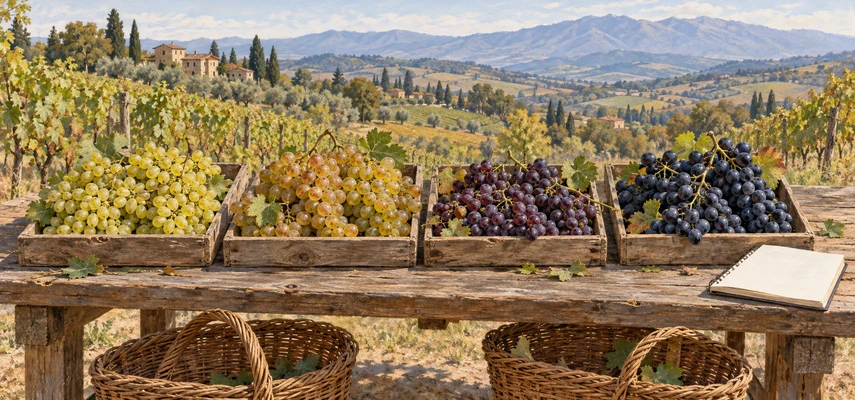

Central Italy becomes easier to remember when the grapes stop behaving like names on flashcards. Verdicchio can make a brisk young white or a more textured wine worth following in bottle. Sagrantino brings a very different tannin problem from Montepulciano. A Malvasia-led Frascati asks different questions again.
Marche, Umbria, Lazio and Abruzzo share a broad central Italian setting, but they don’t share one climate, soil or business model. Use a four-region comparison: locate the vineyards, identify the fruit, then explain which production and commercial decisions suit the intended wine. That approach also helps avoid confusing the Montepulciano grape with the Tuscan town.
Locate Marche between the Apennines and Adriatic
Marche lies on Italy’s eastern side, with vineyards extending from Adriatic-influenced hills towards inland valleys. Verdicchio dei Castelli di Jesi and Verdicchio di Matelica provide the key white comparison. The Matelica appellation account identifies its inland setting; the Jesi account describes a separate, broader hill area. Matelica’s inland conditions can produce different ripening and acid-retention challenges, without guaranteeing every Matelica is more acidic than every Jesi.
Verdicchio’s freshness can accompany considerable texture and concentration. Different picking, lees and maturation choices help explain that range. Classico identifies a delimited historic area in Jesi, while the Riserva DOCG identities have their own production frameworks. Don’t replace those distinctions with a rule that the grape makes only simple wine for immediate drinking.
Marche’s reds include Montepulciano-led Rosso Conero, Montepulciano/Sangiovese combinations in Rosso Piceno, and fragrant Lacrima di Morro d’Alba. The Rosso Conero account connects Montepulciano with the Ancona promontory area. Lacrima’s consorzio account locates another distinct identity; the Alba in its name doesn’t move the wine to Piemonte. Pecorino and Passerina add further white interest in the southern Piceno area. The region isn’t a one-grape white-wine story.
Locate landlocked Umbria and its different styles
Umbria lies inland, west of Marche, with hills and valleys offering different elevations, aspects and water conditions. Orvieto’s white-wine identity centres on grapes including Grechetto and Procanico, the local Trebbiano reference. The appellation extends into Lazio: Sergio Mottura’s Orvieto technical sheet identifies its Lazio-side vineyards. Regional borders and appellation boundaries aren’t always identical.
Don’t assume every Orvieto is sweet, or that every bottle is designed for decades in the cellar. Dry wines and particular sweet categories require different fruit and production decisions. A fresh Grechetto-led white and a richer, selectively matured example can both be appropriate, provided their texture, acidity and flavour remain in balance.
Montefalco offers a red contrast. Montefalco Sagrantino DOCG uses Sagrantino for dry and passito wines. Its substantial tannin makes skin maturity and extraction particularly important; sweetness in passito doesn’t make tannin disappear. Montefalco Rosso is instead a Sangiovese-led blend including Sagrantino. It isn’t simply a shorter-aged version of the all-Sagrantino wine.
Trebbiano Spoletino deserves its own white identity, illustrated by Spoleto DOC. The shared Trebbiano word doesn’t make it interchangeable with every other Italian grape carrying that name. Torgiano adds another important Umbrian red setting, with Lungarotti’s producer information illustrating a Sangiovese-based route. A producer’s particular blend or cellar programme should remain an example, not become the rule for every wine in the region.
Locate Lazio beyond Rome’s restaurant table
Lazio occupies central Italy’s western side around Rome, extending through coastal, volcanic-influenced and inland environments. Frascati’s Castelli Romani setting supplies a familiar white reference. The Lazio agricultural agency’s Frascati Superiore account identifies Malvasia Bianca di Candia and Malvasia del Lazio, also called Malvasia Puntinata, as central grapes, alongside permitted complements.
Frascati DOC and Frascati Superiore DOCG have distinct entitlements. A protected higher-category name doesn’t establish that every bottle has greater complexity than every ordinary DOC example. Assess healthy fruit, crop balance, freshness, texture and storage before reaching a quality conclusion. Volcanic-influenced terrain likewise doesn’t place a compulsory smoky aroma in every glass.
Lazio also makes reds. Piglio’s wine-route account places Cesanese del Piglio in its own production context. Cesanese provides an inland red reference requiring suitable ripeness and tannin management, rather than an afterthought to Frascati. A Lazio range can therefore connect fresh white-wine service with a more structured red occasion without pretending that the entire region has one cellar recipe.
Locate Abruzzo between mountains and sea
Abruzzo lies on the Adriatic side, south of Marche, with mountain massifs, inland basins and hills descending towards the coast. The regional consorzio’s territory account describes both pergola training and more recent upright-row planting, alongside an important cooperative sector. Neither a pergola nor cooperative ownership establishes the quality of a particular wine.
Montepulciano is the principal red reference here. It can supply colour, fruit and structure across different styles, while Cerasuolo d’Abruzzo gives the grape a separate rosé identity. Cerasuolo’s relatively deep colour needn’t imply sweetness or red-wine-level tannin. Trebbiano d’Abruzzo and white wines from grapes such as Pecorino complete a more varied picture than the familiar inexpensive-red stereotype suggests.
Appellation details are changing. The ministry publishes a September 2026 Montepulciano d’Abruzzo specification; use the applicable current text for the relevant category and vintage. Colline Teramane has its own DOCG identity, and Casauria’s registration notice confirms a separate protected designation with the Italian DOCG mention. Don’t keep describing Casauria solely as an unchanged old subzone or assume all Abruzzo reds use one specification.
Compare the environments with an actual wine in mind
Across these four regions, temperature affects growth, ripening and acid retention; elevation and exposure often explain more than latitude alone. Sunlight supports photosynthesis, while shaded bunches and exposed bunches experience different conditions. Compare inland Matelica, Umbrian hills, a Frascati slope and a warmer Abruzzo parcel as individual sites rather than assigning all four the same Mediterranean shorthand.
Water availability depends on rainfall, soil depth, drainage and rooting. Nutrient availability influences vigour and crop balance. Calcareous-influenced Marche soils, varied Umbrian terrain, volcanic-influenced Lazio settings and Abruzzo’s mixed soils don’t behave as four uniform regional blocks. Evaluate the actual parcel’s water and root environment; a geological name isn’t a sensory conclusion.
Weather creates frost, hail, heat, drought and harvest-rain risks. Downy and powdery mildew and bunch rot require monitoring, especially with prolonged moisture or dense canopies. A late-ripening Sagrantino or Montepulciano lot may face a different harvest-weather window from an earlier-picked white. Heat and water stress can also compromise fruit rather than merely helping reds become riper.
Vineyard establishment considers access, drainage, slope stability, exposure and training. Planting materials should match variety, vigour and soil-water conditions. In Marche, retain enough suitable leaf area for Verdicchio ripening; in Umbria, allow Sagrantino the season and crop balance it needs. In Lazio, match Malvasia fruit to a fresh or more textured white target; in Abruzzo, manage pergola or upright rows according to the site rather than treating either system as inherently superior.
Nutrient and water management follows observation and analysis within applicable rules. Canopy management balances productive leaf area, airflow and bunch protection. Harvest timing balances flavour, sugar, acidity, phenolic maturity and health: picking a white only for sugar can miss its texture and acid balance, while picking a red only for colour can leave harsh tannin. Hazard management includes erosion control and appropriate frost precautions. Pest and disease management combines monitoring, canopy work and proportionate interventions in each region.
Choose white, red, rosé and passito routes deliberately
Winemaking approaches begin with the target style. Careful grape transportation limits crushing and oxidation; reception should separate origin, variety, health and ripeness. Marche Verdicchio, Umbrian Grechetto or Trebbiano Spoletino, Lazio Malvasia and Abruzzo Trebbiano or Pecorino can all benefit from protected handling, but they needn’t receive identical pressing or fermentation programmes.
Processing and pressing affect yield and phenolic pickup. Pre-fermentation clarification adjusts solids for the intended white fermentation. Must adjustments require analysis and legal permission, not an assumption that all central Italian must may be treated alike. Alcoholic fermentation decisions include yeast, temperature and vessel. A cool fruit-preserving programme and a more textured fermentation in wood answer different aims rather than establishing a universal quality hierarchy.
Malolactic conversion and subsequent maturation should suit acidity and balance. Lees maturation can build texture in whites, with stirring and oxygen management requiring monitoring. For Verdicchio or an ambitious Umbrian white, greater breadth may be useful; for a fresh Frascati or Abruzzo white, excessive weight or lost freshness can undermine the purpose. Don’t assume all whites require malolactic conversion or all serious whites require new oak.
Extraction and pressing should suit skin maturity and the wine’s intended structure. Compare fragrant Lacrima in Marche with Sagrantino in Umbria, Cesanese in Lazio and Montepulciano in Abruzzo: cap management, temperature and press fractions need adjusting to the actual fruit. Colour is easy to admire, but an attractive palate also needs fruit and tannin to work together. Cerasuolo’s rosé route limits extraction differently from a structured red.
For Sagrantino passito, selecting and drying suitable bunches changes sugar concentration, material costs and fermentation conditions. It doesn’t turn damaged fruit into an advantage. Sweet Orvieto categories likewise need their own specifications and fruit-selection decisions; noble rot and ordinary destructive rot aren’t interchangeable explanations. Where used, drying or botrytis raises a new set of controls rather than providing a shortcut around vineyard health.
Finishing adjustments, sulfur dioxide and filtration should reflect stability needs. Blending eligible lots can improve balance while maintaining traceability: combining components for a permitted Montefalco Rosso differs from changing an all-Sagrantino wine’s varietal identity. Post-fermentation clarification removes unwanted material. Stabilisation considers protein and tartrates, and microbiological safeguards should fit analysis, retained sugar and distribution. A sweet wine needs a particularly clear plan for preventing unwanted refermentation.
Packaging and closures should protect the intended drinking period. Wine transportation requires suitable temperature management, whether the shipment contains a fresh Jesi white, an Umbrian red, Frascati or Montepulciano d’Abruzzo. Heat damage after release can erase careful cellar work. Ageing potential and reliable storage are separate questions that both need answers.
Apply wine law locally and business concepts realistically
International and EU protection frameworks, national Italian law and local appellation specifications interact. Industry associations such as the consorzi support promotion and explain origin; official specifications and control arrangements establish entitlement. A geographical indication ties a place to prescribed conditions. DOC and DOCG sit within the PDO framework; PGI/IGT wines have their own rules, while wines without GI cannot borrow protected names.
Classico, Superiore, Riserva, passito and named subzones answer different questions. Marche’s Verdicchio Riserva identities, Umbria’s Sagrantino versus Montefalco Rosso, Lazio’s Frascati versus Superiore, and Abruzzo’s distinct red designations illustrate why a single national label ladder is inadequate. Read the exact category, date and approved text; more restrictive rules still don’t supply an automatic tasting grade.
Supply depends on yields, suitable fruit, weather losses and stock retained for maturation. Demand differs between accessible whites, fragrant regional reds and structured cellar wines. Costs include vineyard labour, sorting, drying where used, oak where chosen, storage and finance. Legislation affects yields, processing and release choices; currency exchange changes export returns. An Umbrian passito’s limited output and delayed payment create a different cash-flow problem from a regularly replenished Frascati.
A grower may supply fruit, while an estate can coordinate vineyard and cellar decisions. A broker connects parties; a merchant sources wine or grapes; a winery provides production capacity. A virtual winery contracts production, and a custom crush facility supplies agreed production services. A cooperative can share equipment and market access; a conglomerate may coordinate businesses. These describe possible functions to evaluate in all four regions, not a claim that every model is equally common. Abruzzo’s cooperative context provides a concrete reason to examine shared investment and quality-based fruit payment.
Importing adds freight, compliance and currency exposure. Retail needs clear grape and style information; HoReCa buyers require service training and suitable drinking windows. Direct-to-consumer sales can retain revenue but add hospitality and fulfilment costs. Mature and emerging markets contain varied customers. Wine brands can lead with a familiar variety, distinctive place or useful occasion: Marche Verdicchio, Umbrian Sagrantino, Lazio Frascati and Abruzzo Montepulciano each need a proposition that fits the actual bottle.
Marketing concepts begin with a target customer. Marketing options include regional comparison flights, transparent technical notes and producer visits. The five Ps connect product, price, people, place and promotion. For a restaurant range, a fresh white must arrive fresh and be easy to explain; a tannic young red may need a different service plan. More complexity isn’t automatically a better product for every buying occasion.
Compare the evidence here with Campania as a regional case, then apply the regional comparison framework to the comparison. Compare growing conditions, production decisions, style, quality and the commercial reasons for price. Establish the differences rather than assuming that one familiar name must be better.
Original Diploma practice
These original questions and outlines practise explanation and evaluation. They aren’t official examination questions, marking schemes or records of actual bottles tasted.
Question 1: compare two Verdicchio settings
Compare the potential effects of an inland Matelica site and an Adriatic-influenced Jesi hill site on white-wine production. Explain why place alone cannot establish the better bottle.
Reasoned outline: Relate temperature, exposure, rainfall and drainage to ripeness, acid retention and disease pressure. Compare crop balance, harvest choice, pressing, fermentation and lees or wood maturation. Assess fruit, texture and freshness in the resulting wines rather than assigning a compulsory regional acidity ranking. Site creates opportunities that the season and producer still have to realise.
Question 2: compare three red and rosé decisions
Compare an Umbrian Sagrantino, a Lazio Cesanese and an Abruzzo Cerasuolo production plan. Explain the different extraction and commercial needs.
Reasoned outline: Establish varieties and legal identities before discussing maturity, cap management and pressing. Sagrantino’s tannin requires suitable fruit and controlled extraction; Cesanese needs its own structural assessment. Cerasuolo uses Montepulciano in a rosé route with different colour and phenolic aims. Compare maturation, stability, working capital and intended customers. Deep colour or long extraction doesn’t establish a common quality level.
Question 3: assess a regional buying shortcut
A merchant proposes buying every DOCG ahead of every DOC or IGT from these four regions and using one tasting note for all central Italian whites. Evaluate the plan.
Reasoned outline: Distinguish protected identities, category conditions and current amendments from actual sensory quality. Compare Verdicchio, Grechetto or Trebbiano Spoletino, Malvasia-led Frascati and Abruzzo whites as different materials and styles. Include producer choices, storage and customer needs. Protected origin is useful evidence about identity, not a replacement for tasting or a licence to ignore a different grape.
Analytical tasting preparation: connect the four regions
The official recommended-sample programme, printed pages 22–23, includes Verdicchio dei Castelli di Jesi of good or very good quality and Montepulciano d’Abruzzo of good or very good quality among the central and southern Italian essentials. Frascati of acceptable or good quality is optional. Other essential southern selections are addressed in the relevant later chapters; Sagrantino and an Umbrian white can add useful comparisons here without being mislabelled as compulsory rows.
For Marche, Umbria, Lazio and Abruzzo, write full systematic descriptions blind before checking origin. Justify quality through balance, length, intensity and complexity, supported by actual fruit, structural and maturation observations. Assess bottle-ageing suitability separately: a fresh white’s immediate appeal and a structured red’s possible development are different conclusions. A red doesn’t gain a long future from tannin alone, and a white doesn’t lose one merely because it lacks new oak. These are proposed selections and methods, not actual tasting results or official bottle grades.












