










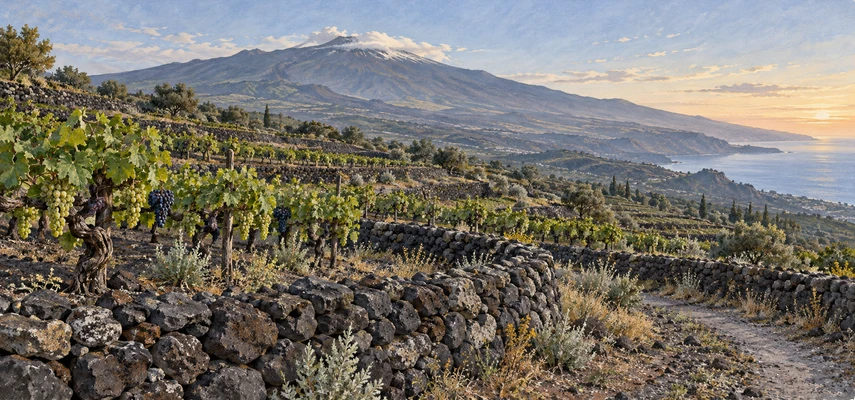

Sicily can offer a bright, fragrant red, a concentrated Nero d’Avola and a sharply defined mountain white without changing islands. The useful question is how those differences arise. Elevation, exposure, water supply and grape variety can alter the starting material dramatically before a winemaker chooses a vessel.
Etna makes that diversity particularly visible, but it shouldn’t swallow the rest of Sicily’s story. For Diploma study, compare the volcano’s higher vineyards with southern and western settings, then connect each wine to its own vineyard, production and market decisions. Mediterranean doesn’t mean identical, and volcanic doesn’t mean automatically outstanding.
Locate Sicily’s different growing settings
Sicily lies off the southwestern end of mainland Italy. Its vineyard landscape includes coastal areas, inland hills, elevated sites and the slopes of Etna in the east. Smaller islands add further settings. The Sicilia DOC consorzio represents a broad protected origin; it isn’t a claim that every Sicilian wine grows under the same conditions.
Nero d’Avola is an important red reference across different areas, while the southeast around Vittoria adds Frappato and the Cerasuolo di Vittoria blend. Western Sicily supplies major white-wine contexts, including Grillo, Catarratto and Inzolia. International varieties also appear, but a familiar grape doesn’t remove the need to explain its actual site and production choices.
Etna stands north of Catania. The Etna consorzio’s terrain account distinguishes slopes with different exposures, rainfall and maritime influence. Higher vineyards can experience cooler conditions and later ripening than lower Sicilian sites. The eastern slope’s exposure to rain and the drier southwestern setting prevent a simple rule that all volcanic vineyards are equally dry.
Explain temperature, water and vineyard risk
Temperature affects growth, the pace of ripening and acid retention. Sunlight supports photosynthesis, while bunch exposure can help maturity or increase heat damage. Elevation and aspect can moderate warmth, but the same cooler site can struggle in one season and retain useful freshness in another. Don’t assume every Nero d’Avola needs more heat or every Etna wine has low alcohol.
Water availability depends on rainfall, rooting, soil depth and drainage. Nutrient availability influences vigour and crop balance. Volcanic materials on Etna differ in age, depth and physical properties; elsewhere, calcareous, clay-rich and other soils create different growing conditions. Rocks don’t enter the wine as compulsory smoky or salty flavours.
Weather creates frost, hail, heat, drought and harvest-rain risks. Downy and powdery mildew and bunch rot remain relevant when moisture persists. Dry summers don’t abolish the effect of a wet spring or autumn. The Sicilian government’s water-emergency measures illustrate why drought requires active management rather than celebration as a free concentration treatment.
Vineyard establishment considers exposure, drainage, erosion, terrace access and training. Planting materials should match variety, soil and water conditions. Old ungrafted vines survive in some sites, but don’t generalise their existence into immunity from phylloxera across Etna. Healthy material and rootstock decisions still require site-specific assessment.
Nutrient and water management follows observation and analysis within applicable rules. Canopy management balances productive leaf area, airflow and bunch protection from heat. Harvest timing balances flavour, sugar, acidity, phenolic maturity and health. Hazard management includes erosion control, suitable frost precautions and practical access on terraces. Pest and disease management combines monitoring, canopy work and justified interventions; volcanic heritage doesn’t replace it.
Give Nero d’Avola and Frappato different roles
The consorzio’s grape overview describes a range of Nero d’Avola styles rather than one unavoidable recipe. Fruit-led examples can emphasise freshness, while more concentrated material can support additional structure and maturation. Site, crop, picking and extraction help explain the difference; neither dark colour nor high alcohol establishes the better wine.
Frappato provides an aromatic red contrast, often with a lighter structural impression than an ambitious Nero d’Avola. Cerasuolo di Vittoria’s consorzio identifies the DOCG blend as 50–70% Nero d’Avola and 30–50% Frappato. That is a red wine, distinct from Abruzzo’s Cerasuolo rosé identity. Similar colour-related names don’t create a shared appellation or production method.
Think about what a blend contributes rather than assigning one component all the quality. Fragrance, fruit, acidity and tannin need to work together. A delicately expressed Frappato needn’t be extracted harder to imitate a bigger red, and a concentrated Nero d’Avola doesn’t necessarily improve through more new oak. Each wine needs a coherent purpose.
Separate Etna’s grapes and places
The Etna wine account identifies Nerello Mascalese as the principal red reference, with Nerello Cappuccio a possible complement. Carricante anchors the white programme, while Catarratto also has a role. Don’t substitute Nero d’Avola for every Sicilian red or Grillo for every Sicilian white merely because those names are more familiar.
Nerello Mascalese can combine relatively modest colour with substantial acidity and tannin. Carricante can retain marked acidity and support a focused white style, including wines with the material to develop in bottle. Those are useful expectations to investigate, not compulsory notes or a quality score before tasting. Paler red colour doesn’t prove dilution; high acid doesn’t establish complexity.
Contrade identify more specific origins within the delimited framework. Differences in lava history, exposure, elevation and human choices can matter at short distances, but a district name isn’t a formal ranking of wines from best to worst. Etna Bianco Superiore also has its own more restrictive origin and production conditions; Superiore isn’t simply a winemaker’s description of a successful batch.
Read the operative specification for the relevant category and vintage. A proposed change of status or label permission shouldn’t be treated as enacted solely because it appears in trade commentary. The existing Etna production specification provides a documented reference, while any later approved amendment needs its own date and conditions.
Keep Sicily’s other whites and island wines visible
Grillo can appear as a fresh dry white or a more textured, matured example. Catarratto, including the Lucido reference, and Inzolia add other materials with different structural and aromatic possibilities. Protected handling, picking and yield choices can affect the result as much as whether the wine comes from a variety currently fashionable overseas.
Zibibbo, the Muscat of Alexandria reference, can produce dry aromatic wines as well as sweet examples. Donnafugata’s Lighea technical sheet illustrates a dry-wine programme using Pantelleria fruit, low bush training and controlled fermentation. A producer’s specific vessel and maturation timings are examples rather than a universal Zibibbo recipe.
Pantelleria’s drying traditions and other island sweet wines need their own production decisions. Sweetness doesn’t automatically imply fortification. Likewise, Grillo’s association with Marsala doesn’t mean every Grillo is fortified; dry still wines form a separate programme. The detailed fortified-wine methods belong in D5, where adding spirit, maturation and the resulting styles can be compared properly.
Follow different materials through the cellar
Winemaking approaches begin with the target style and eligible fruit. Careful grape transportation limits crushing, oxidation and unwanted fermentation, particularly with warm loads. Reception should separate origins, varieties, health and ripeness. An Etna parcel intended for a specific origin claim must remain traceable rather than becoming an anonymous component in the broad regional tank.
Processing and pressing affect yield and phenolic pickup. Pre-fermentation clarification adjusts solids for the intended white fermentation. Must adjustments require analysis and legal permission. Alcoholic fermentation decisions include yeast, temperature, vessel and nutrient management. A controlled, fruit-preserving Grillo programme asks different questions from red fermentation on Nerello skins.
Extraction and pressing should suit skin and seed maturity. A Nerello Mascalese with firm tannin may need restraint rather than prolonged extraction for darker colour; an aromatic Frappato likewise needs its fragrance preserved. Press fractions can help one blend and make another coarse. Malolactic conversion and subsequent maturation should suit acidity, stability and the intended drinking window.
Lees maturation can build texture in Carricante or another suitable white, while stirring, oxygen and microbial condition need monitoring. Oak size, age and duration influence both white and red outcomes, but new wood isn’t a prerequisite for seriousness. Blending eligible lots can improve balance provided origin and varietal entitlements remain intact.
Finishing adjustments, sulfur dioxide and filtration depend on analysis and stability needs. Post-fermentation clarification removes unwanted material; stabilisation considers protein and tartrate risks. Microbiological safeguards should fit analysis, retained sugar and distribution, especially for sweet wines. Packaging and closures should protect the intended drinking period. Wine transportation requires suitable temperature management, including island-to-mainland freight; careful production doesn’t survive unlimited exposure to heat.
Connect legal identity to a realistic market
International and EU protection frameworks, national Italian law and local appellation specifications interact. Industry associations such as the consorzi communicate origin and support promotion; official specifications and control arrangements establish entitlement. A geographical indication ties a place to defined production conditions. DOC and DOCG sit within the PDO framework, while PGI/IGT wines have their own requirements and wines without GI cannot borrow protected names.
Sicilia DOC, Etna DOC, Cerasuolo di Vittoria DOCG and Terre Siciliane IGT answer different origin and production questions. A broad label isn’t a verdict of low quality, and a narrow origin doesn’t guarantee outstanding balance. The 2025 official Sicilia amendment also shows why current rules must be checked rather than frozen in an old national table.
Supply depends on healthy crops, suitable sites, access, water and stocks retained for maturation. Demand differs between accessible varietal wines, specialist Etna bottles and sweet island wines. Costs include terrace labour, sorting, temperature control, barrels where chosen, storage and freight. Legislation affects yields, processing and origin claims; currency exchange changes export returns. A small terrace parcel and a larger accessible vineyard need different budgets before either becomes a finished bottle.
A grower may supply fruit, while an estate can coordinate vineyard and cellar decisions. A broker connects parties; a merchant sources wine or grapes; a winery provides production capacity. A virtual winery contracts production, and a custom crush facility supplies agreed services. A cooperative can share equipment and market access; a conglomerate may coordinate businesses. These are possible functions with different control and margin, not a claim that every model dominates every Sicilian appellation.
Importing adds freight, compliance and currency exposure. Retail needs clear variety, origin and sweetness information; HoReCa buyers require service training that distinguishes fresh Grillo from textured Carricante or a developing Nerello red. Direct-to-consumer sales can retain revenue but add hospitality and fulfilment work. Mature and emerging markets contain varied customers, from visitors buying a memory to collectors comparing sites.
Wine brands can lead with grape, place or producer. Marketing concepts begin with a target customer; marketing options include comparative flights, transparent technical notes and vineyard visits. The five Ps connect product, price, people, place and promotion. Etna’s dramatic landscape can attract attention, but the actual wine, storage and service still have to justify the promise being made.
Compare the evidence here with Sardinia as a regional case, then apply the regional comparison framework to the comparison. Compare growing conditions, production decisions, style, quality and the commercial reasons for price. Establish the differences rather than assuming that one familiar name must be better.
Original Diploma practice
These original exercises practise causal explanation and evaluation. They aren’t official examination questions, marking schemes or reports of actual bottles tasted.
Question 1: compare two Sicilian sites
Compare a lower warm Nero d’Avola parcel with a higher Etna Nerello Mascalese site. Explain potential vineyard and production decisions without assuming one must make the better wine.
Reasoned outline: Relate exposure, temperature, water and season length to sugar, acidity, flavour and phenolic maturity. Compare crop and canopy management, harvest risk, sorting and extraction. Assess terrain-related labour and transport costs. Elevation changes the opportunities and risks rather than supplying a quality grade.
Question 2: evaluate a one-style white range
A merchant proposes describing every Sicilian white as a light, early-drinking Grillo and every Zibibbo as sweet. Evaluate the plan.
Reasoned outline: Distinguish Grillo, Catarratto, Inzolia, Carricante and aromatic Zibibbo, with separate dry and sweet production routes. Compare picking, pressing, fermentation, lees and maturation choices. Explain differing texture, acidity, customer expectations and storage needs. One regional adjective cannot replace grape and production information.
Question 3: assess a volcanic marketing claim
A producer argues that a named Etna contrada guarantees smoky flavour, phylloxera immunity and outstanding quality. Evaluate those claims and suggest a stronger explanation.
Reasoned outline: Establish the actual origin and documented vineyard conditions. Discuss variation in soils, vine material, exposure and management; surviving ungrafted vines don’t establish island-wide immunity. Explain fruit, extraction, maturation and observed balance rather than a compulsory geological flavour. Specific evidence makes a more useful claim than a dramatic landscape alone.
Analytical tasting preparation: compare Sicily’s materials
The official recommended-sample programme, printed pages 22–23, includes Nero d’Avola of good or very good quality among the central and southern Italian essentials. Nerello Mascalese of very good quality is optional. A Carricante or Grillo can add useful white-wine study without being mislabelled as a separate compulsory Sicilian sample row.
Write full systematic descriptions blind, comparing fruit, acidity, body, tannin or phenolic texture and maturation evidence. Justify quality through balance, length, intensity and complexity with actual observations. Assess bottle-ageing suitability separately: retained fruit and integrated structure matter more than colour, a contrada name or an expensive release. These are proposed selections and methods, not actual bottle assessments or official tasting grades.











