










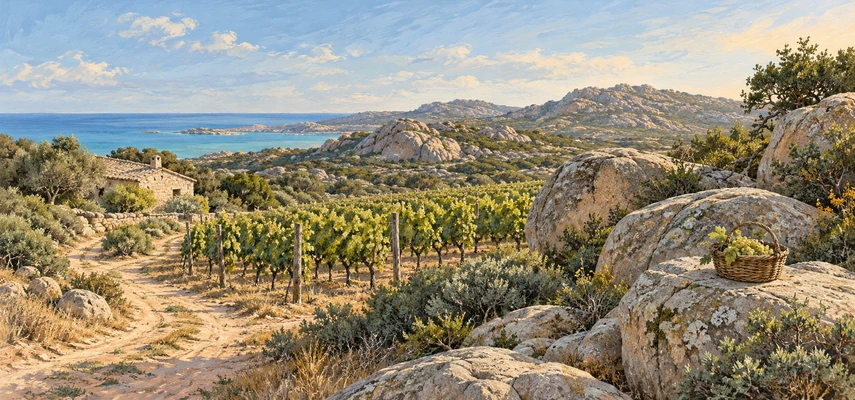

Sardinia’s wine story changes quite quickly when a fresh Vermentino is followed by a structured red or a white matured under flor. Those wines don’t need to share a style to share an island. The interesting question is how grapes, growing conditions and cellar choices produce the differences.
For Diploma study, begin with Cannonau and Vermentino, then widen the comparison. Carignano del Sulcis, other local varieties and distinctive ageing traditions make the island more than a two-grape exercise. A familiar name can introduce the wine; it can’t replace an explanation of what happened in the vineyard and cellar.
Locate Sardinia’s different wine settings
Sardinia lies west of mainland Italy and south of Corsica. Its landscape includes coastal plains, exposed slopes, inland hills and elevated areas. Maritime influence matters, but distance from the sea, elevation and aspect can change the conditions experienced by nearby vineyards. An island outline on a map doesn’t mean every bunch grows in the same breeze.
Gallura occupies the northeast, where weathered granitic materials form an important Vermentino setting. The regional Vermentino di Gallura specification defines a delimited origin with its own conditions. That geology helps explain physical rooting and drainage; it doesn’t dissolve into every wine as a guaranteed mineral flavour.
Cannonau has a much broader regional footprint, with inland eastern areas among its important references. The regional agricultural agency’s Cannonau account distinguishes the broad designation from specific subzones. Sulcis in the southwest supplies a separate Carignano identity, while Oristano and Bosa anchor different white-wine traditions on the western side. Keep those places distinct rather than moving every important grape into Gallura.
Explain the vineyard’s actual growing conditions
Temperature affects growth, ripening and acid retention. Sunlight supports photosynthesis, while aspect and canopy exposure alter bunch conditions. An elevated inland site can have a different ripening rhythm from a lower coastal one, particularly as nights cool. A warm latitude doesn’t establish every wine’s body, alcohol or picking date.
Water availability depends on rainfall, soil depth, rooting and drainage. Nutrient availability influences vigour and crop balance. Granitic-influenced Gallura, sandy parts of Sulcis and alluvial settings around the lower Tirso don’t provide the same root environment. A freely draining soil can be helpful after rain and demanding during drought; the same property can create both an advantage and a management problem.
Weather creates frost, hail, heat, drought and harvest-rain risks. Downy and powdery mildew and bunch rot remain possible when moisture persists. Wind can improve airflow but also increase water loss or cause physical damage. It shouldn’t be treated as a free substitute for monitoring, especially where a dense canopy holds humidity around the fruit.
Vineyard establishment considers exposure, drainage, access, slope stability and training. Planting materials should match variety, soil and water conditions. Bush vines and upright systems have different practical advantages; old vines don’t establish quality simply by having survived for a long time. Some sandy Sulcis sites preserve ungrafted vines, but that isn’t evidence that all Sardinian vineyards are immune to phylloxera.
Nutrient and water management follows observation and analysis within applicable rules. Canopy management balances productive leaf area, airflow and bunch protection from heat and wind. Harvest timing balances flavour, sugar, acidity, phenolic maturity and health. Hazard management includes erosion control, appropriate frost precautions and access planning. Pest and disease management combines monitoring, canopy work and proportionate intervention rather than assuming island conditions remove the need.
Explain Cannonau without a compulsory style
Cannonau is the Sardinian name associated with Grenache or Garnacha. The research-based Italian Vitis Database provides a useful reference for that identity. It doesn’t mean every Cannonau must taste like a southern Rhône blend or Spanish Garnacha, nor does varietal identity settle disputed historical arrival stories.
Ripe fruit and potentially substantial alcohol can form part of a Cannonau profile, but crop level, site and picking affect the balance. Softer fruit-led examples and more structured, matured wines can represent different aims. Evaluate acidity, tannin texture and retained fruit rather than assuming more alcohol means greater quality or a longer future.
The Cannonau di Sardegna framework includes different categories and origin references. Classico identifies a defined geographical entitlement with specific conditions; it isn’t merely an old-fashioned cellar style. The broad designation doesn’t mean every example is identical or every local red belongs under it.
Argiolas’s Costera account illustrates controlled fermentation and a particular malolactic programme for one Cannonau wine. Use that as a production example rather than making the producer’s exact temperatures and vessels compulsory throughout Sardinia. Technical information is most useful when it explains the bottle being discussed.
Compare the two Vermentino origins properly
Vermentino di Gallura DOCG and Vermentino di Sardegna DOC are distinct frameworks. The Gallura specification requires at least 95% Vermentino from its delimited area. The regional agency’s Vermentino di Sardegna account gives a broader island-wide origin and 85% minimum Vermentino. A DOC bottle isn’t automatically a failed attempt at the DOCG.
Fresh fruit, refreshing acidity and a modest phenolic edge can suit an early-drinking Vermentino. More selected fruit, lees contact or other maturation choices may support a broader style. Neither category name establishes the actual wine’s complexity, and bitterness needs to contribute to balance rather than being excused as obligatory regional character.
Gallura’s Superiore and other permitted types have their own conditions, including sweet or sparkling possibilities. Don’t turn a familiar dry still example into a rule that every Vermentino bearing the origin must be produced identically. For comparison, select bottles with known category, vintage and producer information, then test what those differences mean in the glass.
Keep Carignano and other island traditions visible
Cantina Santadi’s Carignano account locates the grape in the southwest and describes sandy sites with surviving ungrafted vines. Carignano can provide fruit and structure for a different red programme from Cannonau. Planting history, vine age and soil need to be connected with actual crop performance rather than used as automatic sensory grades.
Monica, Bovale, Nuragus and other varieties expand the regional picture further. The Laore wine-sector report helps place the main protected origins within a wider agricultural industry. A study of the island should acknowledge that diversity without assuming every grape has the same market recognition or production scale.
Vernaccia di Oristano supplies a particularly useful maturation comparison. Contini’s technical account describes wine held in incompletely filled oak and chestnut casks to allow flor yeast development. That’s a deliberate production route, different from a fresh white accidentally exposed to oxygen. The grape and wine shouldn’t be confused with Vernaccia di San Gimignano merely because the names share a word.
Malvasia di Bosa adds another distinctive western setting. The regional wine guide discusses its traditional maturation in incompletely filled casks with flor. Don’t infer that every Malvasia must be sweet, every traditional island white fortified, or every nutty aroma evidence of a fault. Identify the category and intended method before evaluating whether the wine succeeds.
Follow the fruit from reception to bottling
Winemaking approaches begin with the target style. Careful grape transportation limits crushing, oxidation and unwanted fermentation, especially with warm loads. Reception should separate varieties, origins, health and ripeness. A Gallura claim needs its own traceable fruit; it cannot be created later by blending in a wine that tastes suitably fresh.
Processing and pressing affect yield and phenolic pickup. Pre-fermentation clarification adjusts solids for the intended white fermentation. Must adjustments require analysis and legal permission. Alcoholic fermentation decisions include yeast, temperature, vessel and nutrient management. A protected juice programme for fresh Vermentino asks different questions from fermentation on Cannonau or Carignano skins.
Extraction and pressing should suit skin maturity and the intended red structure. Cap management and press fractions can improve one lot and make another harsh. Malolactic conversion and subsequent maturation should fit acidity, integration and microbial stability. Lees maturation can build texture in a suitable white, but oxygen, stirring and microbiological condition need monitoring rather than a fixed calendar alone.
New wood isn’t required for every serious island wine. Vessel size and age, storage duration and any flor programme affect development in different ways. Blending eligible lots can improve balance while retaining origin and category entitlement. Distinguish an intentional traditional maturation character from tired fruit or uncontrolled microbial spoilage; the name of the method doesn’t excuse every result.
Finishing adjustments, sulfur dioxide and filtration depend on analysis and stability needs. Post-fermentation clarification removes unwanted material; stabilisation considers protein and tartrate risks. Microbiological safeguards should fit analysis, retained sugar and distribution. Packaging and closures should protect the intended drinking period. Wine transportation requires suitable temperature management, including island freight and the final delivery leg. A carefully preserved white can still lose freshness after release.
Connect protected names and commercial decisions
International and EU protection frameworks, national Italian law and local appellation specifications interact. Industry associations such as the consorzi communicate origin and support promotion; official controls establish entitlement. A geographical indication ties a place to prescribed conditions. DOC and DOCG sit within the PDO framework; PGI/IGT wines have their own requirements, while wines without GI cannot borrow protected names.
Gallura, Sardegna, Sulcis, Classico and Riserva therefore need their own contextual reading. More restrictive conditions can support ambitious production without guaranteeing a blind-tasting grade. The official 2026 recognition of the Vermentino di Sardegna consorzio illustrates a specific association’s functions; consorzio recognition and creation of a new wine category aren’t interchangeable events.
Supply depends on suitable sites, healthy yields, weather losses and stocks held for maturation. Demand differs between fresh whites, familiar Cannonau reds and specialist flor-aged wines. Costs include vineyard labour, sorting, temperature control, barrels where used, storage and island freight. Legislation affects yields, origin and release choices; currency exchange changes export returns. A long cask programme ties up capital before a specialist customer buys the wine.
A grower may supply fruit, while an estate can coordinate vineyard and cellar decisions. A broker connects parties; a merchant sources wine or grapes; a winery provides production capacity. A virtual winery contracts production, and a custom crush facility supplies agreed services. A cooperative can share equipment and market access; a conglomerate may coordinate businesses. These are possible functions with different control and margin, not a census of every Sardinian appellation. Contracts and payment terms should reflect fruit quality, traceability and stock risk.
Importing adds freight, compliance and currency exposure. Retail needs clear origin and style information; HoReCa buyers require training to serve a fresh Vermentino differently from a flor-aged Vernaccia. Direct-to-consumer sales can retain revenue but add hospitality and fulfilment work. Mature and emerging markets contain varied customers, including holiday visitors and specialist buyers who may need quite different explanations.
Wine brands can lead with variety, place or producer. Marketing concepts begin with a target customer; marketing options include comparative flights, technical notes and vineyard visits. The five Ps connect product, price, people, place and promotion. A dramatic coastal story can open the conversation, but sound wine, appropriate storage and a clear drinking occasion need to support the sale.
Compare the evidence here with Italian wine laws as a regional case, then apply the regional comparison framework to the comparison. Compare growing conditions, production decisions, style, quality and the commercial reasons for price. Establish the differences rather than assuming that one familiar name must be better.
Original Diploma practice
These original exercises practise explanation and evaluation. They aren’t official examination questions, marking schemes or accounts of actual bottles tasted.
Question 1: compare two Vermentino purchases
A buyer ranks every Vermentino di Gallura DOCG above every Vermentino di Sardegna DOC. Evaluate the method and propose a better comparison.
Reasoned outline: Establish the different origins and minimum varietal compositions, then compare site, crop, harvest, pressing and maturation decisions. Assess fruit, texture, acidity, length and condition in actual bottles, with the intended customer and price in mind. More precise origin information doesn’t remove the need to evaluate the wine.
Question 2: evaluate an old-vine red claim
A producer argues that ungrafted old Carignano vines guarantee outstanding quality and eliminate the need for pest monitoring. Evaluate the claim.
Reasoned outline: Establish the actual sandy site and vine condition rather than extrapolating island-wide immunity. Discuss water supply, yield, fruit health and ripeness, followed by extraction and maturation. Explain the cost and potential value of old parcels without assuming age supplies balance automatically. A valuable vineyard still requires active observation and management.
Question 3: compare fresh and flor-aged whites
Compare production and commercial decisions for a fresh Vermentino and a traditional flor-aged Vernaccia di Oristano.
Reasoned outline: Compare fruit handling, fermentation, oxygen exposure, vessel filling, yeast management, stability and intended flavour development. Discuss time, storage, finance, customer education and drinking occasion. Assess each wine against its purpose rather than treating every nutty note as a fault or every matured wine as superior. Different ageing methods need different controls and a suitable market.
Analytical tasting preparation: build an island comparison
The official recommended-sample programme, printed page 22, lists Vermentino of very good quality as an optional central and southern Italian selection. A suitable Sardinian example can support that comparison, with actual origin and quality checked. Cannonau, Carignano and flor-aged Vernaccia are additional useful study choices here, not separate compulsory rows invented for this chapter.
Write full systematic descriptions blind. Justify quality through balance, length, intensity and complexity with actual fruit, structural and maturation evidence. Assess bottle-ageing suitability separately, distinguishing a fresh white’s immediate appeal from material that may develop together in bottle. High alcohol, old vines and long cask storage aren’t substitutes for retained fruit and integration. These are proposed selections and methods, not actual tasting results or official bottle grades.












