










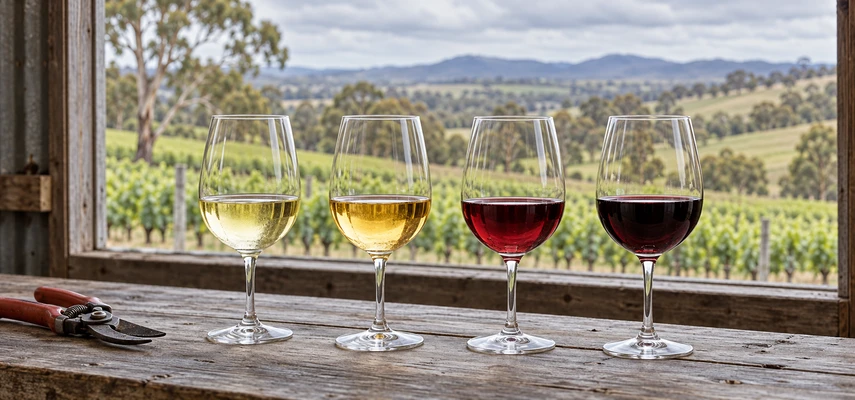

A light, fresh Hunter Semillon and a ripe inland Chardonnay can both come from New South Wales. Victoria can put maritime Pinot Noir beside warm-region Shiraz, while Tasmania adds a cool island setting with its own important differences. State names organise the map; they don’t set a compulsory thermostat.
For Diploma study, connect those differences with grapes, farming and production. Cooler conditions can help retain acidity but also create ripening risks. Warmth can support mature flavours while increasing water and harvest pressures. Neither observation tells you the wine’s quality until you examine what the producer achieved.
Build the map at the correct scale
Victoria contains maritime, elevated and warmer inland wine regions. New South Wales includes Hunter, higher inland districts and irrigated production areas. Tasmania is an island state with a cool maritime setting and substantial local variation. The official GI register separates legal origin names from informal growing-area descriptions.
South Eastern Australia is a much broader zone containing all three states and parts of South Australia and Queensland. South Australia is a state with its own range of regions, including Barossa Valley, Eden Valley, McLaren Vale, Clare Valley, Adelaide Hills, Coonawarra and Riverland. Those South Australian comparisons remain useful when explaining how the eastern states differ.
The broad zone allows eligible sourcing across a large area. It doesn’t mean every wine comes from a hot irrigated vineyard, nor does a narrow name prove that the wine is outstanding. Source entitlement, actual site, production intention and sensory performance are separate steps in the explanation.
Victoria: Yarra Valley and Mornington Peninsula
Yarra Valley lies east of Melbourne and contains significant variation in elevation, aspect and exposure. Pinot Noir and Chardonnay are major references, alongside Cabernet Sauvignon and Shiraz. The regional profile describes this range, which immediately challenges the idea that a cool-region reputation prohibits every later-ripening red grape.
Higher or more exposed parcels need different assessments from warmer, sheltered settings. Soil depth and drainage affect water and vigour; sandy loams, clay components and volcanic-derived soils don’t supply fixed flavours. Choose the actual parcel and season before predicting ripeness, crop or harvest date.
Mornington Peninsula adds a strongly maritime comparison, with Pinot Noir, Chardonnay and Pinot Gris references. Surrounding water moderates conditions, while elevation, exposure and humidity still matter. Maritime doesn’t mean rot-free or incapable of heat, and an exposed site can face wind-related growth and operational costs.
Victoria: Shiraz, Italian varieties and warmer inland supply
Heathcote provides a central Victorian Shiraz reference, with varied sites around the Mount Camel Range. Its red-soil associations are useful for discussing soil properties, not evidence that the whole GI consists of one soil or that every wine must taste identically rich.
The Grampians profile adds a western Victorian comparison involving Shiraz, Cabernet Sauvignon and Riesling, with warm days and cooling influences. Compare fruit, structure and production decisions with Heathcote or Barossa Valley. Pepper, ripeness or tannin alone isn’t a guaranteed regional identification.
King Valley has an important elevation gradient and references including Pinot Grigio and Sangiovese, alongside its sparkling-wine activity. Warmer northern and higher southern sites need separate growing explanations. The profile’s conflicting variety rankings are a reason to avoid presenting an undated “most planted” claim as current fact.
Macedon Ranges, Geelong, Henty, Beechworth, Pyrenees and other regions broaden the inventory. Murray Darling and Swan Hill supply warmer irrigated production, while Rutherglen has both still wines and a major fortified-wine identity. The state overview establishes that range; don’t let a famous fortified style erase other wine production or confuse the D3 still-wine focus.
New South Wales: Hunter’s warmth and fresh Semillon
Hunter Valley is a zone containing Hunter region and its registered subregions, rather than a single uniform vineyard. Its warm, humid setting can bring summer and harvest rain. Cloud and maritime influences modify warmth, while fruit health, canopy work and picking decisions remain essential.
Wine Australia’s Hunter account identifies Semillon, Shiraz, Chardonnay and Verdelho references. Semillon picked at suitable early ripeness can support a relatively low-alcohol, high-acid dry style. Freshness here doesn’t prove the grapes grew in a cold climate; variety, intended style and harvest decisions matter.
Classic Hunter Semillon can develop toasty and honeyed complexity in bottle without oak maturation. That doesn’t make all young bottles insipid or every example suitable for decades. Check the actual season before turning the region’s harvest-rain risk into a claim about every vintage.
Hunter Shiraz can provide a further regional contrast with warmer South Australian examples. Compare actual ripeness, extraction, oak and bottle development rather than assigning every Hunter red one mandatory earthy profile. Chardonnay adds another white route, and Verdelho broadens the aromatic discussion.
New South Wales: higher regions and the inland plains
Orange makes elevation central to the comparison. Chardonnay, Sauvignon Blanc, Shiraz and Cabernet can occupy different sites and objectives. Higher doesn’t always mean better: frost, wind, season length and the ability to reach intended maturity can limit a parcel.
Mudgee, Hilltops, Canberra District and Tumbarumba add different elevation, continentality and grape references. Canberra District crosses the New South Wales–ACT border, so the familiar name isn’t a state-only sourcing shortcut. The state overview places warm inland areas alongside those cooler and elevated opportunities.
Riverina, centred around Griffith, relies heavily on managed water in its warm inland setting. Chardonnay, Shiraz, Cabernet and Semillon serve different programmes. Suitable autumn conditions can support selected botrytised sweet Semillon, while many other lots become dry wines. Noble rot is a specific favourable outcome requiring selection, not a harmless name for every mouldy bunch.
Tasmania: cool island, distinct growing areas
Tasmania’s ocean-influenced, southerly setting supports Pinot Noir and Chardonnay alongside aromatic whites and important sparkling production. D3 study needs the still wines as well. Cooler conditions can extend ripening and preserve acidity, while frost, wind, flowering conditions, disease and harvest timing can affect yield and costs.
Wine Australia’s island overview distinguishes northern and southern growing areas. Tamar Valley and Pipers River provide northern references; Coal River Valley, Derwent Valley and Huon/Channel add southern ones, with the East Coast another important setting. They aren’t all the same rainfall, exposure or soil.
The industry’s wine-trail map helps locate these areas, while the official register establishes Tasmania’s legal GI. A trail name or informal local district isn’t automatically a separately registered subregion. Compare actual sites and sourcing rather than treating the map legend as a set of appellation rules.
Dryer eastern and southeastern vineyard settings also need water management; a green-island image doesn’t establish that every vineyard has ample summer rain. Selected Pinot and Chardonnay need suitable fruit, sorting and production decisions. An island address doesn’t guarantee either outstanding quality or a higher price justified entirely by climate.
Compare farming across the eastern states
Temperature affects growth, ripening and acid retention. Sunlight supports photosynthesis, while aspect and exposure change bunch temperature. Water availability depends on supply, soil storage, rooting and irrigation decisions. Nutrient availability influences vigour and crop balance. An irrigated Riverina block, warm Hunter parcel, maritime Victorian slope and cool Tasmanian site need different arguments about crop and canopy.
Weather creates frost, hail, heat, drought and harvest-rain risks. Downy and powdery mildew and bunch rot remain possible where conditions allow. Vineyard establishment considers exposure, drainage, access, slope and training. Planting materials should match variety, clone, rootstock, soil and water conditions. Healthy material matters to both a high-throughput supply programme and a selected Pinot parcel.
Nutrient and water management follows observation and analysis within applicable rules. Canopy management balances productive leaf area, airflow and fruit protection. Harvest timing balances flavour, sugar, acidity, phenolic maturity and health. Hazard management includes erosion control, appropriate frost precautions and access planning. Pest and disease management combines monitoring, canopy work and proportionate intervention. Heat, bushfire exposure, frost and water allocation add site-specific costs; smoke exposure needs assessment rather than an assumption that every nearby fire taints every wine.
Fit cellar choices to Semillon, Chardonnay, Pinot and Shiraz
Vinehealth Australia’s biosecurity guidance explains the continuing work needed to keep South Australia free of phylloxera. Historic own-rooted vines don’t establish immunity, and vineyard access, equipment and planting-material movement need appropriate controls. For fire exposure, current AWRI guidance supports analytical and sensory assessment; visible haze alone doesn’t establish a finished wine’s condition.
Winemaking approaches begin with the target style. Careful grape transportation limits crushing, oxidation and unwanted fermentation. Reception should separate origins, varieties, health and ripeness. Processing and pressing affect yield and phenolic pickup. Efficient delivery and cooling can preserve fresh broad-origin whites; selected Pinot Noir needs equally deliberate handling of fragile fruit.
Pre-fermentation clarification adjusts white-juice solids for the intended fermentation. Must adjustments require analysis and legal permission. Alcoholic fermentation decisions include yeast, temperature, vessel and nutrient management. An aromatic white may prioritise fruit preservation, while selected Chardonnay may use barrel fermentation and lees work. Lees maturation can build texture, with oxygen and microbial condition monitored.
Extraction and pressing should suit skin and seed maturity. Malolactic conversion and subsequent maturation should fit acidity, texture and microbial stability. Wood maturation involves vessel age, size, toast and time. Blending eligible lots can improve balance while preserving origin and category entitlement. Pinot Noir, Shiraz and a structured Cabernet blend shouldn’t receive identical cap management simply because they share an Australian origin.
Finishing adjustments, sulfur dioxide and filtration depend on analysis and stability needs. Post-fermentation clarification removes unwanted material; stabilisation considers protein and tartrate risks. Microbiological safeguards should fit analysis, retained sugar and distribution. Packaging and closures should protect the intended drinking period. Wine transportation requires suitable temperature management, including warehouses and final delivery. Both accessible exports and selected estate wines need to arrive in sound condition.
Trace origin through the business
Wine Australia’s Label Integrity Program requires records supporting vintage, variety and origin claims through the supply chain. Its blending rules distinguish single claims from combinations. A single named variety, vintage or GI normally requires at least 85% from the stated source; don’t automatically extend that threshold to every multiple claim or export-market condition.
International recognition and trade rules, national Australian law, regional requirements and local controls interact. Industry associations and regional bodies promote and represent producers, while authorised agencies establish legal entitlement. A geographical indication communicates origin under conditions; PDO and PGI are EU frameworks rather than classifications automatically assigned to Australian GIs. Wines without a specific GI claim still face applicable production and labelling rules. Reserve, estate-related wording and sustainability expressions need their actual conditions rather than an automatic tasting grade.
Supply depends on healthy fruit, weather losses, contracts and stocks held for maturation. Demand differs between accessible inland wines, selected Pinot, Chardonnay and Hunter Semillon. Costs include vineyard labour, water management, replacement material, selective harvest, vessels, storage, packaging and finance. Legislation affects sourcing, claims and distribution; currency exchange changes export returns. A favourable foreign-currency receipt can coexist with rising imported equipment costs.
A grower may supply fruit, while an estate can coordinate vineyard and cellar decisions. A broker connects parties; a merchant sources wine or grapes; a winery provides production capacity. A virtual winery contracts production, and a custom crush facility supplies agreed services. A cooperative can share equipment and market access; a conglomerate may coordinate businesses. These are possible functions, not equal-prevalence claims. Contracts need clear origin, health, maturity, delivery and payment terms.
Importing into another market adds freight, compliance and currency exposure. Retail needs clear origin, style and price information; HoReCa buyers require service training. Direct-to-consumer sales can retain revenue but add hospitality, customer acquisition and fulfilment costs. Mature and emerging markets contain varied customers. A larger inland supply contract and an overseas restaurant listing have different costs, volumes and margins.
Wine brands can lead with producer, grape, region, district or vineyard. Marketing concepts begin with a target customer; marketing options include comparative flights, technical notes and vineyard visits. The five Ps connect product, price, people, place and promotion. A convincing regional story creates interest, while reliable condition, suitable style and demonstrated quality support repeat purchases.
Compare the evidence here with Western Australia as a regional case, then apply the regional comparison framework to the comparison. Compare growing conditions, production decisions, style, quality and the commercial reasons for price. Establish the differences rather than assuming that one familiar name must be better.
Original Diploma practice
These original exercises practise explanation and evaluation. They aren’t official examination questions, marking schemes or accounts of actual bottles tasted.
Question 1: explain freshness without assuming cold climate
Compare a classic dry Hunter Semillon with a Tasmanian dry white, explaining why freshness alone doesn’t establish the same growing conditions.
Reasoned outline: Establish actual site, variety, heat, water, ripeness and intended style. Compare harvest and cellar choices, then sensory balance and development. Similar structural features can result from different combinations of climate, grape and production decisions.
Question 2: compare two Pinot sources
Compare a maritime Victorian Pinot vineyard with a Tasmanian site, assessing opportunities, risks and costs without ranking them by latitude alone.
Reasoned outline: Compare actual heat, exposure, frost, wind, moisture, crop and harvest. Explain sorting, extraction, vessel and maturation. Assess quality and price through evidence. A more southerly address doesn’t guarantee a better Pinot Noir.
Question 3: evaluate a broad supply plan
A branded-wine business proposes blending eligible fruit from eastern states and South Australia for a South Eastern Australia release. Evaluate the practical and labelling requirements.
Reasoned outline: Verify permitted geography, records and claim composition. Assess variety, health, maturity, transport, processing capacity, blending, consistency, contracts and customer demand. Broad sourcing adds options while retaining traceability and quality responsibilities.
Analytical tasting preparation: link the regional contrasts
The official recommended-sample programme, printed page 24, specifies essential whites: South Eastern Australian Chardonnay at acceptable or good quality, Chardonnay from any region at very good or outstanding quality, Clare or Eden Valley Riesling at very good or outstanding quality, and Hunter Valley Semillon at very good or outstanding quality.
Essential red Group 1 contains South Eastern Australian Shiraz at acceptable or good quality, Barossa Valley Shiraz at very good or outstanding quality, contrasting-region Shiraz at very good or outstanding quality, and Grenache or GSM at very good or outstanding quality. Group 2 contains Pinot Noir and Cabernet Sauvignon, each from any region at very good or outstanding quality. South Australian comparisons support this programme without replacing the other required origins.
Optional selections are Sauvignon Blanc or a white Bordeaux blend at very good quality; Chardonnay from a region contrasting with essential white wine 2 at very good or outstanding quality; a white Rhone varietal or blend at good or very good quality; Syrah/Viognier at very good quality; Cabernet Sauvignon or a blend contrasting with Group 2 wine 2 at very good or outstanding quality; and a red or white Italian-variety wine at good or very good quality.
Write full systematic descriptions blind. Justify quality through balance, length, intensity and complexity using actual fruit, structure and development evidence. Assess bottle-ageing suitability separately, considering retained fruit and integration rather than acidity, vine age or price alone. These are proposed selections and methods, not actual tasting results or predetermined official bottle grades.












