










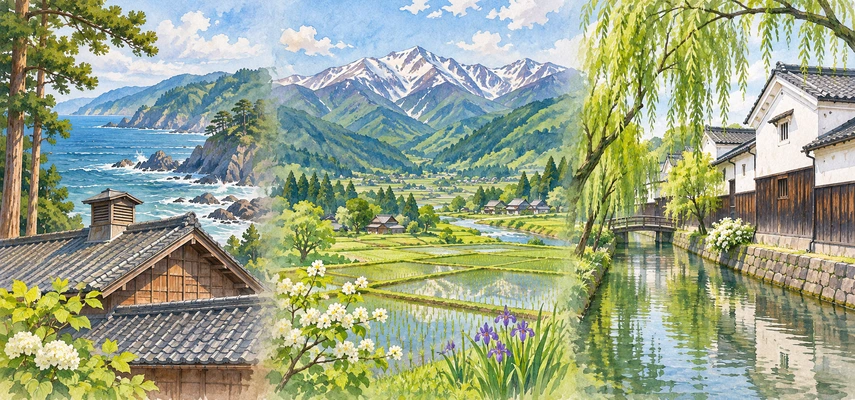

Sake regions become more interesting when they stop behaving like three adjectives on a revision card. Ishikawa, Nagano and Kyoto offer coastal, alpine and historic urban brewing contexts. Their reputations reflect water and agriculture, but also people, technical adaptation and access to markets. None of the three can be explained by scenery alone.
Start with a simple question: what can a place make easier, and what must a brewer still control? A cool location can assist temperature management without choosing the yeast. An abundant water source can support production without guaranteeing its composition. A skilled brewing community can transmit knowledge without forcing every member to make the same style.
Compare sake regions through mechanisms
The WSET specification includes these three prefectures in regional study. A useful explanation needs more than locating them. Connect a natural or human factor to a production decision and then to a qualified consequence in the finished sake.
For instance, mineral composition can influence fermentation activity, while the brewer adjusts nutrition and temperature to maintain the intended course. Don’t reduce this to soft water equals sweet or hard water equals dry. Sugar supply, yeast performance and the fermentation endpoint also matter, and individual sources vary within a prefecture.
Likewise, traditional skill and modern research need not compete. Experienced brewers can use measurement and cooling equipment, while technical institutions can study inherited practices. Regional identity can develop through that interaction rather than remaining a preserved recipe that no producer is allowed to change.
Ishikawa connects coastal identity with Noto skills
Ishikawa faces the Sea of Japan and includes the Noto Peninsula as well as Kanazawa and the Kaga area. Treat those as parts of a varied prefecture rather than assuming every brewery draws identical water or shares one local climate. The geographical scale matters before assigning a sensory tendency.
Noto toji are a major human association. The Agency for Cultural Affairs account links their skills with Ishikawa’s brewing culture and discusses rich, mellow expressions. That provides a useful anchor without turning a guild tradition into a compulsory flavor specification.
The mechanism is trained judgment: people manage rice preparation, koji, starters and fermentation in response to actual materials. A toji’s experience can help maintain control through a changing season or an unfamiliar batch of rice. The guild name itself isn’t an enzyme or aroma compound entering the tank.
Don’t flatten Ishikawa into one traditional style
Fuller palate and savory character are useful possibilities to investigate, particularly when production information points toward them. But Ishikawa also produces aromatic and delicate expressions. A regional tendency should help you ask better questions rather than forbid the sample from showing something different.
The Ishikawa brewers association presents the region through its producers and continuing craft. Read an actual product’s rice, starter and finishing information before attributing its texture entirely to the prefecture. A yamahai label can add a relevant production clue, but it doesn’t prove a fixed acidity or maturity level.
Be careful with contemporary claims about access or operations. A historical brewing account doesn’t establish that a particular facility is currently open or producing after disruption. This lesson explains regional factors; it doesn’t use an old directory as a live travel or production-status report.
Nagano brings the alpine interior into the story
Nagano lies inland among high mountain ranges. Its geography creates varied growing sites and water catchments, along with cold-season brewing conditions. The important comparison with coastal Ishikawa is not simply higher elevation equals better sake. It is how the local environment and materials influence the practical options.
The NTA Nagano specification describes a sake profile combining substantial rice-derived flavor with clean, gentle aroma. The same page includes wine information, so use the sake section for sake claims. Shared place names don’t make grape-growing requirements relevant to rice fermentation.
Cold conditions can help maintain a suitable brewing environment, but the brewery still monitors the mash and manages the chosen temperature course. Modern equipment also extends control beyond the outdoor season. Climate explains part of the historical setting and practical opportunity, not an unavoidable temperature in every tank.
Nagano rice links agriculture and brewing
Miyamanishiki is a useful rice association for Nagano. The NRIB ingredient overview places it among important sake-rice varieties and identifies Nagano among its growing areas. This gives a concrete agricultural anchor without claiming the variety is used nowhere else.
Rice suited to local growing conditions still needs appropriate processing. Grain quality, polishing behavior, water uptake and digestion all affect what the brewery can do. Knowing the variety doesn’t let you skip soaking control or predict the exact sweetness and aroma of the bottle.
For a regional explanation, show the link between agricultural suitability and a production objective. A reliable local rice supply can support a regional product plan, while the brewer’s polishing, koji and fermentation choices shape the final expression. Local origin and finished flavor aren’t interchangeable facts.
Kyoto is larger than Fushimi
Kyoto prefecture contains more than one brewing setting, but Fushimi is the essential regional anchor here. It developed as a major brewing center with important water resources and historical transport connections. A Fushimi example shouldn’t be presented as a complete description of every sake made elsewhere in the prefecture.
The Fushimi brewers’ guide explains the district through water and sake culture. The place supplied both a practical production resource and access to a wider commercial world. Demand, movement of goods and accumulated expertise help explain a center’s importance alongside its wells.
This is a useful contrast with a romantic account in which geography alone does everything. A good water supply doesn’t organize distribution, train staff or decide the product range. Those are human and commercial choices, and they can influence which styles become widely associated with a place.
Fushimi water supports a familiar reputation
The Japan Tourism Agency description links Fushimi springs with a rounded, mellow sake reputation. Such historical descriptions are useful context, provided they aren’t mistaken for an analytical rule. An individual product can be drier, more aromatic or differently textured than the stereotype suggests.
Water influences the brewing environment through its composition. The brewer works with that composition, rice and microorganisms to obtain the desired fermentation. Saying a mellow sample tastes that way solely because the water is soft leaves the rest of the causal chain unexplained.
Older regional writing sometimes uses gendered nicknames to contrast Fushimi and Nada. These are historical metaphors, not technical tasting categories. Use precise terms such as body, acidity, texture and aroma intensity when describing the actual sake, rather than treating a nickname as a measurable property.
The three anchors overlap rather than compete
Ishikawa offers a strong Noto skills association; Nagano makes mountain resources and rice adaptation easy to discuss; Kyoto’s Fushimi illustrates water, commerce and a long-established brewing center. All three also involve the other factors. A useful comparison emphasizes different anchors without pretending only one region has skilled people or good water.
The same principle applies to quality. A region can support excellent production without guaranteeing every bottle’s condition or balance. Transport, storage and service still matter. Regional prestige doesn’t repair a heat-damaged sample, and an unfamiliar producer isn’t automatically less capable than a famous district.
Separate origin, designation and sensory evidence
A producer address confirms an address, while a protected geographical indication has defined conditions and management. Named rice origin is another claim. Don’t assume that every grain came from the prefecture simply because the brewery is located there, or that every local product uses a GI.
Special designations such as junmai ginjo also answer a separate question. Two samples from the same prefecture may have different ingredients, polishing, heat history and maturation. Those differences can be more immediately apparent than the regional tendency the tasting was intended to explore.
Try a controlled comparison
Choose three examples with broadly comparable production descriptions and serve them at a consistent starting temperature. Record what is actually known about rice, alcohol strength and heat history. Then taste without the regional labels visible and describe the samples before explaining possible influences.
After revealing the origins, compare observations with the regional accounts. If an Ishikawa example is particularly delicate, don’t mark the tasting wrong because a revision card said rich. Ask which product choices help explain the result. The exercise teaches how regional context and individual decisions interact.
For written revision, make one factor-to-mechanism chain for each prefecture and add one limitation. This produces explanations that travel well across questions: natural conditions create opportunities, while people select and manage the production. The limitation prevents a memorable association from becoming an unsupported guarantee.
Keep a separate note for the geographical scale of each claim. Noto is a peninsula and brewing tradition, Nagano is a prefecture, and Fushimi is a district within Kyoto. Comparing them is useful only when that difference in scale remains visible rather than being quietly erased.
Set these places beside the northern prefectures and Hyogo, Nara and Hiroshima. Connect regional context to actual samples using the comparative regional tasting method.
One-page revision summary
Link Ishikawa with Noto skills and varied coastal brewing settings, Nagano with alpine resources and rice such as Miyamanishiki, and Kyoto with Fushimi water and brewing commerce. Explain practical consequences, qualify style tendencies and keep actual product facts separate from general reputations. Use the glass to test an expectation, not merely repeat it.
Written practice: original TFE exercises
These suggested marks and indicative points are independent teaching guidance, not official WSET marking schemes.
Exercise 1: 5 suggested marks
Explain how natural and human factors interact in Fushimi rather than assigning all style to soft water. Mapping: Unit 1 LO2.
Indicative marking points:
- Fushimi has significant groundwater resources.
- Water composition affects the fermentation environment.
- Brewers manage rice, yeast and temperature in response.
- Historical commerce and accumulated skills support the brewing center.
- A mellow reputation is a tendency, not a guarantee for every product.
Model answer: Fushimi groundwater provides a useful resource whose composition affects fermentation. Brewers still coordinate rice, yeast and temperature, while historical trade and accumulated skills support the center. These combined factors help explain a mellow reputation, but neither the water nor the place name fixes every bottle’s style.
Why it works: It connects a resource to practical control and a human setting, then qualifies the sensory result.
Common mistake: Writing that soft water alone guarantees sweetness or that every Kyoto product is identical to a Fushimi example.
Exercise 2: 5 suggested marks
Compare the regional significance of Noto toji and Miyamanishiki without treating either as a fixed tasting note. Mapping: Unit 1 LO2.
Indicative marking points:
- Noto toji supplies a human-skills anchor for Ishikawa.
- Training supports judgment across production.
- Miyamanishiki supplies an agricultural anchor for Nagano.
- Rice suitability still requires appropriate preparation and fermentation.
- Individual production choices mean neither fact guarantees a complete flavor profile.
Model answer: Noto toji represents inherited and transmitted skills associated with Ishikawa, helping brewers manage production. Miyamanishiki is an important rice association for Nagano, linking agriculture with suitable raw material. Both matter, but processing and fermentation choices still determine the individual expression, so neither is a complete tasting note.
Why it works: It distinguishes a human factor from an agricultural one and explains how each enters the production chain.
Common mistake: Treating a guild as a rice variety or assuming a named rice guarantees one aroma regardless of fermentation.
Knowledge check: 10 original practice questions
Independent TFE questions, not official WSET examination items. Choose one answer per question; explanations follow separately.
1. What can mountain climate support in Nagano?
2. Which distinction is correct?
3. What improves a regional tasting comparison?
4. Which Kyoto district is the central brewing anchor here?
5. Which association is most directly relevant to Ishikawa?
6. A delicate Ishikawa sample contradicts a rich regional stereotype. What follows?
7. Which rice is an important Nagano association?
8. Why are old gendered regional nicknames limited?
9. How should a rich Ishikawa reputation be interpreted?
10. Why discuss trade alongside Fushimi water?
Answers and explanations
1. D — A useful setting for controlled cold-season brewing.. The brewery still selects inputs and manages fermentation rather than receiving a finished style from the climate. Mapping: Unit 1 LO2 regional factors.
2. A — Brewery address, rice origin and GI eligibility are separate claims.. Each claim requires its own evidence rather than being inferred from another label fact. Mapping: Unit 1 LO2 regional factors.
3. B — Recording production differences and controlling the starting service conditions.. Other variables can confound the comparison unless they are considered. Mapping: Unit 1 LO2 regional factors.
4. A — Fushimi.. Fushimi is an important Kyoto brewing center, not a synonym for every part of the prefecture. Mapping: Unit 1 LO2 regional factors.
5. B — Noto toji skills.. Noto is the useful Ishikawa human-factor anchor, without making every local sake identical. Mapping: Unit 1 LO2 regional factors.
6. C — Investigate individual production choices rather than dismissing the observation.. Actual sensory evidence takes precedence over an overgeneralized revision shorthand. Mapping: Unit 1 LO2 regional factors.
7. C — Miyamanishiki.. Miyamanishiki links Nagano agriculture with sake production, while also being grown elsewhere. Mapping: Unit 1 LO2 regional factors.
8. D — They are historical metaphors rather than technical measurements.. Precise observations of body, aroma and balance are more useful for the actual sample. Mapping: Unit 1 LO2 regional factors.
9. C — As a tendency to investigate alongside the individual product.. Regional reputation informs expectations without replacing product facts and tasting evidence. Mapping: Unit 1 LO2 regional factors.
10. B — A brewing center also develops through markets, transport and skills.. Natural resources and human organization explain different parts of the regional story. Mapping: Unit 1 LO2 regional factors.












