










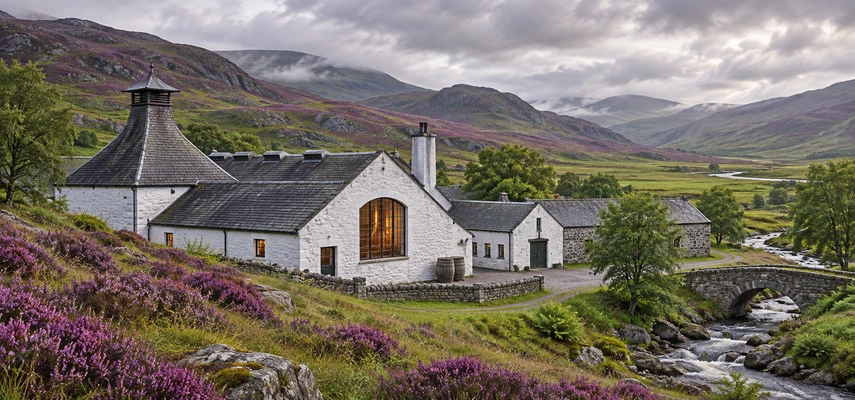

A delicate floral whisky and a deeply smoky one can both be single malt Scotch whisky. So can two bottlings from the same distillery that emphasize very different fruit and oak characters. The category supplies a production identity, not a fixed aroma. The interesting task is to explain which choices operate inside that identity.
Begin with the rules, then follow malt preparation, fermentation, pot still operation and maturation. This order prevents two common mistakes: treating every single malt as smoky, and treating the word “single” as proof that the bottle came from one barrel. Neither conclusion follows from the category alone.
What single malt Scotch whisky actually identifies
Single Malt Scotch Whisky is made at a single distillery in Scotland from water and malted barley, using batch distillation in pot stills. The broader Scotch rules require Scottish production and maturation, distillation below 94.8% alcohol by volume, at least three years in oak casks no larger than 700 litres, and bottling at no less than 40% ABV. These are category boundaries, not a complete flavor recipe.
The Scotch Whisky technical file sets out the production framework. HMRC’s current guidance explains the verification system that supports compliance. Use those sources to distinguish requirements from attractive but optional production stories. A legal category cannot be established merely by describing a Scottish-looking label.
“Single” refers to the distillery, not one cask, one year or one malt variety. A single malt bottling can combine appropriate casks from that distillery. “Malt” identifies the malted-barley basis, rather than a guarantee of an especially malty aroma. Keeping these terms precise leaves the sensory assessment free to describe the actual spirit.
Malt preparation establishes the substrate and some precursors
Malted barley supplies starch and the enzyme activity needed to prepare usable sugars through the relevant process. Milling exposes material; mashing brings it together with water under suitable conditions. Conversion and extraction produce wort for fermentation. Those functions matter even when a brand’s story concentrates more on its picturesque stills.
The malt’s treatment can also influence material that reaches later stages. Different drying or roasting histories can change flavor-related compounds and enzyme performance. A distiller therefore considers both processing suitability and the character desired. Selecting malt isn’t only choosing a cereal name; it is choosing prepared material that must work within a production system.
Don’t assume that every difference in the grain will survive unchanged into the bottle. Fermentation, distillation and maturation can transform or rebalance its contribution. The strongest explanation follows a plausible pathway and names its limitations. “You can taste the field” is a conclusion requiring evidence, not a substitute for describing what the process actually did.
Peat is a choice with several consequences
When peat smoke is used in malt drying, smoke-derived compounds can influence the malt and subsequently the spirit. The degree and character depend on the material, treatment and later processing. A peated malt’s specification is information about a starting material, rather than a direct measurement of the finished whisky’s perceived smokiness.
Many single malts use unpeated malt. Others use different amounts or expressions of peat-related character. Even within peated whisky, smoke may sit alongside fruit, cereal, medicinal or earthy impressions in different balances. “All Scotch tastes smoky” collapses a varied category into one production option and makes comparison less useful.
Likewise, smoke intensity doesn’t establish quality. A powerful smoky spirit can be balanced and expressive or blunt and poorly integrated. A gentle spirit can be detailed and persistent or simple and short. Evaluate how its elements work together before deciding whether a production choice was successful for the intended style.
Fermentation contributes more than the required alcohol
Yeast uses the wort’s available sugars to produce ethanol, carbon dioxide, heat and other compounds. Strain, nutrient environment, temperature and duration influence its performance and the mixture supplied to the still. Congeners and precursors created here can contribute to later aroma, even though the fermented wash is very different from matured whisky.
Longer fermentation may allow additional microbial and chemical development under appropriate conditions. It is not automatically better, and time by itself doesn’t identify which organisms were active. Ask what changed in the environment and composition, then how the distillation strategy might retain or alter that contribution. The clock isn’t doing the entire job.
The Glasgow Distillery’s production account offers a concrete example of coordinated malt, fermentation and distillation choices. It describes different production styles at one distillery. That illustrates why the legal identity can remain constant while operational decisions produce different starting profiles for maturation.
Pot distillation selects from a changing mixture
In common Scottish double distillation, the first run takes wash to low wines, and the spirit run permits selection of the desired heart. Other arrangements exist, so double distillation should be described as common practice rather than the defining requirement of every single malt. The legal requirement concerns batch pot distillation, not one compulsory number of runs.
Still shape and operation influence vapor movement, heat loss, reflux and contact. Reflux returns condensed liquid within the equipment, supporting further separation. The effective result depends on the working system, not just the height visible in a photograph. Two apparently similar stills can deliver different outcomes when feed and operation differ.
Copper contact can influence certain sulfur compounds, while cuts affect which portions of the changing stream are retained. These are different mechanisms. Explain contact, separation and collection individually before bringing them together. Calling a spirit “clean” without saying what changed can conceal that several quite different processes might have contributed.
Cut choices create a style before oak enters
Heads, heart and tails are mixed portions of a distillation run. Changing the selected heart changes the balance entering maturation. That can influence aromatic weight, fruit-associated impressions and other sensory aspects, depending on the actual compounds retained. It does not follow that one universal cut width makes every distillery’s best spirit.
Consider two hypothetical new makes from otherwise comparable conditions. One collection strategy retains more of a later portion, while another excludes it. Their resulting mixtures can differ. To assess quality, examine the sensory consequences and intended cask plan, rather than assuming that a narrower cut is inherently more sophisticated or more expensive-tasting.
The producer also needs repeatable control. A successful style is difficult to maintain if feed conditions and collection decisions vary without suitable assessment. Technical consistency doesn’t demand that every whisky be light or neutral. It means managing the process to reproduce the character intended, including substantial character where that is the goal.
Oak selection can preserve or overwhelm that character
Maturation combines extraction, reactions and evaporation. Cask size, preparation, previous contents, refill history and warehouse conditions influence the spirit. A very active cask can provide a strong contribution; a repeatedly used vessel may work more gently. Either can be appropriate if matched to the new make and desired outcome.
A former wine or spirit cask brings its own history. The label’s cask description doesn’t establish identical composition across every example, because preparation and subsequent use matter. Two casks bearing the same broad description can influence spirit differently. Useful records and actual assessment are more informative than assuming every cask name predicts a complete tasting note.
The SWA’s allowable-cask guidance describes category constraints, including requirements concerning previous use and empty casks before filling. A permitted cask influence is not permission to add the former drink directly. Finishing in a later vessel remains part of a regulated production history, not a loophole around the identity of Scotch.
Age tells you less than it first appears
Where an age statement is used, it concerns the youngest whisky included under the applicable rules. It doesn’t mean every component has precisely the stated age, and it doesn’t describe the activity of every cask. A bottling assembled from several histories can therefore carry a simple age statement without having a simple maturation story.
Longer time may support desirable development, but can also create excessive wood influence or other imbalance. Compare spirits through their observed balance and persistence, not age alone. A younger example can suit its target well, while an older one can be less coherent. Age is a production fact; quality is a supported evaluation.
Final preparation changes the presentation
Appropriate cask selection and combining can pursue a bottling profile. Strength adjustment and permitted coloring affect aspects of presentation, while filtration choices can influence appearance and retained material. Scotch does not permit arbitrary flavoring or sweetening merely because another spirits category uses those techniques. Always bring the legal identity back into a proposed production explanation.
Higher bottling strength doesn’t automatically imply greater quality, and non-chill-filtered isn’t a complete sensory verdict. These are facts about the presentation that deserve interpretation in the glass. A consistent, well-integrated product can be made through different permitted choices. Judge what those choices achieve rather than treating one label phrase as a shortcut to the conclusion.
Build an evidence-based quality answer
Start with concrete observations: the fruit remains distinct, the smoke supports rather than obscures it, the oak feels integrated, or the finish sustains several clear elements. Then explain how plausible production decisions could contribute. Avoid pretending that every observation uniquely reveals its cause; a blind sample rarely supplies a complete recipe.
For a worked contrast, imagine one whisky with intense oak and little remaining fruit, and another with gentler oak, distinct fruit and a sustained finish. The second may support a stronger balance judgment despite being paler. The explanation should connect cask influence with the resulting sensory relationship, rather than rewarding the darkest sample by default.
What to remember
Single malt Scotch identifies one distillery, malted barley and batch pot production within the Scotch framework. Inside those boundaries, peat, fermentation, still operation, collection and oak management create varied styles. Keep law separate from common practice and quality separate from intensity or age. The category starts the explanation; the producer’s choices and the resulting spirit give it substance.
Written practice: original TFE exercises
These suggested marks and indicative points are independent teaching guidance, not official WSET marking schemes.
Exercise 1: 5 suggested marks
Explain why using peat smoke during malt drying can influence whisky style without determining its final quality. Mapping: LO2 explain: processing raw material.
Indicative marking points:
- Smoke supplies relevant compounds to the malt.
- The prepared malt carries material into later processing.
- Fermentation and distillation influence what reaches new make.
- Maturation can alter the balance in the finished whisky.
- Quality depends on integration and suitability rather than smoke intensity alone.
Model answer: Peat smoke can supply compounds to malt during drying. That material enters the later production chain, where fermentation, distillation and collection affect the contribution reaching new make. Maturation changes its context again. The final smoky character can suit a style, but intensity alone does not establish balance or quality.
Why it works: It traces the contribution across stages and keeps a stylistic effect separate from a guaranteed quality judgment.
Common mistake: Treating every smoky whisky as superior replaces sensory assessment with one production preference.
Exercise 2: 5 suggested marks
Explain why choosing a less active cask may help preserve delicate new-make character. Mapping: LO2 explain: post-distillation operations.
Indicative marking points:
- A cask has a particular available wood contribution.
- Previous use can reduce readily available extractives.
- A gentler vessel may add less dominant wood character under comparable conditions.
- This can leave delicate existing aromas more apparent.
- Actual balance depends on the spirit, vessel condition and time.
Model answer: Repeated previous use can reduce the readily available wood contribution of a cask. A gentler vessel may therefore add less dominant oak influence, allowing delicate existing aromas to remain distinct. This is a plausible matching decision, not a guarantee: the actual spirit, cask condition and maturation duration determine the final balance.
Why it works: It links cask history to extraction and sensory balance while preserving the conditions needed for a defensible comparison.
Common mistake: Assuming every old or reused cask behaves identically ignores differences in its actual condition and history.
Knowledge check: 10 original practice questions
Independent TFE questions, not official WSET examination items. Choose one answer per question; explanations follow separately.
1. What is the maximum permitted oak-cask capacity for Scotch maturation?
2. Which statement about peat is correct?
3. Which raw-material basis defines single malt Scotch?
4. Which observation best supports quality reasoning?
5. What does single identify in Single Malt Scotch Whisky?
6. Why does a malt phenol specification not directly equal perceived bottle smoke?
7. What does an age statement generally identify?
8. What is the minimum Scotch maturation period?
9. Which distillation arrangement defines the category?
10. Which distinction is correct?
Answers and explanations
- D — 700 litres. The general Scotch maturation framework specifies oak casks no larger than 700 litres. Mapping: LO2.
- C — It is a production choice rather than a requirement for every single malt. Peated and unpeated approaches can both produce single malt Scotch, with quality assessed from the resulting balance. Mapping: LO2.
- B — Water and malted barley. The single malt category has a malted-barley basis, distinct from permitted other-cereal grain Scotch production. Mapping: LO2.
- B — Distinct fruit and integrated oak with a sustained finish. Sensory relationships and persistence supply evidence, whereas isolated production or presentation facts do not settle quality. Mapping: LO2.
- B — Production at one distillery. Single refers to distillery identity, not a guarantee that the bottling represents only one barrel or year. Mapping: LO2.
- C — Later processing and sensory context change the relationship. A starting-material measure cannot describe all the selection, maturation and perception that follow. Mapping: LO2.
- A — The youngest whisky included under the applicable rules. The statement does not claim every component has one identical age or cask history. Mapping: LO2.
- C — Three years. The Scotch framework requires at least three years in the specified oak-cask conditions, not merely storage for any period. Mapping: LO2.
- B — Batch distillation in pot stills. Batch pot distillation is required; the commonly used double-distillation pattern is not the only possible arrangement. Mapping: LO2.
- A — Double distillation is common; batch pot production is the category requirement. Separating a common operating example from the legal definition avoids excluding valid alternative single malt arrangements. Mapping: LO2.
Continue exploring this series
5. Distillation Science Explained: Volatility, Congeners, Reflux, and Rectification
6. Pot Still Distillation Explained: Design, Heating, Cuts, and Flavor
9. Oak Maturation Explained: Barrels, Oxygen, Evaporation, and Flavor Development
10. Spirits Finishing Explained: Blending, Filtration, Sweetening, Coloring, and Packaging
11. How Grains Become Whisky: Malting, Mashing, Enzymes, and Starch Conversion
13. Grain and Blended Scotch Whisky Explained: Production Choices, Laws, and Style
29. Spirits Quality Explained: How Production Decisions Affect Balance and Complexity
47. How to Assess Spirits Quality: Balance, Complexity, and Evidence
50. WSET Level 3 Spirits Exam: Complete Revision Guide and Practice Examinations












