










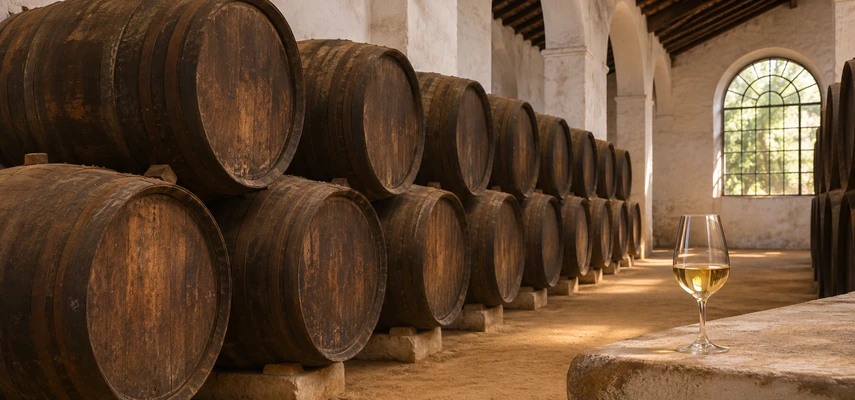

Sherry production makes more sense when you follow two living things: the vine outside the bodega and the yeast inside it. Palomino provides much of the region’s dry base wine, while flor can transform that wine during maturation. Between them sit decisions about pressing, fermentation, classification, alcohol and the movement of stocks through the cellar.
That isn’t the only Sherry story. Oxidative maturation, sweet-wine production and static ageing offer other routes. The aim here is to explain the production choices behind those differences, then connect them to style, quality and the economics of keeping wine for years.
Locate the vineyard and the ageing cellar separately
The Sherry region lies in south-western Spain around Jerez de la Frontera and neighbouring coastal and inland towns. Atlantic influence matters, but a vineyard farther inland doesn’t experience precisely the same conditions as a coastal cellar. The familiar Jerez, El Puerto de Santa María and Sanlúcar triangle is a useful reference, not a complete current boundary for every protected operation.
The distinction between grape origin and ageing location is particularly important for Manzanilla. Its protected identity depends on biological ageing in Sanlúcar de Barrameda. That doesn’t mean every grape must come from within the town itself. Keep the production area and the required maturation location as separate facts in a written answer.
Within the wider area, pagos identify smaller vineyard settings with their own combinations of soils and mesoclimate. A place name can narrow the explanation, but it doesn’t establish a finished wine’s quality without considering the fruit, production choices and actual bottle.
Explain albariza through water rather than a flavour slogan
The region has hot, dry summers, with much of its rain arriving outside the main ripening period. Atlantic influence and the contrasting Poniente and Levante winds modify conditions. The regulator’s viticulture account describes albariza’s water-retaining role alongside other local soils. The practical question is how a vine accesses moisture through a dry summer.
Water stored from the wetter months can support growth when summer rain is limited. That doesn’t make vines immune to drought, heat or poor management. Rooting conditions, soil structure, canopy, crop and the season all affect the balance between available water and demand.
Growers also need to manage disease and fruit health, particularly when humidity or rain creates pressure. Canopy ventilation, appropriate nutrition and timely harvest remain relevant. A pale soil doesn’t deliver a finished saline flavour directly through a root; connect the environment to vine performance before making a sensory inference.
Palomino is central, but check the authorised varieties
Palomino is central to dry Sherry production. Its relatively restrained aromatic profile leaves room for vineyard differences and maturation character to become apparent. That doesn’t make the grape irrelevant: ripeness, acidity, health and extraction still shape the base wine available for selection.
The current Jerez specification lists more than the familiar Palomino, Pedro Ximénez and Moscatel trio, including Beba, Perruno and Vigiriega. Don’t turn a description of established practice into an assertion that only three grapes are legally authorised. Exact eligibility also depends on the protected wine being made.
Pedro Ximénez and Moscatel are important for sweet expressions, with different fruit and production objectives from dry Palomino-based wine. Drying or overripeness can concentrate sugar and other constituents. That creates another reason to establish the intended style before describing harvest timing or fermentation.
Pressing and fermentation create the first selection choices
Fruit reception establishes identity, quantity and condition. Crushing and pressing release must, while separate fractions can differ in phenolic material and other components. The vinification account explains why pressing decisions influence the suitability of base wines for different maturation routes. Avoid assuming every fraction is interchangeable or that maximum extraction is always the objective.
Clarification and permitted must adjustments help establish suitable fermentation conditions. The producer needs sound fermentation and a clean base wine, not merely a liquid with the right alcohol reading. Neutral tanks offer control and volume; some producers use casks for particular wines. Vessel choice should be explained through its consequences rather than treated as a badge of authenticity.
Dry-wine fermentation consumes the available fermentable sugar to the intended dry endpoint. Classification then considers the actual wine’s character and suitability. A lighter, finer base may be selected for biological ageing, while another batch suits oxidative development. Selection continues as the wine evolves; the first decision isn’t a promise that every batch will remain unchanged forever.
Distinguish traditional fortification from current legal eligibility
Traditional dry Sherry production often uses fortification after fermentation to guide ageing. Around 15% ABV has been a familiar biological-ageing example, while higher-strength wine can be directed towards oxidative maturation. The regulator’s fortification explanation describes that traditional relationship.
Current law needs a separate statement. The May 2026 Jerez file recognises both wine and liqueur-wine categories, and its Fino table allows 14–17% ABV. The current Manzanilla specification also allows 14–17% and recognises both categories. A traditional example isn’t a universal requirement that every protected bottle must have spirit added or be at least 15%.
For an individual wine, establish what actually happened. Fortification can raise strength to support the chosen process or adjust it later, while a qualifying wine may reach the relevant conditions without that addition. Don’t confuse alcohol’s role in cellar management with a claim that alcohol alone creates the desired style.
Flor is a living film with a metabolic role
Flor consists of specialised yeasts forming a film at the wine’s surface. It isn’t a layer of sugar, sediment or added mould. During biological ageing, those yeasts operate within a demanding environment and influence both oxygen exposure and wine composition.
The regulator’s flor discussion explains the consumption of compounds including ethanol and glycerol and the formation of acetaldehyde. These changes help explain the distinctive aroma and leaner texture associated with biologically aged wines. They don’t require every bottle to smell identically or support an aroma diagnosis from one compound alone.
Flor needs access to oxygen, so a cask is managed with appropriate headspace rather than filled and sealed as though the objective were complete oxygen exclusion. Temperature, humidity, nutrients and wine composition influence the film. The producer manages those conditions; a photograph of an old barrel cannot prove that flor inside it is healthy.
The bodega helps create a workable environment
Traditional bodega architecture can moderate a climate that is much hotter outside than ideal maturation conditions inside. High spaces, orientation, ventilation and shading influence temperature and air movement. The bodega account also describes the use of albero flooring and moisture management.
Think of the building as part of the production system. A cellar team must monitor wine and conditions, maintain vessels and respond to seasonal changes. Architecture reduces some pressures; it doesn’t eliminate the need for attention or make every part of every building identical.
These choices also cost money. Maintaining suitable premises, old casks and skilled staff adds to the expense of holding wine. Longer ageing increases the amount of stock and working capital needed to sustain a given annual release, even before considering evaporation or slow sales.
Follow the transfers through criaderas and solera
The ageing explanation describes a fractional system. A saca withdraws part of wine from a mature stage; replenishment, or rocío, brings in wine from a younger stage. The solera is the final ageing stage used for withdrawal, while criaderas provide the replenishing stages.
The system can maintain continuity while allowing younger wine to contribute to the evolving blend and biological environment. The proportion transferred matters. Removing and replacing a large share produces a different stock relationship from moving a small share. Counting rows of barrels doesn’t give you a reliable average age.
The stages needn’t all sit directly above one another. Nor does a founding date establish the age of every drop. Describe the transfer logic first, then consider age controls, stock records and the actual wine. Static añada maturation is another permitted route, so solera isn’t a compulsory description of every protected Sherry.
Compare biological and oxidative development
Biological ageing shapes a wine through flor’s activity; oxidative ageing proceeds without a protective film through the intended exposure to oxygen. These routes can produce different colour, aroma, texture and flavour. Amontillado combines biological and subsequent oxidative development, whereas Oloroso’s ageing identity is oxidative. Neither dry style becomes sweet merely because it is darker or more developed.
For quality, ask whether the resulting wine is sound, defined, balanced and persistent. An intense aldehydic note, a very dark colour or a long maturation claim isn’t enough by itself. For bottle-ageing, ask what could improve after bottling and whether the wine has the components and condition to support it.
Finishing can include selection, blending, clarification and filtration suited to the product. An en rama description needs context rather than an assumption of literal absence of every processing step. A more lightly treated bottling can communicate a particular expression, but handling and stability still matter.
Explain the business behind the cellar stocks
Sherry supply depends on eligible fruit, yields, base-wine selection and mature stock. Demand depends on occasions, consumer understanding, alternatives and distribution. Costs include vineyards, purchased inputs, labour, buildings, casks, evaporation, financing, packaging and selling. A small annual withdrawal from valuable old stocks cannot be priced sensibly by considering only the latest harvest’s grapes.
A grower selling fruit differs from an estate retaining it. A merchant or shipper may buy base wine or mature components; a co-operative can pool production and services. Conglomerate ownership can provide investment and distribution. Wine brands can combine these arrangements, so ownership alone doesn’t determine the finished wine’s quality.
Marketing connects product, price position, people, placement and promotion. A fresh biologically aged wine sold through restaurants needs staff able to explain service and style. An older oxidative bottling may target a different customer or occasion. Tourism, specialist retail and broader distribution have different selling costs and margins; they aren’t interchangeable routes to the same net return.
The Consejo Regulador protects and controls the relevant origins. It isn’t the same organisation as the IVDP for Port and Douro or IVBAM for Madeira. The Muscat of Rutherglen Network provides another kind of collective classification and promotion context. Understanding their different roles prevents a shared fortified-wine chapter from becoming an imaginary shared regulator.
Translate the process into tasting evidence
Record clarity, colour depth and hue, plus sediment or other appearance features. Assess nose condition before aroma strength and specific character. On the palate separate sweetness, acidity, tannin quantity and texture where relevant, alcohol warmth and body. A dry wine can have nutty or dried-fruit aromas without becoming a sweet wine.
Distinguish flavour strength from flavour character, note viscosity and other tactile features, and follow the persistence of identifiable flavour. Make one scale choice where instructed; illustrative descriptors guide observation rather than require every example. Explain quality through the combined evidence. Justify bottle-ageing suitability independently, identifying a plausible improvement rather than assuming that years in a solera guarantee years of improvement in glass.
Use Sherry styles and fortified production methods to test the production explanation. Separate the effects of fermentation, fortification and maturation, then explain which differences matter to sweetness, flavour, quality and the resources tied up before sale.
Original Diploma practice
These original tasks use indicative points and outline answers, not official questions or marks. Proposed wines are sourcing targets; no actual tasting or verified grades are claimed.
Question 1: explain a biological-ageing route
Explain how a Palomino base wine can become a biologically aged Sherry. Include vineyard water, pressing, fermentation, classification, alcohol conditions, flor and cellar management.
Indicative points: stored soil moisture; extraction; dry base; selection; current eligibility; yeast metabolism. Outline answer: The process depends on suitable fruit and a sequence of controlled decisions. Flor transforms a sound base wine within suitable conditions rather than rescuing any wine placed in an old barrel.
Question 2: correct three production claims
Evaluate these claims: all Sherry must be fortified to at least 15%; only three grapes are authorised; every solera bottle has the age of the founding date.
Indicative points: current specifications; categories; Fino range; broader varieties; fractional replenishment; age evidence. Outline answer: Each claim confuses familiar practice with a universal rule. Use the current legal files and the transfer process to explain the correction without denying the importance of traditional methods.
Question 3: connect maturation with price
Explain how a producer’s decision to release smaller volumes from older stocks affects supply, costs, price position and marketing. Keep sensory quality separate.
Indicative points: withdrawals; capital; evaporation; premises; demand; channels. Outline answer: Limited release and long holding can raise cost and support a particular proposition, but customers must value it. Quality still requires evidence of balance, definition and persistence.
Analytical tasting preparation: compare maturation routes
Source a good-to-very-good Fino or Manzanilla and a good-to-very-good Oloroso, reflecting essential study selections. An en rama Fino or Manzanilla targeting very good quality is optional. Preserve those alternatives and statuses rather than making every named style compulsory in one session.
Indicative points: condition; sweetness; texture; development; quality; ageing. Outline answer: Conceal identities and write full notes before the reveal. Use the production information to test the explanation, while treating the target grades as sourcing intentions rather than conclusions established in advance.












