










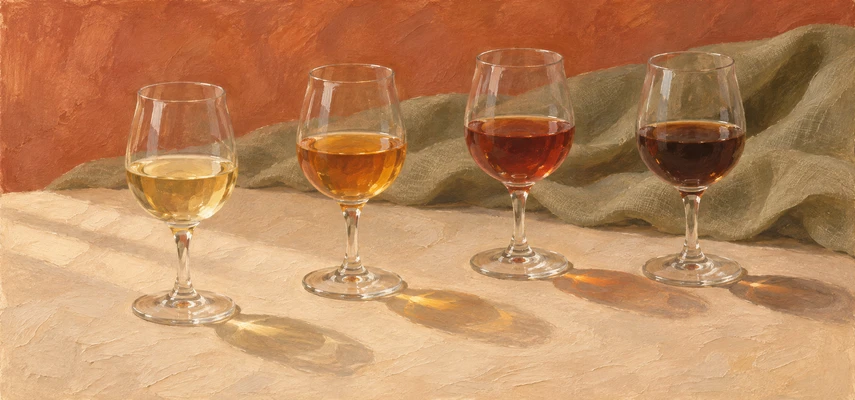

Sherry styles are easier to understand when you ask two questions separately: how did the wine age, and why is it dry or sweet? Colour helps you observe the result, but it doesn’t answer both questions. A mahogany Oloroso can be dry; a pale blended Sherry can be sweet. The glass is under no obligation to follow the usual colour code for desserts.
Begin with biological ageing, move through oxidative development and then examine sweet-wine production and blending. That sequence connects names to processes without turning a varied family into a ladder from pale and simple to dark and superior.
Fino: biological ageing with a dry foundation
Fino is a dry style defined by biological ageing under flor. Palomino is its familiar grape foundation, while pressing, dry fermentation, selection and maturation influence the result. Flor contributes its own aromatic and textural effects rather than merely preventing a wine from changing.
In tasting, expect to investigate yeast-related, apple-like or nutty impressions alongside the wine’s other character. Those are possibilities to assess, not compulsory aromas to copy. The palate may feel lean, with alcohol, dryness and the effects of flor contributing differently from the rounded texture of some oxidatively aged wines.
Current eligibility must be distinguished from older summaries. The May 2026 Jerez specification allows Fino at 14–17% ABV and recognises wine as well as fortified liqueur-wine categories. It also permits static añada maturation alongside fractional systems. Don’t insist that every Fino is fortified to 15% and necessarily comes through the same cellar arrangement.
Manzanilla: a protected ageing location matters
Manzanilla shares the biological-ageing story but has its own protected identity centred on maturation in Sanlúcar de Barrameda. The town’s coastal setting and cellar conditions support a distinctive production context. That isn’t a requirement that every grape be grown inside the town, nor proof that the wine contains seawater.
The current Manzanilla specification requires biological ageing in local bodegas and sets a 14–17% ABV range. It also recognises both wine and liqueur-wine categories. Keep the current conditions separate from a traditional fortification example on an older introductory page.
Compare actual bottles before drawing a categorical sensory border between Fino and Manzanilla. Both can be dry, flor-influenced and expressive, while producer, age, handling and bottle condition add variation. A saline impression is a tasting description, not a laboratory explanation of how the Atlantic entered the glass.
Amontillado: two ageing phases, one dry wine
Amontillado begins with biological ageing and subsequently develops oxidatively after flor disappears. Its style therefore combines a history under flor with later oxygen-related development. The relative contributions can vary, so two examples needn’t show identical proportions of pungency, nutty character and richness.
Colour can move towards amber, while aromas and flavours may suggest nuts, herbs, wood or other developed notes. Explain those observations through the combined maturation history, without claiming that one aroma establishes a precise number of years in each phase.
Amontillado is a dry Sherry identity, not the name for adding sweetness to a Fino. If a seller uses a historical or informal sweetness description, check the actual current label and category. A sweet blended wine and a dry Amontillado can share some base-wine history without being interchangeable styles.
Oloroso: oxidative character doesn’t mean sugar
Oloroso follows oxidative maturation as its defining ageing route. Selection and alcohol management direct the wine towards that development rather than sustained ageing beneath flor. Cask conditions, time, blending and concentration then help shape its character.
An Oloroso may show deeper amber-to-mahogany colour, nutty and developed aromas and a broader texture than a young biologically aged wine. Those tendencies don’t remove the need to assess the actual bottle. Nor does a rounded texture mean residual sugar has made it sweet.
A dry Oloroso can also be a component in a sweet blend. Once a producer makes that different product, the sweetness needs a separate explanation. This distinction is useful in blind tasting: dried-fruit aromas and body can suggest richness while the palate still supplies clear evidence of dryness.
Palo Cortado: resist the automatic accident story
Palo Cortado is associated with a fine aromatic expression and a fuller, oxidative palate. The regulator describes a selection process in which cellar tasting identifies a wine’s direction. Current legal wording identifies predominantly oxidative ageing after the disappearance of an initial flor film.
Don’t reduce every example to a mysterious accident or a failed Fino. Selection, decisions and stock management remain part of the explanation. A romantic production story may be memorable, but it doesn’t establish exactly what happened to a particular batch.
Palo Cortado also isn’t a universal quality grade above Amontillado or Oloroso. It describes a style identity within the applicable framework. A tasting conclusion must still account for condition, balance, definition and finish rather than award points for the unusual name.
Naturally sweet Sherry: begin with the must
Pedro Ximénez uses raisined fruit to provide highly concentrated must. Fortification prevents or arrests fermentation so that substantial grape sugar remains, followed by oxidative ageing. Raisin, fig, molasses-like and other developed impressions can accompany substantial sweetness and viscosity, with variation between wines.
Moscatel supplies a different aromatic starting point, often with floral and citrus-related character. Its fruit can be used fresh or dried as permitted, so don’t make raisining compulsory for every Moscatel. Fortification and oxidative maturation still need to be connected to the intended wine.
“Naturally sweet” doesn’t mean unfortified. Here it distinguishes the production route from sweetening a dry base wine. The sugar originates in the grapes, while alcohol addition is an important part of how the producer preserves the desired sweetness. Neither term alone tells you whether the finished balance is successful.
Blended sweet styles: three different propositions
Pale Cream combines a biologically aged foundation with sweetness, commonly using rectified concentrated grape must to retain a pale appearance. It isn’t a cream-containing drink. Its character depends on both the base wine and the finishing balance, rather than sweetness simply concealing the production history.
Medium covers a substantial sweetness range and can use bases with biological and oxidative influence. Don’t assume the name describes one precise sugar level or one compulsory base-wine recipe. Read the actual wine and label, then describe how sweetness interacts with the developed character.
Cream commonly combines an oxidative foundation such as Oloroso with a permitted sweet component. Its deeper colour doesn’t explain the sweetness on its own. A dry oxidative wine and a Cream may therefore share some aroma associations while requiring different palate observations and production explanations.
The current Jerez table places Pale Cream at 50 to below 115 g/l of glucose and fructose, Medium at 4 to below 115, and Cream at 115–140. Older pages show different boundaries for some styles; use the current operative file when stating a legal threshold. Numbers describe category conditions, not a guarantee of sensory harmony.
Read age and finishing terms in context
Special categories include controlled age claims rather than casual descriptions. VOS and VORS relate to qualified ageing requirements, with control procedures beyond merely printing a large number. Twelve- and fifteen-year indications also have their own framework. A solera’s founding year isn’t a substitute for the required age evidence.
Current files also define Fino Viejo and Manzanilla Pasada through additional conditions, including a minimum average ageing period. Those terms shouldn’t be reduced to an assumption that any slightly darker bottle qualifies. The actual authorised claim matters alongside sensory development.
En rama describes a bottling approach within its context, not an alternative appellation or proof that nothing at all has been done before bottling. Establish the producer’s actual handling. Lighter intervention can offer an interesting expression, but stability, storage and bottle condition still affect what reaches the glass.
Don’t export Sherry’s label system to other fortified wines
PDO identifies a protected origin within its applicable rules. It doesn’t create one shared international ladder for all fortified wines. Sherry labels connect origin, style and controlled ageing claims in their own framework; other regions use different categories even when colour or maturation seems similar.
For Port, Vintage and Colheita indicate different maturation propositions despite both relating to a harvest year. Madeira labels combine their own variety, sweetness and maturation information; they aren’t translations of Fino or Oloroso. In French Vins Doux Naturels, appellation and style terms need their own checks rather than an assumption that “natural” means no added alcohol.
Rutherglen Muscat uses a collective tiered vocabulary including Classic, Grand and Rare. Those are not Sherry age categories or a PDO equivalence. The Australian fortified-wine code offers the relevant classification context. Across all these wines, identify what a term establishes before using it as evidence in a comparison.
Quality, price and ageing answer different questions
Longer maturation requires stocks, premises, monitoring and finance, often with evaporation losses. Strict selection and smaller releases can constrain supply. Customer demand, recognition, channel margins and brand positioning affect the selling price. A producer can incur substantial costs without every customer being willing to pay for them.
Quality depends on the wine’s success within its intended style. A fresh biologically aged wine and a very sweet Pedro Ximénez have different balance problems. Judge how fruit, development, alcohol, sweetness, texture and persistence fit together rather than impose the same sensory ideal on both.
Further bottle-ageing is another judgement. A mature wine released ready to enjoy doesn’t necessarily need more time, and an oxidative history isn’t a guarantee against deterioration. Explain a plausible improvement and its support, or explain why preserving the current expression is the more convincing conclusion.
Build a complete tasting comparison
Record clarity, colour depth and hue, plus sediment or other appearance features. Assess nose condition before aroma strength and specific character. Don’t identify a wine solely from colour: similar shades can arise through different processes, and bottle development adds another variable.
On the palate separate sweetness, acidity, tannin quantity and texture where relevant, alcohol warmth and body. Distinguish flavour strength from flavour character, note viscosity and other tactile features, and follow the persistence of identifiable flavour. A wine’s aroma can suggest sweetness without establishing its measured or perceived sugar level.
Make one scale choice where instructed; illustrative descriptors guide observation rather than require every example. Explain quality through the combined evidence and justify bottle-ageing suitability independently. Reveal the label after the assessment, then use production information to test your explanation rather than rewrite the observations to fit the name.
Use Port production and fortified production methods to test the production explanation. Separate the effects of fermentation, fortification and maturation, then explain which differences matter to sweetness, flavour, quality and the resources tied up before sale.
Original Diploma practice
These original exercises use indicative points and outline answers, not official questions or marks. Suggested bottles and quality levels are sourcing targets; no actual tasting or verified bottle grades are claimed.
Question 1: compare three dry ageing histories
Compare Fino, Amontillado and Oloroso through base wine, biological or oxidative development, likely texture and aroma, and the evidence needed for quality and further ageing.
Indicative points: dry fermentation; flor; two phases; oxidative route; sensory variation; supported conclusions. Outline answer: The styles follow different maturation histories without forming a simple quality hierarchy. Dryness remains compatible with deeper colour and developed aromas.
Question 2: explain two routes to sweetness
Compare Pedro Ximénez with Cream. Explain the must or base wine, fortification or sweetening, maturation and the limits of identifying sweetness from colour.
Indicative points: raisined fruit; retained sugar; dry base; permitted sweet component; oxidation; palate evidence. Outline answer: One route preserves concentrated grape sugar in the sweet-wine process; the other makes a blended sweet style. Similar colour or dried-fruit notes don’t make those processes identical.
Question 3: evaluate label claims
A merchant says that “naturally sweet” means unfortified, VORS proves every drop’s exact age, and Rare Muscat is the Australian equivalent of VORS. Evaluate the claims.
Indicative points: fortification; category context; blend and age controls; separate organisations; classification; tasting. Outline answer: Each term needs its own framework. Similar marketing language doesn’t establish identical production rules, component ages or quality grades.
Analytical tasting preparation: cover the essential choices over time
Plan sessions including Fino or Manzanilla, Amontillado and Oloroso targeting good-to-very-good quality; Medium or Cream targeting acceptable-to-good; Pedro Ximénez targeting very-good-to-outstanding; and a 12-year, 15-year, VOS or VORS Sherry targeting very-good-to-outstanding. These are essential selections, not a requirement to taste every alternative in one sitting. Palo Cortado targeting very-good-to-outstanding and Pale Cream targeting acceptable-to-good are optional.
Indicative points: essential versus optional; alternatives; complete notes; sweetness; quality; ageing. Outline answer: Conceal identities and assess each wine before comparing the styles. Keep the sourcing targets separate from the actual grades justified by tasting, and use several manageable sessions to cover the programme.












