










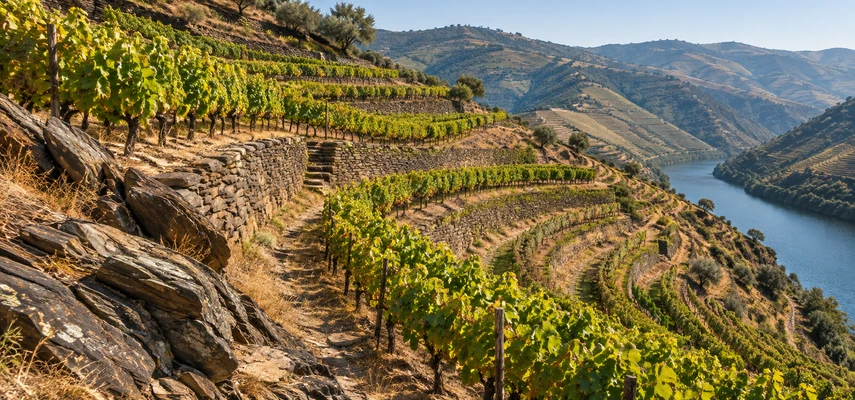

Port production compresses one important job into a short window: extracting the desired colour, flavour and structure before spirit interrupts fermentation. After that interruption, the wine’s future opens into several maturation routes. A fruit-focused Ruby, a cask-developed Tawny and a Vintage intended for bottle development aren’t simply the same liquid wearing different labels.
Follow the chain from Douro vineyard to finished wine. The grapes establish the possibilities, fermentation and fortification shape the young wine, and selection and maturation determine which possibilities are worth pursuing. A famous name or a dramatic terrace photograph can’t complete that explanation on its own.
Start in the Douro rather than the city on the label
Port comes from the demarcated Douro region in northern Portugal. The IVDP’s regional account distinguishes Baixo Corgo, Cima Corgo and Douro Superior. Those subregions provide a useful west-to-east framework, while individual sites vary with elevation, aspect, shelter and position above the river.
Mountains reduce Atlantic influence, contributing to hot, dry summers and cold winters in much of the region. Rainfall generally decreases towards the east. Higher or differently exposed vineyards can supply different fruit from warmer valley settings, so “the Douro is hot” is a beginning rather than a complete answer.
Schist is important across many vineyards, with fractured rock and rooting conditions affecting access to water. Other geological settings also occur. Don’t turn a rock name into a direct flavour prediction or assume that stony soil removes every water constraint. The actual site, soil depth and season determine the vine’s problem.
Steep terrain makes management and cost inseparable
Traditional stone-walled terraces, broader terraces and vineyards planted along slopes create different working conditions. The IVDP’s vineyard account describes the relationship between terrain and vineyard establishment. Slope affects access, erosion management, machinery options and labour, not merely the appearance of a tourism photograph.
Growers must match planting material and varieties to site conditions, then manage crop, canopy and nutrition. Hot, dry conditions can restrict ripening if vines become severely stressed; extra sunshine doesn’t guarantee better fruit indefinitely. Where water management or irrigation is permitted, the applicable conditions need checking rather than assuming unlimited availability or a universal ban.
Harvest timing needs enough flavour and structure for the intended Port without sacrificing every trace of freshness. Fruit health and selection matter too. A concentrated red and a lighter white expression can have different requirements, while a difficult season can make the distinction between a promising parcel and a usable batch especially important.
Blending begins with different grape contributions
Touriga Nacional, Touriga Franca, Tinta Roriz, Tinta Barroca and Tinto Cão are familiar red Port varieties. The IVDP’s variety account also identifies important white grapes such as Rabigato, Malvasia Fina and Viosinho. The familiar red list isn’t an exhaustive statement of all authorised grapes or a compulsory five-part blend.
Different varieties and parcels can contribute fruit, aroma, colour, tannin, acidity or other structural qualities. A producer can retain lots separately before blending, or work with mixed plantings and their own handling requirements. Both approaches need a coherent objective rather than an assumption that complexity increases automatically with the number of grape names.
For study, compare two hypothetical lots: one with strong colour and tannin but less aromatic lift, another with appealing fruit but less structural weight. Explain what blending could achieve and what it couldn’t repair. Combining weaknesses doesn’t necessarily produce balance unless the components actually complement one another.
Extract efficiently before fermentation stops
Crushing releases juice and creates contact with skins. During fermentation, cap management, temperature and alcohol formation influence extraction. Because fortification arrests fermentation relatively early, the producer needs the desired colour and structure within a shorter active-fermentation window than for many dry reds.
Lagares provide one route. Traditional foot treading works the fruit in shallow tanks; mechanical systems and other fermentation equipment offer alternatives. Taylor’s production account describes its treading sequence and mechanical developments. Its preferences explain its process, not an independent verdict that every hand-worked wine outranks every mechanically handled one.
Temperature control, hygiene, extraction intensity and fruit condition remain important whichever equipment is used. Too little extraction can leave the intended red short of structure; harsh extraction can create an unbalanced wine. The target is appropriate material for the selected style, not the maximum measurable amount of tannin.
Fortification preserves sugar rather than adding it
The current Portuguese IVDP account describes adding certified grape-derived spirit when the fermenting must reaches the desired sweetness. The increased alcohol interrupts yeast activity, leaving part of the grapes’ sugar unfermented. Spirit is therefore part of the preservation mechanism, not a sweetener in the ordinary sense.
The spirit’s strength matters to the quantity needed and the resulting mixture. Regulation 412/2026 specifies 77.0 ± 0.5% ABV at 20°C among the spirit’s controls. Don’t substitute Madeira’s familiar 96% example or an arbitrary aged sipping brandy as though fortified regions shared one recipe.
Actual addition depends on the must, target and applicable rules. A typical ratio is an illustration, not permission to ignore analysis or the harvest communication. A wine fermented further before fortification will generally retain less grape sugar, all else equal. That helps explain why white Port can offer several sweetness expressions rather than one fixed sweet style.
Selection continues after the first winter
The young fortified wine needs assessment, stabilisation and appropriate storage. Producers evaluate analytical composition and sensory performance, then decide how lots might contribute to a style or blend. Selection for a future category is a judgement about suitability, not a promise that every dark, tannic batch deserves the most prestigious label.
Large vessels can limit oxygen exposure relative to smaller casks under comparable handling, helping preserve fruit and colour. Smaller casks can support more oxidative development. Vessel size, condition, fill, cellar environment and time all influence the outcome; “wood-aged” is too broad to explain every Port style.
Some wines mature in the Douro, others in lodges farther downstream around Vila Nova de Gaia. Don’t make an old transport story a requirement that every modern bottle must travel by boat. The actual maturation environment and handling matter more than a picturesque version of the route.
Maturation sets up different style directions
Ruby styles generally prioritise red or dark fruit and retained colour, with variation in selection and development. Tawny styles emphasise a different balance of colour change, cask development and blending. The IVDP’s category guide distinguishes these directions alongside categories such as LBV, Vintage and Colheita.
Vintage is associated with relatively early bottling and the potential for further bottle development. LBV receives longer maturation before bottling, with handling differences affecting its later trajectory. Colheita follows a single-harvest, cask-developed proposition. Those categories need their own detailed rules; a harvest date doesn’t mean they should taste alike or be cellared identically.
Blending can bring consistency, complexity or balance to a range. It may combine varieties, parcels, years where permitted or wines at different maturation stages. A successful blend needs integration and a clear purpose. Adding older material doesn’t automatically improve a wine if the fruit, spirit, sweetness or structure stop working together.
Production rights and certification influence supply
Port isn’t simply any Douro wine with alcohol added. Protected origin, vineyard eligibility, production authorisations, records and category approval all contribute controls. The 2025 regional statute provides the framework for the annual harvest communication, including authorised Port must volumes and coefficients by vineyard class.
That links supply decisions with the sector’s production, sales and stocks. A vineyard classification describes production potential within a control system; it isn’t the tasting grade of every future bottle. Nor should an old annual quota or yield adjustment be presented as a permanent current figure.
The IVDP’s role differs from that of the Consejo Regulador de Jerez, IVBAM for Madeira and the Muscat of Rutherglen Network. They belong to different regional and institutional frameworks. A comparison can illuminate regulation and collective identity without inventing one worldwide fortified-wine authority.
Explain the economics from grapes to the customer
Supply depends on eligible production, harvest conditions, selection, purchased components and mature stocks. Demand depends on occasions, consumer knowledge, alternatives, export markets and price expectations. Costs include vineyard labour, maintenance, grapes, spirit, equipment, casks, storage, evaporation, finance, packaging and selling.
A grower selling fruit has a different cash-flow problem from an estate retaining it through years of maturation. A merchant or shipper can assemble components and manage stocks; a co-operative can share processing and marketing resources. Conglomerate ownership can provide investment and distribution. Wine brands can overlap those arrangements rather than reveal a single production model on the label.
Marketing connects product, price position, people, placement and promotion. A fruit-led range for broader retail needs different communication and margin planning from a small release of mature cask stock sold through specialists. Restaurants, visitors, distributors and direct customers impose different service and selling requirements.
Longer holding can increase cost, but price still needs customer demand and suitable placement. Neither expensive production nor a high selling price establishes sensory quality. A good explanation keeps the economic and tasting arguments connected without confusing them.
Assess the finished Port on its own evidence
Record clarity, colour depth and hue, plus sediment or other appearance features. Assess nose condition before aroma strength and specific character. A deposit can reflect the wine and its handling rather than automatically indicate a fault; an unfamiliar developed aroma needs context before being labelled deterioration.
On the palate separate sweetness, acidity, tannin quantity and texture where relevant, alcohol warmth and body. Distinguish flavour strength from flavour character, note viscosity and other tactile features, and follow the persistence of identifiable flavour. Spirit warmth doesn’t substitute for fruit concentration, and sweetness doesn’t erase harsh tannin.
Make one scale choice where instructed; illustrative descriptors guide observation rather than require every example. Explain quality through balance, definition, integration and persistence. Justify bottle-ageing suitability independently by identifying likely improvement and the components supporting it. A mature cask-developed wine and a young structured bottle-aged category can require different conclusions.
Use Port styles and fortified production methods to test the production explanation. Separate the effects of fermentation, fortification and maturation, then explain which differences matter to sweetness, flavour, quality and the resources tied up before sale.
Original Diploma practice
These original exercises use indicative points and outline answers, not official questions or marks. Suggested wines and quality levels are sourcing targets; no actual tasting or verified bottle grades are claimed.
Question 1: connect a Douro site with production
Explain how a steep, warm Douro vineyard can influence fruit, vineyard operations, harvest decisions and production costs. Include the limits of inferring quality from the location alone.
Indicative points: aspect and altitude; water; terraces; labour; ripeness; sensory evidence. Outline answer: Terrain and climate create opportunities and constraints that growers must manage. They influence costs and available fruit without guaranteeing a particular bottle grade.
Question 2: explain the short extraction window
Explain why red Port producers need effective extraction before fortification. Compare traditional treading with a controlled mechanical alternative, then connect fortification timing to residual sugar.
Indicative points: skins; cap management; temperature; early arrest; spirit strength; retained sugar. Outline answer: The intended structure must develop within a limited fermentation period. Different equipment can serve that purpose, while fortification arrests sugar consumption rather than adding sweetness itself.
Question 3: evaluate a maturation decision
Compare keeping a fruit-focused lot in a large vessel with developing another lot in smaller casks. Explain style, selection, losses, finance and the evidence needed for quality and further ageing.
Indicative points: oxygen exposure; fruit; development; evaporation; capital; category suitability. Outline answer: Different containers and handling support different objectives. The resulting balance and intended release proposition matter more than treating one vessel size as inherently superior.
Analytical tasting preparation: compare young and developed directions
Source an acceptable-to-good Ruby or Reserve Ruby Port and a very-good-to-outstanding twenty-year-old Tawny, reflecting essential study selections. Compare colour, fruit, development, sweetness, tannin, alcohol and texture without expecting the same structural balance.
Indicative points: alternatives; condition; full notes; supported quality; separate ageing; production explanation. Outline answer: Conceal identities and assess each wine before revealing the labels. Use category information to test the maturation explanation, keeping proposed target grades separate from conclusions supported by the actual tasting.












