










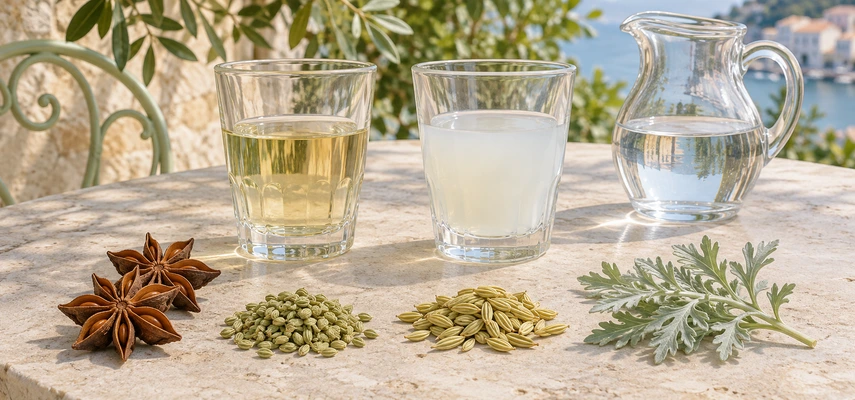

Aniseed spirits offer one of the clearest demonstrations that dilution can do more than make a drink weaker. Add water to a suitable clear sample and a pale cloud appears. Nothing has been fermented or aged in the intervening seconds. The mixture has changed the way it holds aromatic oil.
That visible effect is a useful doorway into pastis and absinthe, but the two should not be treated as interchangeable. They can share anise-related flavour while differing in botanical recipe, extraction, strength, colouring and the framework governing their names.
For this lesson, follow the flavour compounds from plant to spirit. That route explains both what these drinks have in common and why a single description such as liquorice-flavoured can conceal more than it reveals.
Aniseed spirits share an aromatic family
Anethole is an important compound behind the characteristic sweet-seeming anise aroma. It occurs in several plants used in this family. A shared aromatic molecule can create resemblance even when the plants are botanically different.
Aniseed, commonly called green anise, is one source. Star anise is a different plant whose distinctive star-shaped fruit provides another. Fennel supplies related aromatic material alongside its own profile. They should not be described as three varieties of the same botanical merely because a drinker notices a common theme.
The word sweet in a tasting note needs care here. An anise-like aroma can suggest sweetness without establishing how much sugar is dissolved in the drink. Perceived aroma, actual taste and measured sugar are related but separate pieces of information.
This is a recurring lesson in spirits study: a familiar food association is not necessarily an ingredient declaration. Anise aroma does not prove liquorice root was used, just as vanilla aroma in whisky does not prove vanilla pods were added.
Liquorice and wormwood add different dimensions
Liquorice root contributes its own sweet-tasting and aromatic compounds. It can support and complicate the anise impression, but it is not simply another name for anethole. Its contribution matters particularly in the pastis framework.
Wormwood, associated with absinthe, brings a different herbal identity. The plant contains bitter as well as aromatic constituents. The way it is processed strongly affects which of those constituents appear in the finished spirit.
Soaking a bitter botanical and redistilling an alcoholic mixture containing it do not necessarily transfer the same composition. That distinction explains why a traditionally distilled absinthe should not automatically be imagined as the bitterest possible wormwood tea with alcohol added.
Other herbs can contribute additional layers. A producer may include them for aroma, finishing colour or both. Their presence does not remove the importance of identifying the principal anise and wormwood relationships before exploring the finer details of an individual recipe.
A neutral base lets the botanicals lead
These styles commonly use a comparatively neutral alcoholic base. Extensive earlier rectification makes the base less competitive with the intended botanical character. The result can be strongly aromatic even though the alcohol used before flavouring was relatively restrained.
The neutral base still has an agricultural and fermentation history. Botanical flavouring does not create the alcohol from scratch. When explaining production, separate making the base from giving that base its final aromatic identity.
Some origin-specific or producer-specific rules specify additional details about the alcohol or method. Avoid turning one example into a universal requirement for every drink sold under a broad aniseed description. The category, jurisdiction and particular product all matter.
Maceration extracts a broad range of material
During maceration, botanical material soaks in an alcohol-water mixture. Soluble compounds move into the liquid. Depending on the plant and conditions, that can include aroma, colour, sweetness-associated material and bitterness.
Contact time, temperature, strength and physical preparation influence extraction. Finely broken material does not necessarily behave like whole seeds. Leaving every botanical together for the same duration may also be less suitable than preparing and blending extracts separately.
The broad extraction route helps explain why a naturally coloured infusion can look and taste different from a distilled aromatic fraction. It does not establish that darker is better or that every strongly coloured product used the same method.
Natural extracts can also be purchased and combined under the relevant rules. A producer’s ingredient list may disclose anise and liquorice without revealing every extraction detail. State what is known rather than inventing an exact soaking schedule.
Redistillation selects volatile aroma
In redistillation, botanical material or its macerate is distilled with alcohol. Volatile aroma components pass into the condensed spirit, while many non-volatile pigments and bitter compounds remain behind. The output can therefore smell strongly of plants yet emerge clear.
The historical Duplais distillation manual documents a traditional absinthe route involving botanical treatment and distillation. It is evidence for an established technique, not a claim that every modern market applies one identical legal recipe.
Cuts and operating decisions remain important. A distiller chooses a desirable fraction rather than treating the whole run as automatically equivalent. Different mixtures and selections can create variations in aromatic intensity and balance even when the principal plants are the same.
Maceration before distillation and a later colour-giving infusion can also coexist. Asking whether a spirit was soaked or distilled may therefore be too simple. The more useful question is which materials were treated at which stage and what each step was intended to transfer.
Pastis: anise with an important liquorice connection
In the EU framework, pastis is an aniseed spirit that also contains natural liquorice extracts. Pastis and Pastis de Marseille have their own composition and minimum-strength conditions. They are more specific identities than any alcoholic drink smelling of anise.
Ricard’s producer disclosure names star anise, fennel, liquorice and other plants. That is a concrete example of the botanical relationship. Its full proprietary formula is not disclosed, so the ingredient information should not be embellished with a fictional recipe.
Pastis is commonly associated with dilution using water. The serving change reduces alcohol concentration and changes the aromatic presentation. It also makes the oil-solubility effect particularly visible, though the exact appearance depends on the product and dilution conditions.
Do not infer that every aniseed spirit is sweetened to the same level. The pastis framework includes specific limits, while other related categories and markets can differ. The shared aroma does not erase those distinctions.
Absinthe: wormwood and a broader botanical identity
Traditional absinthe brings wormwood into an anise-and-fennel-centred production story. Distilled examples can be bottled clear, while others receive a secondary herbal treatment that contributes colour and further character. Green is therefore not compulsory evidence of authenticity.
A clear example and a naturally green example can share the same broad production family. Conversely, a vivid green appearance does not establish that a careful botanical distillation occurred. The label, disclosed method and applicable origin rules provide better evidence than colour alone.
Avoid turning historical myths into a technical explanation. The syllabus task is to understand plants, base alcohol, flavouring and style. A sensational anecdote is not a substitute for explaining how a botanical maceration differs from the distillate made from it.
Absinthe’s precise legal treatment varies by jurisdiction and protected origin. No single worldwide sugar, colouring or strength recipe should be invented from one producer’s practice. Where a particular numerical requirement matters, attach it to the named framework.
Natural colour, artificial colour and sugar
Natural colour can enter through post-distillation contact with herbs or through another permitted colouring preparation. Colour obtained from plants can change with storage conditions; its appearance is not an infallible laboratory certificate for the method.
Artificial colour can create a different presentation where permitted. Whether it is allowed depends on the relevant category or origin rules. It should not be presumed present merely because the drink is green, or presumed absent merely because the label looks traditional.
Sugar is another separate decision. It can change taste balance and texture without being responsible for every sweet-seeming aroma. Do not assume that all aniseed spirits are liqueurs or share a liqueur’s sugar requirement.
Why water makes the cloud
Anethole-rich oil dissolves more readily in an ethanol-rich mixture than in water alone. When enough water is added, the changed mixture can form tiny oil-rich droplets. Those droplets scatter light, producing the cloudy effect often called the louche.
A primary phase-diagram study examines this water-ethanol-oil behaviour. The key mechanism is spontaneous emulsification after composition changes. It is not milk appearing, sugar crystallising as the universal explanation, or a new fermentation starting.
The extent and appearance of clouding depend on composition and conditions. It is a useful demonstration of solubility, not a universal ranking of quality. A very dense cloud does not prove a superior botanical recipe, and clarity before dilution does not mean there was no oil in solution.
What to remember
Aniseed, star anise and fennel can share anethole-related aroma while remaining different plants. Liquorice is particularly important to pastis, and wormwood to traditional absinthe. Maceration and redistillation transfer different sets of compounds.
Colour and sugar require separate explanations under the applicable rules. Dilution can create an oil-droplet cloud without creating a new ingredient. The most useful comparison follows the botanical recipe and production method before using appearance as supporting evidence.
Continue your study
To compare anise botanicals with gin’s juniper framework, read Gin Explained: Juniper, Botanicals, London Dry, Distilled Gin, and Old Tom. To separate aromatic and bitter botanical contributions, read Amaro and Cocktail Bitters Explained: Gentian, Quinine, and Bitter Spirits. To interpret louching in a sensory comparison, read How to Taste and Compare Spirits: A WSET Level 2 Revision Guide.
Knowledge check: 10 original practice questions
Independent TFE questions, not official WSET examination items. Choose one answer per question; explanations follow separately.
1. What causes a typical louche after water dilution?
- Tiny oil-rich droplets scatter light
- Yeast makes new ethanol
- Milk is chemically created
- Every sugar molecule becomes a crystal
2. What does a sweet-seeming anise aroma prove about sugar content?
- Exactly 100 g per litre
- No exact sugar quantity
- No sugar is ever present
- Every product is a liqueur
3. Which statement about aniseed and star anise is correct?
- They are different plants with related aromatic contributions
- They are the same species
- Both are oak varieties
- Neither can flavour spirits
4. Which plant is central to traditional absinthe?
- Cocoa only
- Wormwood
- Corn only
- Juniper only
5. Which botanical is specifically important in the pastis framework?
- Liquorice
- Malted barley
- Blue agave
- Grape pomace
6. Which compound is strongly associated with the shared anise aroma?
- Oak tannin
- Ethanol only
- Anethole
- Vanillin only
7. Why can maceration and redistillation produce different results?
- Both always transfer every pigment
- They transfer different sets of compounds
- Distillation creates sugar
- Maceration creates oak tannin from glass
8. What is the best comparison of pastis and absinthe?
- Treat both as identical green liqueurs
- Assume identical sugar rules worldwide
- Compare botanicals, flavouring route and applicable framework
- Rank only by cloud density
9. Does a clear absinthe necessarily lack botanicals?
- Yes, clear always means neutral vodka
- Only if sugar is added
- Yes, all botanicals must turn it green
- No, botanical distillation can yield a clear aromatic spirit
10. Which claim about green colour is defensible?
- Green always proves artificial colour
- Green establishes the exact age
- Green always proves herbal colouring
- Appearance alone cannot establish the production method
Answers and explanations
1. A — Tiny oil-rich droplets scatter light. Changing solvent composition can trigger emulsification of anethole-rich oil, producing cloudiness. Mapping: LO3.
2. B — No exact sugar quantity. Aroma associations and actual dissolved sugar should be evaluated separately. Mapping: LO3.
3. A — They are different plants with related aromatic contributions. A similar aromatic compound does not make the botanicals taxonomically identical. Mapping: LO3.
4. B — Wormwood. Wormwood contributes a distinct herbal identity within the traditional anise-and-fennel production family. Mapping: LO3.
5. A — Liquorice. Natural liquorice extracts form part of the specified pastis identity alongside aniseed character. Mapping: LO3.
6. C — Anethole. Anethole is an important aromatic link among several different anise-flavoured botanicals. Mapping: LO3.
7. B — They transfer different sets of compounds. Soaking can extract broad soluble material, while distillation selects volatile material. Mapping: LO3.
8. C — Compare botanicals, flavouring route and applicable framework. Their shared aromatic family leaves meaningful differences in ingredients, technique and category conditions. Mapping: LO3.
9. D — No, botanical distillation can yield a clear aromatic spirit. Colourless distillate can contain strong botanical aroma without retaining plant pigments. Mapping: LO3.
10. D — Appearance alone cannot establish the production method. Both natural extraction and permitted colouring routes can affect appearance, requiring supporting evidence. Mapping: LO3.












