










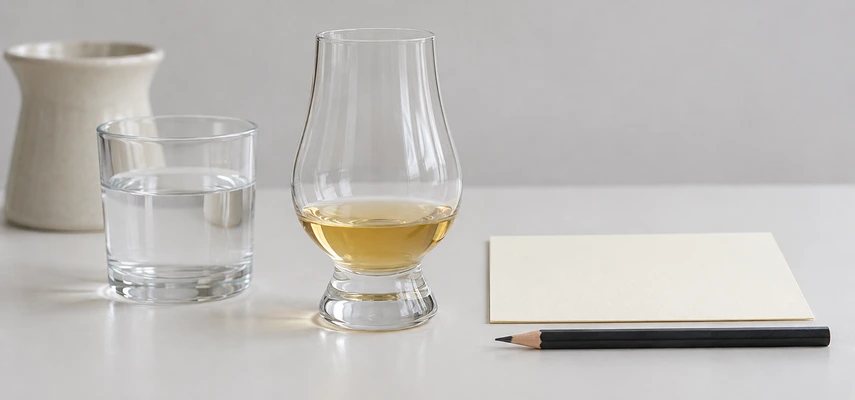

Tasting spirits becomes more useful when a note records what happened in the glass before announcing what the spirit must be. An immediate guess can feel satisfying, but it often pulls every later observation toward the same answer. A structured sequence gives the evidence a chance to lead the conclusion instead.
The current WSET Level 3 Spirits tasting reference organizes the task through appearance, nose, palate and conclusions. This article explains how to work with that sequence using original examples and exercises. Keep the official reference alongside your course materials for its precise terminology; the purpose here is practical coaching rather than reproducing the worksheet.
Prepare conditions that support useful observations
Use clean, appropriate glasses and a neutral background. A scented room, residual detergent or a strongly colored surface can introduce distractions before the first aroma is assessed. Give samples enough space that you can keep their identities and notes separate. Matching glassware also makes a comparison easier to interpret.
Place water, a spit cup and writing materials within reach. For a practice session, decide in advance whether you are working on description, comparison or timed examination technique. A clear objective makes the resulting feedback more useful than tasting a long sequence and remembering only which sample you liked most.
Appearance records what you can see
Look at the liquid against a suitable background and distinguish depth from hue. A spirit can have a relatively deep appearance within a particular color family, while another is paler. Keep those observations separate. Writing only dark leaves the reader uncertain whether you mean brown, red, amber or simply poor lighting.
Do not turn appearance into an automatic age statement. Color can reflect vessel history, additions, filtration or ingredients as well as maturation time. An observation such as pale gold is useful evidence. A conclusion such as definitely twelve years old requires much more information than appearance alone can provide.
The nose needs a measured approach
Approach the glass gradually and use brief, considered assessments rather than an uninterrupted deep inhalation. The aim is to distinguish the sample’s aromas without letting alcohol dominate the experience. If a first impression is unclear, pause and return instead of filling the space with a memorized list of expected descriptors.
Separate the strength of the aromatic impression from the characteristics you recognize. A delicate floral note can be distinct without being forceful, while a strong aroma can remain generic. Recording intensity and identity separately prevents the word powerful from doing the work of a complete aroma description.
Describe aroma families before chasing tiny details
Start with a broad recognizable family, then add a specific comparison when it fits. Fruit might become dried apricot, fresh apple or ripe banana; wood-related impressions might become vanilla or toasted nuts. Choose language that communicates the observation clearly rather than the most elaborate vocabulary available.
A descriptor is an analogy, not an ingredient declaration. Pineapple-like aroma does not prove pineapple was added, and a bread-like note does not identify a particular mash bill. This distinction keeps a sensory note useful across spirits whose production routes can create overlapping aromas through quite different materials and processes.
Palate observations include more than flavor names
Take an appropriate small sample and assess its taste, tactile impression and developing flavor. Sweetness is one dimension, but it should not be inferred solely from a vanilla-like nose. A dry palate can accompany sweet-associated aromas, just as an obviously sweet drink can also have bitterness or spice.
Try describing two dimensions in separate sentences: the flavor impression and the way the liquid feels. A note that names orange peel but says nothing about texture misses information that may be central to the spirit’s style. Likewise, warm and smooth alone do not communicate which flavors were actually present.
Texture should describe a sequence
Write about texture in full sentences and show how it changes. An original example might read: the spirit enters softly, spreads with a rounded oily feel, and finishes with a firm but integrated warmth. That gives the reader a progression rather than three disconnected adjectives selected without context.
Distinguish viscosity, tactile feel and alcohol impression. A light-bodied spirit can still feel sharp, while a mouth-coating one can feel well integrated. Avoid making smooth a complete quality verdict. Explain what feels gentle, forceful, drying, rounded or thin and where in the tasting sequence you noticed it.
Flavor intensity is different from alcoholic force
A strong warming sensation can coexist with relatively modest flavor. Conversely, a lower-strength sample can carry a clear and persistent botanical profile. Record these dimensions independently so the alcohol number does not become a shortcut for aroma or flavor intensity. The note should describe the sample rather than reproduce its label.
Consider a hypothetical spirit with pronounced warmth but only a faint grain impression. Describing the whole palate as pronounced flavor would overstate the evidence. A more precise note separates the warmth from the restrained flavor, which then provides a useful foundation for discussing balance in the conclusion.
The finish has duration and character
After the sample leaves the mouth, notice what remains and how it develops. A persistent aromatic sequence is different from a lingering burning sensation. Identify the continuing flavors and texture before deciding that the finish is long, short or somewhere between. Duration without description is a weak foundation for a quality argument.
An original comparison might distinguish a finish that quickly loses its fruit from one that moves from fruit to spice and then a quieter herbal note. That development can be relevant to expressiveness. It does not establish a universal requirement that every successful spirit must finish with the same number of different aromas.
Conclusions should draw on the written evidence
The 2025 approach places balance and expressiveness at the center of quality reasoning. Ask whether the aromatic and tactile elements work together, and whether the sample communicates clearly as it develops. The evidence should already appear in the descriptive note. A conclusion cannot be supported by details introduced only after the quality label has been chosen.
For example, a claim that alcohol overwhelms the spirit needs a corresponding observation about dominant warmth and obscured flavor. A claim of clear development needs a described progression rather than the word complex by itself. This habit makes the reasoning assessable even when two tasters initially disagree on the final level.
Identity has a broad and a more specific level
The official reference distinguishes a broad type from a more specific category, such as an agave-spirit type and a Tequila category. Learn the required course vocabulary so the answer matches the question. Guessing an exact brand or distillery adds uncertainty without replacing the requested identity.
Use a pattern of observations rather than one supposed giveaway. Juniper can support a gin identification, but a single vanilla association cannot uniquely identify Bourbon. Consider what fits, what conflicts and what remains uncertain. A disciplined conclusion is more useful than a highly specific story built around one familiar aroma.
Practice completeness before practicing speed
WSET’s tasting guidance emphasizes a consistent process. In an early session, work carefully enough to discover which parts you routinely omit. You may find that you describe the nose fully but skip texture development, or record flavor names without returning to the finish.
Then reduce the time gradually while keeping the same sequence. A short, complete note with clear evidence is more useful than a long aroma paragraph followed by blank conclusions. Training speed should mean making observations efficiently, not deleting whole parts of the task that feel less comfortable.
Use the actual examination timing as a practice constraint
The Issue 3 specification gives two blind samples in 30 minutes, with 25 marks available per spirit. The allocation is appearance 2, nose 5, palate 10 and conclusions 8. These are section totals, not permission to invent an official point-by-point marking key for a hypothetical training sample.
For practice, allow roughly fifteen minutes per spirit and reserve a short final check within that allocation. Confirm that the note is complete, identity is recorded and the quality conclusion has supporting reasons. Follow your provider’s instructions for the actual assessment, including when you may begin examining and writing about the poured samples.
Review a note without rewriting the tasting memory
After revealing the sample, keep the original note intact and add corrections separately. If a category guess was wrong, ask which observations were accurate and where interpretation went too far. Do not replace every descriptor with the bottle’s marketing notes and then mistake the edited version for your original sensory evidence.
A useful training log records the sample, conditions, original conclusion and feedback. Repeating a comparable exercise later can reveal whether the same omissions or assumptions recur. The aim is better discrimination and reasoning, not a collection of apparently perfect notes created only after the answer was known.
What to remember
Observe first, describe clearly and conclude from the recorded evidence. Separate aroma from taste, flavor from texture, and identity from quality. Use the current official terminology with your provider, while developing original full-sentence descriptions. Reading explains the process; practical tasting and informed educator feedback are needed to build and calibrate the skill.
Tasting practice: original TFE exercises
These hypothetical training examples and qualitative reviews are independently authored. They are not official samples, worksheets or marking keys.
Tasting task 1: Describe before identifying
Task: With an educator-selected eligible sample, spend fifteen minutes recording a complete note before checking its identity. Keep the reveal covered until your conclusion is finished.
Illustrative observations: Hypothetical example: pale amber; clean medium-plus nose with apple, toasted cereal and vanilla. Dry palate, medium-plus flavor; a light entry develops a rounded middle and gentle warmth. Fruit and spice remain through a medium-plus finish.
Reasoning and review: The note distinguishes sensory dimensions and development. It could support several matured-spirit possibilities; the identity requires the whole pattern and comparison with actual training samples. Quality reasoning should address integrated warmth and definition, not color alone.
Common error: Announcing a category immediately and adding only the descriptors that seem to confirm it.
Tasting task 2: Repair an incomplete note
Task: Improve the following hypothetical note without inventing a bottle identity: amber, smells sweet, smooth, long, very good.
Illustrative observations: The supplied note lacks a separate aroma-intensity judgment, identifiable aroma and flavor characteristics, actual palate sweetness, texture progression and the nature of the finish.
Reasoning and review: Return to a real sample and gather the missing evidence. Do not manufacture descriptors from the proposed quality level. A supported conclusion must follow a fuller observation record; the exercise cannot yield a defensible sample-specific quality verdict from the supplied words alone.
Common error: Turning the word smooth into proof of balance, age, quality and category simultaneously.
Knowledge check: 10 original practice questions
Independent TFE questions, not official WSET examination items. Choose one answer per question; explanations follow separately.
1. Why record palate sweetness separately from aroma?
2. Which current quality criteria organize the argument?
3. Why distinguish flavor intensity from alcohol warmth?
4. What should a finish description identify?
5. What does a pineapple-like aroma prove by itself?
6. What should normally lead an identity conclusion?
7. What should happen after the identity reveal in practice?
8. How long is the official two-sample tasting assessment?
9. What should appearance description separate?
10. What makes a texture description more useful?
Answers and explanations
- D — Sweet-associated aromas do not measure actual palate sweetness. Separate observations prevent one sensory association from becoming an unsupported composition claim. Mapping: Unit 2.
- A — Balance and expressiveness. The 2025 approach asks for evidence about relationships and clear development in the sample. Mapping: Unit 2.
- A — Warmth can be strong while flavor is restrained. Separate dimensions provide a clearer basis for assessing balance and expression. Mapping: Unit 2.
- B — What persists and how it develops. Persistent aromatic character and lingering heat are different evidence. Mapping: Unit 2.
- A — An aroma analogy rather than necessarily an added ingredient. Similar aroma associations can arise through different production routes. Mapping: Unit 2.
- A — A pattern of recorded observations. The conclusion should draw on several observations rather than a single assumed giveaway. Mapping: Unit 2.
- D — Preserve the original note and add feedback separately. Keeping the original record makes interpretation errors and genuine progress visible. Mapping: Unit 2.
- D — 30 minutes. The practice allocation should reflect the separate thirty-minute tasting paper. Mapping: Unit 2.
- A — Depth and hue. A dark impression is incomplete without identifying what kind of color was observed. Mapping: Unit 2.
- D — Full sentences describing its development. The sequence communicates how tactile impressions change through the tasting. Mapping: Unit 2.
Continue exploring this series
1. How to Think Like a WSET Level 3 Spirits Student: Explaining Style, Quality, and Production
29. Spirits Quality Explained: How Production Decisions Affect Balance and Complexity
47. How to Assess Spirits Quality: Balance, Complexity, and Evidence
48. WSET Level 3 Blind Tasting Practice: Spirit Identification and Quality Assessment
49. How to Answer WSET Level 3 Spirits Written Questions: Structure, Reasoning, and Marks
50. WSET Level 3 Spirits Exam: Complete Revision Guide and Practice Examinations
45. Aromatised Wines Explained: Vermouth, Production, Laws, and Style












