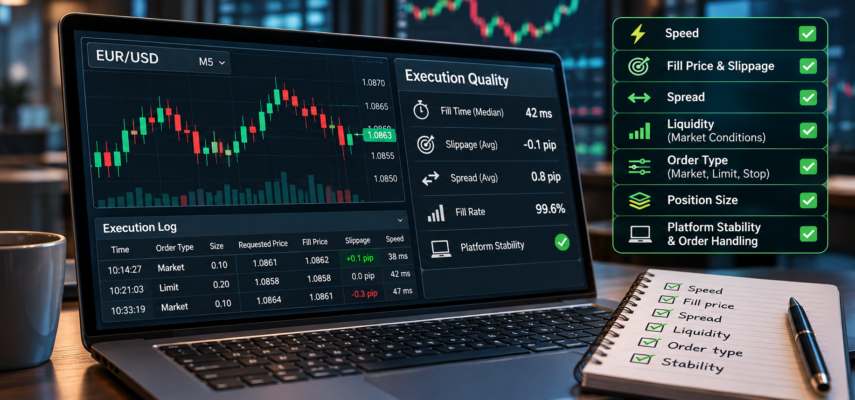

Fast execution is useful in trading. However, speed alone tells only part of the story. A fill that arrives in a few milliseconds can still occur at a different price from the one expected. The useful question is therefore not simply how fast an order was processed, but how reliably the whole execution process worked.
That broader view is consistent with how regulators frame execution quality. Under MiFID II best execution rules, firms consider price, costs, speed, likelihood of execution and settlement, size, and the nature of the order. Traders do not need to reproduce a regulatory test, but the principle is useful: one metric should not stand in for the complete result.
A practical evaluation should connect the requested order with what actually happened. That means recording the price shown when the order was sent, the final fill, the spread, the order type, the time of day, and the market conditions. It also means noticing whether the platform stayed responsive and whether instructions were accepted, modified, and closed as expected.
The goal is not perfect execution in every condition. Prices move, liquidity changes, and order types behave differently. Traders should instead look for consistency and understand when changes reflect normal market conditions.
What Execution Quality Actually Includes

Price and Slippage Belong Beside Speed
Slippage is the difference between the expected price and the price at which an order is filled. It can be negative when the final price is worse, or positive when the trader receives a better price. It is also distinct from the spread, which is the gap between the bid and ask.
That distinction matters because a low latency number does not reveal the final trading cost by itself. If an order is submitted while price is moving quickly, the market may change before a fill is available. A useful execution record should therefore pair timing with price.
For each tested order, record:
- the requested or observed price when the order was sent;
- the executed price;
- whether slippage was positive, negative, or effectively zero;
- the spread at the time;
- the position size.
This makes the result easier to interpret. Ten fast fills in normal conditions may tell a different story from ten placed during a volatile announcement.
Liquidity and Order Type Change What a Fair Test Looks Like
Liquidity affects how easily orders can be filled near the current market price. Major currency pairs during active sessions often have deeper liquidity than less frequently traded instruments or quiet periods. When liquidity thins, spreads can widen, and the next available fill price can move more quickly.
Order type matters as well. A market order prioritizes execution at the available price. A limit order sets a price boundary, but that control creates the possibility that the order will not fill. Stop and stop limit orders also have different activation and execution rules.
| Factor | What to Observe | Why It Matters |
| Speed | Submission to confirmation time | Shows processing latency |
| Fill price | Expected price versus execution price | Reveals slippage |
| Spread | Bid-ask gap when the order is sent | Adds cost context |
| Liquidity | Instrument and market session | Helps explain fill conditions |
| Order type | Market, limit, stop, or stop limit | Changes the balance between certainty and price control |
| Position size | Volume submitted | Can affect interaction with available liquidity |
Because these variables interact, execution tests should compare similar orders whenever possible. A small EUR USD market order during an active session should not be treated as equivalent to a larger order in a thin market late in the day.
Platform Stability and Rejected Orders Complete the Picture
Operational behavior should be measured alongside fill speed rather than reviewed as a separate issue.
Execution numbers become more useful when they are placed inside the wider trading environment, and at that point TMGM broker review for 2026 provides a practical benchmark because its testing considers execution behavior together with spreads and platform stability over several weeks. The value of that example lies in connecting the headline latency figure with the conditions in which trading was actually tested.
Execution also depends on whether the platform remains usable when the trader needs it. A stable environment should display current prices, accept instructions, confirm changes, and remain responsive during normal use.
Track operational behavior alongside the fill itself:
- rejected or cancelled orders;
- delays when modifying stops or limits;
- disconnects or frozen prices;
- unusually slow confirmations;
- whether trade history records the action correctly.
One incident does not establish a pattern. Repeated observations help distinguish an isolated event from behavior that deserves closer attention.

Build an Execution Test That Produces Useful Evidence
Compare Like With Like Before Drawing Conclusions
A fair test keeps surrounding conditions as similar as practical. A quiet morning and a major data release do not create a clean comparison. Instrument, session, order type, size, and volatility all matter.
A simple test log turns personal observations into comparable evidence:
| Test Field | Example Entry |
| Instrument | EUR USD |
| Session | London |
| Order type | Market |
| Position size | 0.10 lot |
| Spread at entry | Observed at submission |
| Fill difference | Better, worse, or unchanged |
| Platform response | Normal, delayed, or interrupted |
| Market condition | Calm, active, or news-driven |
Repeating the same format across several days creates a useful dataset.
Test More Than One Market Condition
Standard conditions provide a useful baseline, but traders should also see how execution behaves when markets become more active. Label those observations instead of mixing them into one average.
Separate ordinary liquid sessions from scheduled news periods, quieter hours, and unusually volatile moves. Wider spreads or greater slippage during a fast market can reflect changing liquidity rather than a simple change in platform speed.
The test should also match the trading style. A swing trader may care less about tiny latency differences than a short-term trader targeting small moves. A trader who uses market orders frequently may place more weight on slippage and fill consistency than someone who relies mainly on limit orders.
Use Repeated Observations Instead of a Showcase Result
One impressive fill is easy to remember, but it says little about consistency. A better method is to collect enough observations to see a pattern. The logic of data-driven decision-making fits here because useful decisions depend on selecting relevant metrics, collecting reliable data, and looking for evidence across more than one observation.
Useful summary measures can include median fill time, the share of orders with positive or negative slippage, average spread under comparable conditions, and the number of rejected or delayed orders. A median can be more informative than a simple average when one unusually slow fill would otherwise distort the result.
The exercise does not need to become complex. It only needs enough structure to stop one memorable fill from deciding the conclusion.
Read the Result in Context
Execution quality should finally be interpreted against the trader’s strategy. Position size, instrument choice, holding period, and preferred order type all change which metrics deserve the most attention.
Speed still belongs in the evaluation, especially when prices move quickly, or a strategy uses short time horizons. Fill price, spread, slippage, stability, and completion likelihood provide the context that makes the number useful.
A sound review therefore asks several connected questions. Was the order filled promptly, was the final price reasonable for the market conditions, did the platform remain stable, and did similar orders behave consistently across repeated tests? Looking at those questions together gives traders a practical way to judge execution without turning one millisecond figure into the whole verdict.
Trade execution becomes easier to assess when each result is recorded with its surrounding conditions and compared with similar observations. That creates a clearer view of execution quality over time.