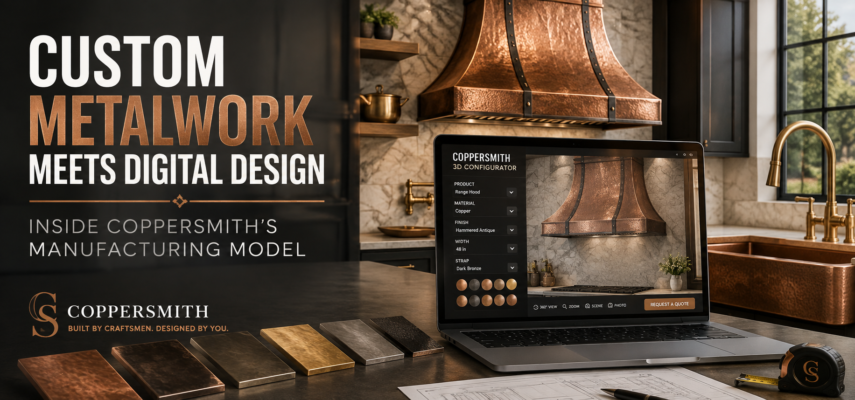
The custom metalwork industry has long relied on slow, opaque processes: sketches, phone calls, and weeks of waiting between concept and finished product. CopperSmith, a Minnesota-based manufacturer founded in 2009, has built its business around changing that timeline. The company has completed more than 15,000 installations nationwide, supplying range hoods, tubs, and kitchen sinks to homeowners and trade professionals such as interior designers. Its growth reflects a broader shift in the home goods sector, where digital tools are increasingly used to shorten the distance between custom design and delivery.
From Local Contractor to National Platform
CopperSmith began as a regional metalworking operation before transitioning into what it describes as an online-first platform for architectural metalwork. That shift has coincided with strong visibility in search results tied to custom metal products.
A Configurator Built for Visualization
Central to CopperSmith’s current model is a proprietary 3D Configurator, developed over four years, that lets customers preview design options through 4K renderings. Rather than working from static catalog images or hand-drawn mockups, buyers can adjust dimensions, materials, and finishes and see the results rendered in near-photographic detail. This kind of visualization tool addresses a common friction point in custom manufacturing: the gap between what a customer imagines and what a supplier can produce. CopperSmith uses this technology as part of a broader mission to bring value to manufacturers, artisans, showrooms, and consumers through continued investment in design tools and marketing infrastructure.
For homeowners exploring options for a kitchen or bath renovation, the CopperSmith configurator functions as an early-stage planning tool, allowing design decisions to be tested digitally before any material is fabricated.
Material Range and Manufacturing Standards
CopperSmith’s product catalog spans copper, brass, zinc, and stainless steel, along with powder-coated finish options. The company offers more than 84 proprietary finishes and colors, in addition to a range of textures and decorative motifs. That breadth positions it toward the upper end of the custom metalwork market, where material variety is often limited by supplier capacity.
Copper, in particular, carries functional advantages beyond appearance: the metal has natural antibacterial and corrosion-resistant properties, which the company points to as a durability advantage over mass-produced alternatives made from less resilient materials. Quality control and hand-finishing are applied throughout production, a standard the company characterizes as central to how each piece is built, rather than an added service tier.
Guided Design as a Substitute for Guesswork
Custom metalwork orders traditionally involve a degree of uncertainty for buyers who are unfamiliar with technical specifications, sizing constraints, or finish compatibility. CopperSmith addresses this through a structured design and approval process, in which staff work with customers to define terms, confirm measurements, and suggest adjustments so a finished piece fits its intended space.
For trade professionals ordering on behalf of clients, this guided process can reduce the back-and-forth that typically accompanies custom fabrication, since technical questions are resolved before production begins rather than after a piece arrives.
Logistics Built Around Large, Custom Items
Shipping oversized, made-to-order products has historically been one of the more difficult logistics problems in home goods manufacturing. A range hood or freestanding tub is heavier and more breakage-prone than typical retail merchandise, and damage during transit can mean a full remake. CopperSmith developed a cross-docking distribution model specifically to manage this risk, paired with custom-built, heavy-duty wood crating for each shipment. According to the company, this combination has effectively eliminated product damage in transit, a claim that speaks directly to a recurring pain point for both retailers and end customers ordering large, one-off pieces.
Positioning Products as Long-Term Fixtures
CopperSmith frames its manufacturing philosophy around longevity rather than volume. The company has stated that sustainability, in its view, comes from producing durable pieces meant to last for decades, in contrast to disposable, mass-produced goods that are replaced more frequently. This positioning aligns with a broader trend in home renovation, where buyers increasingly weigh the long-term cost and environmental impact of fixtures against their upfront price. A copper range hood or sink installed today, under this framing, is intended to function as a permanent architectural feature rather than a component that will need replacing within a normal renovation cycle.
Direct-to-Consumer Manufacturing at Scale
CopperSmith relies on a worldwide manufacturing network to shorten the path between production and delivery for both individual homeowners and trade partners. This direct-to-consumer structure removes several layers of markup common in traditional retail distribution, which the company argues makes higher-end custom products accessible to a broader customer base without lowering material or craftsmanship standards.
Outlook
CopperSmith’s expansion from a Minnesota-based contractor to a nationally distributed manufacturer illustrates how digital tools are reshaping a traditionally slow-moving industry. Its combination of configurator technology, expanded material options, and logistics built specifically for oversized goods addresses several long-standing friction points in custom metalwork. As more homeowners and design professionals look for products that combine visual customization with manufacturing transparency, companies applying digital infrastructure to physical fabrication, as CopperSmith has done, are likely to remain a reference point for how the category evolves.