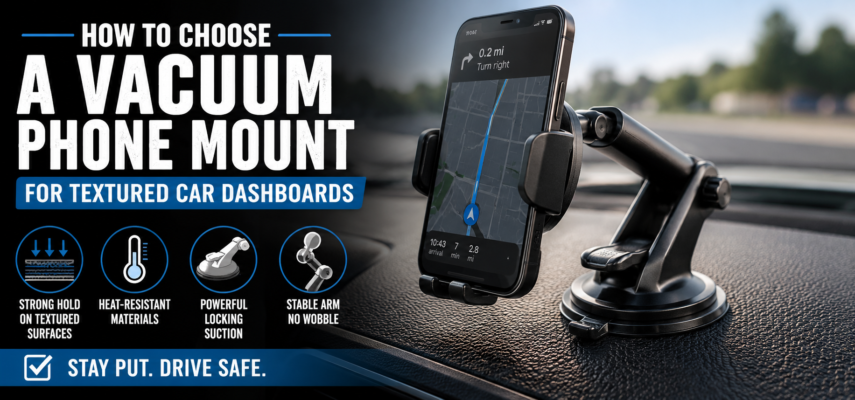
Your mount drops at the first hard stop. You reset it, it drops again, and by the third time you’re ready to throw the whole thing out the window. If your dashboard has a soft-touch, grain-textured, or ribbed surface, you already know standard vacuum cups weren’t built for that reality. Knowing how to choose a vacuum phone mount for textured car dashboards means understanding why most mounts fail on these surfaces before you ever look at a product listing. The problem isn’t the suction cup itself; it’s the gap between a rigid cup rim and a surface that isn’t flat. Air creeps in through the ridges, the vacuum weakens, and down it goes. This article explains the mechanics behind that failure, what materials and specs actually solve it, and which features separate a mount that stays put from one that lands in your passenger footwell.
Why Textured Dashboards Make Suction Mounts Fail
Standard vacuum suction works by pressing a rigid cup against a surface, forcing air out to create a pressure difference that holds the cup in place. On a perfectly flat surface like a windshield, a standard rigid cup does fine. But modern car interiors rarely offer that. Automakers use soft-touch plastics, brushed grain patterns, and rubberized coatings to improve cabin feel, and every one of those textures is a genuine headache for a rigid cup rim. Some mounts address this by adding a flexible silicone pad underneath the suction mechanism. This pad conforms to micro-ridges that would otherwise let air sneak back into the seal. This system is used in products like the MagSafe hypermount for every surface and similar ones. The physics aren’t complicated: adhesion force depends on the total sealed area. Reduce that area with gaps and ridges, and holding force drops proportionally – a mount rated for two pounds on glass might hold half a pound on a medium-grain texture.
How Surface Texture Breaks the Vacuum Seal
The ridges on a textured dashboard aren’t just cosmetic; they’re raised edges that interrupt contact between the cup rim and the surface. A standard cup has a rim width of roughly two to four millimeters. On a flat surface, the full rim contacts the material and seals completely. On a textured surface, that rim bridges across the peaks of the grain pattern, leaving micro-gaps at every trough. Air slowly works back through those gaps under vibration and temperature changes, and the vacuum degrades. Heat accelerates the process; dashboards in direct sunlight can reach 180 to 200 degrees Fahrenheit, which softens the cup material and lets the rim deform. So the hold you felt at 9 a.m. may not survive a noon commute. This is why the baseline spec you should check on any mount for a textured surface is the cup material’s temperature rating, not just its suction force rating at room temperature.
Silicone Gel Pads vs. Pure Suction Cups
Some manufacturers tackle the texture problem with a silicone gel pad bonded to the face of the suction cup. The gel is soft enough to flow into surface irregularities on contact, effectively increasing total sealed area despite the texture beneath it. Gel-pad designs hold noticeably better on soft-touch plastics than bare suction alone. The tradeoff is cleaning; gel attracts lint and dust, which fills the same micro-gaps the gel is supposed to seal. Rinse the pad with water every few weeks and let it air-dry completely; the tacky surface restores itself in most cases. Pure suction designs without gel rely entirely on cup flexibility, so look for cups made from thermoplastic rubber rather than hard polypropylene. Thermoplastic rubber stays pliable across a wider temperature range, which means the rim holds contact under heat stress instead of stiffening and losing its seal.
Features to Check Before You Buy
Surface compatibility is the first filter, but it’s not the only one. A mount that sticks to your dashboard also needs to hold your phone steady at highway speed, adjust to a comfortable viewing angle without wobbling, and lock in place when you grab the phone one-handed. Those demands put stress on the arm, the ball joint, and the phone cradle in ways that cheaper mounts rarely survive. When choosing a vacuum phone mount for textured car dashboards, treat the mounting arm and locking mechanism as equally important as the cup itself. A strong base with a loose arm is still a problem on rough roads.
Cup Diameter and Locking Lever Strength
Larger cup diameters create more sealed surface area, which translates directly to stronger holding force. A 60-millimeter cup on a textured surface will outperform a 40-millimeter cup on the same surface under identical conditions. Look for cups between 55 and 75 millimeters if your dashboard has heavy texture. The locking lever matters too; twist-lock and lever-pump designs that mechanically compress the cup generate more consistent pressure than press-and-go designs that depend solely on how hard you push. Lever-pump designs let you apply the same amount of suction every time, removing the variability of hand pressure. Check whether the lever clicks into a locked position; that audible confirmation tells you the mechanism has seated fully. But mounts that just press on without a locking mechanism tend to hold well initially, then lose adhesion faster under vibration because there’s no mechanical backup to the vacuum.
Mounting Arm Stability and Phone Compatibility
The arm connects the cup to your phone, and its stiffness determines whether the whole assembly shakes with road noise or stays reasonably still. A single-axis arm – one that extends straight out from the cup – is stiffer than a multi-segment arm with multiple pivot points, though it limits your positioning options. A dual-segment arm with a locking ball joint at each end gives you more flexibility; just confirm that both joints tighten fully and don’t creep under load. For phone compatibility, check the cradle width range against your phone’s dimensions with a case on, not without one. Cradles that grip the bottom edge only tend to be more stable than side-clamp designs, which can flex open when the phone shifts. And if your phone supports wireless charging, verify that the mount’s cradle doesn’t block the charging coil position, a detail that gets skipped in product descriptions more often than it should.
Honestly, you’ll notice that most listings advertise suction strength but say almost nothing about arm rigidity. That’s where a lot of mounts fall apart in practice.
Conclusion
Choosing a vacuum phone mount for textured car dashboards comes down to three things: cup material and diameter, surface-sealing design, and arm rigidity. Rigid cups fail on textured surfaces because they can’t conform to the grain. Silicone gel pads and flexible thermoplastic rubber cups solve that by increasing real contact area. A lever-pump locking mechanism keeps suction consistent across temperature swings. And a stiff, fully lockable arm stops the phone from vibrating loose at speed. Apply those filters to any mount you’re considering, and you’ll sidestep the most common failure modes. A phone mount should be something you forget about once it’s installed, not something you’re reattaching every morning.