










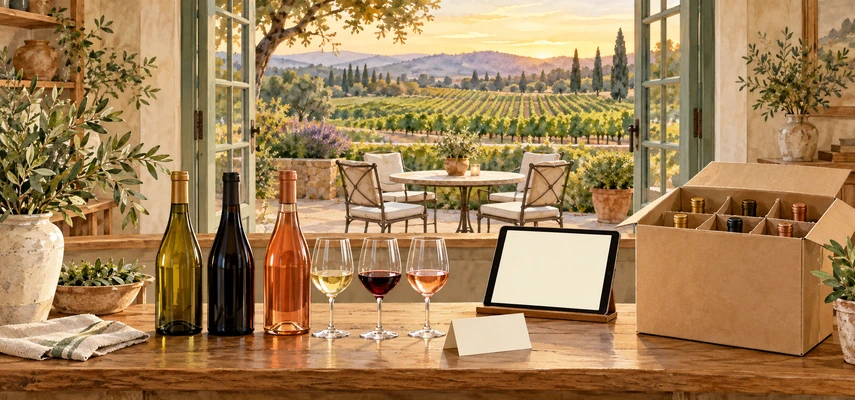

Selling a bottle directly can put more of its selling price into the winery’s hands. It also puts more work there. Someone must attract the customer, answer questions, take payment, prepare the order and deal with the delivery that goes astray. The distributor’s invoice may have disappeared; the tasks haven’t.
Direct-to-consumer wine sales connect a producer with the final customer through its own selling arrangements. Cellar doors, events, wine clubs and online sales can support one another, but they solve different problems and use different resources. A vineyard visit may create a relationship that later produces an online order, while a club turns that relationship into a continuing commitment.
The WSET Diploma specification identifies these four DTC options in D2. The analytical question is when each route offers a sustainable return, given the winery’s location, people, customers and permissions. Direct doesn’t automatically mean easy, cheap or legally available for every destination.
Compare net returns on an equivalent basis
A wholesale price and a direct retail price pay for different work. To compare them, specify the production cost common to both routes, the additional selling and fulfilment costs of each, the realistic volume and the time required to collect payment. Then identify fixed investment and overheads still excluded.
In an original hypothetical example, a winery receives 16 currency units through wholesale and spends 2 on route-specific selling and delivery, leaving 14 before common production costs and other excluded costs. Direct sale brings 24, but payment, packing, delivery, service and customer acquisition total 9, leaving 15 on the same stated boundary.
The direct headline receipt is 8 higher, while the defined route-stage difference is only 1. This doesn’t prove wholesale is better: actual costs, repeat orders and customer benefits can change the result. It shows why retaining the retail price cannot be treated as retaining every intermediary’s margin without performing its work.
Volume and capacity matter too. A small winery may serve a valuable direct customer base without selling its entire output that way. A mixed route can balance demand, reach and resources, provided commitments and pricing are managed sensibly. Neither an all-direct nor an all-wholesale policy is universally optimal.
Cellar doors make the place part of the offer
A cellar door sells at the winery or an associated visitor setting. Tasting, explanation and a sense of origin can help customers understand the wine and choose confidently. The environment gives a producer opportunities to communicate details that are difficult to convey on a crowded retail shelf.
Location shapes the opportunity. An accessible tourism area may provide a visitor stream; a remote site may require deliberate travel and stronger reasons to visit. Seasonality, weather and competing attractions affect demand. Beautiful scenery isn’t a substitute for understanding who will arrive and when.
The operation needs suitable premises, staff, booking arrangements, glassware, tasting stock, payment facilities and visitor management. Time spent with a visitor is a resource even if no purchase follows. Training helps staff explain wines clearly and respond to preferences without turning hospitality into a pressured sales encounter.
Iowa State’s tasting-room training manual connects a consistent guest experience with the winery’s sales and relationship objectives. Apply the principle to the intended audience; the source doesn’t make any single script or conversion rate appropriate everywhere.
Tasting fees can contribute towards the experience and help manage limited appointment capacity. Redeeming a fee against a purchase changes the economics and should be modelled. A fee isn’t automatically profit, and free tasting isn’t automatically wasteful: compare the complete cost, visitor response and subsequent return.
Turn a visit into a continuing relationship
A visitor who buys once may become a repeat customer, but that result needs follow-through. Make ordering information clear, record preferences appropriately and explain available next steps. The useful transition is from a positive experience to an easy future purchase, not from a visitor’s name to an indiscriminate stream of messages.
Consider conversion at several stages. How many booked visitors arrive, how many purchase, what do they spend, and how many order again? A busy tasting room can look successful while producing little contribution if spending is low and staff costs are high. Conversely, a smaller appointment programme may work if the service and return justify its resources.
Avoid judging visitors solely by immediate purchases. Some buy later, introduce friends or attend events, but those benefits need evidence over a realistic period. Don’t add an invented lifetime value to rescue every unprofitable tasting. Track what happens and compare customer groups with consistent definitions.
Events create occasions and concentrate attention
Events can include tastings, dinners, release occasions, festivals or educational sessions, either at the winery or elsewhere. They give customers a reason to engage at a particular time and can connect wine with food, learning or a shared interest.
On-site events may focus attention on the producer while using premises that already exist. They still add staffing, organisation, food or external services, equipment, cleaning and permissions. Off-site events can reach a different audience but bring travel, space fees, stock movement and competition for attention.
Penn State’s tasting-room guidance discusses events and opportunities to build continuing customer contact. Select an occasion that suits the intended customer and the winery’s capabilities. Attendance alone doesn’t show whether the event produced worthwhile sales or relationships.
Separate ticket income, wine sales and costs to prevent double counting. If a ticket includes wine, that wine isn’t free inventory. If an event aims at new customers, distinguish people who would have bought anyway from additional demand. A crowded terrace can be enjoyable and still require a careful budget.
Wine clubs structure repeat purchasing
A wine club offers an ongoing relationship with defined benefits and purchasing arrangements. It may involve scheduled shipments, a spending commitment, access to releases, preferential prices or experiences. The precise offer should be clear; a mailing list and an automatic purchase subscription aren’t the same agreement.
For the winery, clubs can improve planning and encourage repeat demand. They may also provide feedback and a more direct understanding of customer preferences. Predictability depends on retention and actual orders, however. A member count isn’t guaranteed revenue if customers pause, cancel or no longer purchase.
Penn State’s loyalty-programme guidance stresses the need for benefits that work for both business and customer. Compare the incremental return with discounts, shipping, member events, administration and service. Generous benefits can attract members while eroding the contribution the club was meant to improve.
Terms need to explain commitment, selection, timing, charges and how changes or cancellation work under applicable rules. Operational reliability matters: an unexpected shipment or unclear charge can damage a relationship built patiently at the cellar door. Convenience should serve the customer as well as the winery’s forecast.
Retention changes the club calculation
In an original simplified example, a club starts a period with 200 active members and loses 30 of those members during the period. Its retention for that starting group is 85%. If 40 new members join, the closing total is 210, assuming no other changes. A rising total therefore coexists with meaningful attrition.
Track acquisition and retention separately. A campaign may recruit many customers while existing members leave because of excessive stock, poor communication, unsuitable selection or changed circumstances. The appropriate response depends on the reason, not merely the cancellation count.
Estimate member contribution over observed purchasing behaviour rather than assuming indefinite shipments. Include benefits, service and acquisition on a consistent basis. An expensive recruitment offer may pay back through repeat orders, but the winery needs funding during that interval and evidence that members stay long enough.
Online sales make access easier, not costless
Online sales let customers order without visiting and can connect release information, recommendations and club management with fulfilment. For a producer, the channel provides control of presentation and direct contact, within applicable selling and shipping rules.
A working shop needs accurate stock, clear prices and descriptions, reliable payments and a usable checkout. Delivery charges and timing should be understandable before commitment. A beautiful site cannot compensate for unavailable wine or an order that never reaches the correct address.
Fulfilment adds picking, protective materials, transport and support. Order size affects whether those costs are sustainable. Minimum quantities, delivery charges or subscription benefits can change behaviour, but each needs evaluation against customer expectations and the actual cost of the service.
Customer acquisition is another expense. A visitor returning through an email link and a stranger reached through paid advertising can have different acquisition costs. Use consistent attribution and avoid crediting the same sale fully to several campaigns. A growing audience is useful only if it supports a workable relationship and return.
Keep access and communication appropriate
Selling alcohol directly requires the relevant permissions, age controls, tax arrangements and destination compliance. An online shop doesn’t turn national or state boundaries into a single unrestricted market. Check the actual route before promising to ship everywhere.
Customer information also creates responsibilities. Collect and use it appropriately, protect it and respect applicable communication choices. The US FTC’s commercial-email guidance illustrates requirements around accurate identification and opting out. Other territories have their own consent and privacy frameworks; complying with one example doesn’t establish global compliance.
Clear communication has a commercial purpose too. Explain what a customer is joining, what they will receive and how to change preferences. A relevant message about a wine they enjoyed can help; repeated unwanted contact can undo the goodwill of a good visit.
Use evidence without turning benchmarks into promises
Wine Australia’s 2024 DTC report separates cellar-door, club and online performance and examines measures such as order value and discounting. Its defined historical sample is useful for comparison, not a forecast for every winery or a current universal channel mix.
Choose measures that answer the business question: contribution per order, cost of an appointment, repeat-purchase behaviour, member retention or the time needed to recover acquisition spending. Interpret them with the winery’s size, location and offer. A benchmark becomes misleading when its scope disappears.
Connect the channels into a manageable system
A visitor might discover a wine at an event, book a cellar-door tasting, join a club and later make an additional online order. Make that journey convenient while keeping records and costs clear. Count the resulting sale once and recognise the resources used along the way.
A strong D2 evaluation compares control and customer access with staffing, investment, fulfilment, risk and realistic volume. DTC can support a distinctive small producer and a valuable continuing relationship. It succeeds through a proposition people want and an operation capable of delivering it, rather than through the word “direct” alone.
Use marketing and branding and wine supply and demand as tests of the business reasoning here: identify who bears a cost or risk, explain how the route to market changes it and distinguish revenue from the return retained by the producer.
Original Diploma practice
These original exercises are not official WSET questions and have no official mark allocations.
Question 1: compare route-stage returns
A winery receives 16 wholesale and spends 2 on route-specific selling and delivery. It receives 24 direct and spends 9 on the corresponding direct-route work. Common production costs and other overheads are excluded. Compare the results and limitations.
Indicative answer points: equivalent scope; 14 versus 15; headline gap; fixed costs; volume; customer development.
Outline answer: The defined wholesale amount is 14 and the direct amount 15, a difference of 1. The 8 higher direct receipt isn’t an 8 improvement after route-specific work. Compare actual volume, resource capacity, timing and excluded costs before inferring overall profit. Repeat relationships can add value but need evidence rather than an assumed bonus.
Question 2: interpret club growth
A club starts with 200 members, loses 30 of that group and recruits 40. Calculate retention and closing membership. Evaluate why growth alone is insufficient evidence of success.
Indicative answer points: starting cohort; 85% retention; 210 closing; acquisition; member contribution; reasons for leaving.
Outline answer: 170 of the starting 200 remain, giving 85% retention; 40 new members bring the closing total to 210. Growth masks 30 departures. Assess acquisition spending, benefits, purchasing and retention by cohort, plus reasons for cancellation. A larger membership can still produce weak contribution or require unsustainable recruitment costs.
Question 3: evaluate a busy event
A cellar door reports a sold-out event and plans to repeat it monthly. Explain the evidence needed before deciding that expansion is commercially sensible.
Indicative answer points: income boundaries; included wine; staffing; capacity; additional demand; follow-up; seasonality.
Outline answer: Compare ticket and additional sales income with wine, staff, facilities, external services and other incremental costs. Avoid counting included wine as both ticket value and a separate sale. Assess whether guests are new or displacing normal purchases and whether repeat orders occur. Test monthly demand, permissions and operational capacity rather than extrapolating indefinitely from one full event.












