










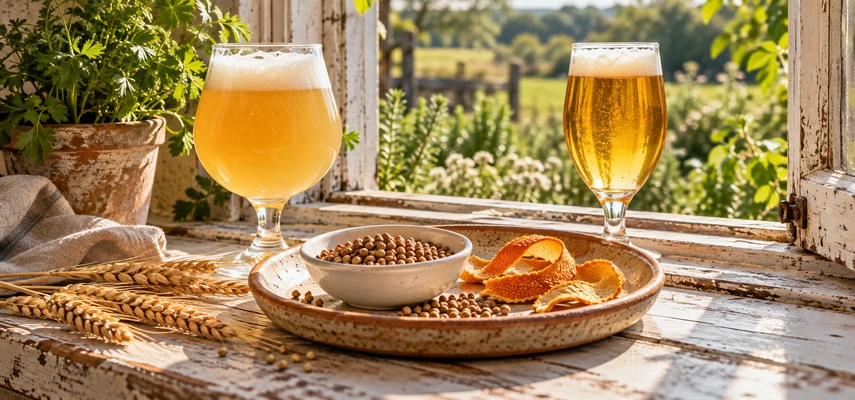

A peppery beer does not necessarily contain pepper. A citrusy one might contain peel, hops or fermentation-derived aromas. Saison and witbier turn that puzzle into a useful lesson: similar descriptive words can come from different production decisions.
Both are prescribed yeast-driven Belgian style references, but neither can be explained by yeast alone. Saison commonly emphasizes dryness, lively carbonation and distinctive fruity-spicy fermentation. Witbier combines a pale wheat-grain base with its own fermentation character and familiar spice-and-citrus additions. Their differences are clearer when the source of each impression is considered separately.
Yeast-driven is an emphasis, not an exclusive ingredient
Every conventional fermented beer contains yeast-derived products, but some styles make them particularly important to identity. Fruity esters and spicy phenolic compounds can sit near the center of the aroma rather than remaining a quiet background behind grain or hops.
However, that does not remove the brewer’s other tools. Grain affects extract, texture and flavor; hops affect balance; additions may provide aromatics. Fermentation also consumes usable material, changing sweetness and the relationship among all those components.
The useful question is therefore not which single ingredient makes Belgian beer Belgian. It is which combination creates the particular profile. A style name gives a set of expectations to investigate, not a shortcut around the production explanation.
Saison: dry, lively and characterful
Saison has a broad modern range, but the central pale reference is usually straw to gold with a large white head. Clarity can be clear or hazy. Aroma commonly brings fruit and peppery or other spicy fermentation expression, with pale grain and possible herbal or floral hop detail.
The palate emphasizes a dry finish, lively carbonation and a firm enough bitter balance to avoid sweetness dominating. Body is generally light to medium, which can make the beer feel brisk despite substantial flavor. Alcohol varies with the strength version; it should integrate rather than automatically turn hot because the style allows stronger examples.
Pale malt and other grains or brewing sugars can shape the wort, while a suitable saison culture and fermentation regime support attenuation and expression. The grain bill is flexible within the tradition, so no one cereal formula explains every example.
By contrast with tripel, a typical saison can seem more rustic, peppery and lean in its balance, though profiles overlap. Compared with witbier, it generally emphasizes dryness and fermentation-led spice more than a softly rounded wheat-and-peel presentation.
Saison variations need names and context
Modern saison includes different strengths, colors and fermentation approaches. The central pale profile is an anchor, not a claim that every product must look equally golden. A darker variation can use more developed grain, and a lower-strength one can retain character without a large alcohol contribution.
Farmhouse is a useful historical and cultural association but does not prove a modern beer was brewed on a working farm. Likewise, saison does not require every beer to be spontaneously fermented, inoculated with Brettanomyces or overtly sour.
Those may be separate choices in particular interpretations. If a producer describes mixed fermentation or wood maturation, use that evidence to explain the result. Do not manufacture those details merely because rustic sounds attractive beside the name.
Witbier: pale wheat with spice and citrus
Witbier typically appears very pale straw to light gold with a cloudy or hazy, sometimes whitish cast and a dense white head. Wheat-derived bread or dough notes combine with citrus and spice, often including coriander and orange-peel associations.
Bitterness is generally low, body medium-light to medium and carbonation lively. The palate can open softly grainy or gently sweet while finishing reasonably dry and refreshing. Alcohol is commonly moderate and unobtrusive, not the warming center expected in a strong abbey ale.
Unmalted wheat is a traditional ingredient reference alongside barley malt, sometimes with other grain choices. Witbier yeast contributes fermentation character, while coriander seed and dried orange peel can provide important aromatic material. The exact recipe and intensity vary; an overwhelming spice cabinet is not the intended universal target.
Compared with German weissbier, witbier commonly relies more on citrus-and-spice additions and less on the classic weizen banana-and-clove pattern. Compared with American wheat ale, it generally has a more explicitly Belgian fermentation-and-spice identity. Wheat alone does not make those profiles interchangeable.
Coriander seed is not a coriander leaf garnish
Brewing coriander commonly means the seed, which can provide citrusy, floral and spicy impressions. That is different from assuming the beer should smell like a handful of fresh coriander leaves. Product selection, freshness and amount influence the result.
Orange peel adds another aromatic possibility, with different peel products and processing creating different expressions. It can contribute citrus aroma without making the beer taste like sweet orange juice. Sugar, acidity and peel aromatics are different pieces of fruit-related sensory information.
As a result, a citrus note deserves more than a quick ingredient guess. In witbier the additions supply a useful expectation, but producer evidence still matters. In a saison, citrus can arise through fermentation or hops even when no peel was used.
Yeast spice and added spice can overlap
Phenolic fermentation compounds can create peppery or clove-like aromas, depending on strain and conditions. Added spices bring their own compounds. A tasting note may capture a similar word while the production explanation differs.
The contrast with a weizen culture is particularly helpful. Lallemand’s German wheat-strain description shows a different expression from the quieter fermentation profile possible in Belgian wheat brewing. Do not assign every wheat beer the same aromatic package.
For revision, create a two-column list: an observation and its possible sources. Pepper, citrus and fruit should each have more than one possible explanation where appropriate. The final answer should be supported by the style, recipe and process evidence rather than the descriptor alone.
Dryness needs the fermentation to finish the job
Saison’s dry impression links to wort fermentability, yeast capability and successful fermentation. Some cultures can use carbohydrates differently from more restrained conventional strains, but strain-specific behavior should not be expanded into a rule for every product carrying the saison name.
Temperature and time influence performance and aroma, yet warmer is not automatically better. The brewer needs conditions suitable to the selected culture. An uncontrolled process that creates harsh alcohol is not made authentic by calling it farmhouse.
Witbier also needs appropriate attenuation. Its softly grainy opening should not be confused with incomplete fermentation by default. Assess the intended balance and actual finish instead of deciding all rounded texture is residual sugar or all dryness is high bitterness.
Acidity is optional context, not the entire definition
Some examples or interpretations may show acidity, but neither style should be reduced to all Belgian farmhouse beer is sour. Intentional lactic souring and mixed fermentation involve additional production decisions, introduced in Article #9 and developed in the later sour-style lessons.
Lallemand’s souring-method discussion illustrates why those microbial choices need their own explanation. They cannot simply be inferred from a rural association or a cloudy glass.
An unintended acidic or vinegary result can still be a fault in a beer designed for a different balance. Context does not mean anything goes. It means identifying the intended production and then judging how the actual sample supports it.
Carbonation and texture carry part of the identity
Lively carbonation can lift aroma and create a brisk finish. In a lean saison, that liveliness interacts with dryness and peppery expression. In witbier, it helps refresh a softer wheat-derived texture. The same broad gas description can therefore support two different mouthfeel experiences.
Meanwhile, glass cleanliness and pouring affect the presentation, so an uneven comparison can mislead. A flat or stale sample does not accurately represent the intended profile merely because the label is correct. Record condition separately from the style description.
For theory preparation without drinking, compare reliable descriptions that include texture as well as aroma. Ask why one beer might feel soft and another lean despite both being pale and aromatic. The answer should connect grain, fermentation and carbonation rather than inventing one universal Belgian mouthfeel.
A controlled comparison worth practicing
Imagine keeping a pale wheat-containing wort constant while changing the culture and whether coriander or peel is added. One change targets fermentation-derived expression; the other introduces additional aromatic material. Therefore, the resulting differences should be explained through those separate variables, not attributed wholesale to wheat.
Afterward, compare a dry saison description with a witbier description and hide the names. Look for the balance of grain, citrus, spice, bitterness and texture. This exercise can use written notes alone; optional tasting for legally eligible readers is educational and does not create a practical examination requirement.
One-page revision summary
Saison typically emphasizes a dry, lively, fruity-spicy fermentation profile with flexible grain choices and modern variations. Witbier combines pale wheat character, Belgian fermentation, low bitterness and familiar coriander-and-orange-peel aromatics in a softer presentation.
Separate the source of the aroma from its name. Spice need not mean an added spice, citrus need not mean juice, and farmhouse need not mean sour or spontaneously fermented. The style comparison becomes much clearer when each production choice receives its own explanation.
Continue your beer studies
Explore the related lessons on brewing adjuncts alongside beer yeast to extend the ingredient, process or sensory reasoning in this article.
Knowledge check: 10 original practice questions
Independent TFE questions, not official WSET examination items. Choose one answer per question; explanations follow separately.
1. Which balance most strongly supports a typical pale saison identification?
- Intense roast and low carbonation
- Dry finish, lively gas and fruity-spicy fermentation
- Mandatory thick sweetness
- Only neutral grain and no yeast expression
2. Which traditional witbier additions are especially relevant?
- Peat and whisky
- Only coffee and cocoa
- Coriander seed and dried orange peel
- Mandatory cherries and Brett
3. Why does peppery aroma not prove pepper was added?
- Yeast-derived phenolic expression can create a spice-like impression
- All pepper aroma comes from barley husk
- Pepper cannot be smelled
- Carbonation turns into black pepper
4. Which statement about farmhouse is most careful?
- It guarantees spontaneous fermentation
- It requires sourness
- It proves a modern working-farm location
- It is a historical or cultural association that needs specific production context
5. How does witbier generally differ from German weissbier?
- Citrus-and-spice additions are more central, rather than the classic weizen banana/clove pattern
- Both must share one strain
- Witbier cannot contain wheat
- Weissbier must contain orange peel
6. What does a citrus aroma in saison establish by itself?
- Orange juice was certainly added
- A citrus-like observation, with source still needing evidence
- The beer is actually lager
- The beer must contain coriander leaves
7. Which statement about saison strength and color is accurate?
- All examples are one pale low-strength recipe
- All examples are dark and very strong
- The central pale reference sits within broader modern strength/color variation
- Every variation is an official new WSET article category
8. Why does warm fermentation not automatically improve saison?
- Temperature never affects yeast
- Every strain needs identical heat
- All warmer beer is more authentic
- The selected culture still needs suitable controlled conditions
9. Which ingredient distinction is useful for witbier?
- Coriander seed has a different aromatic role from fresh coriander leaves
- Every citrus note requires fresh juice
- Wheat creates all spice without yeast
- Orange peel is the main source of alcohol in every recipe
10. Why should acidity be assessed with producer and style context?
- All Belgian beer is sour
- Intentional souring is a separate production choice, not implied by haze or farmhouse language
- Acidity is never perceptible
- Every acidic beer is automatically faulty
Answers and explanations
1. B — Dry finish, lively gas and fruity-spicy fermentation. The central saison reference combines dryness and lively carbonation with characteristic fermentation expression. Color alone cannot establish it. Mapping: LO3 AC1.
2. C — Coriander seed and dried orange peel. Coriander seed and orange peel provide important traditional aromatic references for witbier, alongside wheat and suitable fermentation. Mapping: LO3 AC2.
3. A — Yeast-derived phenolic expression can create a spice-like impression. Fermentation can generate spicy phenolic compounds. An actual addition needs separate recipe evidence rather than an aroma word alone. Mapping: LO3 AC2/AC3.
4. D — It is a historical or cultural association that needs specific production context. Farmhouse language does not independently establish location, culture or acidity. Modern producer information supplies the actual details. Mapping: LO3 AC1.
5. A — Citrus-and-spice additions are more central, rather than the classic weizen banana/clove pattern. The styles use different combinations of grain, culture and additions. Wheat alone does not establish identical fermentation character. Mapping: LO3 AC1/AC2.
6. B — A citrus-like observation, with source still needing evidence. Citrus impressions can come from fermentation, hops or additions. Observation should precede a supported causal explanation. Mapping: LO3 AC1/AC2.
7. C — The central pale reference sits within broader modern strength/color variation. Saison has varied interpretations. The pale reference is a useful anchor without erasing darker or different-strength examples. Mapping: LO3 AC1.
8. D — The selected culture still needs suitable controlled conditions. Temperature influences performance and aroma in a strain-dependent way. Uncontrolled heat and harsh alcohol are not universal style virtues. Mapping: LO3 AC3.
9. A — Coriander seed has a different aromatic role from fresh coriander leaves. The traditional brewing spice reference is seed, with its own citrusy/spicy profile. Avoid treating it as a fresh-leaf garnish requirement. Mapping: LO3 AC2.
10. B — Intentional souring is a separate production choice, not implied by haze or farmhouse language. Specific cultures and methods can create intentional acidity, while unintended acidity may be inappropriate. A broad label does not establish the method. Mapping: LO3 AC1/AC3.











