










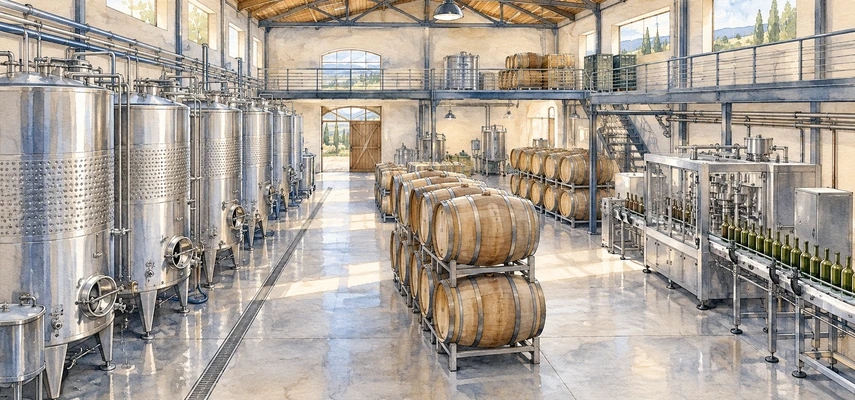

A winery can have a beautiful barrel room and a rather ugly cash-flow forecast. The two are perfectly compatible. Equipment, wine and packaging all absorb money before the customer pays, while the price on a restaurant list tells you surprisingly little about what the producer keeps.
The economics of winemaking connects those physical choices with their financial consequences. Follow the wine from reception to dispatch: which resources does it use, how long does it occupy them, how much saleable product survives, and what receipt can reasonably cover the cost? That approach turns a list of expensive objects into an explanation.
For Diploma D2, the official WSET specification identifies winery establishment, general winemaking, maturation and packaging within production costs. The useful skill is to explain why their importance changes between businesses. A seasonal contract winery and an estate holding several vintages in barrel face different capacity and funding problems, even when both handle the same grape variety.
Winery establishment buys a working system
Winery establishment includes the site, buildings, services and production equipment needed to operate. Land and construction are only the beginning. Water supply, drainage, wastewater handling, electricity, refrigeration, access and suitable storage help determine whether the building can actually function as a winery. A handsome shell without adequate services is an expensive place to discover bottlenecks.
Equipment must match the intended process. White production may put particular pressure on pressing and juice handling during a short receiving window. Red production needs suitable fermentation vessels and ways to manage skins. Pumps, hoses, laboratory facilities, cleaning equipment and safe movement of materials connect the major machines. Their compatibility matters as much as their individual specifications.
Separate an initial purchase from its annual use. Buying a press creates a cash outlay; depreciation allocates its cost across an assumed useful life for accounting purposes. Maintenance, insurance and financing require their own treatment. Adding the whole purchase price, all loan principal repayments and depreciation into one annual production-cost total can count the same investment repeatedly. State the convention before comparing alternatives.
Capacity matters most when the grapes arrive
A winery’s annual volume does not describe every constraint. Suppose two sites each receive the same tonnage. One spreads deliveries over six weeks; the other must receive most of its crop in ten days. The second needs a different peak receiving solution, even though an annual spreadsheet makes the businesses look similar.
Follow the slowest stage. A larger crusher cannot solve inadequate press capacity, unavailable fermentation space or refrigeration that cannot handle simultaneous demand. Nor does spare tank volume guarantee that the available vessels suit the batch sizes and required separation. Capacity is a relationship between equipment, product mix and timing.
Penn State’s preharvest planning guidance connects crop estimates with workflow, equipment readiness, staffing and supplies. Those practical details have an economic purpose: avoid paying for fruit that waits too long, emergency repairs that interrupt production, or temporary solutions arranged when everyone else needs them too.
More capacity can provide flexibility, but unused capacity still needs funding and upkeep. Renting equipment, sharing facilities or contracting production may reduce investment. Compare complete services, including availability, transport, supervision and quality responsibility. The cheapest quoted operation can become expensive if its timing prevents the intended wine from being made.
General winemaking costs follow the process
General winemaking includes fruit or other purchased wine inputs, labour, utilities, consumables, analysis, cleaning, repairs and contracted services. Some costs rise fairly directly with volume. Others depend on batches, operating hours or a particular operation. Ten small lots may need more separate cleaning and testing than one large lot of equal total volume.
Owned grapes aren’t free. An integrated estate can transfer vineyard costs into its winery analysis, while a purchased-fruit producer records the fruit payment. Use a consistent boundary so that comparing the two doesn’t reward one business merely for hiding an upstream cost. Equally, avoid charging the estate both its complete vineyard cost and a second full notional fruit purchase without explaining the purpose.
Labour includes preparation, transfers, cleaning and record keeping alongside the photogenic moments. Automation can reduce some repeated tasks, but it brings investment, servicing and operator requirements. A machine’s advertised speed is useful only if the surrounding process can supply it and handle its output.
Quality control also uses resources. Skipping analysis may reduce today’s laboratory bill while increasing the risk of an unsaleable batch, rejection or reworking. Evaluate prevention against the likely consequences of failure, rather than treating every reduction in spending as an improvement. That reasoning doesn’t establish an unlimited testing budget; it establishes a reason to assess the risk.
Count saleable bottles, not just tonnes received
The denominator changes the apparent cost. Tonnes of grapes, litres after fermentation and finished saleable bottles describe different points in production. Skins and seeds leave the process; wine is lost with lees, during transfers and through packaging operations. Maturation can reduce volume too.
The AWRI’s explanation of wine recovery distinguishes initial extraction from finished packaged volume. It also explains why recovery depends on process and scale. Its illustrative historical figures are not universal conversion guarantees for every variety, winery or wine style.
For an original example, imagine 10,000 litres ready for the final preparation and packaging sequence. If 9,750 litres become saleable wine, that is 13,000 bottles of 750 mL. Dividing the relevant cost by the starting litres would overlook the loss. The correct unit-cost denominator is the saleable output corresponding to the cost being measured.
Higher recovery isn’t automatically better wine or better business. Additional recovery may need equipment, labour and treatment, and the recovered fraction may suit a different product. Compare its additional value with its additional cost and consequences for style. A larger volume of a wine the intended buyer won’t accept is a poor efficiency victory.
Maturation charges for space and time
Maturation includes the vessel, storage environment, handling and monitoring, together with the financial effect of holding wine before sale. A tank and a barrel programme use different equipment and labour. Many small barrels require repeated attention, while a larger vessel can handle more wine in one operation.
Barrel purchase cost must be considered alongside planned use, useful life and the volume that eventually sells. New and previously used wood have different contributions to style; spreading a barrel’s purchase price across more fills doesn’t preserve its original flavour impact. Cost allocation and sensory effect are related questions, not interchangeable ones.
The AWRI’s barrel-alternatives project identifies capital, labour and inventory costs as reasons to investigate alternatives. Oak pieces in another vessel may offer a different cost structure, but flavour extraction alone doesn’t establish complete equivalence to barrel maturation. Evaluate the desired result, permitted practices and customer expectations before presenting substitution as an obvious saving.
Time changes funding needs. A producer ageing wine for two years may be paying for a new harvest while still holding older wine. Storage, monitoring and losses continue before receipts arrive. A longer maturation programme therefore needs a timed inventory and cash plan as well as an eventual selling-price forecast. A profitable sale next year cannot pay this month’s invoice unless funding bridges the gap.
Packaging combines materials with a production decision
Packaging includes the container, closure, label, any capsule, outer packaging and the work needed to fill and prepare the product. Specifications influence material costs, compatibility, breakage risk, transport weight and appearance. An elaborate presentation might support the intended positioning, but it also commits money before the buyer decides whether that presentation is worth paying for.
Order sizes matter. Bespoke bottles or printed cartons can bring minimum quantities and leftover inventory. A label change may make existing stock unusable. Comparing a standard package with a distinctive one therefore means looking beyond a quoted price for the exact number of bottles expected to sell.
The AWRI’s packaging options guidance distinguishes in-house, mobile and outsourced arrangements. Owning a line creates control and scheduling possibilities, but also investment, maintenance, staffing and utilisation demands. Contracting changes that balance; setup, travel, minimum runs, availability and responsibility for quality still need agreement.
Use equivalent boundaries when comparing quotes. Does the charge include filtration, bottles, closures, testing, changeovers and storage? Who supplies materials, and who bears the cost of a rejected run? A low filling charge is not a complete packaged-bottle cost. Production efficiency also needs orders: a fast line cannot turn unsold stock into cash by itself.
Contribution is useful, but it isn’t the final profit
Consider an original simplified model with annual fixed production charges of 100,000 currency units and variable production cost of 4 per saleable bottle. Assume that variable amount includes the relevant fruit, processing and packaging costs. Keep wine style, recovery and capacity unchanged between the following scenarios.
At 50,000 bottles, total production cost is 300,000, or 6 per bottle. At 25,000 bottles, it is 200,000, or 8 per bottle. Lower volume reduces the total bill while raising unit cost because fewer bottles carry the fixed charges. These assumptions illustrate a mechanism; real costs can change in steps when extra staff or equipment becomes necessary.
If the producer’s net receipt is 8 per bottle, contribution after the stated variable production cost is 4 per bottle. Total contribution is 200,000 at the higher volume and 100,000 at the lower. After the stated fixed production charges, the respective production surpluses are 100,000 and zero.
Those results aren’t whole-business net profits. Selling, distribution, financing or other costs excluded from the model still need treatment. Nor is the retailer’s shelf price the producer’s receipt. The next stage of a sound pricing explanation identifies the route to market and what the producer actually retains.
A strong D2 answer connects choice, mechanism and commercial consequence. Longer ageing occupies space and delays receipts; a small run spreads setup costs across fewer bottles; unused equipment raises the cost borne by current output. Then evaluate whether the intended style and achievable market return justify the commitment. Expensive production explains a cost pressure. It doesn’t compel customers to pay for it.
Use wine pricing and wine supply and demand as tests of the business reasoning here: identify who bears a cost or risk, explain how the route to market changes it and distinguish revenue from the return retained by the producer.
Original Diploma practice
These original exercises are not official WSET questions and have no official mark allocations.
Question 1: explain changing unit cost
Use annual fixed production charges of 100,000, variable production cost of 4 per saleable bottle and net receipt of 8. Compare output of 50,000 and 25,000 bottles, including contribution and the limitation of the result.
Indicative answer points: total cost; unit cost; contribution; fixed charges; production surplus; excluded business costs.
Outline answer: At 50,000 bottles, total production cost is 300,000 and unit cost is 6. Contribution is 200,000 and the stated production surplus is 100,000. At 25,000 bottles, cost is 200,000 and unit cost is 8; contribution is 100,000 and surplus zero. Fixed charges are spread across fewer bottles. These figures do not establish net business profit because the model excludes other costs and assumes unchanged variable cost and capacity.
Question 2: evaluate a larger press
A winery proposes buying a larger press to increase output. Its existing fermentation vessels and refrigeration already reach their limit during peak harvest. Evaluate the proposal.
Indicative answer points: process bottleneck; peak timing; compatible capacity; additional investment; contract alternatives; demand and funding.
Outline answer: A larger press cannot remove a downstream bottleneck. Map peak receiving, pressing, fermentation and cooling requirements together before estimating additional saleable volume. Include any necessary supporting investment and annual ownership costs. Compare renting or contracting with equivalent timing and quality provisions. Even a technically workable expansion requires sufficient demand and funding; annual theoretical throughput alone doesn’t justify the purchase.
Question 3: assess extended maturation
A producer expects a higher selling price after extending barrel maturation from one year to two. Explain why a higher forecast price alone is insufficient evidence that the change improves the business.
Indicative answer points: additional vessel occupancy; labour and storage; volume loss; overlapping inventories; receipt timing; achievable demand; incremental return.
Outline answer: Longer holding adds resource use and delays payment. Assess barrel capacity, handling, storage, monitoring and saleable recovery, alongside the cash needed when new production overlaps with older stock. Test whether buyers will actually accept the intended price and volume. Compare additional net return with the full additional cost and risk. A higher advertised price may coexist with weaker cash flow or a smaller economic return.












