










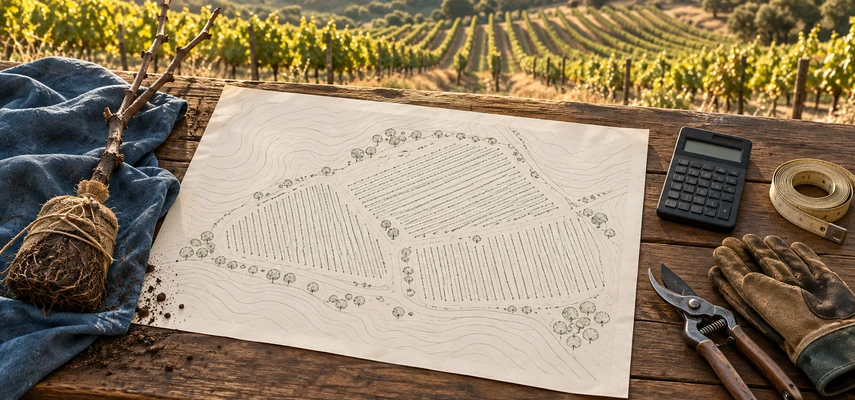

A vineyard can sell its entire crop and still fail to cover its full cost. The harvest cheque must support more than that season’s spraying and picking. Land, establishment, machinery, maintenance and the years before normal production all belong in the economics of grape growing.
The reverse problem is equally easy to miss. A vineyard showing a paper profit can run short of cash when large bills arrive before the buyer pays. Profitability, cash flow and investment recovery answer different questions. A useful budget distinguishes them instead of compressing everything into a single cost per tonne.
The official D2 specification includes vineyard establishment and management costs within wine pricing. The objective is to explain why costs differ and how they reach the fruit’s required selling price, without assuming that the market will pay whatever the grower needs.
The economics of grape growing starts with the saleable crop
Define what is being produced and for whom. A buyer’s variety, maturity, health, yield and delivery requirements influence the vineyard’s operating choices. Growing attractive grapes without a viable customer is not a complete enterprise plan. Nor does a high advertised regional price establish what this crop will realise.
Oregon State’s vineyard-planning guide puts environment and marketing together. A site must grow suitable fruit and provide a workable route to a buyer. Access, distance, available labour and equipment can make two apparently similar parcels economically different.
Specify whether revenue comes from grapes, juice, bulk wine or packaged wine. A grape-growing budget should not quietly claim the retail bottle price as its return. Converting the crop and getting the wine to consumers adds separate costs, risks and margins, even when one owner controls the whole chain.
Land cost is more than the purchase price
Buying land ties up capital and can involve transaction, access and development costs. Leasing changes the cash requirement and contractual position, but does not eliminate the economic cost of using the site. The appropriate comparison depends on the actual arrangement and the vineyard’s expected operating horizon.
Owned land is not necessarily free for an economic analysis. It has alternative uses or a potential rental value, while the capital committed has an opportunity cost. A cash budget and a full economic budget may treat those questions differently. State the convention so that two apparently different cost estimates can be compared fairly.
Separate the land from improvements such as irrigation, trellis and buildings. These assets have different lives and replacement needs. Treating the entire purchase as a recurring annual expense overstates one year’s operating cost; ignoring it altogether can understate what the enterprise must support over time.
A celebrated location may command a high price because buyers expect valuable fruit or other benefits. The cost itself does not prove that the planned business can earn enough to justify it. Site reputation, buyer access, productive capacity and alternative uses need to be assessed independently.
Vineyard establishment spends money before normal returns
Vineyard establishment includes planning, site preparation, appropriate soil or drainage work, plant material, planting, trellis, irrigation where needed and access infrastructure. Design affects not only the initial bill but also future labour, machinery and management options. A cheap layout can become expensive if it repeatedly obstructs essential work.
Young vines require training, protection and maintenance while useful output develops. The length and shape of that period depend on the site, material and management. A mature-vineyard budget cannot simply be applied from planting day. Establishment and early operating cash requirements need to be planned together.
North Carolina State’s cost-and-investment study separates establishment and productive phases. Its monetary assumptions are historical and regional, so they are not current quotations. The transferable point is the structure and timing of costs before and during production.
Allow for plant failures, repairs and a realistic transition to intended output. Assuming full mature yield immediately makes the investment appear easier to fund than it is. Equally, a single universal establishment period can conceal variation. Use a schedule that reflects the proposed vineyard and test less favourable outcomes.
Annual vineyard management creates recurring obligations
Vineyard management includes pruning, canopy work, soil and vegetation management, nutrition, water, pest and disease monitoring, crop protection and harvest. Inputs, labour, fuel, contractors and machinery contribute differently to each operation. Record quantities and work time so that changing a wage or product price can be traced through the budget.
Conditions influence what is required. A wetter disease season can increase interventions, while frost or drought can reduce usable crop after many costs have already been incurred. Protection systems may lower particular risks but add capital and operating expenses. Their value depends on expected avoided losses, performance and cost rather than the presence of equipment alone.
Certification, testing, record keeping and management also require resources. Family labour or owner time should not vanish because no external invoice appears. State whether an estimate includes a charge for those resources. Otherwise a low reported cost may describe unpaid work rather than a more efficient vineyard.
Harvest and delivery need separate attention. Some costs vary with tonnes picked, while others reflect mobilisation, crew availability, terrain or machine access. Penn State’s grape-production budget guidance emphasises market access and tailoring custom-hire assumptions. A budget based on someone else’s machinery arrangement can misstate this operation’s costs.
Labour and mechanisation change the whole system
Hand work can be selective and adaptable, but its timing and availability matter as much as the hourly rate. A task that cannot be completed within the useful window can create crop or quality losses. Include supervision, training and related employment costs appropriate to the operation, without assuming one regional wage applies everywhere.
Mechanisation can reduce work per hectare or improve timeliness, provided the site and vine layout are suitable. It introduces ownership or contract charges, maintenance, fuel and operator requirements. A machine used briefly each year may carry a high cost per operating hour, especially at small scale.
Compare ownership, contracting and shared access on equivalent terms. A contract quote may include costs that are scattered across several lines in an ownership budget. Availability in a difficult harvest window is another difference. Lower apparent annual expenditure is useful only if the required operation can still be delivered.
Scale can spread some costs across more hectares, but it does not erase complexity. Larger operations may need extra management, infrastructure or travel between blocks. The relevant question is whether useful output and operating efficiency grow faster than the associated costs.
Fixed, variable, cash and economic costs differ
Fixed costs remain over the defined short-run output range, while variable costs change with the activity or output concerned. The classification depends on the decision and time horizon. A pruning bill may vary with hectares managed but not fall in direct proportion to the kilograms eventually harvested after frost.
Depreciation allocates the economic use of an asset over time; it is not the same as a cash payment made that season. Interest or a capital charge addresses the cost of finance or committed resources. Oregon State’s enterprise-budget explanation distinguishes these ownership and operating questions.
Avoid double counting. Loan principal repayment affects cash requirements but is not an additional operating expense to add on top of the full asset purchase and annual depreciation in one undifferentiated profit calculation. Identify which measure is being prepared and keep its treatment consistent.
An enterprise budget estimates the cost and return of the activity. A cash-flow schedule places receipts and payments in time. Both can be necessary. A vineyard can cover long-term economic cost yet need working capital between early-season spending and eventual payment for the crop.
Yield changes cost per kilogram
Divide relevant total cost by marketable output, using consistent units. Yield per vine, tonnes per hectare and litres of finished wine are different measures. A cost per hectare can remain similar while cost per kilogram rises sharply after crop loss. The denominator is as important as the expenditure.
Consider an original hypothetical hectare with fixed annual charges of 9,000 currency units and output-related costs of 0.50 per kilogram. At 8,000 kg, total cost is 13,000 and unit cost is 1.625. At 6,000 kg, total cost is 12,000 and unit cost is 2.00. Lower output reduces some spending but spreads the fixed charges across fewer kilograms.
At a selling price of 2.00 per kilogram, the first case earns revenue of 16,000 and a surplus of 3,000 over the stated costs. The second earns 12,000 and just covers them. These are simplified examples, not vineyard benchmarks, and exclude any cost not explicitly included in the assumptions.
Higher yield is not therefore always the answer. Crop requirements, legal limits, fruit maturity and buyer acceptance can constrain usable output. A larger crop that misses the specification may realise a lower price or leave unsold fruit. Compare expected accepted yield and price together.
Sensitivity matters more than a single forecast
Test changes in yield, realised price, labour and other significant inputs. Include scenarios where more than one thing goes wrong: a smaller crop and a weaker price can arrive together. A budget that succeeds only at the most optimistic assumptions is fragile even when its average-looking figures appear attractive.
Washington State’s economics resources point to scenario-based vineyard cost tools. The principle is to adapt assumptions rather than copy a published total. Historical examples remain useful for identifying categories, but current local quantities and quotations are needed for an actual business decision.
Separate short-run and long-run choices. Once spending is committed, a harvest decision may compare additional picking and delivery costs with the likely receipt. That does not prove the enterprise covers all annual costs. A contribution towards existing costs can be rational in one difficult season without justifying the same production indefinitely.
Connect grape cost with wine price carefully
Grape cost is an input into wine production, not the final shelf price. Recovery, winemaking, maturation, packaging, transport, selling costs, tax and margins sit between the vineyard and retail. A higher grape cost can put pressure on a wine business without being fully recoverable from consumers.
An evaluated explanation follows the mechanism: a difficult site needs more labour, usable yield is limited, unit grape cost rises, and the buyer must decide whether the fruit’s contribution supports the intended wine and market. Expensive cultivation can help explain cost. It cannot guarantee outstanding wine or a premium selling price.
Use winemaking economics and wine supply and demand as tests of the business reasoning here: identify who bears a cost or risk, explain how the route to market changes it and distinguish revenue from the return retained by the producer.
Original Diploma practice
These original exercises are not official WSET questions and have no official mark allocations.
Question 1: calculate the effect of crop loss
Use fixed charges of 9,000 currency units, variable cost of 0.50 per kg and price of 2.00 per kg. Compare 8,000 kg with 6,000 kg and explain the limitation of judging efficiency from total spending alone.
Indicative answer points: total cost; unit cost; revenue; surplus; fixed-cost dilution; accepted crop and simplified assumptions.
Outline answer: At 8,000 kg, cost is 13,000, revenue 16,000 and surplus 3,000; unit cost is 1.625. At 6,000 kg, cost is 12,000, revenue 12,000 and surplus zero; unit cost is 2.00. Spending falls by 1,000 but receipts fall by 4,000. The lower bill therefore does not establish better performance. Compare marketable output and the full cost convention, and recognise that real costs may respond differently from this simplified model.
Question 2: evaluate buying a harvester
A small vineyard proposes buying machinery because the estimated fuel bill is below its contractor’s charge. Evaluate the comparison.
Indicative answer points: ownership costs; operator and maintenance; annual utilisation; site compatibility; timeliness; contractor inclusions; alternative uses of capital.
Outline answer: Fuel is only one ownership cost. Include the asset’s use, capital, maintenance, operator time, insurance and storage on a consistent basis. Check whether the machine suits the terrain and vine layout and how many hours it will be used. Contracting may include several of those resources but carries booking and availability considerations. Compare equivalent complete services, including the value of timely harvest, rather than a contractor invoice with a single internal expense.
Question 3: distinguish profit from cash flow
A newly established vineyard forecasts a mature-year profit and assumes it therefore has enough money to reach that year. Explain the missing analysis.
Indicative answer points: establishment outlays; young-vine maintenance; gradual output; timing of receipts; working capital; debt cash payments; downside scenarios.
Outline answer: A mature-year budget says little about the cash needed beforehand. Schedule establishment payments, early maintenance and realistic receipts across the development period. Include the timing of buyer payment and financing commitments using the correct cash treatment. Test delayed production or weaker returns. An eventual operating surplus can coexist with an earlier funding shortfall, so the investment needs both an economic assessment and a timed cash-flow plan.












