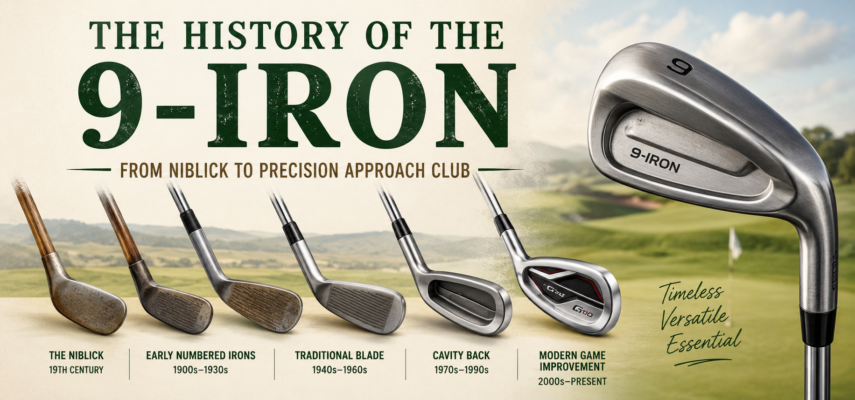
The 9-iron occupies a distinctive place in the golf bag.
It is usually the final numbered iron in a modern set, yet it frequently performs like a wedge. Golfers can use it for full approaches, controlled three-quarter swings, low-running chips, punch shots beneath tree branches, and abbreviated pitches around the green.
That versatility is the product of an evolution stretching back to the niblick, one of the most recognizable clubs of golf’s hickory era.
The old niblick was a heavy, highly lofted implement built to rescue golf balls from rough, sand, ruts, and difficult ground. It was not standardized, particularly forgiving, or primarily designed for attacking flags. Its purpose was often simply to return the ball to safety.
During the 20th century, that rugged recovery club evolved into the numbered 9-iron. Steel shafts made it more consistent. Specialized wedges took over many of its traditional jobs. Improved manufacturing transformed it into a dependable approach club, while cavity-back designs made it easier to hit.
The 9-iron retained the lofted character of the niblick, but its role changed completely.
It evolved from a club used to escape trouble into one used to create scoring opportunities.
Before Numbers, Golf Clubs Had Names
For much of golf’s early history, clubs were identified by names rather than numbers.
Golfers carried mashies, cleeks, spoons, brassies, jiggers, baffies, lofting irons, mashie-niblicks, and niblicks. These names generally described how a club was intended to be used, but they did not represent universal specifications.
One clubmaker’s niblick might differ considerably from another’s. Loft, shaft length, head weight, sole shape, and face design varied. Golfers therefore assembled collections of individual tools instead of buying the orderly, matched sets familiar today.
At the lofted end of the bag, the niblick was among the most important of those tools.
A traditional niblick usually had a short hickory shaft and a small, heavy iron head with substantial loft. Its blade was often thick enough to withstand forceful swings from difficult lies.
The niblick performed many jobs now divided among several clubs:
- Short lofted approaches
- Escapes from deep grass
- Recovery from depressions and ruts
- Shots from sand
- Pitches over obstacles
- Awkward shots around the green
It is commonly identified as the closest historical ancestor of the modern 9-iron, although the comparison is not exact. Niblicks varied too widely to correspond to a single modern loft.
Some resembled short irons. Others performed more like pitching wedges, sand wedges, or specialized recovery clubs.
The connection is one of lineage and purpose. Before the numbered iron set existed, the niblick occupied the high-lofted end of the iron family.
The Niblick Was Built for Trouble
The early niblick was not primarily an elegant scoring instrument. It was a club of last resort.
Golf courses in the 19th century were less manicured than modern layouts. Fairways could be uneven, bunkers were often natural hazards, and balls regularly came to rest in thick grass or damaged ground.
The niblick’s heavy head allowed golfers to strike sharply downward and move the ball from an imperfect lie. It could dig, cut, and lift.
That made it essential, but it also shaped how golfers viewed the high-lofted iron. The niblick was usually selected because something had gone wrong—a poor shot, an unfortunate bounce, or an encounter with a hazard.
The modern 9-iron carries some of that versatility, but its psychological role is nearly the opposite.
A golfer standing in the fairway with a 9-iron is usually in an attacking position. The club is associated with controlled distance, accuracy, and the chance to place the ball near the hole.
The history of the 9-iron is therefore not only a story of changing equipment. It is a story of changing expectations.
How the Niblick Became the Number Nine
Numbered irons emerged as golf entered the age of mass production.
Named clubs made sense when equipment was built individually by local clubmakers. They became less practical as manufacturers sought to sell coordinated sets to a growing international market.
A numerical system was easier to understand.
Lower-numbered irons generally had longer shafts and less loft, producing greater distance. Higher-numbered irons had shorter shafts and more loft, producing higher and shorter shots.
The 9-iron appeared at the lofted end of this progression and gradually inherited the position once occupied by the niblick.
The change did not happen immediately. Traditional club names and modern numbers coexisted for years. A golfer might still ask for a niblick while a manufacturer described the equivalent club as a No. 9 iron.
By the 1930s, however, numbered sets were becoming the commercial norm.
The niblick had not disappeared entirely. It had been standardized, renamed, and placed within a sequence.
Steel Shafts Make the Club Predictable
The rise of numbered irons coincided with one of the most important equipment changes in golf history: the transition from hickory shafts to steel.
Hickory had served golfers for generations, but it was a natural material. Shafts varied in weight, grain, stiffness, and durability. Skilled clubmakers could sort and match them, but producing large quantities of nearly identical clubs was difficult.
Steel provided far greater consistency.
Manufacturers could produce shafts with predictable dimensions and flex characteristics. They could also design matched iron sets in which each club followed a planned progression of loft, length, weight, and feel.
For the emerging 9-iron, this consistency was transformative.
A lofted approach club depends heavily on predictable delivery. Small changes in shaft behavior, head weight, or face angle can noticeably affect trajectory and distance.
The steel-shafted 9-iron became a repeatable club. It related systematically to the 8-iron above it and the shorter clubs below it.
The old niblick had been an individual tool.
The modern 9-iron was becoming part of an engineered system.
The Wedge Revolution Changes Its Role
When the numbered 9-iron first appeared, it retained many responsibilities inherited from the niblick.
It could be used for short approaches, heavy rough, sand shots, pitches, and general recovery play. In many bags, it was the most lofted iron available.
That changed with the rise of specialized wedges.
Gene Sarazen is widely credited with developing and popularizing the modern sand wedge during the early 1930s. His crucial innovation was not merely adding loft. He created a broad, weighted sole that helped the club move through sand without digging too deeply.
The design demonstrated the practical importance of bounce—the feature that allows the sole to resist burying itself in turf or sand.
A 9-iron’s relatively narrow sole remained well suited to clean contact from grass, but the sand wedge was far more effective from soft bunkers.
As the sand wedge became established, the 9-iron was relieved of one of its oldest duties.
The arrival of the pitching wedge brought further specialization. It provided a more lofted option for shorter approaches and pitches. Later, gap wedges and lob wedges divided the short game into even more precise categories.
The 9-iron survived because it occupied a valuable middle ground.
It offered more distance and a flatter full-swing flight than the specialized wedges, while still producing enough height and spin to attack a green.
Its role became narrower, but also clearer.
It was no longer golf’s universal rescue club. It had become a dedicated scoring iron.
The Classic 9-Iron Takes Shape
By the middle of the 20th century, the 9-iron had assumed a recognizable modern form.
It was typically a compact forged blade with a short steel shaft, a narrow sole, and considerably more loft than the middle irons. In many sets, it was the last numbered club before the pitching wedge.
These traditional 9-irons demanded precise contact.
Their compact heads offered limited protection when the ball was struck toward the heel or toe. Their narrow soles could dig into the ground, and their designs provided little help on off-center strikes.
In capable hands, however, the blade-style 9-iron offered tremendous control.
A skilled golfer could alter trajectory, spin, distance, curve, and rollout by changing ball position, swing length, face angle, and impact conditions.
The club became associated with the classic high approach shot: a ball rising steeply, landing near the flag, and stopping quickly.
It could also be manipulated in ways that connected it to its niblick ancestry. Golfers continued using the 9-iron for running chips, shortened pitches, punch shots, and escapes from light rough.
The club had become more precise without losing its versatility.
From Blades to Cavity Backs
Traditional blade irons concentrated much of their weight behind the center of the face. This rewarded pure contact but offered little stability when the ball was struck off-center.
Designers eventually began moving weight toward the perimeter of the clubhead. Karsten Solheim and PING played an important role in popularizing cavity-back construction, which helped the head resist twisting on mishits.
For the 9-iron, perimeter weighting improved consistency.
Although a short iron is generally easier to control than a long iron, golfers still miss the center of the face. Cavity-back designs helped preserve more ball speed and directional stability.
Later models incorporated wider soles, larger faces, progressive offset, vibration-dampening materials, tungsten weighting, and hollow-body construction.
The 9-iron expanded from a single traditional form into a broad equipment category.
A modern version might be a compact forged blade, a cast cavity back, or a hollow club built with multiple materials.
Each still carries the number nine.
The Number Stayed the Same, but the Loft Changed
A 9-iron is not defined by one universal loft. It is defined primarily by its position within a set.
Traditional 9-irons commonly carried lofts in the mid-to-upper 40-degree range. Many modern players’ irons remain relatively close to those specifications.
Distance-oriented models can be considerably stronger.
A contemporary 9-iron may have a loft once associated with an older 8-iron. This trend is commonly called loft strengthening.
Reducing loft helps create additional distance, but loft is only part of the design. Lower centers of gravity can help launch the ball higher. Thin faces can increase ball speed, while internal weighting influences trajectory and forgiveness.
The result is a club with less static loft that can still produce a playable flight.
Even so, the change has complicated the meaning of the number nine.
Two golfers may each use a 9-iron while playing clubs with different lofts, head designs, shaft lengths, trajectories, and expected distances.
The number is not a universal measurement. It identifies the club’s place within a particular manufacturer’s set.
Why the 9-Iron Survived
Many historical golf clubs disappeared because another design performed the same task more effectively.
The brassie was absorbed into the fairway-wood category. The mashie vanished into the numbered iron set. The jigger became a historical curiosity. Some modern long irons have increasingly been replaced by hybrids.
The 9-iron has faced pressure from both directions.
Stronger 8-irons can cover some of its full-swing territory. Pitching and gap wedges can handle many of its shorter shots. Specialized wedges offer more loft and more sole options around the green.
Yet no neighboring club completely replaces its combination of distance, height, and control.
The 9-iron is short enough to be accurate, lofted enough to stop the ball, and powerful enough to remain a true approach club.
It also connects two parts of the golf bag.
Above it are the numbered irons, generally organized around increasing distance. Below it are wedges, increasingly organized around loft gaps, bounce angles, sole designs, and short-game functions.
The 9-iron sits between those systems.
With a full swing, it behaves like a conventional iron. Around the green, it can perform like a wedge.
That dual identity explains its endurance.
The Legacy of the 9-Iron
The 9-iron is not golf’s longest or most glamorous club.
Its historical importance comes from the transformation it represents.
It began with the niblick, a heavy and loosely defined tool created for difficult ground. It entered the numbered set as manufacturers sought order and consistency. Steel shafts made it more predictable. Specialized wedges removed many of its recovery responsibilities. Cavity backs and modern weighting made it more forgiving, while stronger lofts changed the distance associated with the number on its sole.
Through every stage, its central quality survived: versatility.
The 9-iron can still lift a ball from rough, play a running shot beside the green, or escape from an awkward position. In that sense, it retains the spirit of the niblick.
But its primary purpose has been reversed.
The niblick was the club a golfer reached for when the hole was slipping away.
The modern 9-iron is the club a golfer reaches for when the flag is within reach.