










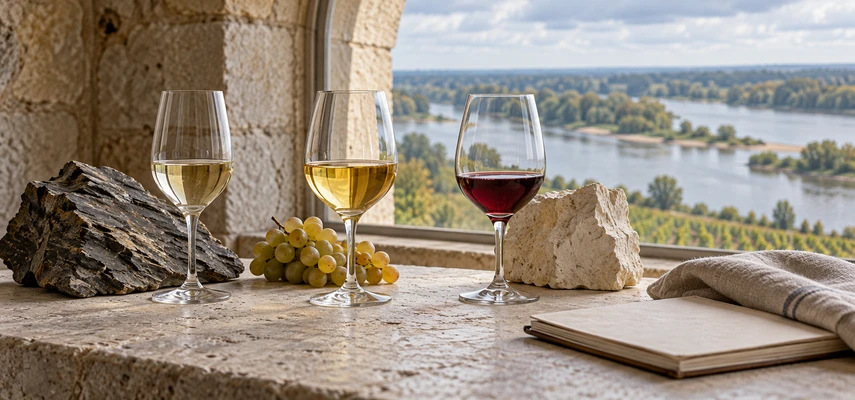

Put a pale Muscadet beside a mature dry Chenin, a sweet Layon wine and a Cabernet Franc red. The wines don’t look like a tidy regional family portrait. That’s the point. The western Loire combines an Atlantic-facing vineyard, varied inland slopes and producers working toward different outcomes. “Cool climate” supplies some context, but it doesn’t explain the whole table.
For Diploma study, start with the intended wine. A grower protecting fresh Melon fruit has a different harvest problem from someone selecting concentrated Chenin grapes. Connect the site, the crop and the cellar choices, then explain their consequences for style, quality and price.
Follow the river inland
The western Loire begins around Nantes and extends through Anjou toward Saumur. Atlantic influence is strongest in the Nantais, while conditions become more transitional inland. The regional geology and climate map distinguishes old crystalline formations in the west from sedimentary areas farther east. Think of a changing landscape rather than a climate switch at a municipal boundary.
Temperature affects the pace of ripening and acid retention; sunlight supports sugar accumulation and changes bunch exposure. A sheltered, well-exposed slope can help fruit ripen, but warmth becomes less welcome during severe heat or water stress. Rivers may influence local conditions without protecting every vineyard from frost.
Water availability depends on rainfall, soil depth, drainage and roots. Nutrient availability influences growth, crop balance and canopy density. Thin soils can restrain vigour but provide a limited drought reserve; deeper or clay-rich soils may retain more water. Don’t turn schist or limestone into an automatic quality ranking, or assume their names describe substances tasted directly in wine.
Weather can upset a promising season. Spring frost threatens new shoots, hail damages crops, and rain during ripening may increase disease pressure or complicate picking. Downy mildew, powdery mildew and bunch rot require attention. A humid Atlantic setting and a relatively dry inland slope present different pressures, yet neither grants immunity from a bad year.
Give Melon and Chenin different jobs
Muscadet is made from Melon, also called Melon de Bourgogne or Melon B.; it isn’t Muscat. The Nantais regional overview also distinguishes Folle Blanche in Gros Plant du Pays Nantais. Similar geography doesn’t mean the two names describe interchangeable grapes or wines.
Melon’s relatively restrained aromatic profile makes freshness, texture and subtle flavour particularly useful comparison points. Its early development creates frost exposure, while maintaining healthy fruit remains important where rain encourages disease. Concentrated fruit and carefully judged lees ageing can produce more depth than the simple “light seafood wine” stereotype suggests.
Chenin Blanc commonly retains marked acidity while supporting several ripeness and sweetness levels. That makes it useful for dry, sweet and sparkling wines, although those outcomes aren’t all made from identical grapes picked together. Chenin’s early budding can expose it to spring frost; obtaining ripe flavours and sound fruit later in the season needs careful site and harvest decisions.
Try explaining the difference between two dry whites without starting from their reputation. Does one show greater concentration, a broader texture or more development? Does its acidity support the fruit or stand apart from it? The answer should come from the sample and production evidence, rather than a rule that Chenin must always be more ambitious than Melon.
Grow a crop for the proposed style
Vineyard establishment involves matching permitted varieties, exposure, access and training to the site. Planting materials should combine suitable selections with rootstocks appropriate to soil, vigour and water conditions. Managing a dense canopy on a vigorous site creates a different problem from preserving sufficient leaf area on a dry, shallow slope.
Nutrient and water management should respond to vine condition and the applicable rules. Canopy management balances airflow, useful exposure and protection from excessive sun. Opening the bunch zone may reduce persistent dampness; aggressive leaf removal in a hot season may increase damage instead. “More exposure” isn’t a complete recommendation.
Harvest timing should consider flavour, sugar, acidity, fruit health and the forecast. A base wine intended for sparkling production needs a different balance from selected grapes for a concentrated sweet wine. Hazard management includes appropriate site choice and practical frost precautions where suitable, but resources and effectiveness vary. Pest and disease management requires monitoring and justified interventions, including prompt selection of damaged fruit.
Careful grape transportation limits crushing, heating and unwanted oxidation. Reception should keep lots separate by origin, condition and intended use. A producer seeking aromatic precision can’t simply blend damaged fruit into sound grapes and expect the press to resolve the problem.
Understand lees before calling them oak
Muscadet production generally centres on pressing white grapes, controlled fermentation and protection of the desired fresh character. Processing choices, including press fractions and handling of oxygen, influence the starting juice. Alcoholic fermentation may occur in different vessels; a clean tank doesn’t make a simple wine inevitable, and a barrel doesn’t make a complex wine inevitable.
Lees are the sediment remaining after fermentation, notably yeast material. Contact with suitable fine lees can affect texture and help a wine feel rounder without new-oak flavour. The producer must monitor condition: extended contact isn’t a substitute for hygiene or sound judgment, and stirring isn’t a compulsory part of every lees programme.
Maturation length, vessel, oxygen exposure and lees handling should serve the desired wine. A little dissolved carbon dioxide can contribute a fresh sensation without turning Muscadet into sparkling wine. Malolactic conversion changes the acid profile and may be avoided to preserve freshness; assess the intended balance rather than assuming that every soft texture proves this conversion happened. Blending eligible parcels or fractions can improve balance, but origin claims constrain the available material.
Packaging and closures should preserve freshness or the intended development. Wine transportation needs suitable protection from heat and avoidable oxidation. Neither a lively young white nor a structured red benefits from careless storage on the journey to its customer.
The regulated phrase sur lie deserves more care than the general cellar expression “aged on lees.” The approved Muscadet Sèvre et Maine amendment published in April 2026 changed packaging provisions and distinguished the routes for sur-lie wines and supplementary geographical names. Older summaries can therefore mislead. Don’t apply one remembered bottling deadline to every Muscadet appellation or vintage situation.
Compare dry and sweet Chenin properly
Savennières is an important reference for concentrated dry Chenin and potential development. The regional appellation guide places it near Angers and distinguishes nearby Savennières Roche aux Moines and Coulée de Serrant as protected origins. These names aren’t three interchangeable quality adjectives.
A mature dry Chenin can provide waxy, honeyed or dried-fruit impressions without necessarily containing perceptible sweetness. Check the palate. Dryness doesn’t mean thinness, and a honey aroma isn’t a sugar measurement. Tank, old wood, newer barrels and lees choices can shape the wine, but explain what each decision actually contributes before assigning a flavour to it.
In the Layon area, Chenin can be selected at advanced ripeness, with concentration through noble rot and/or drying where the relevant rules permit. The council’s Coteaux du Layon Villages account distinguishes successive selection from simply delaying the entire harvest. Botrytis needs favourable conditions; sustained wetness can produce destructive rot instead.
Repeated picking passes require labour and may recover little juice. Pressing concentrated grapes is also different from handling a generous crop of sound early-picked fruit. The resulting wine still needs balance: retained sugar, acidity, flavour concentration and alcohol must work together. More sugar doesn’t automatically mean greater complexity.
Bonnezeaux, Coteaux de l’Aubance, Coteaux du Layon and Quarts de Chaume Grand Cru belong in the sweet-Chenin study picture. Coteaux du Layon Premier Cru Chaume and Quarts de Chaume Grand Cru have distinct identities; neither is a general permission to add a Burgundy-style rank to any good Layon wine. Verify the exact origin and current rules.
Leave room for Cabernet Franc and rosé
Anjou and Saumur also make reds, with Cabernet Franc particularly important. Saumur-Champigny provides a useful comparison of fresh fruit, floral character and tannic structure. The Clos des Cordeliers profile illustrates a producer working with Cabernet Franc and Chenin across several wines; the location doesn’t oblige one uniform cellar recipe.
For reds, extraction and pressing influence colour, tannin and texture. Riper fruit and stronger extraction aren’t synonyms: longer or more vigorous cap work can create coarse structure if the material doesn’t support it. Maturation can help integration, although overt new oak may obscure the character a producer wants to retain.
Rosé names need separating too. Cabernet d’Anjou is a rosé associated with Cabernet Franc and Cabernet Sauvignon and perceptible sweetness. Rosé d’Anjou is another sweeter rosé category with different permitted grape choices; Rosé de Loire is dry. A paler colour doesn’t tell you which style is in the glass. Direct pressing or short skin contact changes extraction, while fermentation and retained sugar influence the finished balance.
Keep origin and commercial promises separate
International and EU protection frameworks, national French law and local appellation requirements govern what can be grown, made and claimed. InterLoire provides regional information and promotion; INAO and the relevant producer organisations have different regulatory roles. A geographical indication concerns defined origin and conditions. The AOC/AOP wines discussed here sit within PDO; broader IGP and wines without GI receive further comparison in the companion Loire chapter.
Labelling terms such as sur lie, a supplementary geographical name and Grand Cru aren’t interchangeable. A precise claim can help a customer understand a wine, but the claim doesn’t replace sensory evaluation. A regulated origin can contain wines with different levels of quality and different intended drinking windows.
Supply varies with harvest volume, selection and usable yield. Demand depends on style, familiarity, occasion and competing wines. Costs include vineyard labour, picking passes, cellar time and inventory. A serious Muscadet held for extended maturation may need a different price and sales explanation from an early-release example. Concentrated sweet Chenin faces the additional challenge of a smaller pool of suitable occasions and customers. Legislation also affects destination sales and compliance; currency exchange changes an importer’s landed cost without altering the wine’s quality. Wine brands can lead with an estate, a merchant or a particular origin, but each needs a credible, consistent promise.
Follow the producer to the customer
A grower may sell grapes, an estate may combine vineyards and production, and a winery may process fruit under different ownership arrangements. A merchant can source, blend eligible lots and market a range; a broker connects trading parties without necessarily owning the wine. Ask who controls specifications, carries stock and bears the risk, rather than judging a business from its front label.
Importing introduces freight, destination compliance and intermediary margins. Retail needs clear style and price positioning; HoReCa buyers consider food compatibility, staff explanation and stock turnover. Direct-to-consumer sales may retain more revenue per bottle but require visitors, service and fulfilment. Mature and emerging markets can differ in awareness and channels, yet neither describes every customer within a country.
An estate selling both dry and sweet Chenin needs buyers to understand the distinction before opening the bottle. A specialist can explain a small, expensive cuvée; a broad listing needs reliable volume and an immediately usable proposition. Evaluate the route alongside the wine’s cost and intended drinking occasion. More listings don’t necessarily produce a healthier business.
Compare the evidence here with the central and eastern Loire as a regional case, then apply the regional comparison framework to the comparison. Compare growing conditions, production decisions, style, quality and the commercial reasons for price. Establish the differences rather than assuming that one familiar name must be better.
Original Diploma practice
These exercises and indicative points are original study material, not official WSET questions or marking allocations.
Question 1: compare two routes to texture
Compare how a Muscadet producer and a dry-Chenin producer could add texture without relying on conspicuous new oak. Explain the risks and evidence needed.
Indicative points: fruit concentration, press fractions, lees, vessel, oxygen and balance.
Outline answer: Suitable ripe fruit supplies the starting concentration, while pressing determines juice fractions. Fine-lees contact and vessel choices may develop texture without strong oak flavour. Monitoring is essential because longer contact can introduce unwanted characters. Assess the actual integration of fruit, acidity and texture; roundness alone doesn’t prove either quality or malolactic conversion.
Question 2: evaluate a sweet-wine harvest
A fictional Layon grower proposes waiting for all grapes to become equally concentrated before one mechanical harvest. Evaluate the plan for a wine requiring selective picking.
Indicative points: uneven ripeness, qualifying concentration, fruit health, labour and risk.
Outline answer: Concentration and noble-rot development vary between bunches and sites. Waiting can sacrifice sound fruit or increase destructive rot. Successive selection may be necessary to meet the intended quality and applicable rules, despite higher labour and lower recovery. Compare saleable yield and likely price with the risk of losing the crop; a single cheap operation isn’t automatically economical.
Question 3: compare a commercial decision
A fictional estate wants the same price and sales channel for an early-drinking Muscadet and a selectively harvested sweet Chenin. Evaluate that proposal.
Indicative points: cost per litre, inventory, customer occasion, channel and explanation.
Outline answer: The wines may differ in usable yield, labour and time before sale. Their buyers also need different information and occasions. Compare margin after service and distribution costs, rather than imposing one price because both wines are Loire whites. A specialist channel may explain the sweet wine effectively, but its capacity and demand still need evidence.
Analytical tasting preparation: western contrasts
Using the official specification’s recommended samples, PDF page 25, plan a good Muscadet or Muscadet Sur Lie, a very good or outstanding Savennières or similar dry Chenin with tertiary characteristics, and a good or very good Cabernet Franc from any Loire appellation. These cover three essential Loire categories; the companion chapter adds the two Sauvignon categories and demi-sec or sweet Chenin comparison.
Optional selections include a good rosé, acceptable or good Chenin and a very good or outstanding Coteaux du Layon or similar wine. This is a proposed study programme, not a completed tasting or a prediction of examination wines. A mature dry Chenin and a sweet Layon wine offer a particularly useful check on the difference between honeyed aroma and actual sweetness.
Write full systematic notes blind before revealing the labels. Compare acidity, sweetness, alcohol, body, texture, fruit, development and finish. Justify quality through balance, concentration, complexity and desirable persistence. Assess bottle-ageing suitability separately, including remaining fruit and the nature of the structure; acidity alone isn’t a promise of improvement. Record uncertainty and ask for tutor feedback when calibrating judgments.











