










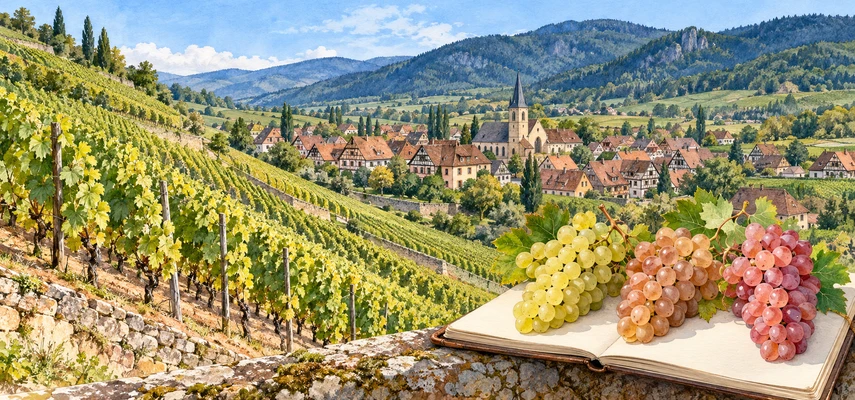

An Alsace label can look unusually helpful: a grape name, a recognisable bottle shape and perhaps a famous vineyard. Then the wine arrives, and the question nobody asked becomes rather important. Is it dry? Alsace rewards readers who keep variety, place, ripeness and finished sweetness separate. They influence one another, but none supplies the complete answer alone.
For Diploma study, the region is a useful test of causal reasoning. Explain how a sheltered slope helps grapes ripen, how picking decisions change the raw material, and how fermentation turns that material into a particular style. Then assess whether the wine succeeds on its own terms.
Understand the shelter without assuming uniform dryness
Alsace lies in eastern France, between the Vosges and the Rhine. Its vineyards occupy a long north–south corridor with considerable variation in elevation, exposure and geology. The regional council’s terroir explanation describes the Vosges shelter from moist western influences and the resulting relatively dry, sunny, semi-continental conditions.
Temperature affects ripening rate and acid retention, while sunlight supports sugar production and influences the bunch environment. Long, favourable autumn conditions can extend the picking window, but a regional description isn’t a forecast. A cool slope and a warm sheltered site don’t necessarily reach comparable maturity together.
Water availability depends on rainfall, rooting and the soil’s capacity to store and release moisture. Nutrient availability influences vigour and the balance between growth and crop. Granite, limestone, marl, sandstone and volcanic formations help create different soils, yet a geological name isn’t a bottled flavour compound. Explain drainage, rooting and vine function before reaching for a poetic rock descriptor.
Weather can change the advantage. Spring frost threatens young growth, hail damages leaves and fruit, and heat or drought can reduce productive activity. Downy and powdery mildew still require attention; relatively low rainfall doesn’t abolish disease. Botrytis can produce valuable concentration under suitable conditions, or destructive rot when conditions and fruit health don’t cooperate.
Match the grape to the intended wine
Riesling commonly provides a firm acid framework, with citrus, floral or stone-fruit character depending on maturity and development. The council’s Riesling profile offers a useful stylistic starting point, but its broad ageing enthusiasm needs testing against an actual bottle. Not every Riesling will improve for decades, and a developed kerosene note isn’t a direct transfer from stony soil.
Gewurztraminer can deliver pronounced rose, lychee and spice-like aromas with substantial body and generally less acidity than Riesling. Pinot Gris often provides ripe orchard or stone fruit, breadth and sometimes smoky or spicy impressions. The regional grape guide is best used to build comparisons, rather than memorised tasting scripts. A quiet sample doesn’t cease to be Gewurztraminer because it lacks the expected perfume.
Muscat can be aromatic yet dry, Pinot Blanc can offer a gentler fresh-fruit profile, and Sylvaner deserves assessment beyond its reputation as a simple wine. Auxerrois also matters, including in wines labelled Pinot Blanc under the applicable rules. Pinot Noir supplies reds and rosés. Crémant d’Alsace belongs to the region too, although its sparkling production receives separate treatment in D4.
Make ripening a vineyard decision
Vineyard establishment involves matching permitted varieties, exposure, access and training to the site. Planting materials should combine suitable varieties and selections with rootstocks that address soil, vigour and water constraints. A warm site may help a later-ripening variety, while excessive heat can make preserving balance harder. Regional familiarity doesn’t replace a site assessment.
Nutrient and water management should follow vine status and legal conditions. Canopy management preserves effective leaf area while managing shade, airflow and sun exposure. Removing more leaves isn’t automatically better: the consequences differ between a damp season and a hot, exposed slope.
Harvest timing balances sugar, acidity, flavour, fruit health and the intended style. A dry Riesling, a generous Pinot Gris and selected sweet-wine grapes may require different decisions even on one estate. Hazard management begins with site and practical preparedness; frost protection, where suitable, consumes resources and offers no universal guarantee. Pest and disease management needs monitoring, justified interventions and prompt responses to damaged fruit. Certification describes an approach, not immunity from a difficult vintage.
Preserve aroma while managing texture
Winemaking approaches range from fresh, dry whites to richer examples and highly concentrated sweet wines, alongside red production. Gentle grape transportation limits crushing and oxidation; reception should separate lots by condition, variety, origin and intended use. Mixing sound fruit and seriously damaged grapes may sacrifice precisely the aromatic clarity a producer wants to preserve.
Processing for many whites centres on pressing rather than fermenting with skins. Extraction and pressing choices affect phenolics and the character of juice fractions; more pressure doesn’t simply yield more equivalent juice. Pre-fermentation clarification adjusts solids to support the desired fermentation and style. Must adjustments require analysis and permission, with stricter conditions applying to particular wines.
Alcoholic fermentation may take place in stainless steel or wood, with temperature selected to balance control, aroma and a healthy finish. Traditional large old casks needn’t give conspicuous new-oak flavour. The council’s white-vinification account supplies regional context; producers still make different choices within the rules.
Malolactic conversion is often avoided in aromatic whites to preserve acidity and the intended profile, but don’t turn that tendency into an absolute regional ban. Maturation on lees can add texture without new oak. Blending eligible lots may improve balance, although a named variety, site or appellation claim limits which material can enter the blend.
Post-fermentation clarification removes unwanted suspended material; stabilisation considers proteins, tartrates and microbial risks separately. Finishing adjustments, sulfur dioxide and filtration should suit the analysis, style and destination. Residual sugar increases the importance of controlling unwanted refermentation. A wine can be deliberately sweet and technically sound, or dry and faulty: sweetness isn’t a cleanliness test.
Packaging and closures need to protect aroma and the expected drinking window. Wine transportation should control avoidable heat and handling damage. A distinguished vineyard name cannot repair a bottle cooked in transit, and unusually ornate packaging doesn’t establish that the liquid deserves long cellaring.
Read Grand Cru as a specific origin claim
Alsace AOC covers a broad origin, with additional geographical claims subject to their own conditions. Alsace Grand Cru comprises 51 named appellations, rather than one promise of an identical style. International and EU protection frameworks, national French law and local specifications work together; check the operative text for the exact site, colour and variety.
The consolidated Grand Cru specification published in January 2026 confirms important exceptions to a simple four-white-variety rule. Riesling, Gewurztraminer, Pinot Gris and permitted Muscat varieties are central, but Zotzenberg admits Sylvaner, and defined blends are possible at Altenberg de Bergheim and Kaefferkopf. Pinot Noir reds are permitted at Hengst, Kirchberg de Barr and Vorbourg. This doesn’t open every Grand Cru to Pinot Noir or every variety to every site.
The approved 2024 Vorbourg amendment is a useful reminder that older producer or promotional pages can lag behind the law. A Grand Cru claim identifies regulated origin and production; quality assessment still requires evidence from the wine. Neither rarity nor a steep slope makes balance automatic.
Industry associations have different roles: CIVA communicates and promotes the region, while AVA provides producer and specification information. INAO oversees the recognition framework. A geographical indication is a protected origin claim; AOC/AOP wines sit within PDO, whereas PGI/IGP is a separate category with different conditions. That comparison doesn’t establish a local Alsace IGP fallback. Wines without a geographical indication can use eligible Vin de France claims, but cannot retain a protected Alsace identity merely because a producer dislikes an appellation restriction.
Separate sugar in the grapes from sugar in the glass
Labelling terms deserve attention before making food or tasting recommendations. The AVA notice on sweetness information describes required sweetness indications from the 2021 vintage for Alsace AOC whites, excluding Vendanges Tardives and Sélection de Grains Nobles. Read the applicable category and label rather than assuming all aromatic wines are sweet or all Riesling is dry.
Vendanges Tardives concerns qualifying overripe grapes of permitted varieties and defined production conditions. Sélection de Grains Nobles involves selection of grapes affected by noble rot, producing highly concentrated wines. These mentions are additional regulated claims, rather than substitutes for origin. Picking late alone doesn’t establish the right to use either term.
The regional late-harvest overview explains their place alongside Alsace and Grand Cru wines. Sugar at harvest and residual sugar after fermentation are different measurements: yeast can turn substantial grape sugar into alcohol, while retained sugar changes the balance and stability requirements. Use the finished wine’s actual sweetness, acidity and concentration to explain its style.
Explain who pays for concentration
Supply varies with usable yields, permitted production and the proportion of fruit allocated to different styles. Demand depends on origin recognition, variety, sweetness expectations, drinking occasion and competing wines. Costs rise with difficult slopes, selective passes, low juice recovery, skilled labour and inventory held before sale. A concentrated sweet wine may therefore need a high price without enjoying an equally large customer base.
Legislation constrains production, claims and destination-market sales; currency exchange changes an importer’s costs without altering the vineyard. A grower may sell grapes, an estate may grow and make wine, and a merchant may source and market several origins. A broker can connect counterparties without becoming the winemaker. A winery provides production capacity, whether attached to vineyards or supplied through purchasing.
A virtual winery coordinates a brand through contracts, while a custom crush facility performs agreed production work. Treat those as analytical business models, not claims of regional dominance. A cooperative can pool equipment, expertise and distribution: Bestheim’s own account supplies a regional example. A conglomerate may coordinate several businesses and channels, with different scale advantages and management demands from an individual estate.
Importing adds freight, compliance and intermediary margins. Retail benefits from clear variety and sweetness information; HoReCa buyers need wines that staff can explain and match with the menu. Direct-to-consumer sales may retain more revenue per bottle but require visitors, service and fulfilment. Mature and emerging markets can differ in familiarity and channels, yet each includes varied buyers rather than one national preference.
Give the customer a usable reason to choose
Wine brands may lead with an estate, a merchant, a variety or a site. Marketing concepts begin with a target customer and a credible benefit. A dry, linear Riesling and a concentrated SGN need different occasions and explanations; the same ornate adjective doesn’t help both customers make a decision.
Marketing options include tastings, tourism, restaurant education and digital information. The five Ps connect product, price, place, people and promotion. A route-to-market decision must support the price and service proposition. For example, a specialist restaurant may explain an unfamiliar sweet wine effectively, but a broad supermarket listing needs particularly clear positioning and reliable demand. More distribution isn’t automatically better distribution.
Compare the evidence here with the western Loire as a regional case, then apply the regional comparison framework to the comparison. Compare growing conditions, production decisions, style, quality and the commercial reasons for price. Establish the differences rather than assuming that one familiar name must be better.
Original Diploma practice
These are original exercises with indicative points and outline answers, not official WSET questions or marking allocations.
Question 1: compare three white-wine plans
A fictional estate wants a dry Riesling, a generous Pinot Gris and a concentrated sweet Gewurztraminer. Compare the vineyard and cellar decisions that could support those aims.
Indicative points: site and ripening, picking criteria, fruit condition, fermentation, balance and stability.
Outline answer: Match site and canopy to ripening needs, then select harvest timing by sugar, acid, flavour and health rather than one date. Protect clean fruit during transport and pressing. Fermentation and retained sugar should serve the intended style; concentration doesn’t remove the need for freshness and integration. A sweet wine needs suitable microbial control, while regulated harvest mentions require additional compliance beyond stylistic intent.
Question 2: evaluate a Grand Cru assertion
A sales representative says that all Alsace Grand Cru is white, single-varietal and dry. Explain the problems and the evidence needed for an actual bottle.
Indicative points: permitted Pinot Noir sites, site-specific blend exceptions, sweetness, operative specification and bottle evidence.
Outline answer: The current rules allow Pinot Noir reds at three named sites and defined blends at particular others. Grand Cru isn’t a universal dryness statement. Identify the appellation, colour, variety or blend and any additional mention, then check current permissions and label information. Assess actual sweetness and quality rather than allowing classification to overwrite observations.
Question 3: evaluate a selective-harvest investment
A fictional producer proposes allocating more fruit to SGN because the bottle price is higher. Evaluate the decision.
Indicative points: suitable conditions, yield and labour, cash flow, demand, technical risk and opportunity cost.
Outline answer: Qualifying fruit depends on conditions, not intention alone. Selection and reduced recovery raise cost per saleable litre; delayed sales tie up money. Compare realistic demand and margin with alternative wines from the fruit, allowing for technical losses and distribution effort. A prestigious label doesn’t establish a commercially sensible production volume.
Analytical tasting preparation: build the six comparisons
The official Diploma specification, PDF page 25, recommends six essential Alsace selections: good or very good Muscat or Pinot Blanc; good Riesling; very good or outstanding Grand Cru Riesling; very good or outstanding Pinot Gris, with Grand Cru optional; very good or outstanding Gewurztraminer, with Grand Cru optional; and very good or outstanding Vendanges Tardives of any permitted variety. Optional additions are good or very good Pinot Noir, good or very good Sylvaner, and very good or outstanding SGN.
These are proposed study samples, not wines tasted for this article or examination predictions. Write a full systematic description blind before revealing labels. Compare sweetness with aroma, acidity with body, and development with remaining fruit. A floral perfume doesn’t measure sugar, and richness doesn’t prove oak.
Justify quality through balance, concentration, complexity and length in each actual sample. Assess bottle-ageing suitability separately, explaining whether fruit, structure and existing development support positive change. Compare a dry Riesling with a richer wine without rewarding one for behaving like the other. Use tutor feedback to calibrate judgments and retain uncertainty where the evidence cannot support a precise claim.












