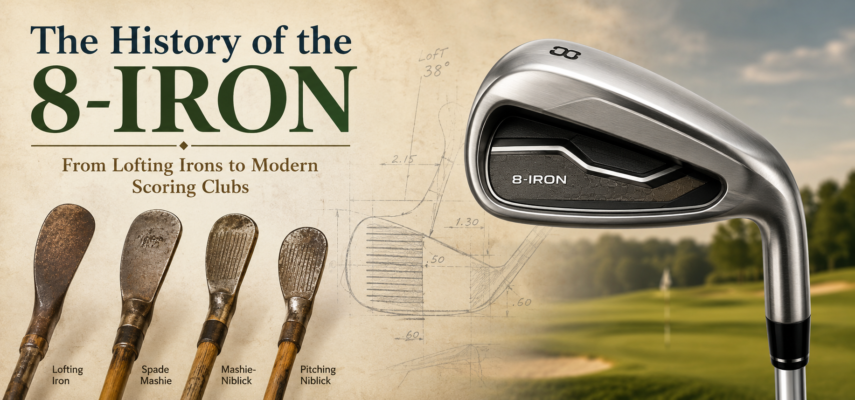
The 8-iron rarely receives the attention given to the driver, the putter, or even the famously dependable 7-iron. It does not promise extraordinary distance, and it lacks the specialized identity of a wedge. Yet few clubs better represent the transformation of golf from a game of improvisation into one of calculated precision.
For generations, the shot now associated with an 8-iron was not played with a universally recognizable club. Golfers relied on lofting irons, mashies, spade mashies, mashie-niblicks, and pitching niblicks—clubs whose names, shapes, and purposes varied from one maker to another.
The modern 8-iron emerged only after manufacturers began organizing irons into numbered, progressively lofted sets. That transition gave golfers something their predecessors had rarely enjoyed: a predictable club for attacking a green from relatively short range.
In that sense, the history of the 8-iron is not the story of a single invention. It is the story of how golf equipment became standardized, how approach play became more precise, and how one of the quietest clubs in the bag became one of the most important.
Before the 8-Iron Had a Number
Early golfers did not purchase coordinated sets running neatly from a 3-iron through a pitching wedge. Clubs were generally identified by names reflecting their shape, construction, or intended purpose.
A cleek was commonly used for lower, longer shots. The mashie filled a broad middle-distance role. The niblick was a highly lofted club used for difficult lies, bunkers, and short approaches. Between those general categories were numerous variations, including the mid-mashie, spade mashie, mashie-niblick, lofting iron, and pitching niblick.
There was no exact historical equivalent to the modern 8-iron because early clubs were not standardized. One maker’s lofting iron could differ substantially from another maker’s pitching niblick. Even clubs carrying the same name might have different lofts, head shapes, weights, and playing characteristics.
Modern historical comparisons therefore vary. Some club charts associate the 8-iron with the lofting iron. Others connect it with the pitching niblick or spade mashie. These differences are not necessarily contradictions. They reflect an era in which a club’s practical role mattered more than a standardized number stamped on its sole.
What these predecessors shared was a basic purpose: they helped golfers produce a relatively high, controlled shot into a green.
That function would eventually become the defining identity of the 8-iron.
The Lofting Iron and the Search for Height
The lofting iron was among the most important ancestors of the modern short iron. As its name suggests, it was designed to elevate the ball more sharply than the straighter-faced irons used for longer shots.
That ability became increasingly valuable as golf courses developed more defended greens. A low running approach might work on an open links course, but it became less effective when a player needed to carry a bunker, clear a ridge, or stop the ball within a confined landing area.
The lofting iron allowed golfers to play a shot that climbed more quickly and landed more softly. It was not yet an 8-iron in the modern sense, but it embodied the same basic strategic idea: sacrifice distance in exchange for trajectory and control.
Some early golf sets included only a small selection of clubs, forcing players to manipulate the face, change the length of their swings, and adapt one club to several different shots. A University of St Andrews collection describing a late hickory-era set lists a driver, two spoons, a mid-iron, a lofting iron, a mashie, a mashie-niblick, and a putting cleek—an arrangement far removed from the uniform iron sets golfers recognize today.
The golfer, rather than the manufacturer, was responsible for creating the required trajectory.
The Hickory Era: Skill Before Standardization
During the late 19th and early 20th centuries, iron heads were usually paired with hickory shafts. Hickory offered a combination of strength and flexibility, but shafts could differ considerably in stiffness, weight, and response.
This made club selection deeply personal. A golfer might carry several clubs that appeared similar but behaved differently because of variations in the shaft or head. Even accomplished players depended heavily on familiarity with their equipment.
The short irons of the hickory era demanded particular skill. Their compact heads offered little protection against mishits, while their shafts could twist or flex unpredictably compared with modern steel. Grooves and face patterns also varied before equipment rules became more formalized.
The mashie-niblick and pitching niblick became versatile weapons in this environment. They could be used for full approaches, chips, pitches, bunker recoveries, and difficult lies. One surviving late-1920s mashie-niblick, for example, has been documented with approximately 47 degrees of loft and a wider sole intended for both full swings and short-game shots.
That loft would place it closer to a modern pitching wedge than to many contemporary 8-irons, illustrating an important point: historical club names describe approximate functions, not exact modern specifications.
How Numbers Replaced Names
By the 1920s and 1930s, golf equipment was becoming increasingly commercialized. Large manufacturers could produce complete sets in greater quantities, while improvements in machining made it possible to create more consistent progressions in club length, loft, weight, and lie angle.
The old names had charm, but they created confusion.
A golfer ordering a mashie or lofting iron could not always know precisely how the club would fit into an existing set. Numbering offered a clearer system. Instead of purchasing a collection of separately named tools, golfers could buy an integrated progression of irons.
The lower numbers generally indicated longer shafts and less loft. The higher numbers indicated shorter shafts and more loft. Within that system, the 8-iron occupied the space between the 7-iron and 9-iron as a short approach club.
The change was already visible by the end of the 1920s. A 1929 account in The New Yorker observed that standardization was teaching golfers to identify clubs by numbers rather than traditional names and noted that the bags of leading professionals were becoming increasingly similar.
The numbered set did more than simplify shopping. It changed the way golfers thought about distance.
Instead of asking whether a shot required a mashie, lofting iron, or niblick, a golfer could begin thinking in predictable yardage intervals. Each club became one step within a larger system.
The 8-iron was no longer merely a type of lofted implement. It became a defined position in the architecture of the golf bag.
Steel Shafts Transform the Short Iron
The adoption of steel shafts accelerated the transition toward standardized equipment.
Steel offered greater consistency than hickory and could be manufactured to more repeatable specifications. Clubs became more uniform from one set to another, and golfers could expect a more predictable relationship between shaft length, clubhead weight, and loft.
The regulatory path was not immediate. The USGA initially regarded steel shafts as a departure from the traditional form of the club and prohibited them in the early 1920s. By the early 1930s, however, steel shafts had been permitted, helping to establish the construction model that would dominate iron design for decades.
For the 8-iron, steel was especially significant.
Short-iron play depends on controlling distance and direction within relatively narrow margins. A small inconsistency that might be tolerable on a long recovery shot can become costly when a golfer is aiming directly at a flag.
Steel shafts made the 8-iron more predictable. The club still required skill, but its response became easier to reproduce. Players could swing more confidently, knowing that a solid strike was more likely to produce the expected trajectory.
The 8-Iron Finds Its Modern Identity
By the middle of the 20th century, the 8-iron had settled into a recognizable role. It was a scoring club, most commonly used for full approaches, controlled three-quarter shots, punch shots, and longer chips.
Its loft was high enough to create a relatively steep trajectory but low enough to produce more distance than a 9-iron or wedge. For many golfers, it became the club used when the target was close enough to attack but far enough away to require a complete swing.
That position gave the 8-iron a distinct psychological identity.
A golfer holding a long iron might be satisfied simply to find the green. An 8-iron created higher expectations. The shot was no longer merely an approach; it was an opportunity.
This was also the era in which iron production improved dramatically. Forging techniques became more refined, sole shapes grew more deliberate, and manufacturers developed more consistent head profiles throughout a set.
Traditional blades remained compact and demanding, but well-struck 8-irons offered excellent feedback and distance control. The club became a favorite for skilled players because it combined enough loft to shape shots with enough length to reward a confident swing.
Perimeter Weighting Makes the 8-Iron More Forgiving
A major change arrived with the development of cavity-back and perimeter-weighted irons.
Traditional blades concentrated much of their mass behind a relatively small central hitting area. Cavity-back designs redistributed weight toward the edges of the clubhead, increasing stability on off-center strikes.
The result was not the elimination of mishits, but a reduction in their severity.
For recreational golfers, this changed the character of the 8-iron. A shot struck slightly toward the toe or heel was more likely to retain useful distance and remain closer to its intended line. The effective hitting area grew larger, and the club became more accessible to players who did not consistently find the center of the face.
Modern 8-irons also benefited from wider soles, lower centers of gravity, improved casting methods, multi-material construction, and increasingly sophisticated face designs.
Some models remained compact and traditional. Others became larger, more offset, and more forgiving. Manufacturers could now design an 8-iron for almost every type of player, from an elite ball-striker seeking trajectory control to a beginner needing help launching the ball.
The Groove Era and the Pursuit of Spin
Short irons must do more than send the ball the correct distance. They must also control how it behaves after landing.
Grooves help channel moisture and debris away from the impact area and influence the interaction between the clubface and ball. As manufacturing improved, grooves became more precise, contributing to increasingly consistent short-iron performance.
That development eventually attracted regulatory attention. Effective January 1, 2010, the USGA and The R&A implemented additional groove and punch-mark specifications for new irons, wedges, fairway woods, and hybrids. The rules reduced allowable groove volume and restricted groove-edge sharpness in relevant clubs, particularly those with higher lofts.
Although groove debates often focus on wedges, the 8-iron was also affected. It is a club frequently used to attack greens from the rough, where the ability to produce predictable spin can determine whether a shot stops near the hole or releases through the back of the green.
The modern 8-iron therefore represents a carefully regulated balance between performance and skill.
The Quiet Revolution of Stronger Lofts
One of the most important developments in the recent history of the 8-iron is also one of the least visible.
The number stamped on the sole no longer guarantees a traditional amount of loft.
Many modern game-improvement irons have substantially stronger lofts than their predecessors. An 8-iron in one set may resemble the loft of an older 7-iron—or, in especially aggressive designs, something even stronger.
Manufacturers can strengthen lofts without necessarily producing unusably low trajectories because modern clubheads launch the ball more efficiently. Low and rearward centers of gravity, flexible faces, tungsten weighting, and lighter shafts can help generate height even when the face has less loft.
This has made contemporary 8-irons longer, particularly in distance-oriented sets. It has also complicated historical comparisons.
A golfer from an earlier era might associate the 8-iron with a particular distance and trajectory. A modern golfer may use a club carrying the same number from considerably farther away.
The name survives, but the engineering beneath it has changed.
From Forged Blade to Hollow-Body Iron
Today’s 8-iron may take several different forms.
A traditional forged blade offers a compact profile and direct feedback. A cavity-back model provides additional stability. A hollow-body iron can combine a relatively sleek appearance with internal weighting and a flexible face. A game-improvement model may feature a wide sole, substantial offset, and a low center of gravity.
Graphite shafts, first seriously pursued by shaft manufacturers in the late 1960s, have also expanded the range of available weights and flex profiles. Originally associated more closely with woods, graphite is now widely available in iron sets, helping players who want lighter total weight, different vibration characteristics, or increased clubhead speed.
Despite these advances, the fundamental purpose of the 8-iron remains remarkably stable.
It is still designed to help a golfer send the ball high enough to clear trouble, far enough to cover a meaningful approach distance, and softly enough to hold a green.
Why the 8-Iron Matters
The 8-iron occupies an important dividing line in the golf bag.
The 7-iron is often treated as the representative middle iron—the club used for practice, testing, and general comparison. The 9-iron sits closer to the specialized world of wedges and partial swings.
The 8-iron connects those categories.
It can still be swung as a full iron, but its primary purpose is increasingly associated with precision. It is long enough to require proper mechanics yet short enough to encourage an aggressive target.
That combination makes it one of golf’s purest scoring clubs.
The history of the 8-iron also reflects the broader development of golf equipment. Its ancestors were individually named, handcrafted, and highly variable. Its modern descendants are numbered, precisely engineered, tightly regulated, and often optimized through computer modeling.
Yet the challenge has not disappeared.
Technology can make the club more forgiving. It can improve launch, preserve ball speed, and sharpen distance gaps. It cannot choose the correct target, control the golfer’s tempo, or guarantee a centered strike.
The Legacy of the 8-Iron
The 8-iron did not enter golf through a dramatic invention or a single celebrated designer. It emerged gradually from the lofting irons, mashies, and niblicks of the game’s early centuries.
Its importance came from standardization.
Once manufacturers began producing numbered sets, golfers gained a reliable short iron positioned within a predictable progression. Steel shafts made it more consistent. Cavity backs made it more forgiving. Modern materials made it faster and easier to launch.
Through every stage of that evolution, the club retained the same essential purpose: turn a manageable approach into a realistic scoring opportunity.
The 8-iron may never be the most glamorous club in the bag. It does not produce the longest drives or the most dramatic bunker escapes. Its finest shots often look almost routine—a controlled swing, a high flight, and a ball settling safely onto the green.
But that apparent simplicity is the product of centuries of development.
From the uncertain lofting irons of the hickory era to the precision-engineered models of today, the 8-iron has become one of golf’s most dependable instruments: a club built not for spectacle, but for accuracy, confidence, and the possibility of a shorter putt.