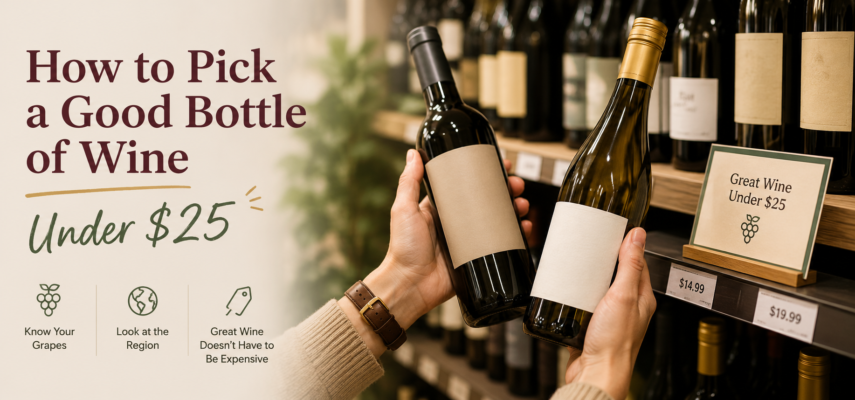
Buying wine can feel intimidating, especially when you are staring at a wall of bottles with different countries, grapes, labels, vintages, scores, and prices. The good news is that you do not need to spend $50, $75, or $100 to find a good bottle of wine. In fact, some of the best everyday wine values are under $25.
The trick is knowing what to look for.
A good bottle under $25 is not always the one with the fanciest label, the highest alcohol content, or the biggest marketing claim. It is usually the bottle that comes from a reliable region, uses grapes that perform well at affordable prices, and fits the occasion you are buying it for.
This guide will help you shop smarter, avoid common mistakes, and find better wine without overspending.
Start With the Occasion
Before choosing a bottle, ask a simple question: what is this wine for?
Are you buying wine for dinner? A casual night at home? A party? A gift? A steak dinner? Pizza? Seafood? A warm afternoon outside?
Wine becomes easier to pick when you stop thinking in terms of “best” and start thinking in terms of “best for this moment.”
For a casual weeknight dinner, you probably want something easy-drinking and food-friendly. For a party, you want a bottle that most people will enjoy. For a gift, you may want something with a recognizable region or elegant label. For a richer meal, you may want a fuller-bodied red. For lighter food, you may want a crisp white, rosé, or sparkling wine.
Under $25, the goal is not perfection. The goal is reliability.
Look Beyond the Most Famous Regions
One of the easiest ways to find better value is to avoid the most expensive names.
Famous regions like Napa Valley, Burgundy, Bordeaux, Barolo, and Champagne produce some incredible wines. They also tend to command higher prices because of reputation, land costs, demand, and prestige. That does not mean you cannot find good affordable bottles from those places, but the odds are often better elsewhere.
For value, look for regions that produce high-quality wine without the same luxury markup.
Good value regions often include:
- Portugal
- Spain
- Southern France
- Sicily
- Chile
- Argentina
- South Africa
- New Zealand
- Washington State
- Oregon
- The Loire Valley
- Beaujolais
- Côtes du Rhône
- Rioja
- Languedoc-Roussillon
These regions can offer excellent bottles under $25 because they often combine strong winemaking traditions with more accessible pricing.
Choose Grapes That Overdeliver at Lower Prices
Some grapes are easier to find in good affordable versions than others.
Cabernet Sauvignon and Pinot Noir can be excellent, but they are often more expensive to produce at a high level. Budget Cabernet can sometimes taste overly sweet, heavy, or simple. Budget Pinot Noir can sometimes taste thin, flat, or unbalanced.
That does not mean you should avoid them entirely. But if you are shopping under $25, you may get better value by exploring grapes that regularly perform well at lower prices.
For red wine, consider:
- Malbec
- Garnacha or Grenache
- Tempranillo
- Barbera
- Dolcetto
- Côtes du Rhône blends
- Portuguese red blends
- Cabernet Franc
- Syrah or Shiraz
For white wine, consider:
- Sauvignon Blanc
- Albariño
- Chenin Blanc
- Grüner Veltliner
- Vermentino
- Pinot Grigio
- Muscadet
- Soave
- Unoaked Chardonnay
For sparkling wine, consider:
- Cava
- Crémant
- Prosecco
- Sparkling wine from New Mexico, California, or South Africa
These styles often give you more flavor, freshness, and balance for the money.
Understand What Price Can and Cannot Tell You
Price matters, but only to a point.
A $25 bottle is usually not automatically twice as good as a $12 bottle. Wine pricing depends on many things beyond taste: region, brand, import costs, packaging, distribution, scarcity, ratings, and reputation.
That said, under $25, a few dollars can make a meaningful difference. Moving from $9 to $15 often gives you a noticeable jump in quality. Moving from $15 to $25 can open the door to more serious, balanced, and interesting bottles.
A practical sweet spot for everyday wine is often $15 to $22. In this range, you can find bottles that taste intentional rather than mass-produced, while still staying affordable.
Do Not Judge by the Label Alone
Wine labels are designed to attract attention. Some are traditional and elegant. Others are colorful, modern, funny, or dramatic. But the label does not tell you everything.
A beautiful label can hide an average wine. A plain label can belong to a serious producer.
Instead of focusing only on the front label, turn the bottle around and read the back. Look for useful details such as:
- Grape variety
- Region
- Producer
- Importer
- Flavor description
- Food pairing suggestions
- Alcohol percentage
The back label will not always tell you whether the wine is good, but it can give you clues about style. Words like “crisp,” “fresh,” “mineral,” and “bright” usually suggest a lighter, more refreshing wine. Words like “bold,” “rich,” “jammy,” and “oak” usually suggest a fuller, heavier style.
Neither is better. It depends on what you enjoy.
Pay Attention to Alcohol Percentage
Alcohol percentage can help you predict how a wine will feel.
A wine around 11% to 13% alcohol is often lighter, fresher, and easier to drink. A wine around 14% to 15% alcohol is usually fuller, richer, and more powerful.
For warm-weather drinking, seafood, salads, appetizers, or lighter meals, lower-alcohol wines can be a good choice. For grilled meats, hearty pasta, barbecue, or colder weather, a fuller-bodied wine may work better.
This is not a strict rule, but it is a useful shortcut.
Ask for Help — But Ask the Right Way
A good wine shop is one of the best tools you have. The people who work there often taste many of the bottles they sell, and they usually know which wines offer the best value.
The key is to give them useful information.
Instead of asking, “What is a good wine?” try asking:
“I’m looking for a red under $25 for pizza and pasta.”
“I want a crisp white under $20 that is not too sweet.”
“I usually like Sauvignon Blanc. What else should I try?”
“I need a bottle for a dinner party that most people will enjoy.”
“I want something similar to Pinot Noir but less expensive.”
These questions give the shop enough direction to recommend something that actually fits your taste and occasion.
Be Careful With Big Discounts
A bottle marked down from $40 to $19.99 can be tempting. Sometimes it is a great deal. Other times, the original price may be inflated or the wine may simply be hard to sell.
Discounts are not bad, but they should not be the only reason you buy a bottle.
A better sign is when a wine shop employee, critic, or trusted source consistently recommends a bottle at its regular price. True value does not need to depend on a dramatic sale tag.
Learn a Few Reliable Categories
One of the easiest ways to become a better wine shopper is to memorize a few dependable categories.
If you want red wine under $25, try:
- Côtes du Rhône
- Rioja Crianza
- Argentine Malbec
- Portuguese red blends
- Chilean Cabernet Sauvignon
- Beaujolais-Villages
- Barbera d’Asti
- Nero d’Avola
- Garnacha from Spain
If you want white wine under $25, try:
- New Zealand Sauvignon Blanc
- Loire Valley Sauvignon Blanc
- Spanish Albariño
- Austrian Grüner Veltliner
- Italian Soave
- French Muscadet
- South African Chenin Blanc
- Unoaked Chardonnay
- Portuguese Vinho Verde
If you want sparkling wine under $25, try:
- Spanish Cava
- French Crémant
- Italian Prosecco
- South African Cap Classique
These categories are not guaranteed, but they are strong starting points.
Match the Bottle to the Food
Food pairing does not need to be complicated. A few simple rules can help.
For pizza, pasta with red sauce, burgers, or casual Italian food, look for medium-bodied reds like Barbera, Chianti, Garnacha, or Côtes du Rhône.
For steak, lamb, barbecue, or grilled meats, look for fuller reds like Malbec, Syrah, Cabernet Sauvignon, or Tempranillo.
For seafood, chicken, salads, and lighter dishes, look for crisp whites like Sauvignon Blanc, Albariño, Muscadet, Grüner Veltliner, or Pinot Grigio.
For spicy food, look for wines with freshness and lower alcohol, such as Riesling, Vinho Verde, rosé, or sparkling wine.
For appetizers, cheese boards, brunch, or celebrations, sparkling wine is usually a safe and flexible choice.
The simplest pairing rule is this: match the weight of the wine to the weight of the food. Light food usually works better with lighter wine. Rich food usually works better with fuller wine.
Know When to Buy Red, White, Rosé, or Sparkling
A common beginner mistake is assuming red wine is more serious than white wine, rosé, or sparkling wine. That is not true.
Under $25, white wines and sparkling wines often deliver excellent value. They can be refreshing, food-friendly, and easier to pair with a wide range of meals.
Rosé can also be a smart choice, especially when you want something versatile. A dry rosé can work with chicken, seafood, salads, grilled vegetables, charcuterie, or casual outdoor meals.
Sparkling wine is one of the most underrated value categories. You do not need Champagne prices to enjoy bubbles. Cava, Crémant, and Prosecco can all offer enjoyable bottles well under $25.
Avoid Buying Only by Score
Wine scores can be helpful, but they are not everything.
A 91-point wine is not automatically better for you than an 88-point wine. Scores reflect one reviewer’s opinion, often in a specific tasting context. They may not match your preferences.
Use scores as one piece of information, not the entire decision.
If a bottle has strong reviews, fits your budget, comes from a reliable region, and matches your taste, that is a good sign. But do not ignore a bottle just because it does not have a big number on the shelf tag.
Keep Track of What You Like
The best way to get better at buying wine is to remember what you enjoyed.
You do not need a complicated wine journal. Just take a photo of the bottle and write a quick note in your phone:
- Liked it or did not like it
- Red, white, rosé, or sparkling
- Grape or region
- Price
- What you ate with it
- One or two flavor notes
Over time, patterns will appear. You may discover that you like Spanish reds, crisp whites, unoaked Chardonnay, dry rosé, or sparkling wine more than you expected.
This is how your personal wine taste develops.
A Simple Under-$25 Buying Formula
If you are standing in a store and feel overwhelmed, use this formula:
Choose a reliable region, a value-friendly grape, and a style that fits the occasion.
For example:
- Weeknight red: Côtes du Rhône, Rioja, Malbec, or Portuguese red blend
- Crisp white: Sauvignon Blanc, Albariño, Grüner Veltliner, or Muscadet
- Party wine: Prosecco, Cava, dry rosé, or easy-drinking red blend
- Dinner gift: Rioja, Oregon Pinot Gris, Loire Valley white, or French Crémant
- Steak night: Malbec, Syrah, Cabernet Sauvignon, or Tempranillo
- Seafood night: Albariño, Muscadet, Sauvignon Blanc, or Vinho Verde
This approach will not make every bottle perfect, but it will improve your odds dramatically.
Final Thoughts
Picking a good bottle of wine under $25 is less about memorizing famous names and more about knowing where value hides.
Look beyond the most expensive regions. Try grapes that perform well at affordable prices. Pay attention to style, alcohol level, and food pairing. Ask better questions at wine shops. Most importantly, keep track of what you like.
Wine does not need to be intimidating, and good wine does not need to be expensive. With a little strategy, $25 is more than enough to find bottles that are enjoyable, interesting, and worth buying again.