










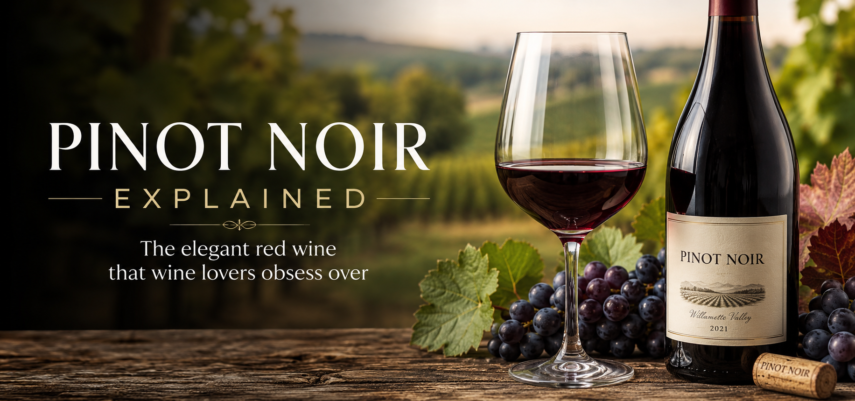
Pinot Noir is one of the most beloved, misunderstood, and romanticized wines in the world.
It is not usually the biggest red wine. It is not the darkest. It is not the most powerful. And it is rarely the easiest grape to grow.
But when Pinot Noir is good, it can be extraordinary.
It can taste like cherries, raspberries, rose petals, mushrooms, forest floor, spice, and earth. It can be light and silky, yet deeply complex. It can feel delicate at first and then unfold in layers.
For many wine drinkers, Pinot Noir is the red wine that changes how they think about wine itself.
What Is Pinot Noir?
Pinot Noir is a red wine grape known for producing lighter-bodied, elegant, highly aromatic red wines.
Compared with Cabernet Sauvignon, Merlot, or Syrah, Pinot Noir is usually lighter in color, softer in tannin, and more delicate in structure. It is often praised for its balance, freshness, and ability to express where it was grown.
That last point matters.
Pinot Noir is one of the great “terroir” grapes. Terroir refers to the way soil, climate, vineyard location, and winemaking choices shape the final wine. Pinot Noir tends to reveal these differences very clearly.
A Pinot Noir from Burgundy may taste earthy, savory, and refined. A Pinot Noir from California may be richer, fruitier, and more generous. A Pinot Noir from Oregon may sit somewhere in the middle, with bright fruit, freshness, and subtle earthiness.
Same grape. Very different wines.
Why Pinot Noir Is So Famous
Pinot Noir is famous for three main reasons.
First, it is the great red grape of Burgundy, one of the most prestigious wine regions in the world. Some of the most expensive wines ever sold are red Burgundies made from Pinot Noir.
Second, Pinot Noir is difficult to grow. It has thin skins, ripens relatively early, and is sensitive to weather, disease, heat, and vineyard conditions. That makes great Pinot Noir hard to produce consistently.
Third, Pinot Noir has a unique style. It does not rely on power alone. Instead, it wins people over with aroma, texture, elegance, and complexity.
Where Cabernet Sauvignon can impress with structure and intensity, Pinot Noir often impresses with subtlety.
What Does Pinot Noir Taste Like?
Pinot Noir usually has red fruit flavors rather than black fruit flavors.
Common Pinot Noir tasting notes include:
Cherry, raspberry, strawberry, cranberry, pomegranate, rose petal, violet, clove, cinnamon, tea leaf, mushroom, dried herbs, earth, forest floor, leather, and sometimes vanilla or toast from oak aging.
The exact flavor depends heavily on where the wine is from.
A cool-climate Pinot Noir may taste tart, bright, earthy, and floral.
A warmer-climate Pinot Noir may taste riper, smoother, fuller, and more fruit-forward.
This is why Pinot Noir can confuse beginners. Two bottles of Pinot Noir can taste very different from each other.
Is Pinot Noir Sweet or Dry?
Pinot Noir is almost always a dry red wine.
That means most of the grape sugar has been converted into alcohol during fermentation. However, some Pinot Noir can taste fruity, especially if it comes from a warmer region.
This is an important distinction: fruity does not mean sweet.
A Pinot Noir with ripe cherry and strawberry flavors may seem juicy or soft, but it is usually still dry.
Pinot Noir Body, Tannin, and Acidity
Pinot Noir is generally light to medium-bodied.
Its tannins are usually low to moderate, which makes it smoother and less drying than bigger red wines like Cabernet Sauvignon, Nebbiolo, or Petite Sirah.
Its acidity is often medium to high, which gives the wine freshness and makes it excellent with food.
This balance is one of Pinot Noir’s greatest strengths. It has enough flavor to be interesting but enough restraint to pair with many dishes.
Pinot Noir vs Cabernet Sauvignon
Pinot Noir and Cabernet Sauvignon are both famous red wines, but they are almost opposites in style.
Cabernet Sauvignon is typically full-bodied, dark-fruited, tannic, structured, and powerful. It often tastes like blackcurrant, blackberry, cedar, tobacco, graphite, and oak.
Pinot Noir is typically lighter-bodied, red-fruited, softer, more aromatic, and more delicate. It often tastes like cherry, raspberry, strawberry, spice, flowers, and earth.
Cabernet is the steakhouse red.
Pinot Noir is the red wine that can work with roast chicken, salmon, mushrooms, pork, duck, turkey, and even some lighter dishes.
Where Pinot Noir Comes From
Pinot Noir is grown in many parts of the world, but it performs best in cooler climates. Too much heat can make Pinot Noir taste overly ripe, alcoholic, or flat.
Burgundy, France
Burgundy is the spiritual home of Pinot Noir.
Red Burgundy is made from Pinot Noir, and the region is famous for producing some of the most complex and expensive wines in the world.
Burgundy Pinot Noir often shows red fruit, earth, flowers, spice, and savory notes. The wines can be subtle, structured, and deeply expressive.
For beginners, Burgundy can be challenging because the labels often emphasize the village, vineyard, or producer rather than the grape. But once you understand that red Burgundy means Pinot Noir, the region becomes easier to approach.
Oregon
Oregon, especially the Willamette Valley, has become one of the most important Pinot Noir regions outside France.
Oregon Pinot Noir often combines bright red fruit with freshness, earthiness, and elegance. It can be a great middle ground between Burgundy’s restraint and California’s richness.
For many wine drinkers, Oregon is one of the best places to explore high-quality Pinot Noir without immediately jumping into Burgundy prices.
California
California produces a wide range of Pinot Noir styles.
Cooler areas like Sonoma Coast, Russian River Valley, Santa Barbara County, Santa Lucia Highlands, and Anderson Valley are especially known for Pinot Noir.
California Pinot Noir is often riper, fruitier, and fuller than Burgundy or Oregon. It may show cherry, strawberry, raspberry, baking spice, vanilla, and a plush texture.
Some California Pinot Noirs are elegant and restrained. Others are bold, rich, and almost jammy.
New Zealand
New Zealand produces excellent Pinot Noir, especially from Central Otago, Martinborough, Marlborough, and Canterbury.
Central Otago Pinot Noir is often vivid, fruit-driven, and energetic, with cherry, plum, spice, and freshness.
New Zealand Pinot Noir can be a great choice for drinkers who want fruit intensity without the heaviness of bigger red wines.
Germany
Germany is an underrated Pinot Noir producer. There, Pinot Noir is called Spätburgunder.
German Pinot Noir can be fresh, elegant, red-fruited, and sometimes smoky or earthy. As German red wine quality has improved, Spätburgunder has gained more international attention.
Why Pinot Noir Is Often Expensive
Pinot Noir can be expensive for several reasons.
It is difficult to grow. It is sensitive in the vineyard. It often requires careful site selection. It does not produce massive, easy yields if the goal is quality. And the most famous Pinot Noir region, Burgundy, has limited vineyard land and enormous global demand.
That combination creates high prices.
But not all Pinot Noir is expensive. Good values can still be found in Oregon, California’s less famous regions, Chile, New Zealand, Germany, and parts of France outside the most prestigious Burgundy villages.
The key is knowing what style you want.
What Foods Pair Best With Pinot Noir?
Pinot Noir is one of the most food-friendly red wines.
Because it has moderate tannin, bright acidity, and flexible flavor, it can pair with dishes that would be overwhelmed by heavier red wines.
Great Pinot Noir pairings include:
Roast chicken, duck, turkey, pork tenderloin, salmon, tuna, mushrooms, risotto, grilled vegetables, charcuterie, soft cheeses, beef bourguignon, coq au vin, and Thanksgiving dinner.
Pinot Noir is especially good with mushrooms because the wine’s earthy notes often echo the savory flavor of the dish.
It is also one of the rare red wines that can pair beautifully with salmon. A heavier Cabernet might overpower the fish, but Pinot Noir has enough delicacy to work.
Should Pinot Noir Be Chilled?
Yes, slightly.
Pinot Noir is usually best served a little cooler than room temperature, around 55–60°F.
If it is served too warm, the alcohol can feel stronger and the wine may taste flat or overly soft. If it is served too cold, the aromas and flavors can become muted.
A simple rule: put the bottle in the refrigerator for about 20–30 minutes before serving.
That small step can make Pinot Noir taste fresher, brighter, and more balanced.
Does Pinot Noir Age Well?
Some Pinot Noir can age beautifully, especially high-quality Burgundy and top bottles from Oregon, California, New Zealand, and Germany.
With age, Pinot Noir can develop flavors of dried cherry, earth, mushroom, leather, tea, spice, and forest floor.
However, not every Pinot Noir is meant for long aging. Many bottles are designed to be enjoyed young, while the fruit is fresh and vibrant.
As a beginner, assume most affordable Pinot Noir is best within a few years of release unless the producer or region is known for age-worthy wines.
How to Buy Pinot Noir
When buying Pinot Noir, start by deciding what style you want.
If you want light, earthy, and classic, look for Burgundy or cooler-climate Pinot Noir.
If you want bright, balanced, and elegant, look for Oregon.
If you want ripe, smooth, and fruit-forward, look for California.
If you want vivid fruit with freshness, look for New Zealand.
If you want something underrated and refined, look for German Spätburgunder.
For beginners, Oregon Pinot Noir is often one of the safest starting points because it offers quality, freshness, and approachability without being as confusing as Burgundy or as rich as some California styles.
Common Pinot Noir Mistakes
One common mistake is expecting Pinot Noir to taste like Cabernet Sauvignon. Pinot Noir is not supposed to be huge, dark, or heavily tannic. Its beauty is in its elegance.
Another mistake is serving it too warm. A slight chill can dramatically improve the wine.
A third mistake is assuming all Pinot Noir tastes the same. Pinot Noir changes significantly depending on region, vintage, producer, and winemaking style.
Finally, many people dismiss Pinot Noir because they tried one thin, cheap bottle. Inexpensive Pinot Noir can be risky because the grape is difficult to grow and produce well. Spending a few extra dollars often makes a noticeable difference.
Is Pinot Noir Good for Beginners?
Yes, Pinot Noir can be excellent for beginners, especially for people who do not like heavy, tannic red wines.
It is smooth, aromatic, food-friendly, and usually easier to drink than more powerful reds. It can also help beginners understand how red wine can be complex without being overwhelming.
That said, Pinot Noir is not always the cheapest beginner wine. If budget is the main concern, grapes like Merlot, Grenache, Malbec, or Tempranillo may offer more reliable value at lower prices.
But if you want a red wine that is elegant, versatile, and worth exploring deeply, Pinot Noir is one of the best places to start.
The Bottom Line
Pinot Noir is the elegant red wine.
It is lighter than Cabernet Sauvignon, softer than many bold reds, and more aromatic than most everyday red wines. It can be fruity, earthy, floral, silky, and complex all at once.
Its greatest strength is not power. It is nuance.
Pinot Noir rewards attention. The more you drink it, the more you notice: the difference between cherry and cranberry, fruit and earth, freshness and softness, simplicity and depth.
For beginners, Pinot Noir is an invitation into the more subtle side of wine.
For collectors, it can become an obsession.
And for everyone in between, it remains one of the most versatile, fascinating, and food-friendly red wines in the world.












