










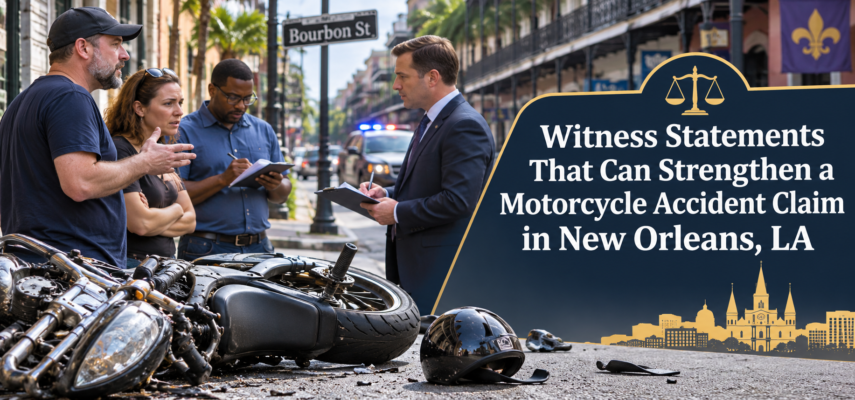

A motorcycle crash on a busy New Orleans street can leave behind more than damaged vehicles and injured riders. It can also leave people arguing about what actually happened. One driver may blame the motorcyclist, while another may remember a very different version of events.
A person standing nearby might have noticed a traffic signal or a sudden turn that others missed. These details can matter when the facts are disputed. A New Orleans motorcycle accident attorney may assess witness accounts alongside other evidence to understand how the collision occurred and which details support the injured rider’s claim.
Let’s look at the types of witness statements that can strengthen a motorcycle accident claim.
Statements From Drivers and Passengers Who Saw the Crash
Drivers and passengers who witnessed a motorcycle collision may remember details that help explain how it happened. On busy New Orleans roads, vehicles often move through crowded intersections, change lanes, or turn across traffic. A witness who saw the crash may be able to describe these actions more clearly than someone who arrived later.
For example, a driver behind a motorcycle might have seen another vehicle turn left without giving the rider enough time to stop. A passenger in a nearby car might have noticed a vehicle moving between lanes before the collision. Such observations can help explain the order of events.
Witnesses should describe what they actually saw rather than guess who was at fault. Their accounts become more useful when they include clear details about vehicle movements, traffic signals, and the position of each vehicle before impact.
Statements From Pedestrians and Nearby Eyewitnesses
Pedestrians can offer a different view of a motorcycle accident in New Orleans. Someone waiting to cross a street or standing near a shop entrance may have a clear view of an intersection that drivers cannot see as easily. Their account might help explain who had the right of way or whether a vehicle entered the intersection against a traffic signal.
People near busy areas, including the French Quarter and the Central Business District, may also witness collisions involving turning vehicles, crowded streets, or sudden stops. However, a witness’s location matters because buildings, parked cars, and other vehicles can block their view.
A useful statement describes where the person stood, what they could see, and which parts of the collision they observed. Even if a pedestrian saw only a few seconds of the event, those details may help clarify a disputed part of the accident.
Statements About What Happened Immediately After the Collision
Not everyone who has useful information sees the actual crash. Some people reach the scene just afterwards and notice details that help describe the conditions following the collision. They may observe where the motorcycle and other vehicles stopped, whether debris covered part of the road, or whether someone appeared injured.
These observations can help establish what the scene looked like shortly after the accident. For instance, the position of a vehicle may support other evidence about its movement, although that position alone does not prove how the crash occurred.
Witnesses may also remember statements made by drivers or others at the scene. Such comments can provide context, but they should be recorded accurately and considered alongside other evidence. Anyone who arrives after the collision should not claim to know what happened before impact unless they personally witnessed it.
Statements From Witnesses Who Noticed Road and Traffic Conditions
Road conditions can play a part in motorcycle accidents across New Orleans, particularly during heavy rain or periods of poor visibility. A witness may have noticed standing water, loose gravel, damaged pavement, blocked signs, or street lighting that made it harder to see approaching traffic.
These details can help explain the conditions surrounding a collision. For example, someone who regularly works near an accident location may have noticed debris on the road before the crash. Another witness might have seen rainwater collecting near an intersection or a traffic sign hidden by an obstruction.
Witness statements about road conditions are more useful when supported by other records. Photographs of the scene, available camera footage, maintenance records, and police reports may help confirm what a witness describes.
Bottom Line
Witness statements can offer valuable details about a motorcycle crash, from driver movements to road conditions and the events immediately afterwards. A New Orleans motorcycle accident attorney may consider these accounts alongside photographs, police reports, and other evidence when assessing a claim.
The strength of a statement depends on what the witness actually observed and how well that account fits the available facts.












