










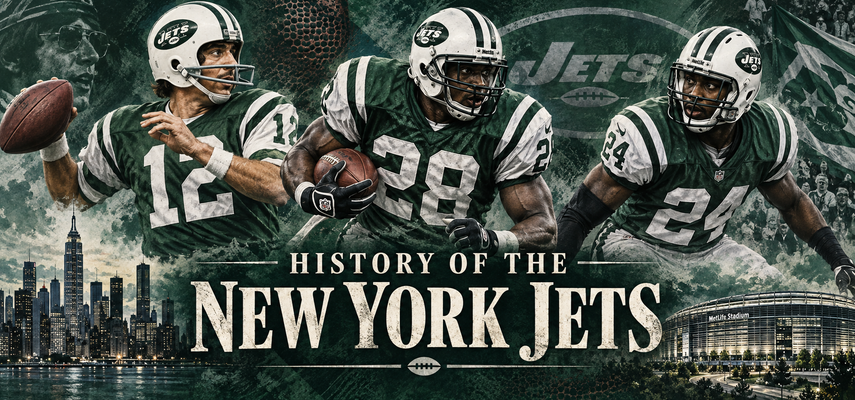

The New York Jets helped change professional football’s balance when Joe Namath’s team defeated the Baltimore Colts in Super Bowl III. That victory remains the franchise’s only Super Bowl championship, but its history includes much more than one celebrated guarantee. The organization began as the financially troubled Titans, developed later generations around strong defenses and running games, and reached four subsequent AFC Championship Games without returning to the Super Bowl. Changing stadiums and repeated rebuilding shaped the experience of its supporters. This history follows those connected chapters, preserving the Titans’ continuity while separating AFL honors, Super Bowl victories and later postseason milestones.
Franchise at a glance
| Field | Details |
|---|---|
| Founded | 1959; charter AFL franchise awarded to Harry Wismer |
| First season | 1960, American Football League |
| Original city and name | New York, New York — Titans of New York |
| Current city and name | New York Jets; home games in East Rutherford, New Jersey |
| Previous cities and names | New York Titans (1960–1962); New York Jets (1963–present) |
| League and conference/division | NFL — American Football Conference East; AFL through 1969 |
| Home venue | MetLife Stadium, East Rutherford; opened in 2010 |
| League championships | 1 Super Bowl championship through the completed 2025 season: 1968 |
| Other recognized championships | 1 AFL championship, 1968; same season as Super Bowl III; no AFC championship |
| Historical coverage | 2025 NFL season, including playoffs completed in February 2026; later developments through October 16, 2026 |
Origins and early years
Harry Wismer received a charter American Football League franchise in 1959, and the Titans began playing at the Polo Grounds in 1960. The name presented a direct challenge to New York’s established Giants, but the young organization struggled financially and failed to build a comparable audience. Don Maynard became an important early player, providing continuity that would outlast the Titans name.
A group led by Sonny Werblin purchased the franchise in 1963, renamed it the Jets and hired Weeb Ewbank as head coach. The new identity accompanied different ownership and a stronger commercial approach, but it did not create a separate statistical franchise. The Jets remained the continuation of the Titans. Their move to Shea Stadium in 1964 supplied a better setting for attracting supporters, with the nearby airport complementing the new aviation-themed name. Ewbank’s experience as a championship coach in Baltimore gave the organization another foundation. The arrival of Namath the following year then added a quarterback and public personality capable of changing the club’s place in the wider football landscape.
Defining eras
1960–1969: The Titans become Super Bowl champions
The ownership change brought a more ambitious organization, and Namath’s signing in 1965 gave the AFL a major recruiting victory. He developed a productive partnership with Maynard and other receivers, while the Jets assembled a more complete team around them. In 1967, Namath became the first professional quarterback to pass for 4,000 yards in a season, demonstrating the offensive possibilities within the younger league.
The 1968 Jets defeated Oakland 27–23 in the AFL Championship Game, earning a place against the NFL’s Baltimore Colts. Namath’s public guarantee attracted attention, but the 16–7 Super Bowl III victory depended on disciplined offense, a strong running game and a defense that repeatedly disrupted Baltimore. Ewbank had now coached major championship teams in both leagues. The result strengthened the AFL’s competitive credibility before the merger took effect in 1970. It did not cause a merger already agreed in 1966. The AFL title and Super Bowl were successive competitions within the same championship season, rather than two different Super Bowl-winning teams.
1970–1982: Difficult transitions and the Sack Exchange
The Jets entered the merged NFL with their most famous achievement already behind them. Namath’s injuries and the gradual departure of the championship core made continuity difficult. Strong individual performances did not consistently produce complete contenders, and New York spent much of the 1970s outside the playoffs.
A new defensive front eventually restored competitive credibility. Joe Klecko, Mark Gastineau, Marty Lyons and Abdul Salaam became known as the New York Sack Exchange, giving the early-1980s team a distinctive identity. Under Walt Michaels, the Jets returned to the playoffs after the 1981 season. The strike-shortened 1982 season then brought a deeper run through an expanded postseason field. Miami won the AFC Championship Game 14–0 on a rain-soaked field, leaving the Jets short of another Super Bowl. That conference-final appearance belonged to a new generation and a different competitive route, not a delayed continuation of the 1968 roster.
1983–1996: Offensive promise and a prolonged decline
Ken O’Brien became the central quarterback of the next period, working with receivers including Wesley Walker and Al Toon. The Jets could produce explosive offense and occasionally looked capable of a deeper breakthrough. The 1985 and 1986 teams reached the playoffs, although neither advanced to a conference championship. The 1986 season’s promising start was followed by a difficult finish and a double-overtime divisional defeat at Cleveland.
New York also changed its physical home. The team left Shea Stadium after 1983 and began sharing Giants Stadium in New Jersey in 1984. The New York name remained, but the everyday geography of home football changed. Subsequent coaching and roster changes produced only intermittent progress. A playoff appearance after 1991 did not begin a sustained revival, and the mid-1990s became especially difficult. The Jets finished 1–15 in 1996 under Rich Kotite, establishing the scale of the rebuilding task for the next leadership group.
1997–2008: Parcells, Martin and changing quarterbacks
Bill Parcells took over in 1997 and quickly made the Jets competitive. Curtis Martin arrived from New England, giving the offense a dependable running centerpiece behind an improved line. With Vinny Testaverde at quarterback, the 1998 Jets went 12–4 and won the AFC East. They advanced to the conference final but lost 23–10 at Denver. The turnaround restored credibility without producing a second Super Bowl appearance.
Parcells left coaching after 1999, and Bill Belichick briefly became his designated successor before resigning and moving to New England. The Jets continued under other leadership, with Chad Pennington eventually supplying another effective quarterback period. The 2002 team won the division and a playoff game, while the 2004 team reached the divisional round before an overtime loss at Pittsburgh. Martin led the NFL in rushing that season. Brett Favre’s arrival in 2008 created another short-lived attempt at contention, but the Jets missed the playoffs.
2009–2010: Ryan’s defense reaches consecutive conference finals
Rex Ryan became head coach in 2009, emphasizing defense, confidence and a physical running game. Rookie quarterback Mark Sanchez joined a team with an established line and experienced supporting players. Darrelle Revis supplied elite coverage, while the defense allowed New York to compete without requiring its young offense to dominate every game. The Jets won two road playoff games before Indianapolis defeated them in the AFC Championship Game.
The following season produced another consequential run. New York eliminated Indianapolis and then defeated New England in Foxborough, a victory that became a defining memory of the Ryan period. Pittsburgh won the next game 24–19, again leaving the Jets one step from the Super Bowl. MetLife Stadium opened in 2010, giving the team a new shared home alongside the Giants. The consecutive conference-final appearances established a meaningful competitive peak, but neither was an AFC championship.
2011–2025: The long postseason absence
The teams that followed could not maintain the 2009–2010 standard. Coaching changes and repeated attempts to find a durable quarterback solution became recurring features. Todd Bowles’ 2015 Jets won ten games with Ryan Fitzpatrick at quarterback but missed the playoffs after a final-week defeat at Buffalo. That near miss remained the strongest regular-season challenge to the developing drought for several years.
High draft selections Sam Darnold and Zach Wilson did not establish the long-term outcome the organization sought. The 2023 acquisition of Aaron Rodgers brought another approach, but an Achilles injury ended his first season after only a few offensive snaps. His return in 2024 did not restore the Jets to the playoffs, and his tenure ended after that season. Aaron Glenn became head coach and Darren Mougey general manager in 2025, beginning another organizational reconstruction. The team finished 3–14 and again missed the postseason. Through the completed 2025 season, the absence therefore covered fifteen consecutive seasons since the 2010 team’s conference-final run, rather than a drought already resolved by another change in leadership.
Recent history
The Jets finished the 2025 regular season 3–14 in Glenn’s first year as head coach and Mougey’s first as general manager. Glenn had previously played cornerback for the franchise, giving the appointment a historical connection without making it a continuation of an earlier coaching regime. The team’s reconstruction continued into 2026 under the same football leadership. At the October 16, 2026 cutoff, that season was still underway; its final record and playoff outcome are not assigned here. The latest completed Jets postseason appearance remained the 2010 season, and the franchise’s only Super Bowl championship remained the 1968 season. Its AFL championship from that same year is identified separately, while none of the four later appearances in the AFC Championship Game produced a conference title or another Super Bowl berth.
Greatest players and influential figures
Joe Namath
Namath’s passing and public presence gave the Jets an identity extending beyond the AFL’s earlier audience. His 1967 season broke the 4,000-yard passing barrier, and his Super Bowl III MVP accompanied the franchise’s only Super Bowl victory. Later service with the Rams belongs to a broader career than his defining Jets years.
Don Maynard
Maynard linked the Titans’ beginning with the Jets’ championship team, becoming a leading deep receiver and Namath’s most enduring target. His long franchise tenure established receiving records and an important institutional continuity. The change in team name did not divide those achievements into separate Titans and Jets statistical careers.
Winston Hill
Hill’s offensive-line play helped protect Namath and support the running game that made the championship team more balanced than its public image suggested. His long Jets tenure connected the AFL peak with the NFL transition. His Hall of Fame recognition reflects a sustained contribution beyond one celebrated January game.
Joe Klecko
Klecko became the versatile foundation of the New York Sack Exchange, earning Pro Bowl recognition at multiple defensive-line positions. His play helped restore postseason relevance in the early 1980s. The Jets retired his No. 73, and his later Pro Football Hall of Fame induction recognized a wider body of work.
Curtis Martin
Martin supplied dependable rushing production after arriving from New England, helping the Jets reach the 1998 conference final and contend in later seasons. His 2004 NFL rushing title marked an exceptional late-career achievement. His earlier Patriots service remains separate from the sustained contribution that established his central Jets association.
Darrelle Revis
Revis gave the Ryan-era defense an exceptional coverage foundation, allowing teammates to play aggressively elsewhere. His Jets peak helped produce consecutive AFC Championship Game appearances. His later Super Bowl victory with New England belongs to another franchise, while his greatest New York contribution remains tied to a different postseason outcome.
Weeb Ewbank
Ewbank brought championship experience from Baltimore and helped transform the Jets into an AFL winner and Super Bowl champion. His work combined a stronger roster with disciplined preparation around Namath. The earlier Colts championships and the Jets’ 1968 season belong to distinct teams within his broader coaching career.
Bill Parcells
Parcells rebuilt the Jets quickly after the 1–15 season, reaching the AFC Championship Game in his second year. His personnel and coaching decisions restored organizational credibility and helped establish the Martin era. The New York turnaround was substantial without becoming another Super Bowl championship on his separate coaching record.
Championships and postseason milestones
The Jets won the AFL championship and Super Bowl III in the 1968 season. Both results are shown because they were separate rounds against different opponents, but they form one championship campaign and only one Super Bowl victory. The franchise later reached AFC Championship Games after the 1982, 1998, 2009 and 2010 seasons, losing all four. Those appearances are important milestones, not AFC titles or additional Super Bowl berths.
On smaller screens, scroll horizontally to see all columns.
| Season/year | Competition | Opponent | Result | Defining figure(s) |
|---|---|---|---|---|
| 1968 | AFL Championship | Oakland Raiders | Won 27–23 | Joe Namath; Don Maynard; Weeb Ewbank |
| 1968 | Super Bowl III | Baltimore Colts | Won 16–7 | Joe Namath; Matt Snell; Weeb Ewbank |
Rivalries, venues and team identity
Rivalries
Miami supplied a lasting divisional rivalry, including the 1982 conference final and several memorable quarterback-era games. New England became especially consequential through the Parcells–Belichick coaching connections and the 2010 playoff victory. Sharing a market and stadium with the Giants creates a different civic relationship from the Jets’ recurring divisional competition.
Home venues and traditions
The Titans and early Jets used the Polo Grounds before the move to Shea Stadium in 1964. Giants Stadium became home in 1984, followed by MetLife Stadium in 2010. The team retained its New York identity while playing in New Jersey. Green-and-white uniforms and the stadium’s J-E-T-S chant connect supporters across those geographical changes.
Retired numbers and team honors
Retired Jets numbers include Namath’s 12, Maynard’s 13, Martin’s 28, Klecko’s 73 and Dennis Byrd’s 90. The Ring of Honor recognizes a broader group, including contributors whose numbers remain in circulation. These club honors are separate from election to the Pro Football Hall of Fame and do not imply that every honoree played on the Super Bowl-winning team.
Legacy
The Jets’ first championship changed perceptions of the AFL, but the franchise’s subsequent history has often concerned the difficulty of returning to that level. The Sack Exchange, the Parcells revival and the Ryan defenses each supplied a distinct competitive identity without another Super Bowl appearance. Repeated quarterback and leadership changes then made institutional continuity a central challenge. The team’s supporters connect those different periods through a shared regional identity and enduring memories of the 1968 season. Its history remains significant because one transformative achievement coexists with several credible revivals and a much longer unfinished pursuit.
Where to eat in New York City
Planning a visit? Explore our best restaurants in New York City guide.







