











Cigar terminology brings together agriculture, Spanish factory vocabulary, measurements and marketing language. A reader may encounter all four in one sentence. The difficulty is often deciding whether a word names a material, an operation, a shape or a judgment about the finished product.
This glossary of common cigar terms groups definitions by function so they are easier to use together. It is a reference for understanding historical accounts, manufacturing descriptions and product claims, not an invitation to begin tobacco use. No construction term, color name or craftsmanship label establishes that smoking is safe.
Parts of the object
Cigar
A roll of tobacco with a tobacco-leaf or tobacco-containing covering, following the FDA’s product description. The family includes more than large handmade examples. Size and the presence of a filter do not settle classification by themselves.
Wrapper, or capa
The exterior covering. In traditional handmade construction it is a natural tobacco leaf. A wrapper description identifies an outer component, not necessarily every tobacco inside. Habanos’ anatomy account supplies the Spanish term capa.
Binder, or capote
The layer enclosing the filler bunch beneath the wrapper. Its supporting job differs from the wrapper’s visible covering role. An intact exterior usually conceals the binder, so a photograph cannot independently establish all its material characteristics.
Filler, or tripa
The interior tobacco. Filler is a component name rather than an automatic judgment about material value. Describing a cigar’s wrapper without describing its filler leaves a substantial part of its construction unspecified.
Bunch, or bonche
The assembled filler contained within its binder. This is an intermediate construction unit, not another name for a retail bundle. Keeping those meanings separate helps readers follow a factory account without confusing an object with its packaging.
Head
The mouth end of the cigar. In a conventional capped handmade example, it is the closed end. This is a location term, useful when a manufacturing source discusses where finishing occurs; it is not the same as the foot.
Foot
The opposite end, normally the end intended for lighting. Naming it is a way to orient a description or historical photograph, rather than an instruction to use the product. Finished shapes and end treatments can vary.
Cap
Tobacco finishing material closing the head and helping secure the wrapper in conventional handmade construction. Habanos’ craft description explains cap finishing as part of assembly. The cap is tobacco material, not the printed band around the body.
Band
The separate identifying ring around a cigar. It belongs to presentation rather than to the three tobacco layers. A visible band may assist identification, but its design alone cannot verify hidden components or authenticate every claim attached to an object.
Materials and leaf preparation
Long filler
Filler consisting of substantial lengths of tobacco leaf running along the cigar. “Long” describes the interior material’s form, not the finished cigar’s overall length. A short-format object can therefore require a separate filler description.
Short filler
Filler made from smaller tobacco pieces. It does not necessarily mean machine-made: Habanos documents handmade short-filler production. The example is useful because it separates a material classification from a manufacturing classification.
Handmade
A description of manual participation in assembly. It does not mean that boards, blades, templates or molds were absent. Read a producer’s stated process to establish which operations were manual rather than assuming the adjective supplies every manufacturing detail.
Reconstituted tobacco
A tobacco material produced from processed tobacco constituents, used in some binders or coverings. The National Cancer Institute’s 1998 technical chemistry chapter describes such materials. Smoothness alone is insufficient to identify them in an image.
Curing
Managed post-harvest drying and associated leaf changes. It is a production stage, not a synonym for all subsequent storage. University of Kentucky curing guidance illustrates why handling, ventilation and environmental conditions matter for a particular wrapper crop.
Fermentation
A processing stage applied to much cigar leaf after curing. In Habanos’ sun-grown preparation account, leaf piles require temperature monitoring and rearrangement. The term describes processing; it does not certify the finished tobacco or its smoke as safe.
Aging
Time spent storing prepared leaves or finished cigars under managed conditions. Identify what is being aged before interpreting the claim. Habanos distinguishes wrapper processing and later storage; time alone does not disclose the whole production history.
Shade-grown
Cultivated with protection that reduces direct sunlight. Habanos’ cultivation description gives the example of cloth-covered wrapper fields. The term describes growing conditions, not a universal wrapper color or a guarantee that every similarly named leaf shares one origin.
Sun-grown
Grown in the open rather than beneath the shade covering described above. Its meaning belongs to cultivation. It should not be used as a complete shorthand for filler composition, finished shape, manufacturing method or a person’s nicotine exposure.
Shapes, formats and measurements
The following terms use the conventions discussed in Habanos’ shapes-and-sizes guide. Commercial usage can vary, so a familiar format name should be checked against stated dimensions rather than treated as a universal specification.
Length
The end-to-end dimension, usually expressed in inches or millimeters. State the unit when interpreting a number. A length measurement alone cannot establish diameter, tobacco quantity or how the interior was assembled.
Ring gauge
A diameter convention expressed in sixty-fourths of an inch. A hypothetical 48-ring-gauge cylinder is 48/64 inch, or three-quarters of an inch, across. Ring gauge concerns diameter rather than circumference and does not measure nicotine content.
Vitola
A cigar format term. In Cuban usage, factory and market names may differ; a reader should identify which naming system a source uses. The term has other regional meanings, so context matters more than a rigid one-word translation.
Parejo
A straight-sided cigar form. This broad geometry category does not determine the wrapper’s origin, the filler length or whether people or machines performed particular assembly steps. It is one field in a fuller description.
Figurado
A shaped cigar form, including examples with tapered ends. It contrasts broadly with straight-sided construction. The label covers more than one geometry, so it should not be treated as the name of a single standardized size.
Robusto and Churchill
Common format names. They are useful reference points, but different brands can use familiar market names for differing dimensions. A clear description records length and ring gauge rather than assuming the name supplies identical measurements everywhere.
Factory people, tools and inspection
Torcedor or torcedora
A cigar roller. These are occupational terms referring to skilled work, not labels for a particular brand or tobacco variety. When interpreting a factory account, distinguish the worker’s task from the finished product’s advertised status.
Ligador
A blender in the Cuban factory vocabulary recorded in the Habanos glossary. This names a production responsibility. It should not be confused with a growing location or with one of the tobacco components themselves.
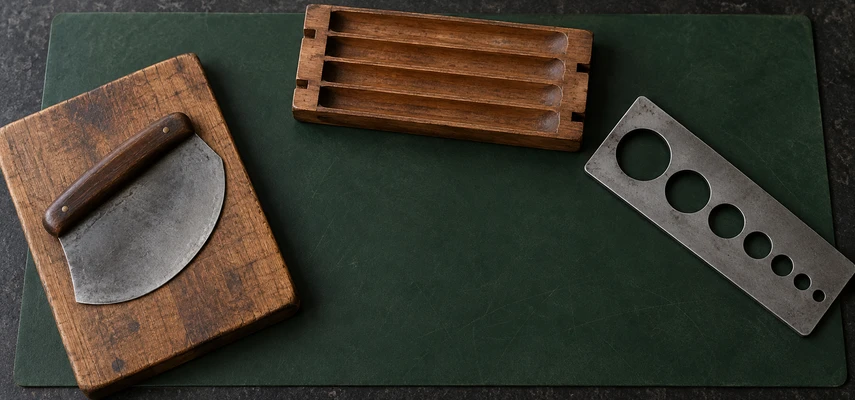
Tabla
The wooden board used at the rolling bench. Recognizing a board in a workshop image can help identify the setting, but it cannot establish the age of the photograph, the factory’s identity or every operation performed there.
Chaveta
A curved, commonly semicircular tobacco-cutting blade used in cigar manufacture. It is a factory tool, rather than a synonym for every consumer cutter. A tool’s presence in an illustration does not document how a specific worker used it.
Cepo
A template used to check dimensions such as length and diameter. It belongs to measurement and consistency. It does not test chemical exposure, and its presence should not be interpreted as a certification of health or safety.
Draw
Resistance to airflow through the cigar. Habanos’ quality-control description discusses testing bunches by suction. This is a construction characteristic; a favorable airflow result cannot establish that inhaling or otherwise contacting the smoke is harmless.
Appearance, storage and claims
Claro and maduro
Color descriptors commonly referring to lighter and darker wrappers, respectively. Habanos’ discussion of color sorting illustrates the fine distinctions involved in presentation. Color should not be treated as a dependable nicotine measurement or as a safety scale.
Humidor
A storage enclosure intended to manage conditions for cigars. Habanos’ storage account discusses this function. The word describes preservation equipment, not an assurance that contents are authentic or that tobacco use is safe.
Premium
A term whose criteria depend on the commercial, editorial or research context. The National Academies’ 2022 recommendations call for consistent research definitions. Ask for the actual material and manufacturing criteria; the adjective alone leaves them uncertain.
Nicotine
An addictive constituent of tobacco. Product appearance, wrapper shade and manual construction cannot establish the amount a person absorbs. The CDC’s cigar overview explains that exposure occurs even among people who report not inhaling cigar smoke.
Secondhand smoke
Tobacco smoke to which people nearby are exposed. It is part of the health context, not a manufacturing grade. The National Cancer Institute’s cigar fact sheet explains risks to smokers and nonsmokers; cigar smoking can cause cancer and is associated with heart and lung disease. No glossary category removes those risks.
Using the glossary without overreading it
A hypothetical description such as “handmade, long-filler parejo, 5 inches by 48 ring gauge” combines separate kinds of information. Handmade concerns assembly, long-filler concerns the interior, parejo concerns shape, and the figures specify dimensions. None supplies a clinical safety conclusion.
The same discipline works in reverse. A historical source that supplies only a brand or wrapper color has left other details unknown. A careful reader preserves those gaps rather than completing the description from assumptions.
Common cigar terms become useful when each retains a clear job. Materials explain components; process words explain work; format names and measurements explain shape. Reading them together makes an account more precise while leaving marketing claims open to evidence and tobacco’s health risks fully visible.












