










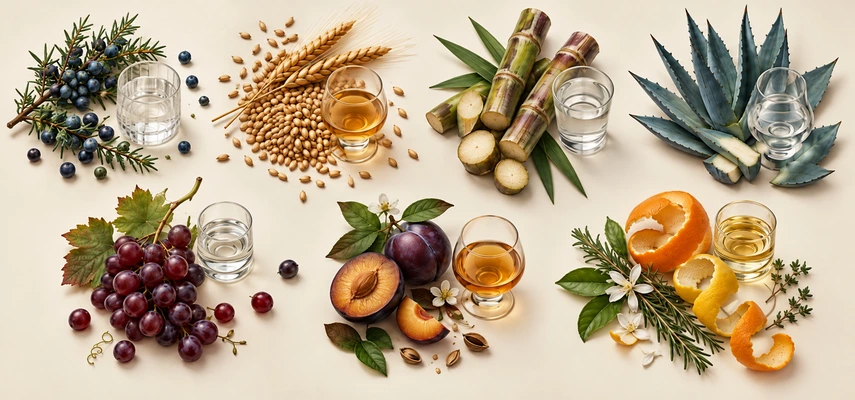

A spirits shelf can look like a very expensive geography exam. French names sit beside Mexican ones, familiar categories share space with unfamiliar bottles, and several entirely different drinks appear to be the same shade of transparent. The labels aren’t all answering the same question, which is where the confusion starts.
Some names describe a raw material. Others describe a production method, a place, or a combination of all three. Brandy tells you something about fruit; Cognac narrows that conversation to a protected French tradition. Gin tells you to expect juniper, but it doesn’t identify the crop that originally supplied the alcohol.
The useful approach is to build a map with several layers. Once you separate ingredients, processing and protected origins, the families become easier to recognize without pretending that every bottle fits into one tidy drawer.
Start with the ingredient, then ask what happened
All distilled spirits depend on alcohol produced through fermentation. The agricultural starting point can be grain, fruit, sugarcane, agave or something else containing suitable carbohydrates. Distillation then concentrates alcohol and changes which volatile compounds remain in the collected liquid.
That’s the shared foundation, not a complete classification. A highly neutral grain spirit can become vodka or provide the alcohol for a botanical gin. Sugarcane can lead to several distinct regional spirits. Fruit can become a clear eau-de-vie or an oak-matured brandy.
The U.S. standards of identity illustrate how regulators combine ingredients, production and origin. Those are U.S. rules, not a universal dictionary. A term can have a different legal scope elsewhere, and a tasting description is not automatically a regulated category.
Vodka: neutrality is a direction, not an ingredient
Vodka is often introduced as a potato spirit, which is rather like introducing bread as something made from rye. Sometimes true; hardly the whole story. Grain, potatoes and other suitable materials can supply its fermentable carbohydrates.
What connects the family is the pursuit of a relatively neutral spirit through extensive separation and, in some cases, filtration. Under U.S. vodka rules, vodka is a type of neutral spirit, with specific conditions governing production and permitted treatment.
Neutral doesn’t mean every vodka feels or smells identical. It means the category occupies a different stylistic position from a spirit deliberately retaining forceful fermentation character. Flavored vodka creates another distinction: a citrus aroma may come from a later addition rather than from the crop that supplied the alcohol.
Gin: follow the juniper
Gin is defined by botanical character, especially juniper. Its alcohol commonly begins as a relatively neutral base, which can be flavored through distillation or other permitted methods. The U.S. gin standard requires juniper to supply the main characteristic flavor.
Other botanicals may suggest citrus, spice, flowers or roots. They work around that juniper identity rather than making gin a completely unrestricted flavored-spirit category. London dry, distilled gin and other descriptions deserve a closer look because their requirements depend on the market.
For now, keep two questions separate. What provided the ethanol? What provided the botanical flavor? A grain-based gin is not a grain spirit wearing a misleading name. The name is describing a different layer of its production story.
Rum: the sugarcane family
Rum begins in the sugarcane world. Molasses is a common starting material, but fresh cane juice and other permitted cane-derived materials also matter. The U.S. rum standard explicitly includes several sugarcane sources.
That shared origin leaves room for enormous variation. Fermentation can encourage different aromatic profiles; distillation can preserve or reduce them; wood, blending and permitted additions can change the finished drink again. A pale rum needn’t be simple, and a dark one needn’t be old.
Regional names add another layer. Cachaça is a Brazilian spirit with its own national identity and rules, even though the U.S. standard places it within rum. Rhum agricole points toward cane-juice traditions. Those relationships show why a family tree is useful but needs notes in the margins.
Tequila and mezcal: agave plus protected identity
Agave spirits come from plants whose carbohydrates are prepared for fermentation. Tequila and mezcal are the most familiar names internationally, but neither is merely a generic synonym for distilled agave.
The U.S. agave-spirits standard recognizes tequila and mezcal as distinctive Mexican products made under Mexican laws. Their identities involve permitted plants, geography and production requirements, rather than a flavor test alone.
That matters when someone says tequila is always smooth or mezcal is always smoky. Those are broad sensory claims about diverse products. Some production traditions produce pronounced smoke, but smoke isn’t a reliable shortcut for identifying every member of the family. Read the actual designation and production information before letting one adjective take charge.
Brandy: fruit takes several routes
Brandy is made from fermented fruit material. Grapes are prominent, but apples, pears, plums and other fruits also support important traditions. Depending on the category, the material can include fruit wine or residues such as grape pomace.
The U.S. brandy rules distinguish several types. In that market, unqualified brandy generally means grape brandy, while other fruit identities require appropriate designation. That’s a labeling point worth remembering when comparing a general family description with the words permitted on a particular bottle.
Brandy needn’t be brown. Clear fruit spirits can preserve a vivid fruit aroma without long oak maturation. Grappa, made from grape pomace under its own geographical and production framework, also reminds us that agricultural leftovers can become a distinct spirit rather than a second-rate imitation of another drink.
Cognac and Armagnac are more specific addresses
Cognac and Armagnac are French grape-spirit traditions with protected identities. Calling either simply brandy is broadly informative but leaves out the requirements that make the name meaningful. Calling every brandy Cognac goes much too far in the other direction.
The Cognac interprofessional organization describes the connected stages of vineyard work, winemaking, distillation, maturation and blending. Geography is accompanied by a production system; it isn’t a decorative place name attached at the end.
Grain spirits extend well beyond one family
Whiskey is a major grain-spirit family, but it already has its own detailed TFE guide. Here, it’s enough to recognize grain fermentation, distillation and the importance of maturation within its various regulated traditions.
Grain also supports spirits that deserve their own introductions: baijiu, shochu and awamori, among others. Some use distinctive fermentation cultures and techniques that don’t fit a simplified European grain-to-still narrative. Nor does every bottle called soju follow exactly the same production route.
Rather than treating unfamiliar names as exotic versions of vodka, ask how the producer prepares carbohydrates, ferments them and handles distillation. A comparison can orient you; it shouldn’t erase the identity of the spirit being explained.
Liqueurs organize flavor and sweetness differently
A liqueur combines distilled alcohol with flavoring and sweetness under the relevant rules. Fruit, herbs, spices, coffee and many other ingredients can supply its character. The base alcohol may be comparatively neutral or a recognizable spirit such as brandy or rum.
The U.S. liqueur standard sets a minimum sugar content of 2.5% by weight for the class, with further requirements for certain types. Don’t export that number automatically to another jurisdiction’s definitions.
Sloe gin is an instructive name: in U.S. classification it is a liqueur whose characteristic flavor comes from sloe berries. Familiar words can therefore cross the boundaries a beginner expects. Likewise, aperitif and digestif commonly describe the role or occasion of a drink, rather than one agricultural family.
Use the map without turning it into a ranking
Imagine three imaginary bottles: a clear grape spirit, an amber rum and a juniper-led gin. Sorting by color would put the grape spirit beside gin. Sorting by raw material would send it toward brandy. Sorting by flavor additions would give you another arrangement entirely.
None of those observations is useless. The mistake is assuming one describes everything. Start with the legally stated category, add the ingredient and origin, then look for production details. Use aroma descriptions to understand style rather than to override the label.
These families also don’t form a ladder from basic to sophisticated. Neutrality, fruit intensity, botanical complexity and wood influence are different goals. Price, color and unfamiliar terminology can’t decide which goal a producer has achieved successfully.
One practical reading exercise is to cover the brand name and find the product designation. Then ask which words describe origin and which describe treatment. A named place, an age statement and a botanical description contribute different information. If the label leaves a question unanswered, a producer’s technical sheet can be more helpful than a dramatic tasting adjective on the front.
Alcohol content remains a separate question. Check the stated ABV and remember that a small serving of a stronger drink can contain as much ethanol as a larger serving of a weaker one. Knowing a category is useful; knowing the amount poured is useful too.
The spirits shelf becomes easier when you stop expecting every name to answer the same question. Some bottles tell you about a crop, some about a process and some about a place with rules attached. Read those layers together, and the geography exam starts to look more like a set of interesting conversations.











