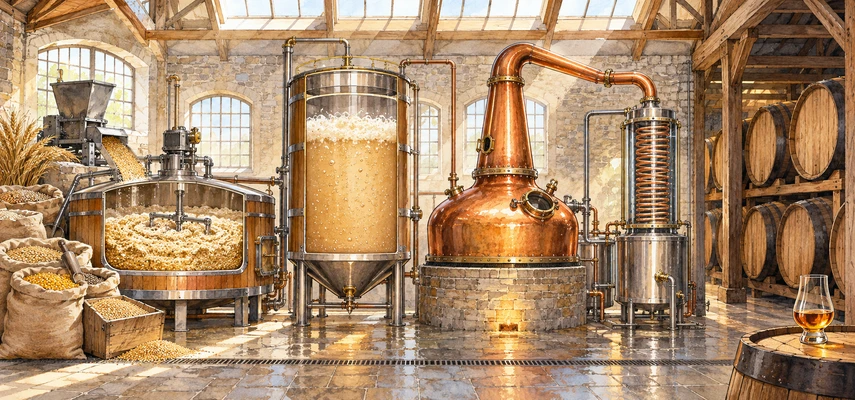

A whiskey distillery is doing several very different jobs under one roof. Part of it resembles a grain mill. Another part behaves like a brewery. The still room manages a heated mixture, and the warehouse leaves the result inside wood for years. The bottle is what happens when those jobs agree with each other.
That makes whiskey production easier to understand than its reputation suggests. Each stage solves a particular problem: free the grain’s energy, let yeast make alcohol, concentrate a useful spirit, develop it in a cask and assemble a finished product.
The details vary by country and style. This is the common route through a commercial distillery, not a recipe for operating one. There isn’t one universal mash temperature, distillation schedule or barrel plan that explains every whiskey.
Begin with the grain recipe
Barley, corn, rye and wheat are common whiskey grains. Each supplies starch, along with proteins and other material that affects processing and the eventual spirit. The grain recipe is often called the mash bill.
A bourbon recipe needs a corn majority under U.S. rules, whereas single malt Scotch uses malted barley. These aren’t decorative differences. They change the raw material the distiller must prepare and the character available to develop later.
Grain choice doesn’t work alone. How the grain was grown, stored and processed matters too. A distiller needs a reliable supply that performs consistently, not simply an ingredient with a romantic agricultural description.
The grain is normally milled to make its contents accessible. That doesn’t mean reducing every grain to the finest possible powder. Milling has to suit the equipment and the way the distillery will handle liquid and solids. A useful particle size in one system can create problems in another.
Malting unlocks a biological tool kit
Starch is a chain of sugar units, but yeast can’t simply consume a sack of dry cereal and produce whiskey. Much of that starch first needs to be converted into fermentable sugars.
Malting helps provide the enzymes that do the conversion. Grain, commonly barley, is encouraged to germinate under controlled conditions, then dried. Germination activates and develops the plant’s own machinery for using its stored reserves.
The useful comparison is with opening a locked pantry. The grain already contains the stored energy; malting helps make the tools available to reach it. The distiller then uses those tools under suitable conditions during mashing.
Drying also creates a flavor opportunity. When peat smoke is used in drying malt, smoke-derived compounds can remain with it and influence the whisky later. Peat isn’t an ingredient poured into finished Scotch. Nor is peat drying used for every malt whisky.
Springbank’s production account provides a concrete example of how malting, drying and milling fit together. Other distilleries may buy prepared malt rather than perform those operations themselves.
Mashing makes sugar available
Mashing combines prepared grain with water and uses appropriate conditions to release fermentable sugars. Enzymes break starch into smaller molecules, including sugars that yeast can use.
Temperature matters because enzymes are working biological tools. Conditions that help one part of the process may reduce another enzyme’s activity. Different grains also need different treatment to make their starch accessible. That’s why a detailed production explanation can’t reduce every style to “add hot water.”
Some distilleries separate a sugary liquid, called wort, from the grain solids before fermentation. Others ferment with solids present. The choice affects equipment, handling and the environment in which microorganisms work.
Spent grain doesn’t become the whiskey in the bottle. Much of its material remains outside the collected spirit and can have other uses, such as animal feed where suitable. Distillation later separates volatile components rather than transferring the whole cereal mixture into a glass.
Yeast makes alcohol and creates flavor
Once the prepared material is ready, yeast starts fermentation. It converts sugars into ethanol and carbon dioxide while producing smaller quantities of many other compounds.
Those smaller products matter. Some contribute fruity, floral or other impressions. Fermentation is therefore both an alcohol-producing stage and a flavor-producing stage. Treating it as a simple way to fill the still with alcohol misses half the interest.
Yeast strain, fermentation conditions and the composition of the sugary material affect the result. Time and temperature are part of the distiller’s design, rather than background details. Microbial activity beyond the selected yeast can also matter in particular production systems.
Research from Heriot-Watt University’s brewing and distilling program explores how raw materials influence fermentation compounds and the resulting spirit. It’s a reminder that flavor development begins long before a barrel enters the story.
The fermented liquid, often called wash in malt whisky production, has a much lower alcohol concentration than the finished spirit. It contains water, ethanol and a complicated mixture of other substances. The next task is selective separation.
Distillation selects and concentrates
Heating that mixture creates vapor with a different composition from the liquid left behind. Collecting and cooling the vapor returns it to liquid. Properly managed distillation increases alcohol concentration while influencing which other volatile compounds accompany it.
This is not pure alcohol escaping at one precise temperature while every other molecule waits its turn. A real fermented mixture behaves as a mixture. Water and aroma compounds travel into the vapor too, and their behavior changes as the run progresses.
Pot stills and columns
Pot stills work in batches. A column uses repeated separation stages and can be part of a continuous production system. Both are tools; neither is a quality certificate by shape alone.
Still dimensions, contact with copper, how the equipment is operated and which material is collected affect the spirit. Distillers select the portion intended for maturation, often discussed as making cuts. The familiar heads, hearts and tails terminology describes portions of a run, but the exact handling is specific to the process.
The Scotch production overview illustrates how distillation fits within a regulated whisky tradition. Other styles use different configurations and requirements. More distillations don’t automatically mean a better spirit; removing character can be a disadvantage when character is the objective.
Wood changes the clear spirit
Fresh distillate is generally clear. A cask gradually changes its appearance and sensory character through several processes at once.
The spirit extracts compounds from wood. Chemical reactions continue over time, including reactions involving oxygen. Some material evaporates through the cask, while the previous use and preparation of the wood affect what is available to interact with the spirit.
New charred oak and a previously used cask don’t start from the same position. Heat treatment changes the wood, and earlier fills remove or alter some of its available material. That’s why “oak” isn’t a complete barrel specification.
Annandale’s technical discussion of casks explains the importance of cask size, history and wood contribution. The surrounding climate and the warehouse environment add more variables. Maturation is not simply a clock running until the whiskey becomes expensive enough.
Different categories impose different minimums. Scotch requires at least three years in oak in Scotland, while American whiskey types have their own rules and exceptions. The U.S. standards are a useful reminder not to apply one country’s requirements everywhere.
Why the warehouse needs judgment
Imagine two casks filled on the same day. One may give up wood compounds quickly; another may develop more slowly. Even when the starting spirit is similar, different cask histories and storage conditions can produce different sensory results. A producer therefore samples and evaluates rather than assuming the calendar has done all the quality control.
The judgment isn’t simply whether a sample tastes more strongly of wood. Grain-derived character, fermentation aromas and oak influence need a useful relationship. A cask that overwhelms everything else may have reached an impressive color without reaching an appealing balance. The production goal is a finished spirit with a coherent character, rather than the maximum possible dose of any one component.
The finished bottle is another set of decisions
After maturation, producers assess casks and decide how to construct the release. A single malt can combine many casks from the same distillery. A blend can bring together qualifying components from different sources under its category’s rules.
Water is often added to reach the intended bottling strength. Filtration choices can affect appearance and the retention of certain compounds. Some categories permit coloring under specified conditions, while others do not. These decisions belong to the finished product’s design and legal identity.
Alcohol by volume tells you the proportion of alcohol in the bottled liquid. In the U.S. proof system, that percentage is doubled. A higher bottling strength means the same volume contains more alcohol; it doesn’t automatically measure better craftsmanship.
Once bottled, whiskey no longer undergoes cask maturation. A bottle stored for ten extra years has acquired ten years of storage history, not ten more years of barrel age.
Following the process reveals why similar grains can produce such different results. Fermentation creates possibilities, the still selects among them, wood develops them and the producer assembles the final expression. The bottle isn’t the work of one secret ingredient. It’s the accumulated effect of decisions that began with a mill and continued long after the still went quiet.