










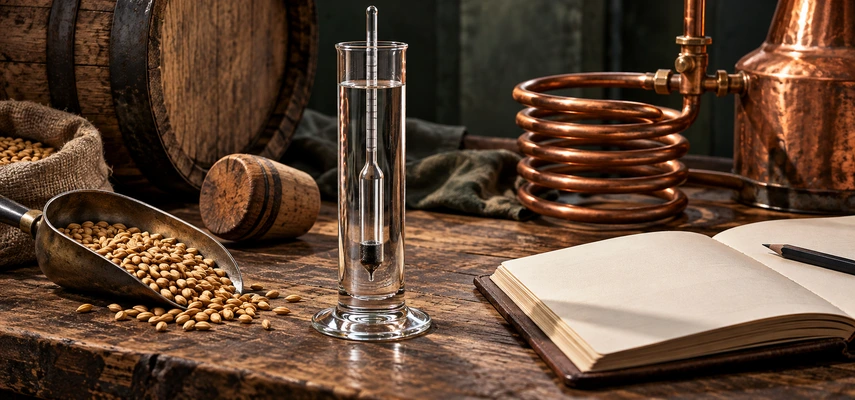

A distillery tour can become a vocabulary test without warning. Someone mentions the wash, points toward a rectifier, explains a cut and then says the spirit will rest before blending. Everyone nods. At least one person is quietly wondering whether wash means the equipment needs cleaning.
Most spirits terminology becomes easier when you attach each word to a job. Some terms describe ingredients, others describe separation, and others describe what happens after the still. A few sound technical while carrying less precise meaning than the label suggests.
This guide follows those jobs rather than presenting an alphabetical wall of definitions. The aim is to understand a producer’s explanation, ask a useful follow-up question and recognize when a familiar word needs a little more context.
Words for the starting material
Mash, must, wash and wine
Mash commonly refers to a mixture involving processed grain and water, although its precise use depends on the tradition and stage. Must is associated with fruit material prepared for fermentation, especially grape juice with or without solids. Neither term automatically means a finished alcoholic drink.
Wash commonly describes the fermented liquid prepared for distillation. In some traditions people instead speak of beer or wine, even when the liquid isn’t intended for sale as that beverage. The important question is its role in the process, not whether the word appears on a supermarket shelf.
The WSET production framework separates raw-material preparation from fermentation and distillation. Keeping those stages in mind helps you interpret local vocabulary without insisting that every country use identical terms.
Fermentation and distillation
Fermentation is the biological stage in which yeast converts suitable sugars into ethanol and carbon dioxide, while producing other compounds as well. Distillation is a physical separation process involving vaporization and condensation. They aren’t two names for making alcohol in the same way.
The spiritsEUROPE process description makes that distinction explicit. If a bottle claims an unusual fermentation, the claim concerns what happens before separation. If it emphasizes distillation, ask what the equipment and operating choices were intended to select.
Words heard around a still
Distillate and new make
Distillate is liquid collected through distillation. It’s a broad process word rather than a guarantee of a particular category or quality. New make is often used for newly produced spirit before maturation, though traditions differ in their preferred terminology.
A clear new spirit can already carry substantial aroma. Clear doesn’t mean chemically empty, and young doesn’t necessarily mean unfinished: some categories are intended to be consumed without extended wood maturation. Ask whether aging is part of the product’s design before assuming the liquid is waiting to become something better.
Pot still, column still and condenser
A pot still commonly handles a charge in batches. A column provides repeated contact between rising vapor and descending liquid and can support continuous production. Hybrid systems combine features. Those descriptions identify equipment arrangements; they don’t award medals for flavor.
A condenser cools vapor so it becomes liquid. Without condensation, the producer wouldn’t have a collected liquid distillate. The WSET introduction to distillation explains the underlying enrichment: the condensed vapor can contain a greater ethanol proportion than the starting fermented liquid.
Reflux and rectification
Reflux is condensed liquid returning within a distillation system instead of being collected immediately as product. That return can increase interaction between liquid and vapor. Rectification refers to purification or increased separation through distillation, often using repeated stages.
Think of the difference between one sorting pass and a system that repeatedly gives components another chance to separate. That’s an analogy, not a count of identical tiny stills. More separation can support a neutral spirit, but the desired degree depends on what the producer is making.
Heads, hearts, tails and cuts
In batch distillation, the collected output changes composition over the run. Heads and tails describe fractions toward the beginning and end; hearts describe the selected central portion intended for the product. A cut is a decision about separating or redirecting fractions.
The boundaries depend on the spirit, equipment and process. These aren’t perfectly sealed boxes containing only good or bad molecules. Nor are they safe operating instructions for improvised distillation. In a production discussion, ask what a cut contributes to the intended aroma and style.
Congeners
Congeners are compounds other than ethanol and water associated with the production and character of alcoholic beverages. The term covers a broad collection, including substances that can contribute aroma. It isn’t a synonym for contamination.
Calling a spirit congener-rich tells you less than identifying which compounds are present and how they affect perception. A strongly aromatic product isn’t automatically superior, and a more neutral one isn’t automatically deficient. The producer’s goal matters more than whether the word sounds reassuringly scientific.
Words for strength and serving
ABV and proof
Alcohol by volume expresses ethanol concentration by volume under specified measurement conditions. In the current U.S. system, proof is twice ABV: 40% ABV equals 80 proof. Historical proof systems elsewhere differed, so always identify the convention when reading old accounts.
The TTB label guide distinguishes the required alcohol-content statement from an optional proof statement. Neither tells you the amount consumed until you also know the serving volume.
Standard drink
A standard drink is a reference quantity of pure alcohol, not a universal glass size. The CDC uses 14 grams in the United States, equivalent to about 1.5 U.S. fluid ounces of 40% ABV spirits. Other countries use other definitions.
A generous pour or stronger bottle can contain more than one such unit. Adding water changes concentration without removing the ethanol already poured. The reference helps compare quantities; it doesn’t establish a risk-free dose or an instruction about how much to drink.
Neat, diluted and chilled
Neat generally means served without added ice or mixer. Diluted means water or another liquid has reduced the concentration. Chilled describes temperature, which is a separate variable. A drink can be both diluted and chilled, or one without the other.
These words describe presentation rather than quality. Water and temperature can change aroma release and the impression of alcohol. Someone evaluating a spirit may deliberately compare conditions, but a preferred serving style isn’t evidence that everyone else is experiencing it incorrectly.
Words used after distillation
Maturation, resting and finishing
Maturation describes development during storage under relevant conditions, often involving wood. Resting may refer to a period in a relatively nonreactive vessel, though usage varies. Finishing commonly describes a later maturation stage in another container, often one with a different previous use.
Don’t assume these words have identical legal definitions across categories. Wood influence, oxygen, time and storage conditions interact. Moving a spirit into a different cask can introduce another influence, but it doesn’t guarantee that every claimed flavor actually came from that cask.
Blending and single batch
Blending combines components to achieve an intended result. It can improve balance, create complexity or maintain consistency as individual batches vary. The word doesn’t by itself imply that the producer is concealing inferior material.
Single batch sounds straightforward but needs context: what constituted the batch, and what happened before or afterward? Similar caution applies to single barrel or single cask. Such claims can provide useful production information, but they don’t remove the need to examine the category and the actual product description.
Botanicals, maceration and redistillation
Botanicals are plant materials used for flavoring, such as juniper, citrus peel or roots. Maceration involves soaking material to extract compounds into liquid. Redistillation means distilling an already distilled alcoholic liquid again, potentially with flavoring ingredients.
The U.S. gin standard permits several ways of obtaining gin’s juniper-led identity. A botanical list tells you which plants were involved; it doesn’t reveal how each was treated. Extraction and distillation can produce different results from the same ingredient basket.
Words that need an extra question
Small batch, premium, smooth and artisanal can describe a producer’s positioning or a drinker’s impression without providing a precise technical specification. They aren’t interchangeable with a verified age, measured alcohol content or protected origin.
Ask what a claim allows you to check. A category designation can connect to a published standard. A production statement can sometimes be supported by technical records. Smooth is a sensory judgment, not a laboratory assurance of lower alcohol exposure or better health.
The same habit helps with age. A large number on a label isn’t automatically an age statement; it might identify a recipe, brand or anniversary. Read the accompanying words and the rules for that particular category before making the number do more work than it should.
Origin terms need similar care. Distilled in, bottled in and imported by describe different activities, so they needn’t identify the same place. A bottler’s address isn’t sufficient evidence that fermentation or distillation occurred there. When origin is central to a purchase, look for the specific production statement and check what a protected designation requires, rather than treating every place name as equivalent evidence.
You don’t need to memorize every term before enjoying the subject. Locate the word in the production chain, ask what it measures or describes, and notice when its meaning depends on a place or tradition. The next tour will still contain unfamiliar vocabulary, but you’ll have better questions than a polite nod.












