










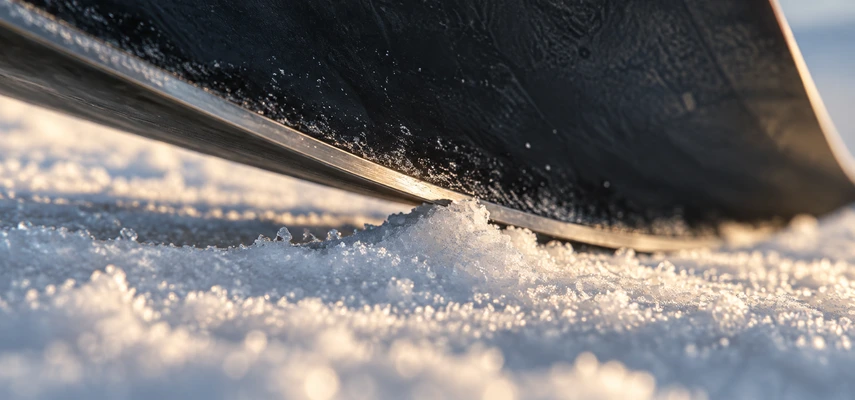

An edge catch can feel as though the snowboard suddenly discovered a reason to stop while the rest of you missed the announcement. The surprise is part of what makes it unsettling: one moment the board slides, and the next its contact with the snow changes abruptly.
The basic mechanism is an edge engaging in a way that disrupts the intended movement. If the board slows or redirects sharply while your upper body continues, balance can disappear quickly. Either edge can be involved, and it can happen at low speed as well as during faster riding.
Understanding the mechanism helps you practice more intelligently. It doesn’t provide a guarantee against falls. Work with qualified instruction on appropriate terrain, and treat repeated catches as information that something needs assessment rather than as a compulsory initiation into the sport.
Separate where the board points from where it travels
A snowboard can point in one direction while moving partly sideways across the snow. That’s a normal feature of a skidded turn or sideslip. The difference between its orientation and its direction of travel is essential to understanding an edge catch.
Imagine sliding a closed book across a table while its long side points diagonally. The book’s shape doesn’t have to align with its route. A snowboard has edges that can engage a yielding surface, so the consequences of that mismatch depend on tilt, pressure and the snow beneath it.
During a controlled sideslip, you’re managing the edge relationship so the board can brush sideways. If the inappropriate edge engages abruptly across that sideways movement, the board may stop or redirect much more suddenly than intended.
This is why saying point the nose downhill isn’t a complete explanation. The important relationship is to the actual movement and contact with snow. The fall line, board direction and direction of travel are related ideas, but they aren’t interchangeable.
Grip and catching are different outcomes
You need edges to guide and slow a snowboard. Useful engagement can help the board follow a curve or manage a controlled slide. An edge catch isn’t evidence that edges are inherently troublesome; it means their engagement doesn’t fit the intended movement at that moment.
The AASI technical performance guide describes pressure, tilt, pivot and twist as coordinated controls. Problems can arise when those relationships become poorly timed or the rider loses a workable position over the platform.
A sudden tilt, an awkward rotation or uneven snow can change the contact. Equipment characteristics can influence the response too. There isn’t one universal catch caused by one universally incorrect body part.
Nor is every fall an edge catch. A loss of grip, a collision, an obstacle or a balance error can produce a different sequence. If you repeatedly fall in a similar way, ask an instructor to observe it rather than assigning the familiar label to every event.
Why beginners often encounter the problem
Beginners are learning several unfamiliar relationships simultaneously. The feet share a board, the stance is sideways and edge contact changes with relatively small movements. A cue that makes sense while stationary can become harder to apply once the platform starts sliding.
You may intend to change direction while still moving significantly across the old one. If the edge transition is abrupt or poorly coordinated, the new contact can arrive before the movement is organized for it. The result may feel instantaneous even though the preceding sequence contains clues.
Looking only at the bindings or swinging the shoulders can also disturb awareness and movement. Those aren’t universal explanations, but they are patterns an instructor may investigate. The useful question is what happened just before the board caught.
The PSIA-AASI Eastern adaptive workbook connects beginner teaching with appropriate tasks, movement analysis and individual needs. The teaching task includes selecting the environment and progression, not merely telling learners to be more careful.
Edge changes need timing, not a sudden leap
When turns connect, the board’s old edge engagement reduces and a new relationship develops. Body position and direction need to change with it. Throwing your body abruptly across the board can create a larger disturbance than the task requires.
The board can also twist, meaning its front and rear portions don’t always have identical tilt. That doesn’t mean beginners should force their knees to produce maximum twist. It means a rigid-plank explanation leaves out part of how useful movements can work.
An instructor can use small tasks to develop the release and transition. If full linked turns feel overwhelming, a single turn or controlled partial exercise may reveal the needed sensation more clearly. The right reduction depends on what the instructor sees.
Don’t add speed to outrun the difficult moment. A catch may still happen, with less time to respond and greater potential consequences. Appropriate terrain and timing practice are more useful than treating momentum as a substitute for coordination.
A flat board isn’t automatically a mistake
Flat-base gliding is a legitimate snowboard skill, including in early one-foot practice. A relatively flat base also appears during some changes of contact. The rule never let the board go flat is too broad to describe normal riding.
The relevant question is whether the orientation, direction of travel, body position and surface make the contact appropriate. A flat glide on suitable terrain is different from accidentally dropping an edge into a sideways slide.
REI’s beginner progression includes gliding before developed turning. It provides a useful counterexample to slogans that make every flat-base moment sound wrong. Learn those tasks under supervision instead of trying to choose between competing absolute rules.
Likewise, always use the uphill edge is useful only in a limited context, such as a particular across-slope exercise. During ordinary turns the board and route change. Ask what the instruction means in the actual task rather than extending a beginner cue to every situation.
Small surface changes can matter
A ridge, rut or patch of uneven snow can alter contact unexpectedly. Soft and firm surfaces respond differently to loading, and a familiar movement may produce a different result after conditions change. Looking ahead helps you notice the environment before the board reaches it.
That doesn’t mean staring at every snow grain. Scan the intended route and keep the practice manageable enough to respond. If visibility or surface conditions exceed your current control, choose an appropriate alternative with staff or instructor guidance.
Low speed doesn’t eliminate the issue. A slow sideways slide can still place an edge in an unfavorable relationship to the snow. Equally, riding faster doesn’t make an edge catch inevitable. The mechanism depends on more than the speed reading alone.
Avoid treating a gentle-looking trail as proof that no preparation is needed. Terrain ratings are relative and don’t account for every temporary surface change. Match the task to the actual conditions and the skills you can repeat.
Equipment can influence the feel without solving the skill
Board shape, profile, flex and edge condition can affect how readily the equipment engages. A beginner-appropriate setup can support learning, but no board makes every edge interaction harmless. Boots and bindings also need to fit and work correctly.
If the board behaves unexpectedly after equipment changes, ask a qualified technician and instructor to assess the situation. Describe the conditions and movement rather than assuming the newest component must be defective.
Burton’s edge-maintenance discussion explains why edge tuning changes the feel. That isn’t a reason to blunt an unfamiliar rental board yourself. Removing material can change useful grip, and maintenance decisions should fit the board, riding and technician’s assessment.
Buying another board or altering edges before understanding a repeated movement problem can leave the cause untouched. Equipment and technique deserve separate attention, with qualified help connecting the two.
Reduce the demands so you can understand the sequence
Choose suitable gentle terrain with an instructor and practice the skill that’s actually missing. That might be controlled sideslipping, a turn finish, a more deliberate transition or a short glide. A smaller task gives both of you a clearer view of the cause.
Keep feedback specific. Was the board sliding sideways when the edge changed? Did your body remain behind the board? Did a surface ripple coincide with an abrupt tilt? These observations are more useful than deciding you’re simply someone who catches edges.
Fatigue and distraction can make movement less reliable. Pause when you can’t repeat a manageable task with attention and control. If a fall produces concerning pain or symptoms, stop and seek appropriate assistance rather than trying to ride through it.
Protective equipment has limits, and no written tip makes falling risk-free. The NSAA Responsibility Code still requires appropriate control and decisions around other slope users. Risk reduction includes knowing when the next attempt isn’t a useful one.
An edge catch becomes less mysterious when you understand the changing contact beneath your feet. The practical response is patient, specific learning: identify the movement, choose a manageable setting and build a more predictable relationship with the snow. The objective is fewer surprises, not a promise that surprises can never happen.












