











Something smells odd. Is the bottle faulty, simply unfamiliar, or being served in a glass that spent the week beside a scented candle? Wine faults explained through observation give you a better starting point than immediately announcing that the wine is corked. First describe what you notice. Then decide which explanation fits.
This is Article #23 of The TFE Guide to WSET Level 2 Wine. We’ll focus on cork taint, failure of closure and heat damage, then use oxidation and a little wider context to make those problems easier to distinguish. You don’t need a laboratory in your dining room. You do need to keep a clue separate from a conclusion.
What WSET Level 2 expects you to know
The current WSET specification names cork taint, failure of closure and heat damage within Learning Outcome 6. It also expects service checks on appearance and nose. These checks connect knowledge with action: assess condition before serving a wine rather than assuming that every sealed bottle is sound.
Not every aroma you dislike is a fault. Dry Sherry, mature Riesling and youthful Sauvignon Blanc can offer very different characters. Nor does a fault have to announce itself with an enormous smell. Some problems mainly suppress the attractive fruit you expected. Learn the normal style as well as the warning signs, otherwise normal variation can look suspicious.
Start with a simple inspection
Look at the bottle and closure. Is there leakage, a displaced cork or evidence that the seal has been compromised? These observations justify closer attention, but they don’t identify one cause with certainty. A stained label may reflect an old spill rather than a leaking bottle; context still matters.
Pour a little into a clean glass and inspect the appearance. Consider colour in relation to age and style. Then smell the wine before food or strong surrounding odours complicate the assessment. If the glass itself smells of detergent or stale storage, change it and check again. You want to investigate the wine, not the washing-up routine.
Describe the evidence plainly: damp cardboard, muted fruit, unexpectedly brown colour, cooked-fruit aroma, or an unusual vinegary smell. Those descriptions give another person something useful to assess. “It tastes weird” is an honest first reaction, but it leaves the cause and the next step rather open.
Cork taint is chemical contamination, not floating cork
Cork taint is commonly associated with TCA, short for 2,4,6-trichloroanisole. It can give wine a musty, damp-cardboard or mouldy-cellar character. At low levels it may reduce fruit expression without an obvious dramatic smell. The result can seem dull and less fresh than the wine should be.
The Australian Wine Research Institute’s fault reference reports both taint aromas and suppression of positive fruit character. This helps explain why two bottles of the same wine can seem different even when one doesn’t smell spectacularly bad. Sensitivity varies between people, so a second informed assessment can be useful.
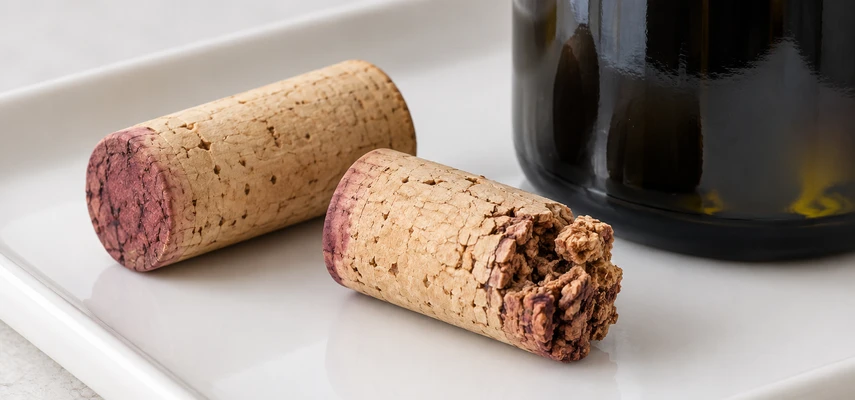
Cork fragments are a separate physical issue. A cork can break during opening while the wine remains free of taint. Conversely, a visually perfect cork can accompany tainted wine. Don’t decide from appearance alone. Looking for little bits of cork is a poor way to detect a compound whose main evidence is in the wine’s aroma.
A screwcap isn’t an absolute guarantee against taint
Although the name points to cork, TCA contamination can arise from other materials in the winery. The AWRI notes that wine can acquire this type of taint without contact with a cork. Alternative closures avoid some risks associated with natural cork, but they don’t make contamination from every other source impossible.
For an exam answer, the useful association is mustiness and suppressed fruit with cork taint. The useful qualification is that the defect isn’t defined by visible cork debris or by closure type alone. You aren’t expected to identify the precise contaminated piece of equipment from a sniff at the table.
Don’t confuse cork taint with a wine that has simply been open too long. Loss of freshness can have several causes. The musty character and the wider evidence matter. One symptom shared by multiple problems doesn’t make their underlying mechanisms identical, even when all of them lead to a disappointing glass.
Failure of closure: the protection no longer works
A closure’s job includes limiting unwanted air exposure and keeping the wine contained. If the seal fails, oxygen can enter more readily and the wine may deteriorate prematurely. Leakage, a poor seal or a damaged closure are possible warning signs. The key chain is failed protection leading to unwanted exposure, then loss of intended condition.
With natural cork, drying during unsuitable long storage can contribute to sealing problems. Damage can also arise in handling or from other bottle conditions. Keep the claim proportionate: an upright bottle on a shop shelf isn’t automatically faulty. Storage duration, closure and actual condition determine how much concern is justified.
Closure failure and cork taint therefore belong in different boxes. One is a failure of the seal’s physical function; the other is an unwanted chemical taint. They can both involve cork, but naming the material doesn’t explain the problem. That distinction is particularly useful when a multiple-choice question offers both as plausible-looking answers.
Oxidation: unwanted change versus intended style
Excessive oxygen exposure can reduce fresh fruit and produce stale, bruised-apple or nutty impressions, with whites becoming deeper gold or brown and reds losing youthful colour. A compromised closure or poor handling after opening can contribute. The important word is excessive relative to the wine’s intended style and stage of development.
Oxygen also has deliberate roles in winemaking and maturation. Oloroso Sherry and aged Tawny Port develop oxidative character intentionally. A nutty note in those wines isn’t automatically a defect. Compare the observation with the style: a fresh young white unexpectedly smelling stale and brown is a different proposition from an intentionally mature oxidative fortified wine.
Normal bottle development also changes colour and aroma. A mature red may show a garnet rim and less primary fruit than a young example. You need evidence that the wine is out of condition, rather than a rule that every brown tint or developed aroma proves failure. Age and intended production are part of the diagnosis.
Heat damage: more than wine served too warm
Prolonged excessive heat can cause premature development, loss of freshness and cooked or stewed-fruit character. Expansion may push a cork upwards or encourage leakage. WSET’s fault guide describes these warning signs. They support suspicion, but the bottle needn’t show every sign to have suffered damage.
Distinguish historical damage from today’s service temperature. A sound red served too warm may feel alcoholic and lose balance in the glass; gentle cooling can improve its presentation. A bottle damaged by prolonged heat won’t regain its original fruit just because you chill it. Changing temperature now doesn’t undo chemical changes that already occurred.
Think about the journey as well as the cupboard. A bottle left for hours in a very hot vehicle can be exposed before it ever reaches a rack at home. Prevention means avoiding excessive heat throughout handling. There isn’t one universal short time limit that guarantees every wine will be safe in every hot environment.
What else can seem wrong?
Some sulfur-related aromas can smell of rotten egg or other reduced characters. Some may diminish with air, but aeration isn’t a universal repair. Vinegar-like or solvent-like impressions can indicate excessive volatile acidity. These are useful wider context, beyond the three faults explicitly named here in the Level 2 specification.
The AWRI’s research-based reference distinguishes different aroma families. Keep those categories separate from cork taint. Musty cardboard, cooked fruit and rotten egg aren’t three interchangeable ways of saying the same thing, even though each might prompt closer assessment.
Equally, a struck-match nuance or a developed savoury note needs context and intensity before you condemn a wine. This article isn’t an instruction to treat every unfamiliar smell as a defect. The exam priority remains the prescribed faults and the service checks that identify a possible problem without overstating certainty.
Sediment and crystals aren’t automatically faults
Mature red wines can form sediment during development. Clear wine can be separated from it by careful decanting. Tartrate crystals can also form in some wines; their appearance doesn’t establish cork taint or spoilage. Physical deposits and objectionable aromas require different explanations, even when they occur in the same bottle.
Cloudiness also needs context. Some wines are deliberately made with less filtration, while an unexpected haze in a style normally presented clear deserves attention. Observe first and ask what is normal for the wine. Aesthetic preference, intended production and a genuine condition problem are related questions, but they aren’t identical.
Make the next step fit the evidence
Check another clean glass, confirm the intended wine and style, and ask for a second assessment if uncertainty remains. If a bottle appears faulty, retain it and explain the specific observation to the seller or service team. You don’t need to pretend certainty about the chemistry to describe mustiness, stale fruit or suspected heat exposure.
Avoid kitchen experiments presented as guaranteed cures. Decanting can separate sediment and sometimes help a sound wine express itself, but it won’t reliably repair cork taint, severe oxidation or heat damage. The most useful habit is a calm sequence: check equipment, observe wine, compare with expected style, then decide whether the evidence warrants replacement.
Related study guides
Knowledge check: wine faults
Choose one answer for each question.
1. Which aroma most strongly suggests cork taint?
- Damp cardboard and mustiness
- Fresh lemon in a young white
- Vanilla in an oaked wine
- Strawberry in a rosé
2. What does a broken cork prove?
- The wine must contain TCA
- A physical opening or closure issue, without proving taint
- The wine is sweet
- The wine has aged perfectly
3. What is a likely consequence of closure failure?
- Guaranteed improvement
- New grape varieties
- Unwanted oxygen exposure and premature deterioration
- Mandatory carbonation
4. Which statement about chilling heat-damaged wine is correct?
- It recreates lost fruit
- It removes every fault
- It sterilises the bottle
- It doesn’t reverse established heat damage
5. Why might low-level TCA be difficult to recognise?
- It can mainly suppress fruit expression
- It always makes the wine bright pink
- It always creates sediment
- It only affects empty glasses
6. Which wine can legitimately show intentional oxidative character?
- Every fresh young white regardless of condition
- Oloroso Sherry
- Only sparkling Asti
- Only freshly pressed grape juice
7. An odd smell appears in just one glass. What should you check?
- Whether the wine’s country changed
- Whether the bottle grew new grapes
- The cleanliness of that glass
- Whether all sediment is sugar
8. Which is a possible external warning sign of heat exposure?
- A normal printed vintage
- A screwcap alone
- A clear glass
- A displaced cork or leakage
9. What does sediment in a mature red establish by itself?
- A deposit that may be normal, rather than automatic spoilage
- Certain cork taint
- Certain heat damage
- The need to add spirit
10. Why can a screwcap wine still show TCA-type taint?
- Screwcaps are made from cork
- Contamination can come from other winery materials
- Every screwcap contains yeast
- TCA is the same as dissolved oxygen
Answers and explanations
1. A — Cork taint; LO6. Musty damp-cardboard character is a useful warning sign. Fruit suppression may accompany it, whereas fresh fruit or appropriate oak aromas aren’t inherently faults.
2. B — Evidence and diagnosis; LO6. Cork breakage is a physical observation. A sound-looking cork can accompany taint, and a broken cork can accompany sound wine, so smell and condition still need checking.
3. C — Closure failure; LO6. A failed seal can admit unwanted oxygen and accelerate deterioration. That mechanism differs from the chemical contamination associated with cork taint.
4. D — Heat damage; LO6. Cooling can improve the service temperature of a sound wine, but it doesn’t undo established chemical damage caused by excessive heat.
5. A — Cork taint recognition; LO6. Low-level contamination may reduce attractive fruit without producing an overwhelming musty smell. This can make assessment less obvious than a simple aroma checklist suggests.
6. B — Style context; LO5/LO6. Oloroso is intentionally oxidatively aged. Similar nutty development can be appropriate there but unexpected in a fresh-fruit-focused young white.
7. C — Service checks; LO6. A contaminated glass can create misleading impressions. Checking it helps isolate whether the concern belongs to the wine or the equipment.
8. D — Heat warning signs; LO6. Expansion and leakage can accompany heat exposure. They justify closer assessment but aren’t a complete diagnosis or required in every damaged bottle.
9. A — Normal deposits; LO6. Sediment can arise during normal maturation. Careful decanting separates it from clear wine; its presence doesn’t identify taint or heat damage.
10. B — Taint sources; LO6. TCA-type contamination can originate in winery materials other than cork. Alternative closures reduce particular risks without eliminating every possible contamination route.
One-page revision summary
| Observation or issue | Useful interpretation | Avoid assuming |
|---|---|---|
| Musty cardboard; muted fruit | Possible cork taint/TCA | Visible cork fragments are required |
| Broken cork | Physical condition or opening problem | It proves chemical taint |
| Failed seal/leak | Protection may be compromised | Every stained label proves current leakage |
| Unexpected stale fruit and browning | Possible excessive oxidation | All developed wine is faulty |
| Nutty Oloroso/aged Tawny | Can be intended oxidative style | Nutty always means spoiled |
| Cooked fruit, lost freshness | Possible heat damage | Chilling reverses past damage |
| Raised cork or leakage | Warning sign needing assessment | Every damaged bottle shows both |
| Rotten-egg aroma | Wider sulfur-related context | It is another name for cork taint |
| Vinegar/solvent-like aroma | Wider volatile-acidity context | All faults have one cause |
| Mature-red sediment | Can be normal | Sediment automatically means spoilage |
| Tartrate crystals | Can be a normal deposit | Crystals establish TCA |
| Before diagnosis | Check glass, appearance, nose and expected style | Dislike alone establishes a fault |
| Response | Describe evidence; seek assessment/replacement if appropriate | Decanting reliably repairs established damage |
This independent guide complements current WSET course materials. The questions are original practice material, not official examination questions.












