










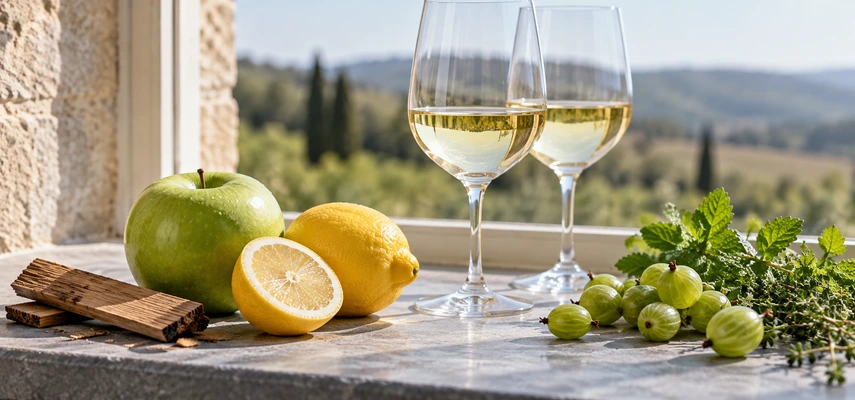

Someone says they dislike Chardonnay but love Chablis. There may be a perfectly sensible preference behind the statement: perhaps they dislike rich, obviously oaked styles. But Chablis is itself a Chardonnay wine. The bottle has supplied a place name where the drinker expected a grape name.
Chardonnay and Sauvignon Blanc explained together reveal two useful lessons. Grape varieties have recognizable tendencies, but growing conditions and winemaking create variation. Regional names can point back to those grapes, so learning the connections makes a wine list much less mysterious.
What WSET Level 1 expects you to know
The official specification, Issue 1.2 includes both white grape varieties and the named wines Chablis, white Burgundy and Sancerre within Learning Outcome 2. Know the typical styles and connect each named example to its principal grape.
Detailed village classifications and vineyard rankings are outside this lesson. Treat flavour examples as typical descriptions, not a compulsory checklist for every bottle. This independent TFE lesson has no WSET affiliation, and the questions are original.
Chardonnay: a grape with a broad wardrobe
Chardonnay commonly makes dry white wine, but its body and fruit character vary considerably. Cooler examples can suggest green apple and citrus, with noticeable acidity. Riper examples can suggest peach or tropical fruit and have a fuller feel.
The grape’s range is one reason “Chardonnay tastes like this” can be a frustrating sentence. A useful answer asks where the grapes grew and how the wine was made. Those questions don’t erase varietal character; they explain why different expressions can share a name.
WSET’s Chardonnay profile discusses its stylistic versatility. At beginner level, remember the contrast between fresh, restrained examples and richer, fuller examples rather than imagining one mandatory buttery style.
What oak changes, and what it doesn’t
Oak can add vanilla, toast or spice notes. A Chardonnay matured with noticeable oak influence may therefore seem more layered or richer in character than an unoaked version. However, Chardonnay doesn’t need oak to qualify as Chardonnay.
Butter-like aromas and creamy impressions can involve other winemaking processes as well. They aren’t simply the taste of an oak barrel. That distinction is helpful enrichment; the Level 1 priority is recognizing that fruit and oak characteristics can come from different sources.
Consider a hypothetical dry Chardonnay showing lemon and apple without obvious toast. A second dry Chardonnay shows ripe peach, vanilla and a fuller body. Both descriptions are plausible. The second isn’t necessarily sweeter, and the first hasn’t failed to develop the grape’s supposedly required oak flavour.
Chablis and white Burgundy: place names, not extra grapes
Chablis is a wine region within Burgundy in France, and its white wines are made from Chardonnay. The classic beginner association is dry white wine with fresh acidity and citrus or green-fruit character. Pronounced new-oak flavour isn’t the defining requirement.
White Burgundy is likewise a principal Chardonnay association at this level. Burgundy contains a range of styles, including fuller examples where winemaking choices are more evident. White Burgundy and Chablis aren’t opposite grape varieties: Chablis is part of the wider Burgundy story.
The Burgundy wine body’s Chardonnay guide provides the regional foundation. For Level 1, learn the principal association without turning it into a legal claim that every white wine anywhere in Burgundy must use only Chardonnay; other local white varieties exist.
This distinction also helps with labels. “Chardonnay” answers the grape question. “Chablis” answers an origin question that also supplies a reliable grape association. A regional label doesn’t mean that the producer forgot to name the ingredient.
Sauvignon Blanc: freshness and an aromatic signature
Sauvignon Blanc typically makes dry white wine with high acidity and clear aromatic character. Common comparisons include gooseberry, citrus, grass and green herbs. Riper expressions may suggest passion fruit and other tropical notes.
WSET’s Sauvignon Blanc profile explains the range from grassy, lighter styles to weightier examples. The useful Level 1 anchor is its fresh acidity and recognizable fruit/herbaceous character, not an absolute ban on body or oak.
High acidity doesn’t mean the wine is faulty or unripe. When balanced with its fruit and other components, acidity is part of the style’s refreshing character. Equally, tropical aromas don’t establish sweetness: many intensely fruity Sauvignon Blanc wines are dry.
Sancerre: another place-to-grape connection
Sancerre is in France’s Loire region. For the prescribed white-wine association, connect Sancerre with Sauvignon Blanc: dry, fresh, high-acid white wine. The regional name and grape name are different kinds of information about the same wine.
Sancerre also has red and rosé production, so the accurate study statement is about white Sancerre. This small qualification avoids teaching a shortcut as a universal claim about everything produced under the name.
Chablis and white Sancerre are therefore useful comparison partners. Both are French dry white examples and can have refreshing acidity, but Chablis points to Chardonnay and white Sancerre to Sauvignon Blanc. “French, white and fresh” isn’t enough to make the grape identities interchangeable.
Compare aroma, acidity and body separately
| Feature | Chardonnay, typically | Sauvignon Blanc, typically |
|---|---|---|
| Sweetness in these core examples | Dry | Dry |
| Fruit/aroma | Apple, citrus; riper peach or tropical fruit | Citrus, gooseberry, grassy/herbal; sometimes tropical fruit |
| Acidity | Varies with growing conditions; Chablis is a fresh reference | Usually high |
| Body | Can range from lighter to full | Often light to medium, with exceptions |
| Oak | May be obvious or absent | Often unobtrusive in introductory examples, but oaked styles exist |
| Named French associations | Chablis and white Burgundy | White Sancerre |
Don’t turn the table into a contest. More body isn’t better than less body; more aroma isn’t better than restraint. These features describe the experience a reader might prefer, not an automatic ranking.
A useful two-bottle thought experiment
Imagine comparing a restrained Chardonnay with a fresh Sauvignon Blanc at appropriate temperatures. The first might show apple and lemon; the second might add a more obviously grassy or gooseberry-like aroma. Both can be dry and acidic enough to make the mouth water.
Now replace the first bottle with a richer, oaked Chardonnay. The contrast may move toward body, ripe fruit and vanilla rather than simply which wine tastes more acidic. The grape comparison hasn’t changed, but the examples have. This is why tasting notes should describe actual styles rather than repeat a memorized stereotype.
Common misconceptions and exam traps
Chablis isn’t a grape and isn’t Sauvignon Blanc. White Sancerre isn’t Chardonnay. White Burgundy doesn’t automatically mean heavily oaked, and Chardonnay doesn’t automatically mean butter.
Sauvignon Blanc’s herbal notes aren’t evidence that herbs were added. A gooseberry aroma doesn’t establish sugar. When a question asks for the principal grape behind a named wine, answer that task before considering flavour variation.
Read the label as a set of questions
Imagine three shelf cards: Chablis, white Sancerre and oaked Chardonnay. The first two emphasize origin, while the third emphasizes variety and production style. They aren’t three equivalent categories, which explains why comparing only the largest word on each label can create confusion.
Translate each card into the same framework. Chablis supplies a Chardonnay association and a particular French origin. White Sancerre supplies Sauvignon Blanc and a Loire origin. Oaked Chardonnay supplies the grape plus a likely additional flavour influence, while the origin still needs checking. Once the information has been aligned, the comparison becomes clearer.
Next ask which feature matters to the drinker. Someone avoiding noticeable oak needs information about production influence; someone wanting a particularly aromatic, herbaceous white needs aroma information. Neither preference can be answered simply by saying French wine is better or Chardonnay is richer.
The exercise also explains why a bottle needn’t print the grape in large letters to be understandable. A place name can encode a useful connection once learned. For revision, cover the grape column of the comparison table, supply the missing names, then reverse the task and recall the place associations. This tests the relationship in both directions.
Knowledge check: 10 original questions
1. Which principal grape is associated with Chablis?
- Chardonnay
- Sauvignon Blanc
- Merlot
- Riesling
2. Which grape is the principal association for white Sancerre?
- Cabernet Sauvignon
- Sauvignon Blanc
- Chardonnay
- Pinot Noir
3. Which statement about Chardonnay is accurate?
- It is always sweet
- It is a red grape
- It can be made with or without obvious oak
- It must always taste of new oak
4. Which aroma set is a useful Sauvignon Blanc reference?
- Only chocolate and coffee
- Only dried beef
- Only caramel and raisins
- Gooseberry, citrus and grass
5. What kind of name is Chablis?
- A regional wine name
- A separate grape variety
- A sweetness category
- A fermentation gas
6. Which principal grape association belongs with white Burgundy?
- Cabernet Sauvignon
- Chardonnay
- Gamay
- Syrah
7. What acidity level is a useful typical Sauvignon Blanc anchor?
- Always lower than every Chardonnay
- Zero if it smells fruity
- High
- Always absent
8. Which Chardonnay description is plausible?
- Always sweet with vanilla
- Always red and tannic
- Always sparkling
- Dry, lemon/apple, no obvious oak
9. Does tropical-fruit aroma prove a Sauvignon Blanc is sweet?
- No, aroma does not establish sugar
- Yes, always
- Yes, if French
- Only if bottled under cork
10. Which comparison has the correct named-wine pair?
- Chablis–Sauvignon Blanc; white Sancerre–Chardonnay
- Chablis–Chardonnay; white Sancerre–Sauvignon Blanc
- Chablis–Merlot; white Sancerre–Gamay
- Chablis–Riesling; white Sancerre–Syrah
Answers and explanations
1. A — Chardonnay. Chablis is the prescribed Chardonnay white-wine example from Burgundy.
2. B — Sauvignon Blanc. White Sancerre is the Sauvignon Blanc association in the Loire.
3. C — It can be made with or without obvious oak. Chardonnay’s styles vary with origin and winemaking; oak is optional.
4. D — Gooseberry, citrus and grass. Sauvignon Blanc commonly has citrus/gooseberry and herbaceous character.
5. A — A regional wine name. The place name supplies an origin and a principal Chardonnay association.
6. B — Chardonnay. Chardonnay is the principal white Burgundy association at this level.
7. C — High. High acidity is a common Sauvignon Blanc characteristic, even in fruity dry styles.
8. D — Dry, lemon/apple, no obvious oak. A fresh unoaked dry Chardonnay is a normal style, not an exception to its grape identity.
9. A — No, aroma does not establish sugar. Fruit aroma and finished sweetness are separate dimensions.
10. B — Chablis–Chardonnay; white Sancerre–Sauvignon Blanc. These are the two principal place-to-grape connections taught in this lesson.
One-page revision summary
Chardonnay: dry white styles ranging from fresh apple/citrus to fuller ripe-fruit and oak-influenced expressions. Chablis and white Burgundy are the principal French associations. Sauvignon Blanc: usually high acidity, citrus/gooseberry and herbaceous character; white Sancerre is the principal Loire association. Grape, place, sweetness and winemaking are connected pieces of information, not substitute words.











