











The easiest vineyard to photograph is not necessarily the easiest vineyard to farm. Neat rows can hide disease pressure, uneven ripening or a shortage of water. Vineyard management is the business of matching a living plant to its site, its crop and the wine somebody intends to make. Every intervention has a purpose, a cost and usually a tradeoff.
Article #4 · Part I: Wine Science, Viticulture, and Winemaking. This independent lesson covers Unit 1 LO1, criterion 2, in the 2022 Issue 2 WSET Level 3 specification. Build on the annual cycle to explain training, pruning, canopy, density, water, hazards, pests, farming approaches and harvest. Original TFE practice material is not official WSET content, and no affiliation or endorsement is implied.
Training sets the framework; pruning selects the wood
Training establishes the vine’s lasting shape. In a head-trained vine, growth is concentrated around a head at the top of the trunk. Cordon training retains one or more permanent horizontal arms. Neither term alone tells you whether all green shoots are tied to wires or how many fruitful buds remain each winter.
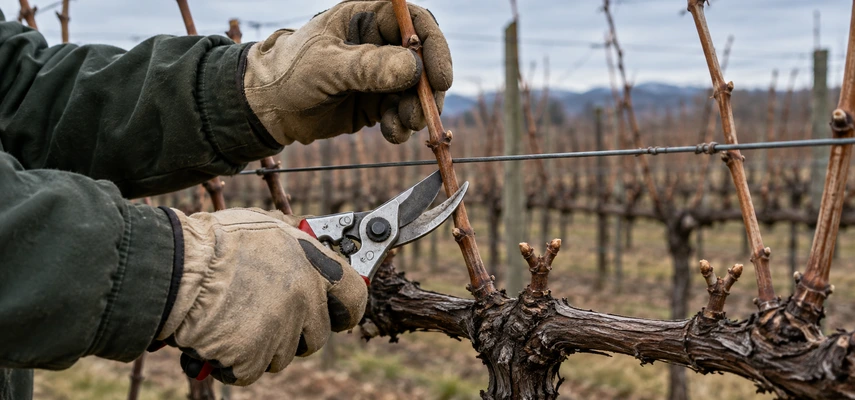
Pruning removes selected growth and determines the retained buds. Spur pruning leaves short lengths of one-year-old wood, usually with a small number of buds. Replacement-cane pruning retains a longer cane to carry fruitful buds, replacing it during the following dormant pruning. Basal-bud fruitfulness influences which approach suits a variety. Pruning is an informed allocation of growth, not simply cutting the vine smaller.
The BC trellis guide connects system choice with vigour, fruitfulness and equipment access. A producer must consider labour and repeated annual work alongside fruit exposure. A system that gives excellent fruit may still be uneconomic if its handling costs exceed the price the resulting wine can support.
Trellised and untrellised canopies
A trellis supports and positions shoots, helping organise the canopy into a workable space. Vertical shoot positioning, or VSP, keeps shoots in a relatively narrow upright plane. This can improve access, distribute foliage and facilitate some machinery. An untrellised bush vine can form a self-supporting canopy, useful in suitable low-vigour, dry settings but often requiring more manual work.
Canopy management includes shoot thinning, positioning, trimming and selective leaf removal. The goal is sufficient functional foliage with appropriate light and airflow around fruit. Too much shading can hinder flavour development and encourage humid conditions. Excessive exposure can overheat or sunburn berries, particularly when previously shaded fruit is suddenly exposed late in the season.
The BC canopy-management guide emphasises matching the system to the site. More leaf removal is not automatically better. In a cool, damp vineyard, opening the fruit zone may help drying and spray access; in a hot, sunny one, retaining some shade can protect the crop. Explain the setting before prescribing the method.
Density, yield and vine balance
Planting density describes the number of vines in a given area. Closer spacing can alter competition for water and nutrients and the distribution of canopy and crop. It also increases planting materials and may restrict machinery. Wider rows can accommodate equipment and more vigorous vines. The appropriate arrangement depends on available resources, growth habit and the intended production system.
Yield is the amount of fruit produced, commonly expressed per area or per vine. These measures are not interchangeable: low yield per vine can accompany a substantial crop per hectare when density is high. Assess the crop relative to the vine’s capacity to ripen it. Neither an isolated tonnage nor a photograph of small bunches establishes quality.
An excessive crop may delay ripening if the vine cannot supply enough resources. Thinning may help where crop load is genuinely excessive, but cutting an already appropriate crop can waste fruit without improving the wine. Lower output can raise cost per bottle by spreading fixed costs over fewer litres. The quality and commercial consequences need separate explanations.
Irrigation and nutrition need diagnosis
Water supply influences photosynthesis, shoot growth and berry development. Severe drought can close stomata, restrict sugar production, damage foliage and compromise future performance. Where permitted and feasible, irrigation supplies missing water. Its timing and amount matter: excessive water can encourage unwanted vigour, while an unsuitable deficit can undermine the very ripening it was intended to improve.
Drip irrigation delivers water locally near the root zone and can offer precise control. Sprinklers distribute water over a larger area; overhead systems can wet foliage and need more water or pumping capacity in some applications. Flood irrigation spreads water across the ground and depends on suitable terrain and supply. Installation, maintenance, energy and water all affect cost.
The BC irrigation guide warns that excessive deficit can damage vines. Nutrient deficiency also needs identification before correction. Fertiliser can replace a missing nutrient, but excess nitrogen may increase canopy growth and shading. Soil and tissue testing help distinguish a true deficiency from symptoms caused by damaged roots, disease or water problems.
Weather hazards: match the response to the mechanism
| Hazard | Possible response | Mechanism and limitation |
|---|---|---|
| Spring frost | Choose sites with suitable cold-air drainage | Reduces some cold-air accumulation; cannot eliminate every frost event |
| Radiation frost with an inversion | Wind machines | Mix warmer air above with colder air near vines; need a usable inversion |
| Frost | Heaters or correctly operated sprinklers | Add heat, or release heat as water freezes; require resources and suitable operation |
| Winter freeze | Earthing up suitable low vine parts or graft union | Soil provides insulation; labour and local conditions matter |
| Hail | Nets and vineyards in several locations | Nets shield fruit; dispersed sites reduce exposure to one local storm, without preventing hail |
| Rain near harvest | Adjust picking dates where appropriate | May avoid deterioration, at the cost of changing maturity at picking |
| Sunburn | Retain suitable canopy shade | Protects berries while avoiding excessive shading and poor airflow |
| Nutrient shortage | Appropriate fertiliser | Replaces a diagnosed deficiency; extra nutrient is not inherently beneficial |
Frost and winter freeze concern different vulnerable tissues and conditions. The BC frost-protection guide distinguishes the resources and weather conditions required. Sprinklers do not protect simply because ice is a blanket: the useful heat is released during freezing, and adequate continuing water supply is essential. A wind machine is not a reliable cure for a windy cold air mass with no warmer layer to mix down.
Hail can damage leaves, shoots and berries, reducing crop and opening wounds. Nets require investment and may complicate vineyard operations. Rain can replenish water, but wet flowering can reduce fruit set and rain-damaged fruit can become more vulnerable to rot. A response that makes sense in one season may be unnecessary or counterproductive in another.
Phylloxera and other animal pests
Phylloxera is a small insect that can damage susceptible vine roots, reducing vine performance and potentially killing vines. Grafting a desired variety onto an appropriately resistant rootstock protects the vulnerable root system. The rootstock must also suit soil, water and other local conditions. It is not simply a universal accessory that makes every vine resistant to every pest.
UC IPM’s phylloxera guidance supports resistant rootstocks and clean planting material. Movement of contaminated plants or equipment can spread pests. Other insects may damage leaves or berries, while birds and mammals can consume fruit. Monitoring, appropriate physical barriers such as nets or fencing, and targeted permitted insecticides address different threats; one treatment does not solve them all.
These measures protect fruit quantity and health, but add costs and operational choices. A net may prevent bird losses while requiring installation and removal. A spray programme requires monitoring and appropriate timing, with product suitability and local rules checked separately. The educational mechanism is protection of the crop, not a recommendation to apply a particular chemical everywhere.
Fungal diseases, viruses and bacteria
Fungal problems such as powdery mildew, downy mildew and damaging bunch rots can affect leaves, fruit and ripening. Their precise weather requirements differ, so “all fungi need exactly the same wet conditions” is misleading. Canopy management can improve airflow and drying, while correctly selected and timed fungicides can reduce particular disease pressures. Both prevention and monitoring matter.
Viruses such as leafroll can reduce performance and interfere with ripening. Bacterial problems, including crown gall, can damage vines through a different biological route. The BC disease guide describes persistent virus infection and its consequences. A fungicide does not cure a virus merely because both problems affect leaves.
Management may require removing infected vines, controlling relevant vectors and replanting with clean material. Where a soil-borne pest or pathogen is involved, land preparation, removal of infected roots and appropriate sanitation or treatment may be needed before replanting. “Sanitising the land” is not a promise that one treatment sterilises a vineyard permanently. Diagnosis determines the appropriate response and replacement interval.
Conventional, organic, biodynamic and sustainable approaches
Conventional viticulture can use a broad range of permitted tools. Good conventional management can include monitoring and selective intervention rather than indiscriminate treatment. Organic farming restricts inputs under its applicable standards and emphasises approaches such as soil management and preventative husbandry. Organic does not mean no spraying, no disease or automatically lower production costs.
Biodynamic farming combines organic foundations with a whole-farm philosophy and particular preparations and practices. Demeter describes its preparations as certification requirements. That establishes what its system requires, not independent proof that every proposed mechanism or resulting quality advantage is scientifically demonstrated. Judge the wine and the farming claim on their respective evidence.
Sustainable viticulture considers long-term environmental, social and economic performance, including water, soils, biodiversity, workers and viability. It is not a synonym for organic or biodynamic. Programmes differ, so a specific certification needs its own standards checked. Compare actual actions and outcomes: a label alone cannot tell you the vineyard’s disease pressure, water use or the wine’s quality.
Harvest method changes flexibility and cost
Hand harvesting can permit selection in the vineyard and collection of intact bunches where needed. It suits steep or otherwise inaccessible sites, but requires an available workforce and can be slow or expensive. Machine harvesting can pick substantial volumes quickly and operate at night in suitable vineyards, helping bring cooler fruit to the winery.
Machines require compatible training, spacing and terrain; fruit handling and selection also depend on equipment and winery arrangements. Neither method guarantees superior quality. A quick harvest before deteriorating weather may protect fruit better than an overstretched hand crew. Conversely, a method needing whole bunches or very selective picking may make manual harvesting the appropriate choice.
For a regional explanation, start with the site’s constraints, select the relevant response and trace its effect. A dry Mendoza site raises water-management questions; a frost-prone Chablis parcel raises cold-protection questions; a steep Mosel slope raises labour and access questions. Those are useful mechanisms, not claims that every vineyard in each region is managed identically.
Knowledge check: 10 original practice questions
1. What does cordon training retain?
2. Which statement describes replacement-cane pruning?
3. Why can excessive leaf removal be harmful in a hot site?
4. Why must yield per vine be distinguished from yield per hectare?
5. Which response most directly protects susceptible roots against phylloxera?
6. When is a wind machine’s frost mechanism most applicable?
7. What is a potential advantage of machine harvesting in a suitable vineyard?
8. Which statement about organic viticulture is correct?
9. Why can severe drought hinder ripening?
10. Why is a fungicide not a general cure for leafroll?
Answers and explanations
1. B — Permanent framework. A cordon is a permanent arm. The training term describes structure and does not by itself specify every shoot-management choice.
2. C — Renewed fruiting wood. Retaining and later replacing a longer cane distinguishes this pruning approach from retaining short spurs. Roots are not removed annually.
3. A — Exposure tradeoff. Removing protective shade can overheat berries. The amount of useful exposure depends on the site and timing, not a universal rule.
4. D — Density matters. Many low-cropping vines can still produce a substantial crop per hectare. The two measures need their vine-count relationship explained.
5. B — Root resistance. A suitable resistant rootstock protects against the root pest. Blending or pricing wine cannot protect living roots from attack.
6. C — Warmer air to mix. An inversion provides the warmer layer used by the machine. Without suitable conditions, the proposed mechanism cannot supply the same protection.
7. A — Speed and timing. Machines can provide fast harvest and cool-night access where the vineyard permits. They do not guarantee intact bunches or work on every slope.
8. D — Restrictions, not immunity. Organic standards constrain tools, while growers still manage disease. Certification is not a substitute for evaluating wine quality.
9. B — Restricted function. Severe shortage can limit photosynthesis and damage leaves. A reduction in crop or berry size is not proof of successful ripening.
10. C — Different cause. Viral infection needs different prevention and management from fungal disease. Naming the correct biological problem determines the useful response.
Written exercise 1: choose canopy exposure
Question: A cool, damp vineyard has a dense, shaded fruit zone. Explain two potential benefits of selective leaf removal and one reason not to remove all protective foliage. Suggested marks: 5. Learning outcome: Unit 1 LO1, criterion 2.
Indicative marking points: One point each for improved fruit exposure; connecting exposure with ripening under light-limited conditions; improved airflow or drying; connecting that change with reduced conditions favourable to some rots; and explaining a risk from excessive exposure such as sunburn or loss of useful photosynthetic area. Accept equivalent accurate points, without double counting.
Model answer: Selective leaf removal can expose previously shaded fruit, helping ripening where exposure is insufficient. Opening the fruit zone can also improve airflow and drying, reducing conditions favourable to some damaging rots. Removing too much foliage can expose berries to sudden heat or sunburn and reduce useful leaf area, so the operation needs to be selective and timed to the site.
Why it earns credit: Each benefit includes a mechanism and consequence, followed by a relevant limit. Common mistake: asserting that opening a canopy cures all fungal diseases or that maximum sunshine is always desirable.
Written exercise 2: protect against frost
Question: A vineyard has radiation-frost risk and a confirmed temperature inversion. Explain how a wind machine and a correctly operated sprinkler system can help protect green shoots. Identify one cost or resource requirement for each. Suggested marks: 6. Learning outcome: Unit 1 LO1, criterion 2.
Indicative marking points: One point each for identifying warmer inversion air; mixing it towards the vines; a machine cost such as equipment or energy; water releasing heat as it freezes; adequate continuing water/application to protect tissues under suitable conditions; and a sprinkler resource or cost such as water supply, pumping or infrastructure.
Model answer: The wind machine mixes warmer air from the inversion towards the colder fruiting zone, helping raise temperatures around vulnerable shoots. It requires capital equipment and energy. Sprinklers can supply water that releases heat as it freezes, helping protect tissues if adequate application continues under suitable conditions. That needs sufficient water, pumping capacity and installed infrastructure; a badly matched system can fail.
Why it earns credit: The mechanisms remain distinct, and each is paired with a specified resource implication. Common mistake: describing ice as the sole source of protection or promising that a wind machine works equally well without an inversion.
One-page revision summary
Training determines framework; pruning selects retained buds and wood. Canopy and crop load must fit the vine’s resources, and low yield is not a quality guarantee. Match frost, drought, hail, pests and diseases with responses that address their actual mechanisms. Compare farming approaches by their practices and standards, not assumed tasting superiority. Harvest method is a decision about fruit requirements, access, timing and cost.











