










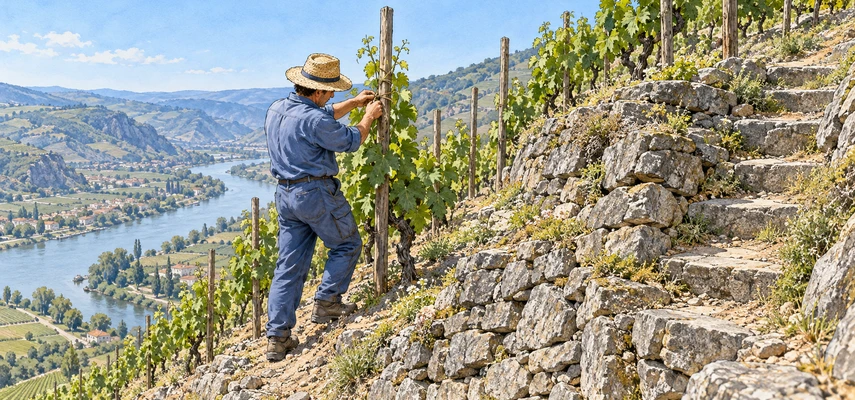

Rhône Valley wines make an excellent argument for keeping a map beside your glass. In the north, Syrah climbs steep hillsides where exposure and hand labour matter enormously. In the south, Grenache often leads blends grown under Mediterranean heat. Both can make generous reds, but they arrive there through different conditions and decisions.
The white wines and rosés prevent the story becoming too tidy. Viognier makes Condrieu, Marsanne and Roussanne supply other northern whites, and Tavel has built an appellation around rosé. This independent lesson follows the WSET Level 3 specification, with original questions and written exercises rather than official WSET examination material.
Rhône Valley wines: separate the two growing environments
The Northern Rhône, broadly between Vienne and Valence, is a relatively narrow vineyard corridor. Steep slopes and continental influences make aspect valuable for ripening, although Mediterranean influence increases towards its southern end. Syrah is the key black grape. Granite and metamorphic rocks feature in many hillside sites, with more varied deposits elsewhere.
The Southern Rhône, around Orange and Avignon and neighbouring districts, is broader, generally warmer and more Mediterranean. Hot, dry summers suit Grenache and other heat-loving varieties. Limestone, clay, sand and stony terraces provide varied growing conditions. Neither half has a single soil or a uniform wine style. Inter Rhône’s regional account describes this geographical diversity.
The Mistral is a strong, often cold and dry northerly wind. It can help dry foliage and reduce some fungal pressure, but can also damage shoots and increase water loss. Shelter, training and site choice matter. Drought, heat, frost, hail and poor flowering weather remain possible; sunshine doesn’t remove vineyard risk.
Northern Syrah: exposure is useful, terraces are expensive
Syrah can give deep colour, black fruit, pepper, floral aromas and substantial tannin. Suitable warmth helps ripen skins and fruit; cooler sites or seasons can preserve freshness but make full maturity harder to achieve. A peppery impression isn’t automatically underripeness. Judge it with fruit concentration and tannin quality, rather than treating every savoury note as a defect.
Steep slopes can provide favourable exposure and drainage. Terraces keep land usable and help retain soil, but walls need maintenance. Machinery access may be limited, increasing manual pruning, tying, canopy work and harvesting costs. Individual stakes can support shoots against wind. Inter Rhône’s terrace explanation connects the walls with the working landscape.
| Northern appellation | Site, grapes and useful style connection |
|---|---|
| Côte-Rôtie | Steep right-bank slopes near Ampuis. Syrah reds can include Viognier, contributing aromatic lift; floral complexity and fine texture can coexist with structure. |
| Condrieu | Nearby right-bank hillside sites. White Viognier gives pronounced peach, apricot or floral aromas, often with full body and relatively modest acidity. |
| Saint-Joseph | A long right-bank area with considerable site variation. Syrah reds dominate, alongside Marsanne/Roussanne whites; hillside and other sites shouldn’t be treated as identical. |
| Hermitage | A prominent left-bank hill above Tain-l’Hermitage. Concentrated Syrah reds and Marsanne/Roussanne whites can have significant development potential. |
| Crozes-Hermitage | A wider left-bank area around Hermitage, with hills and more level terraces. Syrah reds range from accessible fruit-led wines to concentrated examples; whites use Marsanne/Roussanne. |
| Cornas | Sheltered right-bank slopes near Valence. Red wine from Syrah alone can be deeply coloured, firmly tannic and capable of ageing. |
The official profiles of Côte-Rôtie, Condrieu, Hermitage and Cornas distinguish these grape and site identities. Cornas doesn’t permit a white-grape component. Côte-Rôtie’s permitted Viognier is an option, not proof that every producer adds it or that the finished wine is rosé.
The Crozes-Hermitage account and Saint-Joseph account also caution against reducing a broad appellation to one hillside picture. More accessible sites may allow more efficient production, but producer ambition and individual parcels still create a wide range.
Northern whites need their own explanation
Viognier needs enough ripeness to express its distinctive perfume. Waiting too long can increase sugar and potential alcohol while acidity falls, so picking requires a careful balance. Condrieu is generally dry, despite aromas that can suggest ripe or sweet fruit. Barrel fermentation or lees maturation may add texture, but overt oak isn’t compulsory.
Marsanne can supply body, relatively restrained youthful fruit and later nutty or honeyed complexity. Roussanne contributes aroma and freshness in blends, with lower yields and disease susceptibility creating growing challenges. Their proportions and maturation choices vary. Don’t assume that one always plays a fixed supporting role in every bottle.
Neutral tanks, older wood, new barrels, lees contact and malolactic decisions offer different routes to balance. A full-bodied white still needs sufficient freshness and flavour definition. The Rhône grape guide places these varieties alongside Viognier in the regional mix. Great longevity isn’t guaranteed by a grape name or a large barrel bill.
Southern blends: give each grape a job
Grenache is well suited to warm, dry conditions and can accumulate substantial sugar, producing generous alcohol and body. Red fruit, spice and comparatively modest colour or tannin are useful reference points. Its sturdy bush-vine form can suit exposed sites, although growing choices vary. Heat and drought tolerance doesn’t mean unlimited resistance to severe water stress.
Syrah adds darker fruit, colour and tannin, often helping structure. Mourvèdre ripens late and needs warm sites; it can contribute dark fruit, savoury complexity and firm tannin. A site that ripens Grenache comfortably may still leave Mourvèdre short of suitable maturity. Cinsault commonly supplies fragrance and red-fruit character, especially useful in blends and rosés.
Blending spreads decisions across grapes with different strengths and ripening patterns. The objective might be balancing Grenache’s body with Syrah’s colour and Mourvèdre’s structure. It isn’t a compulsory three-grape recipe for every appellation or a guarantee that the blend is better than a single-varietal wine. Inter Rhône’s Grenache profile gives the dominant southern grape its regional context.
Growers balance yield, leaf area and water supply. Bush vines can protect bunches with foliage; trained Syrah may need support. In very warm seasons, harvesting decisions must consider acid loss and high potential alcohol as well as flavour. Shade can protect berries, while crop reduction that is excessive for the conditions may merely sacrifice volume.
Southern appellations: broader names and individual crus
Côtes du Rhône is the broad regional appellation, with much production in the south. Reds commonly offer ripe fruit and spice at accessible prices, but whites and rosés also exist. Côtes du Rhône Villages has a more restricted geographical scope and stricter production requirements; some entitled names can add a geographical designation. Neither label means every bottle follows the same blend or quality level.
The regional appellation account and Villages account explain the hierarchy. Individual crus have their own appellations. Cru status concerns recognised origins and rules, not a yearly contest ranking every producer.
| Southern cru | Geography and style connection |
|---|---|
| Châteauneuf-du-Pape | Left-bank country north of Avignon, with rolled-stone, sand, clay and limestone sites. Grenache-led reds can be powerful and complex; white wines also exist. |
| Gigondas | Around the Dentelles de Montmirail, where elevation and exposure can moderate the warm setting. Grenache-led reds commonly combine ripe fruit with structure; rosé and now white wines also occur. |
| Vacqueyras | Near Gigondas, with terraces, plains and varied soils. Mainly Grenache-based reds, alongside rosé and white production, offer ripe fruit and substantial structure. |
| Lirac | On the Rhône’s right-bank side, opposite the Châteauneuf area. Stony, sandy and limestone sites produce reds, whites and rosés. |
| Tavel | Right-bank country west of Avignon. Rosé-only production commonly gives dry, fuller-bodied wines with more colour and structure than the palest rosé styles. |
The Châteauneuf-du-Pape profile shows why photographs of rolled stones aren’t a complete soil description. Stones can absorb and release heat, while underlying clay or other layers influence water supply. In an already hot season, still more warmth isn’t automatically useful. Sandier sites can produce different outcomes within the same appellation.
Gigondas is especially worth updating in older notes: white wine gained appellation recognition from the 2023 vintage. Producer Pierre Amadieu’s account records the change. The Vacqueyras, Lirac and Tavel profiles clarify their contrasting colour rules. Don’t make “southern Rhône red” a synonym for every wine from these places.
Extraction, maturation and the intended wine
For red wines, sorting, destemming or whole-bunch choices, fermentation temperature and cap management shape extraction. A ripe, concentrated lot can support more tannin than a lighter one, but rough handling can spoil either. Malolactic conversion normally forms part of red production. New oak, older large wood, concrete and tanks offer different flavour, oxygen and cost effects.
An early-drinking Côtes du Rhône might prioritise fruit, supple tannin and earlier release. A concentrated Hermitage or southern cru might undergo longer maturation, with wood impact adjusted to the fruit. “Longer” and “newer” are choices to explain, not automatic synonyms for quality.
Tavel uses grapes and skin contact to achieve its rosé style rather than simply blending finished red and white wine as a universal method. Extraction of colour and some phenolics can give a more substantial texture. Fermenting dry and retaining balance matter more than matching the palest fashionable shade. Protective handling and neutral vessels can preserve fruit; maturation decisions vary by producer.
Explain quality and price beyond the famous name
Quality rests on balance, intensity, complexity and length. Northern Syrah needs enough ripe fruit to support acidity and tannin. Southern Grenache blends need alcohol integrated with fruit and freshness. Viognier’s perfume must work with body and acidity; Tavel’s colour doesn’t by itself establish sweetness or quality.
Steep vineyard work, terrace repairs, hand harvesting and crop losses influence northern grape costs. In the south, site, yield, water stress and selection also affect costs. Small lots, barrels and holding stock add cellar expenditure. Efficient larger-scale production and earlier release can reduce some unit costs. Transport, storage, applicable taxes and trade margins contribute to retail prices, while strong demand for a limited supply from a reputed producer can add a premium.
A famous appellation supplies expectations, not the conclusion of a tasting. An accessible red can be an excellent example of its intended style. A costly cru can still have excessive oak or unbalanced alcohol. Explain how the site and decisions shape the wine, then use the glass to decide how well they worked together.
Knowledge check: 10 original questions
Choose one answer per question. These are independent educational questions.
1. Which comparison best explains the north-south grape pattern?
2. What is the main cost consequence of steep northern terraces?
3. Which statement about Côte-Rôtie and Cornas is correct?
4. Why is Viognier harvest timing important?
5. Which grape most clearly requires a particularly warm site because it ripens late?
6. Which statement about the Mistral is most accurate?
7. Which southern appellation produces rosé only?
8. What is the correct relationship between Hermitage and Crozes-Hermitage?
9. Which statement avoids an outdated description of Gigondas?
10. What is the soundest reason for blending Grenache with Syrah and Mourvèdre?
Answers and explanations
1. C — Climate and site suitability. Northern slopes provide important ripening contexts for Syrah, while southern warmth suits Grenache and other varieties. Local sites and rules still vary. One broad regional climate or grape recipe can’t explain the whole valley.
2. A — Labour and maintenance. Steep terraces can restrict machinery, increase hand work and require wall repairs. Those costs are part of producing grapes before winemaking begins. Neither slope nor terrace guarantees a larger harvest.
3. D — Different rules. Côte-Rôtie permits Viognier alongside Syrah, without making it compulsory. Cornas is red Syrah alone. Remembering that some northern reds can use white grapes doesn’t make that permission universal across appellations.
4. B — Ripeness and balance. Viognier needs suitable maturity for its characteristic aroma, but waiting may raise sugar and reduce acidity. Harvest timing therefore weighs competing objectives. Fruit aroma doesn’t establish residual sugar in the finished wine.
5. C — Late Mourvèdre. Mourvèdre needs warm growing conditions to complete ripening. Its useful tannin and savoury contribution depend on suitable fruit maturity. Success with an earlier grape on a site doesn’t automatically demonstrate suitability for late Mourvèdre.
6. D — A trade-off. Drying foliage can reduce conditions favourable to some fungal problems. Strong wind can also damage growth and increase water loss. Shelter and training decisions reflect those competing effects rather than a wholly beneficial or harmful label.
7. A — Tavel identity. Tavel is a rosé-only appellation. Lirac and Vacqueyras make multiple colours, while Châteauneuf-du-Pape makes reds and whites. Regional reputation doesn’t override the individual appellation’s permitted styles.
8. B — A hill and a wider area. Hermitage centres on its famous left-bank hill. Crozes-Hermitage includes a broader range of sites, including more level terraces. Both have red and white production, and neither belongs to the Grenache-led southern context.
9. D — Current colour recognition. Gigondas is especially famous for reds, but white wines gained recognition from the 2023 vintage. That change doesn’t turn it into a Viognier-only origin or remove its established red and rosé contexts.
10. C — Complementary contributions. Producers can use different grapes to balance fruit, body, colour, acidity and tannin. The outcome depends on the components and decisions. Blending isn’t universal, a fixed percentage recipe or automatic proof of quality.
Written exercise 1: explain a northern red’s price
Question — 5 marks: Explain five reasons why a small-production red from steep northern Rhône terraces might cost more to produce per bottle than an efficiently made red from flatter vineyard land.
Indicative marking points: Award one mark each for manual vineyard work; difficult movement of fruit or materials; terrace-wall maintenance; small-volume handling or reduced saleable crop; and longer maturation/stock costs where used.
Model answer: Limited mechanisation means that tying, canopy management and harvesting may require more hand labour. Moving fruit and materials along narrow access routes can also demand smaller loads and additional trips. Terrace walls require maintenance to keep the land usable. Small parcels or a limited saleable crop spread costs over fewer bottles and may require separate small-lot handling. If the wine also receives longer maturation, cellar space and delayed income add costs. These mechanisms explain production expense without assuming that reputation itself is a physical input.
Why it earns credit: Five separate cost mechanisms follow from the scenario or a qualified production choice. Merely saying “steep land is expensive” would not explain where the expenditure occurs.
Written exercise 2: explain a southern blend
Question — 5 marks: Explain how Grenache, Syrah and Mourvèdre can complement each other in a southern Rhône red, including one vineyard requirement and one limitation of blending.
Indicative marking points: Award one mark each for Grenache body/ripe red fruit; Syrah colour/tannin/dark fruit; Mourvèdre structure/savoury contribution; warm conditions for late Mourvèdre; and blending not repairing fundamentally unsuitable or unripe fruit.
Model answer: Grenache can give ripe red fruit and generous body. Syrah may add darker fruit, colour and tannin. Mourvèdre can supply firm structure and savoury complexity. Because Mourvèdre ripens late, the grower needs a sufficiently warm site and season for suitable maturity. Blending then balances useful components, but it cannot reliably turn fundamentally unripe or damaged fruit into a balanced premium wine. The proportions must suit both the vintage and the desired style.
Why it earns credit: It links three grape contributions to a blend, then adds a growing condition and a genuine constraint. These are original educational marking suggestions, not an official WSET mark scheme.
One-page revision summary
| Topic | Causal connection |
|---|---|
| North and south | Northern slopes and continental influences contrast with the broader, warmer Mediterranean south. |
| Syrah sites | Exposure supports ripening; steep terraces add labour and maintenance costs. |
| Northern appellations | Côte-Rôtie, Saint-Joseph, Hermitage, Crozes-Hermitage and Cornas have distinct sites and rules; Condrieu is a Viognier white context. |
| Northern whites | Viognier needs aroma ripeness with balance; Marsanne and Roussanne offer different body, aroma and freshness contributions. |
| Southern grapes | Grenache often supplies body and red fruit, Syrah colour and tannin, Mourvèdre late-ripened structure, and Cinsault fragrance. |
| Mistral | Drying benefits coexist with shoot damage and water-loss risk. |
| Hierarchy | Côtes du Rhône, Villages and individual crus identify different origins and requirements, not one universal blend. |
| Southern crus | Châteauneuf, Gigondas, Vacqueyras and Lirac have individual sites and colours. Tavel is rosé-only; Gigondas whites were recognised from 2023. |
| Winemaking | Extraction and maturation must suit fruit. New oak, heavy extraction and deeper colour don’t automatically mean higher quality. |
| Quality and price | Assess balance, intensity, complexity and length. Explain price through vineyard work, yields, cellar costs, transport, margins and demand. |












