











Three Greek wines can challenge three familiar shortcuts. A white from a hot island can have startling acidity. A relatively pale red can contain formidable tannin. A red from the sunny Peloponnese can change character markedly as vineyards climb into the hills.
Santorini, Naoussa and Nemea make these contrasts especially useful. Each pairs a distinctive indigenous grape with a specific growing environment, while leaving plenty of room for producer decisions. Learn the connections and the names become anchors, rather than an exercise in spelling under pressure.
This is article 22 of The TFE Guide to WSET Level 3 Wine. It follows the three Greek origins and grapes in the official specification. All questions and marking guidance are original study material, not official WSET examination content.
Greek wines begin with geography, not one national climate
Greece’s latitude gives many vineyards substantial warmth and sunshine, but mountains, elevation and surrounding seas create important differences. An exposed Aegean island isn’t the same growing environment as a northern mainland slope. Likewise, a high vineyard can have a different ripening season from lower land within the same origin.
Warm summers favour sugar accumulation and flavour development. The risks include declining acidity, excessive potential alcohol, drought and sunburn. In cooler or higher sites, achieving sufficient ripeness becomes a different challenge. Spring frost, hail and harvest rain also matter where local conditions permit them. “Mediterranean” is a useful starting point, not the end of a vineyard explanation.
For each region, follow a simple chain: conditions affect the vine; growers respond through site choice and management; grapes reach a particular balance; winery decisions shape the finished wine. That chain helps explain variation without assuming every Greek bottle is powerful, rustic or made for immediate drinking.
Santorini: Assyrtiko in a demanding island setting
Santorini lies in the Aegean’s Cyclades, with vineyards on volcanic materials including ash, pumice and weathered rock. Rainfall is limited, summer sun is intense and strong winds can make exposed growth difficult. Assyrtiko is the key white grape, capable of retaining high acidity while achieving considerable ripeness and alcohol.
The national Assyrtiko profile describes a variety whose appeal often rests on texture and structure as much as perfume. Citrus fruit, a firm palate and sometimes a saline impression are useful tasting references. Don’t treat “saline” as proof of seawater entering the wine, or a smoky note as evidence of volcanic particles in the juice.
Soil structure and available water affect the vine’s ability to function through dry conditions. Wind can reduce humidity, while also increasing water loss and damaging shoots. A naturally adapted local grape still needs adequate resources; drought doesn’t become beneficial simply because the vineyard is famous.
Basket training is a practical response
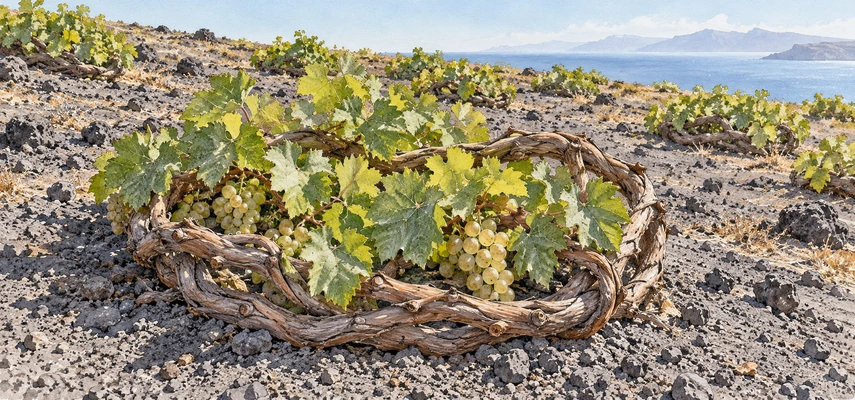
Santorini’s kouloura training coils living vine wood into a low basket-like shape. Grapes develop within the protective structure and foliage. This keeps the fruit close to the ground and helps shelter it from strong winds and excessive exposure. It is vine training, rather than a harvested bunch placed inside a separate wicker basket.
The PDO Santorini account describes the system. Maintaining and harvesting these vines requires skilled hand work. Low, irregular vine shapes and small parcels can restrict conventional machinery, helping explain labour costs. Training solves some problems while creating practical constraints of its own.
Crop and canopy management must support enough flavour without leaving too much fruit for the vine’s water and leaf resources. Appropriate shade helps prevent damage; excessively dense foliage can reduce air movement. The intended harvest balance matters too: sufficient ripe fruit must support Assyrtiko’s acidity and potential alcohol rather than merely producing the highest sugar reading.
Santorini in the cellar: Acidity meets texture
Many dry Assyrtikos use gentle pressing and controlled fermentation to preserve fruit and freshness. Stainless steel can support a direct style without strong oak flavour. Lees contact can add texture, while barrel fermentation or maturation can create a different expression. Neither vessel is an automatic quality upgrade.
A Santo Wines technical example illustrates protected handling and steel fermentation; a Sigalas barrel example illustrates another route. These are producer choices, not compulsory recipes. Oak needs sufficient fruit to remain integrated, and preserving acidity may favour avoiding malolactic conversion.
Santorini also produces Vinsanto, a sweet style from sun-dried grapes, with Assyrtiko important in its blend. Drying concentrates fruit before fermentation; maturation develops a different aromatic profile. Don’t confuse it with a dry Assyrtiko simply because both carry the same geographical name, or with Italy’s similarly named Vin Santo. The core regional lesson is dry white wine, with Vinsanto providing a useful concentration contrast.
Naoussa: Xinomavro on northern mainland slopes
Naoussa lies in northern Greece, in Macedonia, on the slopes of Mount Vermio. Its Mediterranean climate has continental influences, with cold winters and relatively warm summers. Elevation, slope orientation and varied soils change conditions between parcels. The PDO Naoussa profile identifies Xinomavro as its grape.
Xinomavro can combine high acidity and firm tannin without exceptionally deep colour. Typical references include red fruit, floral notes and savoury tomato or olive associations, with development bringing further complexity. The grape account provides that stylistic framework. Colour intensity alone gives an unreliable guide to tannin or quality.
The grape’s ripening demands make site and crop balance important. A suitable sunny slope can support maturity; excessive crop or poor exposure can leave inadequate fruit and unripe structure. Yet picking later isn’t a universal cure: rain risk, fruit condition, acidity and potential alcohol must also be considered. Good fruit needs more than a favourable name on the map.
Manage Xinomavro’s structure rather than maximise it
In the winery, extraction determines how much material enters the wine from skins and seeds. More prolonged or forceful extraction can increase tannin, but doesn’t necessarily improve its texture or balance. Daily assessment and suitable cap management help a producer obtain enough structure without overwhelming the fruit.
Maturation can integrate texture and add complexity. New wood may contribute spice or toast; older or larger vessels provide different options. Bottle development can bring savoury and earthy notes, but harshness doesn’t guarantee that time will eventually create balance. A wine needs sufficient fruit at the outset.
Naoussa isn’t limited to one austere style requiring decades of patience. The national organisation’s current regional discussion describes more approachable, fruit-led interpretations alongside ageworthy wines. Explain the individual result through fruit, extraction and maturation rather than turning a traditional reference into a compulsory drinking window.
Nemea: Agiorgitiko changes with elevation
Nemea, in the northeastern Peloponnese, is associated with Agiorgitiko. Its vineyards span lower ground and much higher inland sites. Mediterranean warmth remains important, but elevation and aspect change temperatures, ripening speed and acid retention. The PDO Nemea guide describes this variation within the zone.
Agiorgitiko commonly offers ripe red fruit and a rounded texture, with fresher, earlier-drinking styles alongside more concentrated, structured reds. Its national grape profile explains that versatility. Don’t turn “softer than Xinomavro” into an absolute statement about every wine: extraction, crop and maturation can change the comparison.
At a warmer, lower site, grapes may accumulate sugar quickly while losing acidity. Higher sites can retain freshness and ripen later, although insufficient warmth can create problems in an unfavourable year. Matching fruit to the intended wine is therefore more useful than ranking all elevations from best to worst. Soil drainage and water storage add further differences.
Nemea’s vineyard and winery decisions work together
Growers can manage crop size and foliage to support the required balance. Leaving excessive fruit may weaken concentration, while extreme exposure can damage berries. Harvest decisions then connect grape composition with the desired style: a fresh young red requires a different balance from a dense wine intended for extended maturation.
Moderate extraction and neutral-vessel maturation can preserve juicy fruit and support earlier release. More concentrated grapes may support additional tannin extraction and oak maturation, creating greater structure and potentially complexity. The extra expense is justified only if the components remain balanced. New barrels don’t manufacture missing fruit intensity.
Although Agiorgitiko can make rosé, that doesn’t automatically make the result PDO Nemea. The PDO is for red wines; dry wines are the principal reference here, with sweet categories also permitted. Variety and geographical permission are separate pieces of information. A producer can grow a grape locally and still need another permitted designation for a different wine style.
PDO and PGI: Read the actual origin framework
PDO, protected designation of origin, links a defined area with its grape and production requirements. PGI, protected geographical indication, uses a different, generally broader framework. The national appellations guide maps those origins.
For the red PDOs here, Naoussa is based on Xinomavro and Nemea on Agiorgitiko. Santorini’s dry whites are Assyrtiko-led, with permitted supporting grapes under their own rules. Don’t apply one PDO’s blending permissions to another, and don’t assume a varietal wine made elsewhere acquires the grape’s most famous origin.
A wine grown near Naoussa may use a different designation if its blend doesn’t meet the PDO rules. The regional PGI Imathia account illustrates that broader context. PDO and PGI provide regulated information; neither makes sensory assessment unnecessary. Exact grape percentages and numerical Reserve requirements aren’t needed to explain these core distinctions.
Quality and price: Evidence before reputation
Judge balance, intensity, complexity and length. Assyrtiko needs enough fruit and texture to support acidity and alcohol. Xinomavro needs fruit to balance tannin; Agiorgitiko needs sufficient freshness and definition. Power, pale colour and a famous island name are all incomplete arguments for quality.
Grape costs reflect labour, usable crop and site access. Basket-trained vines, difficult slopes, sorting and hand harvesting can increase expense. Small lots, barrels, cellar space and delayed release add production costs. Transport, storage, applicable taxes and trade margins contribute to retail price, with island logistics potentially adding complexity. Market demand and scarce supply can raise prices further. Explain those mechanisms separately from what the wine tastes like.
Knowledge check: 10 original multiple-choice questions
Choose one correct answer per question. These are independent practice questions.
1. Which pairing correctly links grape and region?
2. Why is Assyrtiko a useful warm-island reference?
3. What is Santorini’s kouloura?
4. What can a relatively pale Xinomavro still contain?
5. Which statement about Naoussa is most accurate?
6. Why does Nemea’s elevation range matter?
7. What is a useful general Agiorgitiko reference?
8. Which statement correctly treats PDO Nemea?
9. Why might a producer choose a larger old vessel?
10. Which is a sound price explanation?
Answers and explanations
1. A — Assyrtiko and Santorini. The other two core connections are Xinomavro with Naoussa and Agiorgitiko with Nemea. Correct geography provides a foundation, but site and production decisions are still needed to explain a particular wine’s balance and quality.
2. C — Acidity alongside ripeness. Assyrtiko can retain high acidity in warm, dry conditions, making texture and fruit important to the finished balance. That potential doesn’t eliminate water stress or harvest decisions, and doesn’t guarantee every example is identical or excellent.
3. D — A living training system. Kouloura coils vine wood close to the ground, providing shelter for grapes within the structure and foliage. It helps manage wind and exposure while requiring skilled work. It isn’t a separate harvest container placed around ordinary upright vines.
4. B — Colour and structure differ. Xinomavro can have relatively modest colour with firm tannin and high acidity. Appearance therefore doesn’t independently establish palate structure or quality. Fruit concentration and tannin texture must be assessed separately in the individual wine.
5. A — A varied regional expression. Naoussa includes different sites and approaches to ripeness, extraction and maturation. Some wines are more accessible young, while others benefit from development. Tannin or traditional reputation alone doesn’t establish a fixed drinking window for every bottle.
6. C — Different growing conditions. Higher sites are generally cooler than nearby low ground and may ripen later or retain more acidity. The advantage depends on the vintage and intended style. Neither the highest site nor the warmest parcel is automatically best for every wine.
7. D — Fruit and texture as reference points. Agiorgitiko commonly offers red fruit and can have a rounded palate, while concentrated examples support more structure. Vineyard and cellar choices matter, so don’t turn a general comparison with Xinomavro into an absolute tasting rule.
8. B — The origin has its own rules. PDO Nemea concerns red wines based on Agiorgitiko. A rosé made from the grape needs an appropriate alternative designation. Local grape growing doesn’t automatically permit every wine style to use the same protected name.
9. A — Different maturation effects. Large old wood contributes less overt oak flavour than a new small barrel while providing a maturation environment. It doesn’t eliminate every oxygen interaction or create fruit that wasn’t present. The vessel should suit the intended style and grape concentration.
10. C — Several identifiable mechanisms. Vineyard labour, reduced saleable volume, maturation and stock holding affect production costs. Transport and margins contribute further, while demand can add a premium. These mechanisms help explain price without proving sensory quality from the price tag.
Written exercise 1: Explain basket training in five marks
Question: Explain five links between Santorini’s conditions, its low basket training and the resulting production constraints. Give five distinct points. This is an original five-mark practice exercise.
Model answer: Strong winds can damage exposed vine growth, so the low coiled form provides shelter. Foliage around fruit can reduce excessive sun exposure. The training form requires skilled maintenance of living vine wood. Its low, irregular shape makes ordinary mechanised harvest difficult. Dry conditions can also limit usable yield, spreading vineyard costs across fewer bottles.
Why it earns credit: Award one practice mark each for wind shelter, sun protection, training maintenance, machinery constraints and low-yield unit costs. The final point concerns limited volume, rather than counting manual harvest twice. Simply naming kouloura doesn’t explain its purpose. These original practice points aren’t an official WSET scheme.
Written exercise 2: Balance a structured red in five marks
Question: Explain five decisions that can help a Naoussa producer make a balanced Xinomavro red. Connect each decision with a purpose; don’t assume maximum tannin is desirable.
Model answer: A suitably exposed site supports the ripeness this demanding grape needs. Matching crop size to vine resources helps develop enough fruit concentration. Harvest timing balances fruit and tannin ripeness against weather risk and acidity. Measured extraction controls how much tannin enters the wine without excessive bitterness. Suitable maturation can integrate the structure while preserving enough fruit for balance.
Why it earns credit: Award one practice mark each for site, crop, harvest, extraction and maturation with the relevant consequence. Repeating “more time” for both ripening and barrel ageing without explaining their different effects earns no extra credit. This independent five-point model isn’t an official examination answer.
One-page revision summary
| Origin or concept | Explanation to retain |
|---|---|
| Greece’s geography | Mountains, altitude and maritime influences create variation within a broadly sunny setting. |
| Santorini | Dry, windy Aegean conditions and volcanic soils make water, exposure and training important. |
| Assyrtiko | High acidity can coexist with ripeness and substantial body. Assess texture, fruit and alcohol balance. |
| Kouloura | Low living-vine basket training shelters fruit. Skilled hand work and limited machinery access affect costs. |
| Santorini cellar choices | Steel, lees and barrels offer different expressions. No vessel automatically improves quality. |
| Vinsanto | A sweet dried-grape contrast within the regional context. It isn’t the same style as dry Assyrtiko. |
| Naoussa | Northern mainland slopes with continental influences and varied sites. Xinomavro defines the PDO. |
| Xinomavro | Modest colour can accompany firm tannin and high acidity. Ripeness, extraction and maturation explain texture. |
| Nemea | Peloponnese sites vary in elevation and growing conditions. Agiorgitiko produces different red-wine expressions. |
| Agiorgitiko | Red fruit and potentially rounded texture. Concentration and structure change with vineyard and cellar decisions. |
| PDO and PGI | Origin and production frameworks differ. A locally grown grape doesn’t automatically qualify every style for a PDO. |
| Quality and price | Assess balance, intensity, complexity and length. Explain labour, cellar costs, transport, margins and demand separately. |
A practical tasting comparison
Compare Naoussa and Nemea reds using modest pours. Assess colour, acidity, tannin quantity, tannin texture, fruit intensity and finish as separate observations. Ask whether the paler wine is actually less structured. If adding a dry Santorini, compare its acidity and body without assuming a hot island must produce a soft white. Offer a production explanation while acknowledging producer and vintage variation.
Sources and course context
Primary sources include the WSET specification, the national Wines of Greece organisation and producer technical information. Regional accounts establish the three origin-grape relationships; producer examples illustrate cellar alternatives. Marketing superlatives, universal longevity claims and direct soil-to-flavour assertions aren’t used as evidence. Numerical legal thresholds are omitted.
Continue your studies: Articles 2 and 4 explain site and vineyard management. Articles 5, 6 and 8 cover white production, red extraction and maturation. Article 23 introduces northern Italy, while article 49 compares wine laws.












