










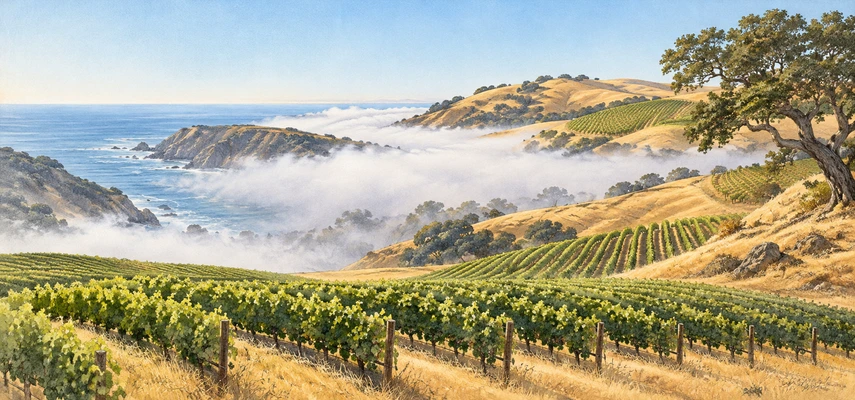

California wines make more sense once you stop treating sunshine as the entire explanation. A warm inland site can ripen Cabernet Sauvignon generously, while a vineyard a relatively short distance away needs the right exposure to ripen Pinot Noir at all. Cold Pacific water, fog, wind and gaps in the coastal hills do a remarkable amount of the organising. The map is less “north cool, south hot” than you might expect.
For WSET Level 3, connect those conditions with grape choice, production and price. This guide covers the California origins assigned in the WSET specification, with original questions and worked exercises. Geographic names include counties and American Viticultural Areas, or AVAs; they aren’t all the same kind of label.
Follow the cooling air
California occupies the western side of the United States beside the Pacific. Much vineyard land has a Mediterranean pattern of warm, dry summers and winter rainfall. The cold ocean moderates nearby sites, but coastal mountains can shelter inland valleys. Gaps and valleys allow marine air and fog to travel inland, creating cool growing conditions surprisingly far south.
Fog reduces sunlight and can delay daytime warming. Breezes moderate temperatures and may help retain acidity through a longer ripening period. Farther inland, warmth supports sugar and flavour development but can increase acid loss and water demand. Elevation adds another complication: a hillside above a fog layer can receive more sun than the valley below, so higher doesn’t always mean cooler at every hour.
Water availability, heat, frost and occasional smoke exposure are relevant risks. Irrigation, where used, needs matching to vine demand and available resources; severe water stress can obstruct ripening. Canopy management balances light with sunburn protection. On level land, machinery can reduce labour costs; steep plots or selective picking may require more manual work. No expensive address makes those decisions unnecessary.
Match the main grapes to the intended style
Cabernet Sauvignon benefits from sufficient warmth to ripen fruit and tannins, commonly giving blackcurrant, substantial tannin and potential for development. Merlot can contribute plum fruit and a rounder texture, as a varietal wine or blending partner. Harvesting decisions affect freshness, alcohol potential and whether herbal notes appear pleasantly complex or unripe.
Pinot Noir is important in suitably cool sites, producing red-fruit wines with generally less colour and tannin than Cabernet. Careful extraction can preserve fragrance without making the finish coarse. Zinfandel can deliver ripe berry fruit, spice, full body and high alcohol. Uneven berry ripening within bunches can make picking and sorting consequential; it isn’t automatically a sweet wine despite jam-like fruit descriptions.
Chardonnay is highly responsive to both site and winemaking. Cooler fruit can show citrus and fresh acidity; warmer fruit can move towards riper orchard or tropical character. Malolactic conversion, lees and oak can create broader, buttery or toasty styles, while their absence can preserve a leaner fruit-led expression. Sauvignon Blanc can range from citrus and herbal freshness to riper fruit and textured barrel-shaped wines. Riesling provides another cool-site comparison, with high acidity, floral or citrus aromas and dry-to-sweet possibilities.
Napa County and Napa Valley: keep the scale clear
Napa County is an administrative county. Napa Valley is an AVA within that setting, with further nested AVAs identifying different growing areas. The Napa Valley climate account describes stronger cooling influence around San Pablo Bay in the south and generally warmer conditions farther up the valley. Aspect, elevation and local air movement create considerable overlap.
Cabernet Sauvignon is especially important, alongside Merlot, Chardonnay, Sauvignon Blanc and other grapes. Warmth can support concentrated ripe fruit; careful picking helps preserve acidity and avoid excessive alcohol. Suitable extraction and oak maturation can support structured reds, while neutral fermentation or barrel and lees choices shape whites. Neither the county nor AVA name specifies one compulsory blend or oak recipe.
| Assigned Napa origin | Location and growing contrast | Useful style or production connection |
|---|---|---|
| Los Carneros | Southern bay-influenced area spanning Napa and Sonoma | Cooler conditions suit Pinot Noir and Chardonnay; not exclusively still wine |
| Oakville | Central valley setting with varied floor and slope sites | Cabernet fruit and structure depend on exposure and harvest, not one uniform soil |
| Rutherford | Central valley, alluvial and benchland variation | Ripe Cabernet is familiar; “dust” isn’t literal soil transferred into wine |
| Stags Leap District | Eastern side of the southern-to-central valley | Warmth and air movement support Cabernet; producer and site create variation |
| Saint Helena | Farther north in the valley | Warmer conditions can support generous ripe reds; freshness still needs managing |
| Calistoga | Northern valley, with substantial day/night contrasts | Warm ripening and cooler-night opportunities, not uniformly overheated wine |
| Howell Mountain | Elevated north-eastern mountain sites | Many vineyards above valley fog; sun, exposure and limited yields can support structure |
| Mount Veeder | Western mountain slopes, relatively close to bay influence | Cooler mountain conditions and steep plots can mean later ripening and costly work |
The Los Carneros profile explains its shared-county, bay-cooled setting. Compare Howell Mountain with Mount Veeder: both are mountain origins, but that doesn’t make their exposure, fog or ripening identical. The Calistoga account also shows how local cooling qualifies northern warmth.
Land, skilled labour and selective harvesting can make grapes expensive. New barrels and extended storage add separate winery costs. Prestige and limited supply can increase market demand beyond those expenditures. That explains a possible price premium, not a guarantee that every Napa Cabernet has better balance or complexity than every Cabernet elsewhere.
Sonoma County: several different conversations
Sonoma County lies west of Napa, extending towards the Pacific. Its hills, valleys and coastal openings create substantial climatic variation. The county appellation overview provides a starting map, but “Sonoma” isn’t a synonym for one cool Pinot style or one warm Cabernet style.
Russian River Valley receives important marine fog influence, helping explain its association with Pinot Noir and Chardonnay. Cooler conditions can retain acidity and extend ripening, while canopy and crop decisions still need to secure mature flavours. Sonoma Coast is a broad AVA with considerable variation; proximity to the sea, elevation and exposure matter more than assuming every vineyard sits beside a beach. Its boundaries also differ from the narrower West Sonoma Coast AVA.
Alexander Valley, farther inland in northern Sonoma, is strongly associated with Cabernet Sauvignon. Warm growing conditions can support black fruit and ripe tannins, with hillside and valley-floor differences. Dry Creek Valley is particularly known for Zinfandel, alongside other reds and Sauvignon Blanc. The Dry Creek growers’ Sauvignon Blanc account illustrates the white comparison: fresh citrus and acidity needn’t require a cold-country origin.
Winemaking choices broaden the range. Neutral vessels can preserve Sauvignon’s fruit, while lees or barrels add texture. Pinot can be fragrant and relatively restrained or riper and more extracted. Chardonnay may be fresh and unoaked or broader with malolactic conversion and oak. Treat those as decisions to explain rather than infer a single house style from an entire county.
Mendocino County: coast and interior differ
Mendocino County lies north of Sonoma. Coastal openings and cooler valleys can suit Pinot Noir, Chardonnay and aromatic whites, while sheltered inland sites can ripen warmer-style reds, including Cabernet and Zinfandel. County-level breadth therefore needs qualifying before assigning a flavour or alcohol level.
Anderson Valley supplies a useful cool-site example within Mendocino. Its growers’ Riesling profile demonstrates the place of an aromatic high-acid variety beyond Chardonnay. Dryness depends on the finished wine, not the grape name. Protective pressing and fermentation can preserve floral and citrus character, while suitable concentrated examples may develop in bottle. The county also has important sparkling production, covered separately later in the series.
Santa Cruz Mountains: elevation meets the ocean
The Santa Cruz Mountains lie south of San Francisco, with vineyards on different sides of a rugged coastal range. The regional growers’ overview identifies Pinot Noir, Chardonnay and Cabernet Sauvignon among important specialities. Marine influence and the fog layer interact with elevation and aspect, creating different ripening conditions across sites.
Cooler exposed locations can suit Pinot and Chardonnay, while suitably sheltered, warmer sites support Cabernet. Steep land and scattered small vineyards can restrict machinery and increase labour costs. Low yields may concentrate fruit but can also reflect difficult conditions; they aren’t a quality score by themselves. Extraction, lees, malolactic conversion and oak need matching to the grape and intended balance rather than copied across every wine.
Monterey: ocean air travels down the valley
Monterey lies farther south on the Central Coast. Marine air and fog enter from Monterey Bay, producing a marked contrast between cooler exposed sites and warmer sheltered land. The Monterey growers’ AVA guide describes the range. Chardonnay is especially important, with Pinot Noir and Riesling suited to cooler conditions and Cabernet or Merlot possible in appropriately warmer locations.
Cool winds can slow ripening and help retain acidity, but excessive wind or insufficient warmth can challenge a late variety. Matching site, canopy and crop is therefore essential. Fresh whites can use protective neutral fermentation; lees, malolactic conversion or wood can create broader Chardonnay. Don’t assume every Monterey wine is either a lean coastal white or a rich inland red: the region contains both conditions and varied production aims.
San Luis Obispo County and Paso Robles
San Luis Obispo County lies south of Monterey. Ocean-exposed coastal areas can be notably cool, supporting fresh Chardonnay and Pinot Noir, while inland locations are warmer. The SLO Coast AVA petition documents maritime influence; its geographical discussion doesn’t turn the whole county into one uniform coastal mesoclimate.
Paso Robles lies inland of the Santa Lucia coastal mountains in northern San Luis Obispo County. The Paso geography account describes varied terrain and the importance of gaps and day/night contrasts. Warm days can ripen Cabernet Sauvignon, Merlot and Zinfandel, while cooler air and nights can help preserve freshness. Sites differ substantially in exposure, rainfall and water availability.
Full-bodied ripe reds are familiar, with extraction and oak shaping tannin and complexity. Generous fruit needs enough acidity and structural balance; high alcohol alone isn’t evidence of quality. Easier machinery access and larger volumes can support efficiency on some sites, while steep or selective vineyards cost more. Neither “Central Coast” nor “Paso” establishes one fixed production cost or barrel programme.
Santa Barbara County and Santa Maria Valley
Santa Barbara County lies farther south, but transverse valleys allow Pacific air to travel inland. Its regional AVA guide explains the unusual east-west geography. Cooler western sites and warmer inland settings coexist, so latitude alone is particularly misleading here.
Santa Maria Valley, in the northern part of this county’s wine-growing area, is an important ocean-influenced origin associated with Pinot Noir and Chardonnay. Its AVA extends across the county boundary into San Luis Obispo County. Cool conditions can support fresh acidity and a long season, while site selection and yield management help achieve ripe fruit. Other Santa Barbara areas can suit warmer varieties; don’t extrapolate one valley’s profile across the whole county.
Measured Pinot extraction preserves fruit without excessive grip. Chardonnay can be shaped by neutral fermentation, lees, malolactic conversion and oak in different combinations. Costly fruit or a celebrated vineyard might explain price, but balance, intensity, length and complexity remain the quality evidence. A cool-region label doesn’t guarantee low alcohol or prohibit ripe flavour.
Lodi: warm inland wine with a cooling route
Lodi lies in the inland Central Valley, east of the Sacramento–San Joaquin Delta rather than in the coastal mountain regions. The Lodi commission’s climate explanation describes the influence of Delta air movement. Warm sunny conditions support ripe grapes, while cooling breezes qualify the idea that every inland vineyard stays relentlessly hot.
Zinfandel is particularly important, including old-vine examples, alongside many other varieties. Ripe berry fruit, spice and full body can be balanced by careful harvest and extraction. Sorting unevenly ripe bunches can add labour, while larger workable parcels can support efficient production elsewhere. Old-vine age doesn’t automatically establish either low yield or superior quality. Neutral maturation and earlier release differ commercially and stylistically from new oak and extended storage.
Read an AVA label accurately
An AVA identifies a delimited growing area with distinguishing geographical features; it isn’t an official quality rank or a rule requiring one grape variety. Federal rules generally require at least 85% of the wine to derive from grapes grown in the named AVA, as the TTB appellation guidance explains. Counties are a different category of origin, and California imposes additional requirements on California origin claims.
A single-variety designation generally requires at least 75% of that grape, while AVA-labelled vintage wine generally requires at least 95% from the stated harvest year. The TTB label guide distinguishes these tests. Origin percentage, grape percentage and vintage percentage answer different questions; none means the wine must be 100% one grape from one estate. Check applicable state rules and the full claim before applying the federal baseline mechanically.
For price, separate grape costs, winery production, transport, margins and market forces. Land and growing labour affect fruit cost; barrels and stockholding affect later production. Freight, distributor and retailer margins add further amounts, while scarce supply and demand can create another premium. For related study, revisit #2, #4, #5, #6 and #8 on environment and production, #31 on other North American regions, and #49 on law.
Knowledge check: 10 original practice questions
Choose one correct answer per question.
1. Which factor best explains many cool vineyard sites in California?
2. Which statement about Los Carneros is correct?
3. Why shouldn’t Howell Mountain and Mount Veeder be treated as identical?
4. Which Sonoma pairing is useful?
5. Which grape offers an aromatic high-acid comparison in cooler Mendocino sites?
6. Which statement best describes Paso Robles?
7. Why can Santa Barbara support cool-climate styles despite its southern location?
8. What is a useful qualification when describing Lodi?
9. What does a named AVA generally require under the federal origin test?
10. Which decision can add buttery character to Chardonnay?
Answers and explanations
1. C — Marine access. Coastal gaps and valleys can channel cool air and fog. Latitude alone fails to explain why some southern or inland-accessible sites remain relatively cool.
2. B — Shared origin and cooling. Los Carneros crosses Napa and Sonoma county lines and benefits from San Pablo Bay influence. Its Pinot and Chardonnay association isn’t a rule limiting every wine to those grapes.
3. D — Different mountain settings. Elevation interacts with aspect, marine proximity and the fog layer. “Mountain vineyard” therefore doesn’t establish one universal ripening pattern.
4. A — A familiar cool-site association. Russian River’s marine influence helps explain Pinot and Chardonnay. Other Sonoma areas provide useful warmer Cabernet and Zinfandel comparisons.
5. C — Riesling. Suitable cool sites can preserve its acidity and aromatic character. The finished wine’s sweetness depends on production decisions, not simply the variety name.
6. B — Inland but varied. Paso lies within northern San Luis Obispo County, behind coastal mountains with important gaps and temperature contrasts. Warmth and cooling operate together rather than being mutually exclusive.
7. D — East-west access. Transverse valleys allow ocean air into the region. Vineyard exposure and distance inland still create warmer and cooler locations within the county.
8. A — Warmth with moderation. Delta breezes help qualify a simplistic hot-interior description. Harvest, water and crop management remain relevant to ripe but balanced Zinfandel.
9. C — The origin percentage. This test concerns where the grapes grew. Variety and vintage claims have separate requirements, while an AVA does not award an official sensory score.
10. B — Malolactic conversion. It can contribute buttery character and soften the acid impression. Oak and lees have other effects, and none is established merely by an origin name.
Written exercise 1: compare mountain and valley conditions
Explain five separate considerations when comparing an elevated California vineyard with a nearby valley-floor site. Five marks.
Model answer: A hillside above the fog layer may receive more sunlight than a fog-covered valley, affecting ripening. Aspect changes the timing and intensity of exposure, so two hillsides needn’t experience the same warmth. Soil depth and drainage influence water availability and vine vigour. Steep land can restrict machinery and raise growing labour costs. Air movement and cold-air drainage can change frost exposure, although the actual risk depends on the location and weather.
Why it earns credit: One mark each for fog/sunlight, aspect, root-zone conditions, access/labour and frost setting. The answer explains mechanisms rather than asserting that elevation always means cooler, drier, frost-free or better wine.
Written exercise 2: shape two Chardonnay styles
Compare a fresh, fruit-led Chardonnay with a broader style shaped by additional cellar work. Give five separate production-to-style links. Five marks.
Model answer: Earlier picking at suitable flavour maturity can retain more acidity than a later, riper harvest. Neutral-vessel fermentation avoids prominent new-oak aroma. Malolactic conversion can soften the acid impression and contribute buttery character. Lees contact can add texture and complexity. Barrel fermentation or maturation, especially with newer wood, can add toast or spice and shape the wine’s structural impression.
Why it earns credit: One mark each for harvest balance, neutral vessel, malolactic conversion, lees and oak influence. The techniques are choices, not a requirement that every broad wine uses all of them. More expensive cellar work does not by itself demonstrate better balance or quality.
One-page revision summary
| Origin or concept | Remember | Useful connection |
|---|---|---|
| California | Pacific, coastal gaps, elevation and inland shelter | Latitude alone cannot explain ripening |
| Napa County / Napa Valley | County versus AVA and nested origins | Geography isn’t one mandatory Cabernet recipe |
| Los Carneros | Southern bay influence across Napa and Sonoma | Pinot and Chardonnay, including sparkling possibilities |
| Oakville / Rutherford | Central Napa Cabernet settings | Site, harvest and extraction shape fruit and tannin |
| Stags Leap District | Eastern southern-to-central Napa | Local warmth and air movement, not identical winery style |
| Saint Helena / Calistoga | Northern valley warmth with local contrasts | Ripe reds need freshness and alcohol balance |
| Howell Mountain / Mount Veeder | Different mountain exposures and fog interactions | Structure, ripening and manual-work costs vary |
| Sonoma County | Russian River, Alexander, Dry Creek, Sonoma Coast | Pinot/Chardonnay versus Cabernet/Zinfandel/Sauvignon comparisons |
| Mendocino County | Cool openings and warmer inland sites | Pinot, Chardonnay, Riesling and warmer-site reds |
| Santa Cruz Mountains | Rugged coastal range | Pinot/Chardonnay/Cabernet according to site |
| Monterey | Marine corridor with warmer sheltered settings | Chardonnay, Pinot and Riesling versus warmer-site grapes |
| San Luis Obispo County / Paso Robles | Cool exposed coast versus varied warmer interior | Pinot/Chardonnay and ripe structured red contrasts |
| Santa Barbara / Santa Maria Valley | Transverse marine access | Southern location can still mean fresh cool-site wine |
| Lodi | Warm interior with Delta cooling | Zinfandel ripeness, sorting and production scale |
| AVA / variety / vintage | Generally 85% / 75% / 95% for the described federal tests | Different questions; check state and claim-specific rules |
Try explaining a Pinot Noir from a cool marine site and a Cabernet from a warm inland site before memorising another nested AVA. Conditions, decisions and consequences are what make the place names useful.












