










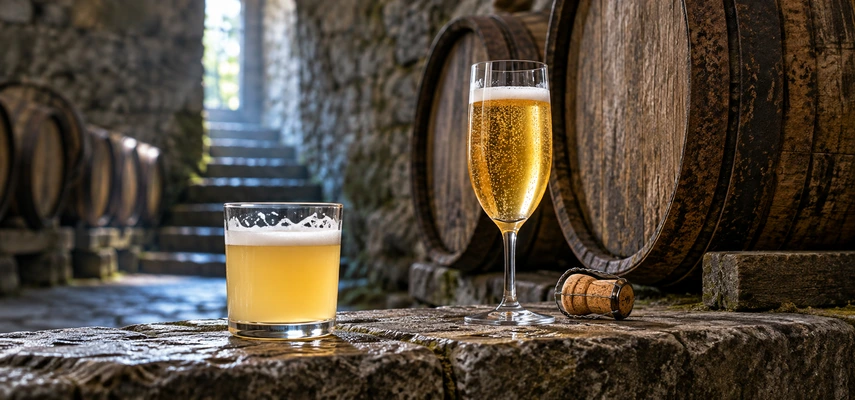

A tart beer is not necessarily a beer gone wrong. Sour beers explained through their intended production show how acidity can become the center of a deliberate style. Berliner weisse and geuze both make that point, yet they differ in much more than the sharpness of the first sip.
One is commonly light, pale and briskly lactic. The other is a sparkling blend associated with lambic traditions and a broader microbial complexity. Their comparison connects ingredients, fermentation approach, time and blending with what a drinker actually notices.
Sour is not another word for bitter
Sourness is associated with acidity, while bitterness is a different taste. A beer can have little hop bitterness and still feel sharply balanced because acidity supplies the contrast. Treating every non-sweet sensation as bitterness would hide the defining feature of this group.
The official specification lists Berliner weisse and geuze, also spelled gueuze, as the prescribed sour styles. Both still involve malt, yeast and other familiar brewing materials. The category highlights a leading sensory feature rather than describing a drink made from acid alone.
The microorganisms matter, but the earlier fermentation chapter supplies the general biology. Here the question is how different approaches create two recognizable styles. Sourness by itself doesn’t reveal the precise organisms, their source or whether a selected culture was added.
Berliner weisse: pale wheat and lively acidity
Berliner weisse commonly appears very pale straw, from clear to somewhat hazy, with white foam and a highly sparkling impression. Its light appearance is consistent with a pale malt and wheat foundation. It isn’t the orange or red fruit-colored beer that some modern labels may lead a beginner to expect from the word sour.
Aroma is often fresh and tart, with gentle grain or bread-dough character and possible restrained fruit-like associations. Strong hop aroma is not the focus. Flavor emphasizes clean lactic acidity, supported by light wheat or bread-like malt rather than deep caramel or roast.
Bitterness is very low, often barely noticeable against the acidity. Sweetness is low in the classic dry presentation, body light, and carbonation high. Its generally modest alcohol context helps distinguish it from many stronger styles, but actual ABV still needs a verified producer statement rather than a visual guess.
The BJCP Berliner weisse reference describes a refreshing wheat-based sour profile. Pale malt and wheat provide the grain foundation; yeast and lactic-acid bacteria contribute to the fermentation and acidity. The particular microbial and process choices can vary, so the style name doesn’t prove one exact production schedule.
Why Berliner weisse differs from Weissbier
Both can contain wheat and look pale or hazy. However, the familiar Weissbier comparison emphasizes yeast-derived banana and clove, while Berliner weisse is organized around acidity and a lighter, brisker structure. The shared grain doesn’t erase the sensory distinction.
This is also why all sour wheat beers cannot be assumed spontaneously fermented. Brewers can use selected microorganisms to create acidity. Traditional and modern production approaches vary, and a direct claim about a particular brand needs its actual production information.
Some service traditions add syrup, and modern products may include fruit. Those additions can change sweetness, color and aroma. Learn the underlying classic dry sour profile first, then distinguish the base style from the effect of an addition rather than treating syrup sweetness as the defining requirement.
Geuze: a sparkling lambic blend
Traditional geuze commonly appears golden, often clear, with a persistent white head and lively carbonation. Its appearance can be quite different from the cloudy fruit drinks sometimes grouped loosely under sour beer. It need not contain cherries, raspberries or other added fruit.
Aroma and flavor can combine acidity with fruit-like, earthy, hay-like or other distinctive fermentation associations. Descriptions sometimes use funky as shorthand. That word is less useful than naming the particular impression, and it should never become an excuse for treating every unpleasant smell as desirable complexity.
Hop bitterness is low, with acidity providing much of the balance. The classic presentation is dry, with light to medium-light body and high carbonation. A tart finish may linger alongside the more complex fermentation character. Sourness is central, but the goal isn’t simply to maximize intensity at the expense of everything else.
The BJCP gueuze reference describes a traditional dry, sparkling product and stresses the role of blending young and aged lambic. Some commercial products carrying related names may be sweetened; use current producer information to understand a particular bottle rather than assuming every label describes exactly the same balance.
Lambic production makes the blend possible
Lambic is associated with spontaneous fermentation, in which the initial inoculation comes from the environment rather than a conventional selected starter addition. Traditional production includes exposure of cooling wort, followed by a complex course of fermentation and maturation. Grain ingredients include barley malt and wheat, while hops have a different role from a fresh aromatic IPA addition.
The Lindemans production account describes cooling wort in a coolship and maturing lambic before blending younger and older material for traditional geuze. This is a primary producer example, not a universal instruction for every sour beer. The distinction between a documented method and a whole category matters.
Yeasts and bacteria contribute through time, creating a profile that cannot be reduced to one moment of acid addition. Brettanomyces is yeast, while lactic-acid bacteria are a different group. Both can belong in a deliberately managed mixed microbial setting without being biologically identical.
Blending is a production decision
Younger and older lambic offer different contributions. Blending can combine remaining fermentable potential with developed character, helping produce a balanced beer that undergoes further fermentation in the bottle. That bottle fermentation contributes to geuze’s sparkling presentation.
The blend is therefore more than pouring leftovers together. A blender selects components for the intended result. Time, microbial development and bottle conditioning become part of the explanation for the sensory profile, just as hop variety and addition timing explained IPA earlier.
At Level 1, the important connection is traditional geuze, lambic, spontaneous fermentation and blending. Detailed age regulations and every producer’s exact blend are beyond the necessary starting comparison. Don’t replace understanding with a list of numbers that may be specific to a particular designation or producer.
Compare the patterns without ranking sourness
| Feature | Berliner weisse | Traditional geuze |
|---|---|---|
| Appearance | Very pale, clarity variable | Golden, often clear, sparkling |
| Grain impression | Light wheat or bread dough | Supportive grain beneath broader complexity |
| Acidity | Clean lactic emphasis | Sourness with complex fermentation character |
| Bitterness | Very low | Low |
| Structure | Light, dry and highly carbonated | Dry, light to medium-light, highly carbonated |
| Production clue | Wheat beer with acidifying microbes | Blend associated with spontaneously fermented lambic |
The useful distinction isn’t a universal statement that one must be more sour than the other. Examples vary. The sources of complexity, typical structure and production approach provide a richer explanation than an imaginary sourness contest.
Intentional acidity versus an unwanted fault
Acidity can be expected in these styles, but unexpected souring in a beer intended to remain non-sour deserves investigation. Style context is essential. A clean pale lager developing an unplanned sour impression should not automatically be defended by saying that sour beers exist.
Equally, a tart traditional geuze should not be rejected merely because it doesn’t resemble a pale lager. Compare the actual beer with its intended profile and producer information. Desirable fermentation character and spoilage are not interchangeable simply because both involve microorganisms.
Sensory assessment is not a safety certification. A strange package, damaged seal or otherwise suspect product should be handled through appropriate service procedures rather than an amateur tasting experiment. The faults chapter focuses on recognizing common deterioration mechanisms and preventing them.
An optional comparison for study
Compare two producer descriptions on paper. Mark acidity separately from bitterness, then identify the statements about grain, organisms, maturation and blending. If one source does not specify spontaneous fermentation, don’t supply that fact yourself because the beer tastes tart.
Voluntary tasting can use small samples under suitable local age rules, but consumption isn’t necessary for the qualification. Describe aroma, acidity, sweetness, body and fizz separately. Notice how low hop bitterness can coexist with a firm, refreshing balance supplied by acidity.
A useful revision test is to remove the word sour from both descriptions and explain what remains different. Wheat-led lightness, a lambic blend, maturation character and bottle-conditioned sparkle provide information that the shared taste word cannot. That explanation should still make sense to someone who chooses not to drink beer.
One-page revision summary
Berliner weisse is commonly very pale, wheat-based, light, dry and highly carbonated, with clean lactic acidity and very low hop bitterness. Traditional geuze is a dry, sparkling lambic blend with acidity and a broader complex fermentation profile.
Remember three boundaries: sourness isn’t bitterness; sour beer isn’t automatically spontaneously fermented; and deliberate bacterial influence isn’t automatically a fault. The production story explains the styles more reliably than color, a single adjective or a guess about what wild must mean.
Knowledge check: 10 original practice questions
Independent TFE questions, not official WSET examination items. Choose one answer per question; explanations follow separately.
1. What chiefly balances classic Berliner weisse rather than hop bitterness?
- Dark roast
- Acidity
- Very high sweetness
- A mandatory spirit addition
2. Which note fits classic Berliner weisse?
- Very pale, light-bodied, dry and highly carbonated
- Black, roasted and thick
- Dark caramel-rich and strongly warming
- Clear amber with intense pine bitterness
3. What is traditional geuze associated with?
- Only adding citrus juice to pale lager
- Avoiding all microorganisms
- A mandatory coffee addition
- Blending younger and older lambic
4. Which fermentation approach is central to traditional lambic?
- Only malting
- Only force carbonation
- Spontaneous fermentation
- No fermentation
5. Does every sour beer prove spontaneous fermentation?
- Yes, acidity can arise in no other way
- No, selected microbes can be added deliberately
- Yes, all sour beers are geuze
- Only color decides the method
6. How does classic geuze usually finish?
- Dry and sparkling
- Always syrupy and still
- Always strongly hop-bitter
- Always roasted
7. Which distinction separates Weissbier and Berliner weisse?
- Only one can contain wheat
- All their microbes and flavors are identical
- Neither uses grain
- Banana-clove emphasis versus a central sour profile
8. What should a syrup addition be understood as?
- A requirement of every classic Berliner weisse
- Proof that fermentation never occurred
- A service addition that can change sweetness and color
- The source of every sour beer’s acidity
9. Is bacterial influence always a fault?
- Yes, sour styles cannot be intentional
- No, it can be deliberately used in suitable styles
- Yes, bacteria and yeast are the same
- Only pale beer can have bacteria
10. What is the most useful geuze comparison beyond sourness?
- Its complex fermentation character, blending and carbonation
- Only the package price
- A guarantee that fruit must be added
- A fixed rule that it exceeds every Berliner in acidity
Answers and explanations
1. B — Acidity. Lactic acidity is central while hop bitterness is very low, making sourness and bitterness important to distinguish. Mapping: LO2.
2. A — Very pale, light-bodied, dry and highly carbonated. Its wheat foundation and lactic sourness sit within a light, sparkling structure. Mapping: LO2.
3. D — Blending younger and older lambic. Lambic maturation and blending help create the complex sparkling traditional beer. Mapping: LO2.
4. C — Spontaneous fermentation. Initial environmental inoculation distinguishes the traditional approach from adding a conventional selected starter. Mapping: LO2.
5. B — No, selected microbes can be added deliberately. Sensory sourness does not establish the inoculation method; production information is needed. Mapping: LO2.
6. A — Dry and sparkling. Traditional geuze combines a dry balance, acidity and high carbonation with fermentation complexity. Mapping: LO2.
7. D — Banana-clove emphasis versus a central sour profile. The common wheat ingredient does not make their defining fermentation character and sensory balance the same. Mapping: LO2.
8. C — A service addition that can change sweetness and color. Learn the base style separately from the effects of optional syrup or fruit additions. Mapping: LO2.
9. B — No, it can be deliberately used in suitable styles. The intended style and controlled production determine whether the contribution is expected or unwanted. Mapping: LO2.
10. A — Its complex fermentation character, blending and carbonation. A full production and sensory profile is more informative than ranking one taste dimension alone. Mapping: LO2.












